Air Quality
Study: Car Traffic As Bad As Second Hand Smoke in Causing Asthma
 A large new European study released this week found that as much as 14% of chronic children's asthma in the Continent's urban areas could be due to traffic pollution. That would put it on par with the effects of second-hand smoke, linked to anywhere from 4 to 18% of all childhood asthma.
"Air pollution has previously been seen to trigger symptoms but this is the first time we have estimated the percentage of cases that might not have occurred if Europeans had not been exposed to road traffic pollution," lead author Dr. Laura Perez, at the Swiss Tropical and Public Health Institute, said in a press release. "In light of all the existing epidemiological studies showing that road-traffic contributes to the onset of the disease in children, we must consider these results to improve policy making and urban planning."
Although the idea of getting cars off the road as a benefit of mass transit isn't new, this study and others that have been published recently flesh out a new public health concern about the immediate impacts of such reductions in the neighborhoods adjacent to highways. Often these neighborhoods are already low and moderate income, and/or minority-majority with higher-than-average asthma rates already institutionalized because of lack to access to care, poverty or other factors. Highway plannning has yet to take this kind of localized impact into account, especially in Texas and DFW, where regional highway builders are still salivating to build the Trinity Toll Road straight through the middle of Dallas or criss-cross Ft. Worth neighborhoods with the new "Chisholm Freeway."
Asthma affects one in 12 people, or 8 percent of the U.S. population, according to 2009 data from the Centers for Disease Control and Prevention. The number has increased since 2001, when one in 14 people were affected.
Your’re Downwind of Lots of Burning Trucks
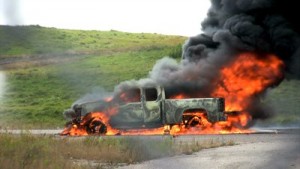 A funny thing happened to Dallas Morning News automobile columnist Terry Box while he was out test driving a new Dodge pick-up truck – it self-immolated and burned to ashes on the side of the road. As he writes about it, his experience is both funny and terrifying. But something he noted in how cars and trucks are made these days caught our eye:
"Open the hood of your late-model car or truck, and you’ll see a half-acre of plastic — actual engine pieces like valve covers, caps and containers for various liquids.
Thirty years ago, most of the pieces under the hood were metal and resistant to fire.
A fire in a modern vehicle burns fast and furiously. What’s intact for the moment can be gone or enveloped in toxic smoke in a matter of seconds."
Yep. When we've described the lovely new cement additive called ASR – Auto Shredder Residue – we've often talked about all the vinyl seats, dashboard and switches that get stipped out of a car and shredded, then thrown into a cement kiln. We really haven't talked about all the plastic in the engine compartment that would also be included in this new "fuel" that TXI has already been permitted to burn at its Midlothian cement plant.
As more and more of every car is made of "soft materials" – that is, not metal – more and more of it becomes fodder for cement kilns. This is material that could be recycled but isn't, and as long as it's cheaper just to burn it, there won't be amrket for recycling it.
Here's the thing, burning plastic creates bad kinds of pollution, including the creation of Dioxin, one of the most potent posions ever discovered by science. The same "toxic smoke" Terry Box saw pouring off of his burning Ram pick-up is created when you throw the same plastic parts into a cement kiln. The cement industry would like you to think that all of that is taken care of by the polluton control measures installed at the kilns, but it's not. There's no real time Dioxin montoring, much less any kind of monitoring for the host of other exotic fumes coming off burning plastic of various kinds. They barely even know what or how to test for such pollutants, but that doesn't keep the cement industry from marketing its kilns as "Long, Hot, and Good for America"™
If you're an old-timer, you might remember an earlier episode or two that occurred when the cement industry, including TXI, assured everyone that it could burn hazardous waste and make it completely disappear into water vapor. Remind us, how did that turn out?
Want to Send Dallas City Hall a Message? Claudia Meyer For Dallas City Council
 As hard as it is to believe, despite everything that's happened, Dallas could wind up with a more pro-drilling City Council in May than it has right now. Angela Hunt is term-limited. Scott Griggs is being paired with another incumbent, Della Jasso, and one of them won't be back. That's two out of the three major drilling opponents. Only Sandy Greyson is safe.
That's why it's important to look at the only Dallas City Council race that pits a grassroots environmental leader of the drilling fight against an over-the-top supporter of more drilling – Claudia Meyer vs. Vonciel Hill in District 3, a new district that includes much of Griggs' Oak Cliff and Southwest Dallas turf along with precincts from Hill's old District 5.

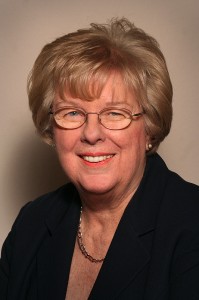 You know Claudia, even if you haven't met her personally – because she's one of you. She's a 20-year Dallas resident, who along with her husband Ed, was there at the very beginning of the Dallas fight four years ago. Like so many others, curiosity about a proposed well near her neighborhood initialed research and activism that continues today. She attended every single Dallas Gas Drilling Task Force Meeting. She's a co-founder of Dallas Residents at Risk. And if that's isn't enough bone fides for you, she's also an original Downwinder, a veteran of the TXI hazardous waste fight of the 1990's.
Vonciel Hill is a two-term incumbent who enthusiastically supports gas drilling and has shown a propensity for cronyism in office.
Most recently, you might remember her from her February 27th rant comparing City Manager Mary Suhm to Christ for having to suffer through Angela Hunt's cross-examination of Suhm about the circumstances of the secret agreement between Suhm and Trinity East over their pursuit of gas drilling permits in Dallas. The Dallas Observer's Jim Schutze wrote a column about it the next day headlined: "Vonciel Hill: City Council Member, Prophet, Theologian and Sell-Out:"
Yesterday in a Dallas City Council debate over gas drilling on city parkland, Hill compared council member Angela Hunt to Haman, the killer of Jews and symbol of all evil in the Book of Esther.
Not done yet. Next, Hill compared Dallas City Manager Mary Suhm to Jesus Christ. She predicted that Suhm would one day rise from the dead and enjoy her own personal version of Easter.
Council member Hunt had questioned City Manager Suhm sharply over a deception Suhm pulled on the council in 2008, promising to fight against gas drilling on parkland, then secretly signing a deal with a gas company saying she would win them permission to drill on parkland, then taking a $19 million check from them, on behalf of the city, in return for the deal that she hid for years from the council and from the public until Hunt and council member Scott Griggs got onto it recently.
"Recall in the story of Esther how Haman built the gallows for Mordecai, but it was Haman who hanged on the gallows. Those who affix the gallows for you may themselves hang on those gallows.
"And then reach forward from the Hebrew scriptures to the New Testament scriptures, where those who said of Jesus Christ on Good Friday, 'Well, he's done, he's dead, we've got him now,' wait three days, because Easter will come and there will be the resurrection. And those who pierced him on Good Friday are no longer known, and their names are not around, but two thousand and some years later, the name of the Christ is still ringing forth.
"Miss Suhm, this is a Good Friday moment, but I guarantee you from the faith well into which I reach, your Easter is coming, and you will sail forth."
One last thing about this. Since Hill is the one who chose to put the gas drilling debate on these terms, I think it's fair for me to turn it around and ask her a question on the same terms. And this is not a joke.
If Jesus Christ had signed a secret covenant with the Romans agreeing to look the other way while they screwed over the Jews, would we remember his name today? Really? Or wouldn't he have been just one more forgotten cheap politician who took on all sorts of cheap gaudy religious airs in order to pump up his profile? Like you, Ms. Hill. Exactly like you.
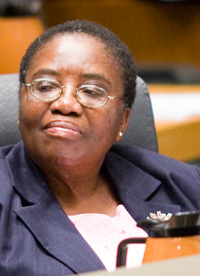 So many people were disgusted by her performance that day that Claudia was overwhelmed by requests to run against Hill. At the last minute, Claudia said yes.
This race is now the necessary next step in the Dallas Drilling Fight. The stakes are very high. If Claudia runs and doesn't win, it not only sets the cause back, but residents could very well have a Dallas city council that will be more pro-drilling than now.
Claudia starts out in a familiar place: underfunded and overworked. That's why she's asking for your help. She's requesting that you please go to her website contribution page right now and send her some needed cash. She needs to raise $9,000 by the end of the first week in April to be able to run the campaign she needs to run to win. Do this today if you want to send City Hall a message that you will continue to fight its drilling plans.
Claudia also needs volunteers to help block walk and make telephone calls, and deliver yard signs. She needs the same army that shows up at City Hall to show up in District 3 to carry the day. Send an e-mail to elect.claudiameyer@gmail.com and let them know you want to volunteer for the campaign. Do it today please.
Remember how you're always saying you'd really like to work for a candidate you believe in? Remember saying how you wish you could send those so-and-so's down at City Hall a real sign of how you feel? The time is now. The opportunity is an e-mail away. In these campaigns, every day is like a week. Don't waste any time. Don't put it off. Or come May, you may find yourself with a City Council that wants to Drill, Baby Drill.
Be There When The Picture Is Painted Today
 "Those who profess to favor freedom and yet depreciate agitation want crops without plowing up the ground, they want rain without thunder and lightning. They want the ocean without the awful roar of its many waters. Power concedes nothing without a demand. It never did and it never will."
– Frederick Douglass
"They always say time changes things, but you actually have to change them yourself"
– Andy Warhol
"You have to make more noise than anybody else, you have to make yourself more obtrusive than anybody else, you have to fill all the papers more than anybody else, in fact you have to be there all the time and see that they do not snow you under, if you are really going to get your reform realized."
– Emmeline Pankhurst
"The only place you can truly be universal is in your own back yard."
– Dietrich Bonhoffer
'Every step toward the goal of justice requires sacrifice, suffering, and struggle; the tireless exertions and passionate concern of dedicated individuals."
– Martin Luther King, Jr.
"The important thing is to be there when the picture is painted."
– John Minton
Today, Thursday, March 21st
Dallas City Plan Commission
Vote on Trinity East Drilling Permits
1:00 pm Press Conference
1:30 pm Meeting Begins
Dallas City Hall
6th Floor
Dallas Park Driller Was Former Haz-Waste Handler Forced to Shutter California Plant for Violations
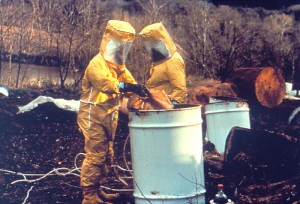 The President of the company at the center of the current Dallas drilling controversy was Vice-President and General Counsel of a hazardous waste disposal firm that was forced to close its California plant site after a long history of environmental violations.
Thomas Blanton is President of Keystone, the parent company of Trinity East, which is applying to the City of Dallas for three gas drilling and production permits in the Trinity River flood plain near Irving. But in the 1990’s and early years of this century, he was a leading officer of the Board of Directors of US Liquids, a large broker of hazardous wastes that had its California facility ordered shut by the state’s California Department of Toxic Substances Control.
From 1999 to 2003, US Liquids owned Romic Environmental Technologies Corporation. Romic’s Bay Area operation received hazardous wastes from throughout the country, “blended” them on-site, and then shipped the toxic soup for use as “fuel” for cement plants like the TXI kilns in Midlothian.
Records show that from 1999 to 2004, Romic was slapped with 28 separate environmental violations by the State of California, which resulted in penalties of $849,500. The California Occupational Safety and Health Administration (CalOSHA), discovered 57 violations at the plant from 1988 to 2004, totaling another $163,360 in fines.
Romic closed in 2007 on orders from the state of California as part of a legal settlement stemming from a series of environmental violations. The state and EPA ordered a clean up and closure of the facility after extensive soil and ground water contamination was discovered over most of the site. According to the EPA, the contamination is primarily attributed to the spills, overflows, flooding events, and other accidental releases around the “central process area.” The primary contaminants were volatile organic compounds such as trichloroethene (TCE), a solvent used to clean metal parts. Toxins migrated as much as 80 feet below ground that borders San Francisco Bay tidal marshes.
All three sites that Blanton’s company wants to drill on are located in the Trinity River’s 100-year flood plain; two are also on City of Dallas park land. Opponents have warned about probable contamination from surface spills, which a 2011 UT study concluded were more frequent with fracking than conventional drilling.
It was recently disclosed that a Trinity East sister company experienced a casing failure at an Irving gas well it tried to drill in 2009, although the extent of any environmental damage caused by the incident remains unknown.
“Does Dallas really want hand over its park land to a businessman who has a history of contaminating and threatening soil and water resources?” asked Gary Stuard, Chair of Downwinders at Risk, a local DFW clean air group that’s been battling the Trinity East permits.
After denying Trinity East’s permits once last December, the City Plan Commission is scheduled to vote a second time on them at its meeting on Thursday afternoon.
Stuard was critical of the lack of due diligence city staff had performed on Trinity East and its owners and said this new information was another example of residents doing the job themselves. “There’s never been a review of the company’s track record by the City. It had gone completely unexamined until Dallas residents took it upon themselves to do the research. What else don’t we know because the City isn’t doing a routine background check?”
Back in California, the first phase of the EPA-ordered clean-up at the Romic site ended in 2010 with clean-up of surface and above ground messes. A second phase is addressing the remediation of below surface soil and groundwater contamination. The estimated cost for closure and cleanup of the facility is $2.5 million.
Dallas Morning News Says Enough is Enough: Deny Gas Permits
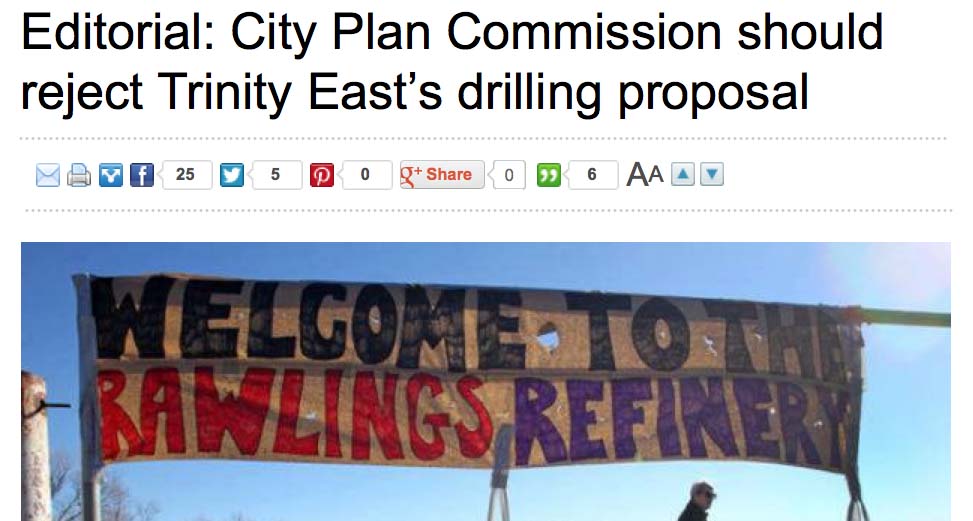 Win, lose or draw at Thursday's City Plan Commission vote, there is no question that, slowly, but surely, residents have built a consensus of public opposition to the Trinity East permits. For the latest proof, look no further than Wednesday's lead editorial in the Dallas Morning News advocating denial. It's the first time the paper has taken such a position. We know some of you can't get over the DMN paywall, so as a public service, here's the whole peice.
Groups Call for Full Open Public Hearing for Dallas Gas Permits Vote on Thursday
 Here's the full text of a letter that was sent to all Dallas City Plan Commission members last week:
Commissioners and Chair,
Despite the request to the City Council made by members of the Commission on February 7th to change city policy in order to accommodate the Trinity East gas permits by your March 21st meeting, there has been no effort to do so.
For this reason alone, we urge you to take no action on these permits next week, or uphold your December 20th denial. These permits would allow surface drilling on park land and in floodplains, contrary to current city policy.
However, information and circumstances that have come to light since the December 20th vote to deny these permits make them even more objectionable.
We know that the proposed Trinity East processing facility and compressor station will be at least the 10th largest source of air pollution in the city, with a strong probability that emissions would grow to be much greater, out of the regulatory reach of the City of Dallas as they grow.
We know that city staff is working to locate this large air polluter next to the new Elm Fork Athletic Complex, in direct contradiction to recent city staff and City Council actions to protect the area around the Complex from lesser air pollution threats.
We know that, despite the title of the facility itself, the scale of operations, and the equipment it proposes to install, city staff refuses to classify Trinity East’s “Luna South Gas Processing Facility” as a gas processing facility under current City of Dallas zoning law.
We know that Trinity East misled the CPC at your February 7th meeting when its representative told you that gas well casings always protect underground aquifers. In fact, Trinity East had a casing failure at a previously undisclosed well in Irving, only a few miles away from the proposed Dallas sites, and with the City of Dallas participating in the lease agreement.
We know that on January 10th, Trinity East representatives told the Commission that its processing facility and compressor station would handle only the gas from its three Dallas sites—despite its Manager stating in published interviews that it was the centerpiece of a larger regional plan that incorporated Trinity East wells in at least two other cities.
We know that the city staff has a conflict of interest in performing an unbiased due diligence of the Trinity East permits because the City Manager had already pledged to support approval of the permits in a previously-undisclosed 2008 agreement. This is the reason there has not been a comprehensive review of the environmental and public health impacts of these permits by the City of Dallas staff, as there have been for other proposed polluting facilities in the same area as the Trinity East sites.
We know that a complaint has been filed with the Dallas County District Attorney’s Office alleging possible Open Meetings Act violations leading up to the January 10th CPC meeting that could make a second, “reconsidered” vote on the Trinity East permits illegal.
We know that a vote to approve these Trinity East permits is a vote condoning five years of the public, the Commission, the Park Board, and the City Council being intentionally mislead by the City Manager concerning the circumstances of these specific sites. It is perhaps the most important vote you will cast as a City of Dallas Plan Commissioner.
If you do decide to take a second vote on the Trinity East permits at your March 21st meeting, we request that you adopt special public hearing procedures that will guarantee a Dallas resident’s right to speak.
Based on the experience of the Commission’s February 7th meeting, the CPC format of 15-minutes per-side is clearly not adequate to allow everyone who wishes to give testimony on this high profile and controversial issue to be heard.
Because the CPC only meets during weekdays, many of us take off from our jobs or home responsibilities to attend. Our time should be respected. When a government entity announces a public hearing, it should be willing to listen to everyone who makes the effort to attend and speak. You owe us that courtesy.
The only time citizens have become angry during CPC meetings has been when they were completely shut-out of any opportunity to provide public comment (January 10th), and when public comment was shut down prematurely with many dozens of speakers still lined up to give testimony (February 7th). We make no apology in standing up for our right to speak out.
To avoid future frustrations, any definitive vote on the Trinity East permits taken on March 21st should be preceded by an inclusive, open-ended public hearing that gives each person their say. Toward that end, we propose that the CPC adopt the City Council rules for public hearing and allow everyone who wants to testify a total of 3 minutes each. The hearing would remain open until the last person spoke. Commission members would still be able to ask questions of specific presenters. This offers freedom of speech without sacrificing any of your tools to elicit further information from the participants.
We know that some of you must be as frustrated as ourselves in having to revisit this issue time and again, but there is a way to definitely put it to rest. Let the December 20th denial of the Trinity East permits stand.
Thank you for your consideration.
Raymond Crawford
Dallas Area Residents for Responsible Drilling
Jim Schermbeck
Downwinders at Risk
Sharon Wilson
Earthworks’ Oil & Gas Accountability Project
Marc McCord
FracDallas
Ed Meyer
Mountain Creek Neighborhood Alliance
Molly Rooke
Greater Dallas Chapter, Sierra Club
Zac Trahan
Texas Campaign for the Environment
Dallas Fracking Mystery Tour
State Budget Writers Vote to Keep Raiding Anti-Smog Funds
 Today brings news of the first skirmish in this year's state Legislative session over using anti-smog funds collected in DFW and other EPA "non-attainment" areas to ease budget gaps in general revenue.
The Dallas Morning News has an account of local Dallas State Representative Helen Giddings teaming up with Houston Rep. Turner Sylvester during a House Appropriations Committeee meeting on Tuesday to make the case that the funds are desperately needed to help reduce air pollution in Texas' largest cities where unhealthy air is still the norm during "ozone season."
Everyone who gets their car inspected in North Texas pays an extra $6 that goes to the "Low-Income Repair and Replacement Assistance Program," (LIRAP). The money is supposed to be used to help low-income car owners upgrade their vehicles so they'll run cleaner. Because they can't afford to buy new vehicles as often, low income owners usually drive older cars. Older cars are dirtier cars. Fix them or upgrade them to newer cars and you reduce air pollution.
According to the folks that wear the green shades, the LIRAP fund will have approximately $77 million in unspent money at the end of August. Another $80 million is expected to be collected in the state's "non-attainment areas" over the next two years. That's a lot of car repair money. But as it turns out, state budget writers are proposing to only spend a little over $11 million in the next two years to be split up between Houston, DFW, Austin and San Antonio.
The size of the diversion has publicly angered elected officials in DFW and the other urban areas who are facing compliance with a new, stricter EPA smog standard by 2018 even as they annually fail to meet the old standard. In DFW and Houston LIRAP funding is traditionally used to build the clean air plans that must get approved by EPA. Without sufficient funds, local officials are telling the state that its next plan, due in 2015, might not get approved by EPA. You can imagine the disappointment in Austin of hearing that news.
Austin and San Antonio officials have actually threatened to pull out of the fee system all together unless they get more back of what their residents are putting in. That huffing and puffing paid off a bit Tuesday, as the Republican-led committee voted to approve an additional, but token, $1.4 million to those cities. Still, perhaps that lesson will not be lost on DFW officials, who have a long history of suffering silently as the state increasingly robs the region of its ability to control it's own air quality fate.
This was only the opening round of votes, and the House is more conservative than the Senate. But it's probably not a good sign that Rep. Giddings was the only one of at least five DFW-based members of the House Appropriations Committee quoted in News as leading the charge. Missing in Action was former Arlington City Council member and previous sometime-clean air supporter Diane Patrick, and oh yeah, the Chair of the Committee that hails from non-attainment Ellis County, Representative Jim Pitts. If the local North Texas clean air establishment can't get more help from its own players in the Lege, they're unlikely to see more money flowing their way.
Another Study Links Autism to Air Pollution
 The more Ozone and Particulate Matter pollution a baby in the womb is exposed to, the more likely he or she will be born with autism according to a new UCLA study published March 1st in Environmental Health Perspectives, a peer-reviewed journal published by the National Institute of Environmental Health Sciences. It's the largest study of its kind to date and is the first to link autism with ozone, or smog, levels.
Researchers compared levels of air pollutants, mostly related to vehicle traffic, during pregnancy gestation periods of 7,603 children with autism and 75,635 children without autism, born from 1995 to 2006 in Los Angeles. Babies at the 75th percentile of exposure to toxins had a 8 percent to 10 percent higher risk of autism than babies at the bottom 25th percentile, the study said. Ozone and fine particulates had the strongest association with autism.
Using government air monitoring stations, researchers estimated average exposures during pregnancy to carbon monoxide, nitrogen dioxide, nitric oxide, ozone and particulate matter. The study adjusted for factors that include maternal age, birthplace, race and education. Using birth certificates, researchers compared control children with non-control children who had matching birth year, sex and gestational age at birth.
"These findings are of concern, since traffic-related air pollution is ubiquitous," said Dr. Beate Ritz, chair of UCLA's Department of Epidemiology and the study's senior author. She said she was reluctant to advise expectant mothers to leave LA or polluted cities, because that's not an option for many. "We can't tell them to not breathe or not go outside or not go to work," she said. She did recommend avoiding sitting in traffic, when pollutant exposure is worst."
Autism is a spectrum of disorders ranging from a profound inability to communicate and mental retardation to milder symptoms seen in Asperger's syndrome. The Centers for Disease Control and Prevention estimates that autism affects one in every 88 children born in the U.S., a 25 percent increase from 2006.
Research on autism and exposure to chemicals has been limited. Studies from 2006 and 2010 found an association between autism and air pollutants from industries and other sources.
A study in 2010 was the first to look at autism and toxins specifically from auto exhaust. The study, based in California, reported that children born to mothers living within 9/10 mile of a freeway during pregnancy were more likely to be diagnosed with autism than children whose mothers lived more than 1/4 mile from a freeway. However, the sample size — 304 autism cases and 259 controls — was much smaller than the just-published UCLA study.
Most policy discussions concerning air pollution in DFW surround the damage done to lungs, or maybe hearts and lungs. Rarely are the other, now well-known associations between air pollution and birth defects, or air pollution and brain function mentioned. And even rarer is the fact mentioned that these harms are often occurring at levels of pollution considered to be officially "safe" or at least legal. We really have no idea what the assault on our bodies by chemicals we involuntarily breathe actually can do to our health over the long term. That's why we should minimize exposure to them as much as possible. And that means limiting the chemicals' movements, not those of expectant moms.