Air Quality
More Gas Drilling Smog in Rural Wyoming Leads To More Doctor Visits
 The higher the smog levels in Sublette County Wyoming, the more people go to see doctors. Sounds about right. Unless you know we're talking about a very rural area in the middle of the wintertime. Thanks to waves of new gas drilling, lots of ozone is now created by the winter sunlight reflecting off snow and photochemically changing the voluminous Nitrogen Oxide and Volatile Organic Compounds into ozone, or smog.
According to a new study from 2008 to 2011, for every 10 parts per billion ozone rose in Sublette County, respiratory-based visits by residents to doctors rose 3 percent.
Kerry Pride, a Centers for Disease Control epidemiologist assigned to the Wyoming Department of Health, said the study’s results are in line with what the department expected. Similar studies around the country and internationally have indicated similar trends.
Wyoming's Department of Environmental Quality has rolled out a plan to reduce the pollution with a deadline of 2015.
West to Dallas: Zoning is Important.
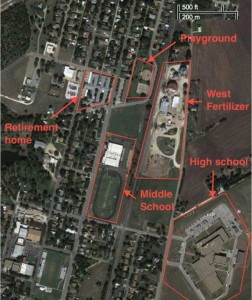 For many of us dealing with the Texas "environmental regulatory system" the shock isn't that something like the West disaster happened, it's the fact that similar accidents don't happen more frequently. Still, it seems like it combined a perfect storm of all-too familiar circumstances
1984 – the company moves two large pressurized tanks of liquid anyhydrous ammonia, a potentially lethal poison, from a site in nearby Hill County to its current location in West without notifying state authorities. It was 1992 before the state caught the mistake and made the company do the paperwork. It moved into an area whre there was already residential development.
1987 – the company was venting ammonia that built up in transfer pipes into the air despite explicit orders in its permit not to do so.
Mid-1990's – the plant’s neighbors complained often about ammonia odors from the company. A neighbor reported “strong anhydrous ammonia odor at her house on Jane Lane.” Another “alleged that strong ammonia odors had intermittently been coming from the West Chemical and Fertilizer facility.” That happened repeatedly, but each time a state inspector arrived, usually days later, he couldn’t smell any ammonia or find any leaks.
2004 – The company’s “grandfathered” status for the two large pressurized tanks of liquid anyhydrous ammonia expires. It was 2006 before an ammonia odor complaint sent an inspector to the company in 2006, a records check revealed the overdue permits.
2006 – a West police officer called a company employee to tell him an ammonia tank valve was leaking. The employee confirmed the leak and “took the NH3 [ammonia] tank out to the country at his farm,” according to a handwritten note. “West Police followed him.”
2006 – EPA fined cited West Fertilizer $2,300 for not implementing a risk-management plan, according to an EPA database.
2011 – In the required risk-management plan, West Fertilizer said the “worst-case scenario” would be an ammonia leak from a storage tank or hose. It didn’t specify the likely consequences. The company said the plant had no alarms, automatic shutoff system, firewall or sprinkler system.
2012 – the Office of the Texas State Chemist, which regulates fertilizer, visited the company 12 times and found "no problems" with the management of its material.
The Occupational Safety and Health Administration had not inspected the plant since 1985, when it gave out a $30 fine. Because of budget cuts, OSHA can inspect plants like the one in West about once every 129 years.
All the elements found in West – disregard for common sense, "grand-fathering" of incompatible zoning, no enforcement of current regulations – can be found just about anywhere you could throw a dart on a map of Texas. All it takes is a lightning strike, a mistake at a control board, or a wind-whipped ember. For evidence, look only to the stories being told by an ex-Exide employee about working conditions at the recently-closed lead smelter in Frisco.
But much more common still are the daily insults to workers and neighbors inflicted by "upsets," accidental releases, and routine pollution that no one has assessed for its full toxicological impacts. These are the non-spectacular injuries of under and no-regulation, and they overwhelm the headline-making ones. Together with the potential for catastrophe, this is why zoning is important. This is why paying taxes for inspectors is important. This is why industry cannot be trusted with its own regulation. This is why environmental protection is a DIY proposition.
There's been a lot of tsk-tsking over the wayward rural ways of West that allowed the accident to inflict so much damage, but countless North Texas officials have shown they're no more sophisticated. Many Barnett Shale communities allow drilling sites within just 100-500 feet of homes and schools, much less as processing plants and compressor stations. Currently, the majority of the Dallas City Council is in favor of putting drill sites in city parks and a gas refinery dealing with dangerous Hydrogen Sulfide only 600 feet from a giant children's athletic complex. Imagine the indignant questions should they get their wish and something terrible happens. "Who allowed a facility like that so close to those kids?"
We think we live in places where a West could not happen. We're wrong.
Why Frisco’s Lead Clean-up is Now Tied to California Courts
 Smelling green, lawyers suing on behalf of Exide shareholders have begun to flock to the Golden Gate state's courts to file lawsuits alleging the company lied to purchasers of stock about the substantial environmental liability of the company's Vernon smelter, recently cited as presenting the highest cancer risk of any industrial facility in Southern California.
At last count there were at least five separate law firms preparing to sue, alleging Exide has…
"…violated certain provisions of the Securities Exchange Act of 1934. Specifically, the complaint alleges that defendants misrepresented and/or failed to disclose that, among other things: (a) the Company was polluting the environment and exposing almost 110,000 residents near its Vernon, California battery recycling facility with potentially fatal levels of arsenic and other pollutants; (b) the Company knew that it would not be able to meet its debt repayment obligations and other pledges and promises based on actual and projected revenues and expenses; and (c) the Company knew that its environmental liabilities, debt obligations and potential insolvency did not support Exide’s statements to investors. According to this complaint, when these facts were finally revealed to the market, Exide’s shares plummeted by approximately 46%.
This isn't the first, or even the second or third time the company has had these kinds of problems. As it turns out, Exide has a history of financial shakiness and corporate irresponsibility:
Despite market dominance, Exide lost about 75% of its share value from 1996 to 1998. Some shareholders sued management, alleging misrepresentation, and the Florida attorney general and the SEC launched probes into whether the company sold used batteries as new. (In 1999 Exide settled with Florida without admitting wrongdoing, and it also settled with shareholders.) In 1998 management clumsily announced a recapitalization attempt and then changed its mind. Amid these problems, Hawkins resigned as chairman and CEO and former Chrysler exec Robert Lutz replaced him.
In 1999 Exide canceled a contract with Sears (4 million batteries a year) to focus on profits rather than volume. Later that year Exide sold its Speedclip division to Prestolite Wire. In 2000 it acquired the global battery business of Pacific Dunlop (now Ansell Limited), GNB Technologies. Exide also sold its remanufactured starter and alternator business (Sure Start).
In 2001 Exide agreed to a plea deal with federal prosecutors whereby the company would pay out $27.5 million in fines over five years. The company admitted to making defective batteries, covering up the defects, and bribing a Sears, Roebuck buyer. Burdened with heavy debt, Exide also announced in 2001 that it planned to issue 20 million new shares in a debt-for-equity deal. That year the company changed its name from Exide Corporation to Exide Technologies.
In 2002 Exide filed for Chapter 11 bankruptcy reorganization as a result of its acquisitions bender and poor conditions in the automotive sector. Later in the year Exide inked a deal to become the exclusive battery supplier to Volvo Truck Australia, giving the battery maker a 74% market share for heavy truck batteries in Australia.
Arthur Hawkins, the former CEO of Exide, was convicted in 2002 of fraudulently selling defective batteries to Sears Automotive Marketing Services. He was sentenced to 10 years in federal prison; the sentence was upheld in 2005. Three other Exide executives were convicted of various federal charges.
When Exide emerged from Chapter 11 bankruptcy in 2004, the company had cut its debt by a reported 70%. That year the company combined its motive power and network power operations into one segment, industrial energy.
While Exide exited Chapter 11, it still experienced corporate pain — the company continued to lose money, and it shut down its lead-acid battery manufacturing plant in Shreveport, Louisiana, in 2006. The plant served Ford Motor and other aftermarket customers. The Shreveport factory was operating since 1968. Production was shifted to other Exide facilities.
Guess what lucky North Texas community helped pick up Exide's slack?
So this is the corporate entity the City of Frisco reached an agreement with concerning the "outer ring" of the Exide lead smelter in that town, also other wise known as the "J" parcel. As it turns out, that agreement gives the company a big financial incentive to clean up that part of their property and hand it over to the City for development. Exide is counting on getting $45 million from the City when the clean-up of the "J Parcel is given the Good Housekeeping Seal. To put that amount in perspective, 2013 second quarter operating income for Exide was only $6.8 million.
So if Exide is as greedy and needy as their record indicates, that J Parcel will be spic and span. But that's not the land the smelter and all of Exide's tons of lead smelter waste is on. That's on the approximately 100 acres smack dab in the middle of the J Parcel and central Frisco that Exide will still own. And there's no City deal to make sure that contaminated property is ever cleaned up.
Now add the current round of financial troubles Exide is in and there's absolutely no incentive for the company to spend money on the kind of state-of-the-art clean-up Frisco residents say they want. In fact there's a huge disincentive. Frisco is a former Exide smelter site with no discernable assets and all sorts of long-term expensive liabilities. And if Exide goes belly-up, the City will find itself at the end of a long line of creditors, beginning with the shareholders who have the best lawyers, with little luck in recovering the money necessary to do a proper cleaning and closure.
The solution? Perhaps a little pro-active planning on Frisco's part could make sure the money is there to clean-up the worst of the worst contamination in a timely way. Requiring Exide to put up a bond pre-bankruptcy, or maybe taxing hazardous waste disposal by the pound are two possible paths that come to mind. Unless the City does something like this, and soon, it's central downtown development, and ambitious Grand Park plans will be forever held hostage to the fate of a company that's looking less and less viable with each passing day.
UPDATE: It was announced Wednesday that the State of California has ordered the Vernon smelter closed because the facility has "been continuously releasing hazardous waste into the soil beneath its plant because of a degraded pipeline" along with poisoning an unacceptable cancer risks.
Downwinders and Others File Stay Against EPA Over Weakened Cement Plant Rules
 Seventeen years and counting – that's how long Downwinders at Risk has been fighting to get the EPA to modernize their rules for waste-burning cement plants. And we're not giving up.
On Wednesday, a national coalition of environmental and community groups that included Downwinders at Risk asked a federal court to stay a decision by the U.S. Environmental Protection Agency to weaken and delay Clean Air Act protection against toxic pollution from cement plants.
By the agency’s own calculations, the delay will cause between 1,920 and 5,000 avoidable deaths and will allow cement plants to release an additional 32,000 pounds of mercury into the environment.
The complete list of groups seeking relief include Cape Fear River Watch, Citizens’ Environmental Coalition, Desert Citizens Against Pollution, Downwinders at Risk, Friends of Hudson, Huron Environmental Activist League, Montanans Against Toxic Burning, PenderWatch & Conservancy, and the Sierra Club, all of which have members who live and work in close proximity to cement plants and have suffered from cement plants’ excessive pollution for many years. Earthjustice filed the stay motion on their behalf in the U.S. Court of Appeals for the D.C. Circuit. A copy of the groups’ motion can be found here: Cement Motion to Stay Rule
Cement plants are among the nation’s worst polluters, emitting vast quantities of particulate matter, mercury, lead, and other hazardous air pollutants.
“As if gutting and delaying the rule were not bad enough, EPA has essentially created a compliance shield for the industry, making it impossible for citizens to hold facilities accountable for their toxic emissions. These changes in the cement rule are irresponsible and reckless,” said Jennifer Swearingen, of Montanans Against Toxic Burning.
“Los Angeles is ringed by cement plants, and three of them operate near my home in Rosamond,” said Jane Williams, of Sierra Club and Desert Citizens Against Pollution. “The pollution from these plants hurts the people in this community and robs us of the outdoor lifestyle we came here to enjoy. We can’t wait two more years to get relief from these plants’ pollution. I don’t want anyone in these communities to be among the people this pollution is going to sicken and kill.”
Our own Midlothian is the cement capital of the United States and so Downwinders at Risk' Director Jim Schermbeck had something to say about the move. “The EPA seems to have learned nothing from having cement plants exploited as inadequate hazardous waste incinerators. As cement plants are once again becoming the nation’s Dispos-All, and new wastes are generating new emissions, the Agency is weakening air pollution controls and making it easier for cement kilns to poison their neighbors. It was wrong to turn kiln into incinerators in the 1980s and it’s wrong to try and do so again in the 21st century – especially accompanied by a roll back in regulations."
In North Carolina groups are fighting a massive proposed cement plant. “A gigantic foreign cement company wants to build one of the world’s biggest plants here,” said Allie Sheffield, of PenderWatch and Conservancy, a group that works to protect the coastal ecosystem in Pender County, North Carolina. “If this plant is built, EPA’s new rule will let it emit twice as much lead, arsenic, and particulate matter into our air and waters. At this point, I have to ask – why do they call it the Environmental Protection Agency?”
William Freese, of Huron Environmental Activist League, lives near what the EPA’s Toxic Release Inventory lists as the dirtiest cement plant in North America for point source pollution. “This makes one wonder how the EPA, in violation of U.S. Court of Appeals’ order, can allow this company to do keep polluting for two more years. By the time they get around to finally doing what’s right, they won’t have any environment to protect,” Freese said.
“Federal law required EPA to put limits on this pollution more than a decade ago,” Earthjustice attorney James Pew said. “But under one administration after another, the agency has refused to put limits in place. Real people suffer as a result of EPA’s scofflaw behavior, and now they are going to court to say ‘enough is enough.’”
The 1990 amendments to the Clean Air Act required EPA to limit cement plant’s emissions of hazardous air pollutants such as mercury. In 2000, a federal court had to order EPA to set these standards after the agency refused to do so.
In 2010, in response to a lawsuit filed by Earthjustice on behalf of community groups living in the shadow of cement plants, EPA finally set the standards that the Clean Air Act had required it to set more than a decade before. These standards would have significantly reduced cement plants’ emissions of soot, mercury, lead, benzene and other toxic pollutants by September of this year.
Rather than acting to clean up their pollution, cement companies attacked EPA’s new rule in court and in Congress. The attacks failed. The court denied their request to vacate or delay the standards, and legislative efforts to do the same failed to gain support on the Hill.
In 2013, however, the EPA voluntarily gave the cement industry the very relief it had failed to get in court or in Congress. It delayed emission reductions that were already more than a decade overdue for another two years, until 2015. Additionally, EPA weakened particulate matter standards and eliminated requirements that would have required cement plants to monitor and report their emissions to the public.
Citizens are down but not out. And we will never rest until we see cement plants regulated the way they should be when they burn so many different types of waste. We can fight this fight because of your support over the years. Please help us keep fighting by putting a bill in the tip jar. We need your help to raise our 2013 budget to keep our staff in the field working for your lungs. Thanks.
If Exide Goes Bankrupt, What Happens to the Lead-Filled Landfills of Frisco?
 Last week the Exide battery company, owner of the now defunct Frisco lead smelter, hired a financial "restructuring" specialist firm by the name of Lazard, although the media coverage that followed the move suggested the more apt moniker could be Lazarus.
"Exide Technologies has been in the midst of a turnaround for awhile now and, like a car stuck in a snowbank, it hasn't been able to gain traction. Yesterday's price action on its stock suggests the market thinks it's going to end up in the ditch."
The news came on the same day the Los Angeles-based law firm of Glancy, Binkow & Goldberg said it would look into claims on behalf of Exide stockholders about possible violations of federal securities laws. Specifically, the firm’s investigation concerns allegations Exide issued misleading statements or failed to disclose material adverse facts concerning the company’s operations.
Nationwide, the company has been pulling back, selling off assets and closing plants. At last count, it had one operating smelter left in the US, and Exide just received noticed from the State of California that it will have to significantly reduce its pollution or it will be forced to close for causing a cancer hazard.
Meanwhile, the company is in the middle of a forced withdrawal from its Frisco smelter site, removing most buildings and surface structures, but leaving millions of pounds of lead contaminated smelter waste behind in a variety of landfills and dumps. It got some needed cash when the City of Frisco purchased surrounding acreage that was never the site of any production, but Exide is retaining ownership of the core smelter site – the very most toxic part.
Besides begging the question of whether this is the kind of company you want owning 100 toxic acres in the middle of your town – what happens if Exide doesn't own it? If the company goes bankrupt, who's responsible for insuring a thorough clean-up of the site, or doing anything else with it…ever?
You have to ask yourself if you were buying Exide's assets, would you really want a former smelter site with no smelter and lots of potential clean-up problems? On the other hand, the only path toward redevelopment of any kind hinges on the location of the land being in one of the region's hottest markets, so maybe a buyer that could invest in a clean-up could see some return from exploiting its proximity to everything else in Frisco.
If there's no buyers for Exide, the party of last resort is you the taxpayer via the EPA's Superfund Program. But that only guarantees you a spot on a waiting list. It could be left abandoned and toxic for decades after it's been officially listed.
You only have to look at Exide's former Dixie Smelter site in South Dallas to get an idea of what's in store for Frisco if the company is left to its own devices. Chain link fencing, warning signs, and a ring of groundwater monitoring wells surrounding a blank slate of land.
Which is to say that the City of Frisco has a spectacular self-interest in seeing that this entire smelter site gets the most protective, and most economically-desirable, clean-up that can be won. And so frustrating that the City signed over its rights to intervene in the formal closure permitting process.
If Frisco residents want a more pro-active role in insuring a proper and protective clean-up of a potential Superfund Site directly upstream from the City's proposed Grand Park, they're going to have to find a way for themselves or the City to act in self-defense on some other front besides the regulated closure process. Otherwise, they're just going to be helpless spectators to the last thing manufactured at the Exide site: a permanent toxic no-man's land.
A Breather’s Guide to Voting in Dallas City Council Races
 In it's recent Dallas City Council questionnaire, The Dallas Monring News asked this question: What is your position, for or against, allowing gas drilling in Dallas and the city's attempts to regulate it?
Here are the answers:
Council District 1:
Delia Jasso (incumbent):
I am most concerned with safety for all the citizens of Dallas as gas drilling relates to clean air and clean water. At this time, I would not like to comment on being for or against allowing gas drilling as there may be future legal issues involved with this issue.
Scott Griggs (incumbent):
I have studied this issue extensively and I oppose gas drilling, fracking, refining, and production within the City of Dallas adjacent to our neighborhoods, schools, and parks. I am opposed to surface gas drilling operations in our parks. Under state law, we must have a gas drilling ordinance and I look to cities such as Flower Mound and South Lake for best practices.
Council District 2:
Adam Medrano:
I do not believe gas drilling has a place in high-density urban areas like Dallas.
Herschel Weisfeld
The Citizens of Dallas deserve the right to have a clean safe environment to live and work with guarantees that our air, water and playgrounds can be protected for generations to come. It is the City Council's responsibility to make informed decisions that are guided by the best information available and by Council Members that are willing to do homework outside of the traditional briefing in order to answer the hard questions that demand alternative evaluation with respect for the best interest of our Citizens and the entire North Texas Region.
Vernon Franco
I am against drilling anywhere in the city that could present a danger to public health and safety. Our civic leaders have an obligation to design, implement and enforce local ordinances that protect the health and welfare of our residents. With our current city efforts to encourage Green building and a transition to cleaner burning CNG-powered vehicles, it is imperative that we make public safety number one as we move forward.
Ricky Gonzales
The City of Dallas has made a spectacle of it's self when it comes to this issue. I have not participated in the gas meetings because Dallas has no right to agree to drilling while they are accepting fees only to deny the actual process. I agree we have to utilize our natural resources in the appropriate manner, but the method should have been scrutinized way before we accepted any funds from the gas industry.
Council District 3
Vonciel Hill (incumbent District 5)
Claudia Meyer
I have spent over three years intensively researching the pros and cons of gas drilling on our air, land, and water. Based on the research, and input of residents, I support passing a more protective gas drilling ordinance which prohibits surface drilling in park land, keeps it out of floodplains, and is kept at a minimum of 1000 feet from homes, schools, parks, dams and hospitals. The decision by the City Plan Commission to deny the pending Trinity East permits should be upheld by the City Council, and any new permits applied for should be processed under the new, more protective ordinance.
Michael Connally
I am for drilling but only if the highest standards for safety and a clean environment will be met. Gas is a resource. It's value can only be realized by tapping the resource. Untapped, the resource remains and will likely appreciate in potential value. We can afford to take the time to get it right.
Kermit Mitchell
Gas drilling should be allowed in the city. Environmental concerns must be respected. The regulatory prohibitions should have been cleared before the RFP was publicized. This is a grievious mistake at the staff level of the City Manager and the Council. The City of Dallas is obligated to regulate such drilling to protect the citizens, the environment, and control the competition for the projected profits. The City of Dallas needs the resultant tax revenues to improve the city quality of life. As Councilor, I would explore the possibility of the drilling site to move to an industrial area, such as the warehouse for the beer distribution in South Dallas, and look to give the residents of South Dallas payment for oil and mineral rights as the oil is drilled in a slant or horizonal pattern underneath their properties. There is acreage in District 3 that might be developed in a similar manner.
Council District 4
Dwaine Caraway running unopposed
Councl Diistrict 5
Jesse Diaz
I am a person that believes in clean energy, protecting the environment and a green economy. Having said that, I consider myself a pro-business individual. As a Council member I will review the proposal of drilling and listen to proponents and those against drilling. I will not be afraid of asking tough questions and making informed decisions in this and other topics.
Bruce Shaw
I am against drilling at this time seeing how North Texas already has a serious air quality problem. Also,the long term effect on environment in this region is not known.
Rick Callahan
I am for it. Dallas needs the revenue. However, the City of Dallas has an obligation to regulate the drilling activity in a safe, efficient, environmentally responsible way. The City leadership, staff, particularly the City Attorney's office has a duty to make sure that all city ordinances are obeyed to the fullest or change them to reflect the will of the people or majority. That includes, but is not limited to prohibiting the surface drilling in parks.
Yolanda Williams
I can not offer my position at this time. In the future , I recommend the city to be more transparent and educate the citizens. Seek their input.
District 6
Monica Alonzo (incumbent)
I cannot support an application until after the council has had the opportunity to debate and vote on the task force recommendations.
Raymond Salinas
The Dallas Morning News did not receive a response from the candidate prior to our deadline.
District 7
Carolyn Davis (incumbent):
Until we have much better information about potential public health and safety impacts, I am opposed to gas drilling in Dallas. Our city is a densely populated area and this is an environmentally sensitive issue that we need to move slowly on. I want to see adequate protections for neighborhoods. We need to do some more work, and clearly define how and where gas drilling can safely occur with minimal risk to public safety.
Ona Marie Hendricks:
I digress.
Council District 8
Tennell Atkins (Incumbent):
I voted to allow drilling on sites voted upon by the city council, which excluded park land.
Subrina Brenham:
The plan commission is a quasi-judicial board established to provide an indebt view of city's land view policies. Therefore, I have some concerns that Atkins demanded his appointee to the CPC to change her vote to support the Trinity East fracking on parkland. Sure we need money. I have not been convinced of the negative impact on our natural resources.
Council District 9
Sheffie Kadane running unopposed
Council District 10
Jerry Allen running unopposed
Council District 11
Lee Kleinman
I will not take a postion at this time because the issue is far to complex to evaluate in the midst of a campaign. The Task force spent 9 months on this issue and I personally know and respect a number of its members. The Council has yet to adopt its recommendations and it will take a much deeper study of the facts before I can take a formal position.
Ori Raphael
I am currently for allowing gas drilling in Dallas as long as it is deemed safe and not in a public park, case in point next to a soccer field. A major concern is the fact that the city has already spent the money that the gas companies have paid for their leases. What is to come if and when they request their money back? In the end the tax payers have to fit the bill in legal and other unforeseen costs. The situation was not handled well and the City Council should have made a clear decision on this issue from the very beginning.
Council District 12
Sandy Greyson – running unopposed
Council District 13
Leland Burk
As an oil and gas investor, I know both the risks and rewards of drilling. I am against gas drilling on park land, or any land in the City of Dallas.
Jennifer Staubach-Gates
I do not support gas drilling / fracking in or near neighborhoods. I think there are very few areas in our City where drilling could potentially be allowed. These opportunities should be considered on a case-by-case basis with careful consideration to protecting our air quality, water usage and other environmental concerns.
Jacob King
A lease does not always guarantee that drilling will occur, and the city must consider all possible means to generate revenue without levying taxes on the residents of Dallas. I beleive leases should be limited to park land that is not open for recreation purposes as it is, and I do not believe any recreational parks should ever be closed for drilling.
Richard Sheridan
The Dallas Morning News did not receive a response from the candidate prior to our deadline.
Council District 14
Bobby Abtahi
We need to tighten our regulations and recognize an evolving technology. Locating intense uses on city parks is not appropriate and we need to be consistent. I was one of three City Plan Commissioners to vote against allowing a concrete crushing operation to locate near a park. The City Council later reversed the majority of the Commission and denied the request. We also need to keep a critical eye on the Legislature to ensure that our oversight capability is not diminished.
Phillip Kingston
I oppose gas drilling, fracking, and refining within the city limits of Dallas. These activities are inconsistent with my focus on improving residential quality of life, but they will also do long-term damage to Dallas’s ability to attract economic development. I believe our air quality, specifically our EPA non-attainment status, is already limiting Dallas’s growth. As businesses and high-skill workers have more and more choices in where to locate in the future, air quality will factor into their decision making.
David Blewett
I support the City's ability to allow gas drilling in Dallas. However, the city's attempt to regulate it has been inadequate. I do not believe we have done enough to educate our citizens about the potential risks involved (particularly in the flood plain and parkland) and that until we do, we should not be drilling. We must have community input and involvement from the start, no matter the issue, without any back room deals.
Kevin Curley
In Dallas, the potential for natural gas development is only a viable option for a small part of the western perimeter. In 2008, recognizing the economic benefit to other cities, Dallas sought out and entered into lease contracts for drilling and accepted $34 million in lease payments from companies wanting to drill. There are still issues that need to be addressed before drilling in Dallas should move forward. I would support increasing the setbacks for specific uses. I would not arbitrarily support drilling in parkland, but I would support discussions about drilling in remote and undeveloped parkland that included a master plan for development. A good example of how drilling and land use development could work is a former drilling site in Burleson that has been converted to baseball fields and a green for a golf course. Drilling can and has been done prudently in many other areas and with tremendous economic benefits and hopefully Dallas can realize some of its reserve potential. But my first priority would be to assure we have established guidelines that protect the environment, the safety of our residents, our property values and the future development of our park areas.
Chuck Kobdish
Fracking has created a great deal of wealth for municipalities, businesses, and property owners alike. It is highly regulated and so I am for fracking when conducted responsibly. It is safer than burning fossil fuels and that is often overlooked. I am opposed to drilling on land designated as public parks. The equipment creates an eye sore and noise and therefore affects our quality of life.
Judy Limatainnen
Gas drilling is a very difficult subject. If you are talking about the drilling that is one subject. If you are talking about the compressor station being built also ajacent to the part that puts a whole new spin on it. I think that the city of Dallas needs to look very hard at any contract going forward on public land to make sure the public is protected, the environment is not damaged and if drilling occurs that the city benefits financially at the best rate possible. I don't think a compressor station should ever be put that close to public/park land.
Jim Rogers
I am opposed to “fracking” within the City of Dallas. The primary obligation of the City of Dallas is to protect Dallas’ citizens and Dallas’ assets (water). Without question the city must regulate drilling in the city limits including on city parkland. I am absolutely against drilling in Dallas parks or near homes or businesses We know that drilling operations are disruptive to surrounding property owners and have the potential to damage property values. In addition, it is essential to protect our water supply.
Can Obama’s EPA Save Us From TCEQ’s “Clean Air Plans”?
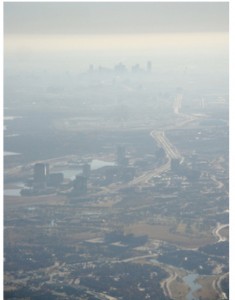 It's only a proposal, but the Obama Administration's plan to cut sulfur in gasoline is aimed primarily at drastically reducing smog-forming Nitrogen Oxide, Volatile Organic compounds and Particulate Matter, the major pollutants that causes DFW to have such bad "ozone seasons." Would it reduce it enough to finally put the region in compliance with the Clean Air Act? Good question.
Sulfur content in gasoline would drop from the current standard of 30 ppm to 10 ppm by 2017 – one year before the compliance deadline for the tougher 75 parts per billion national ambient air ozone standard. That's not a coincidence. The EPA hopes that this initiative is going to drive urban ozone clean-up throughout the country, even in stubborn dirty air hot spots like DFW, which hasn't been in compliance with a smog standard since it was created over 20 years ago.
Along with new stricter emission standards for cars that have already been implemented, the pollution from cars will be coming down over the next decade to historic-per-vehicle lows. Since forever, the state of Texas and local officials have put almost all the blame for DFW's poor air quality on cars. So does this mean that we might actually have a chance to breathe safe and cleaner air, by say, 2020?
Maybe.
First, there's the question of continued growth. If per-car emissions go down, but you're importing 120,000 more cars every year into North Texas, the decreases in emissions are being canceled out to some degree. In this respect, DFW has been its own worst clean air enemy. By attracting new residents year after year and, for the most part, not creating successful transportation options other than private vehicles, the Metromess dooms itself to more total car pollution.
Then there's the climate. Everyone knows how unbearably hot it can get in DFW during July, August and September. That heat and sunlight is one reason we have a smog problem – it chemically transforms the Nitrogen Oxides (NOx) and Volatile Organic Compounds (VOCs) into ozone. What if it gets hotter, and drier? When the ground can't cool off at night and you start out with high morning temperatures that will only get worse by 5 pm, you know it's going to be a bad air day. The more days like that, the harder it's going to be to have safe and legal air despite the changes in engine design and fuel specs. So climate change could rob us of some of those automobile reductions.
If the last couple of years are any indication, you also have to wonder how much of those vehicle changes will be lost on DFW because we live in the Barnett Shale. 16,000 gas wells that are relatively short-term air polluters are being supplemented with more processing infrastructure like compressors, refineries, and pipelines that are year round polluters. Last year's Houston Advanced Research Consortium study estimated the impact of even a single compressor or flare to be as much as 3-10 ppm within five to ten miles, something it would take thousands of cars to accomplish. Even if those cars aren't there anymore, or their emissions make them less of a clean air threat, you have these decentralized major sources taking up the slack. This is one reason why the state itself told EPA that last year there was more VOC air pollution coming from oil an gas sources in North Texas than all the area's on-road cars and trucks, and a large contributing cause to why air quality has been getting worse in DFW over the last two years.
It's not just the number of these facilities but their physical location as well. The more the gas industry moves eastward, the more of the DFW core urban area is "downwind" of these sources, the more the pollution from these facilities combines with car emissions and other urban sources, and the longer they take to leave the now 10-county "non-attainment area," meaning they linger, exposed to sunlight and heat, and have more opportunity to create high levels of ozone. If you have more flares and compressors within 1 to 3 miles of one of 18 or so state air monitors – you will probably begin to see higher ozone readings as a result of their operation – as you have the last couple of years. Most of these pipelines and processing facilities have come online only since 2006.
And that's just in the North Texas area. There's evidence to suggest that the gas industry's building-out to the southeast – or upwind – of DFW is also affecting our air quality. In the same way that Houston's air pollution is said to make our initial "background" ozone levels higher, so too the 60-100 compressors in Freestone County, about 90 miles southeast of Dallas also feed their under-regulated "Standard Permit" pollution into the DFW urban mix. As does the Haynesville Shale gas play itself, as do the remaining east and central Texas coal plants and so forth. If sources to the south and east continue to increase their emissions, it means DFW starts from further and further behind, so that even if cars get cleaner, they might not get so clean so fast as to compensate for this imbalance.
Then there's the "fire hose" effect of the three Midlothian cement plants sitting so close to one another as to create one large super plume that's usually pointed toward the DFW urban core most of "ozone season." Because of citizen efforts, those cement kilns are substantially cleaner in 2013 than they were as recently as 2008. All but one wet kiln is closed, and that one is due to shut down next year. None are burning hazardous waste. But they're still the largest stationary sources of pollution in North Texas – including emitting copious amounts of NOx and VOCs – and they can still impact monitor readings miles and miles away. It's unclear what impact the burning of newly-permitted "non-hazardous" industrial wastes like car parts and plastics in the Midlothian kilns will have on the formation of smog-forming pollution.
EPA estimates an 80% drop in VOC and NOX pollution from cars as a result of its new low-sulfur fuel rule. That's steep. Remove that amount of pollution from all DFW's cars and trucks, and you'd expect to see a substantial improvement in air quality. That's what you'd expect. But, depending on a lot of other variables the state and federal government may or may not be interested in fixing, it could take more than this proposal to bring DFW into compliance with the new 75 ppb ozone standard that is now the federal definition of safe and legal air.
It’s April 1st: Merry Ozone Season!
 We're off to a better start this year than last, if only because we didn't have any "exceedences" of the old 85 ppb ozone standard in March. But there's still six months left – ozone season is the longest season we have now – and plenty of time to rack the violations up. Stay tuned.
Dallas Drilling Scandal: Act 3
 See what happens when you show up?
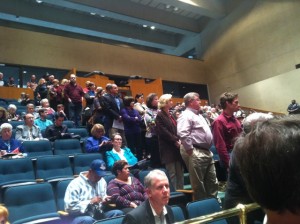
Last Thursday's razor thin vote by the City Plan Commission to deny the Trinity East gas permits – for a second time – was proof that Dallas environmentalists can marshal the political muscle it takes to beat City Hall on a critical issue of public policy, even when the system is scandalously rigged against us. Can anyone else remember the last time that happened? This is one of those turning points in the maturity of the city's green movement and the city itself.
By showing up in record numbers for the third meeting in as many months, you won the latest round in "one of the biggest zoning fights Dallas has ever seen" according to the Dallas Morning News. Plan Commission members remarked they had never seen the kind of crowds that turned out for the gas permit fight. Congratulations and thank you very much.
 We know it's hard for you to take off work or home responsibilities and come down to City Hall for the day. But this was time well spent. By recommending to deny the permits, the Plan Commission forwards them to the entire City Council for a final vote that by rule will require a "super majority" of 12 council members to overturn. By our math, there is currently no such super majority in favor of the permits, although the margin is whisker close again. So where does that leave us? How do we finally kill the Dallas zombie gas permits?
A FINAL COUNCIL VOTE – BUT WHICH COUNCIL?
The very first motion made at last Thursday's City Plan Commission meeting was by permit supporters and it called for postponing a vote until June – after a new city council is seated. That should be your first clue. Trinity East supporters must believe they stand a chance of electing a more pro-drilling city council than the one now seated.
Angela Hunt, Sandy Greyson, and Scott Griggs are steadfast opponents of the permits. Carolyn Davis is believed to be against them. Those are the four votes that can uphold the CPC denial of the permits and deny the supporters their 12- member super majority to overturn.
But it takes five council members to bring an item to the agenda for a vote. And there is no deadline for action by the Council – the CPC decision could lay out there for an indefinite amount of time with no follow-up by Council necessary. If supporters don't think they have at least 12 votes now, they can wait until they think they do…in June.
Rumor has it that Hunt, Greyson and Griggs are trying to find a fourth and fifth council member to help bring the Trinity East permits up for a vote now – in April or May – and uphold the CPC denial. We support this strategy, and have an easy way for you to help make it happen. Our "Featured Citizen Action" has a new and direct message to all 15 members of the Dallas City Council: VOTE NOW AND VOTE NO. As always, you can add your own message as well. Be the first one on your block to send yours.
 THE FIGHT HAS ALREADY MOVED INTO THE VOTING BOOTH
Look again at that list of the four council members who most observers believe make up the current firewall of opposition to the Trinity East permits.
Angela Hunt is term-limited. She won't be there in June. Her hand-picked successor is Phillip Kingston, a solidly anti-Trinity East permit candidate who faces a very well-funded pro-permit candidate. Environmentalists are backing Kingston, but he's not a shoo-in.
Scott Griggs is being forced to run against fellow incumbent Delia Jasso for a new North Oak Cliff district, which is also shaping up to be a tight race. If their attitudes regarding the revelation of City Manager Mary Suhm's secret agreement with Trinity East are any indication, Jasso is a permit supporter.
If both anti-permit candidates lose, and the rest of the current council remains the same, chances are very good the permits would have their super majority and breeze through in June. If you want these gas permits denied, you need to work and vote for Kingston and Griggs.
That's also why the Claudia Meyer vs Vonciel Hill race in District 3 in Southwest Dallas is also so important. It's the only city council race that features an over-the-top supporter of the Trinity East permits running against a longtime grassroots opponent. For environmentalists, it's the same kind of proxy war over drilling in Oak Cliff that took place two years ago when pro-drilling Dave Neumann lost – only now its even more important that the good guys win. This race could provide the margin of victory needed to make sure the CPC denial is upheld.
THE NEW FRONT IN IRVING
One of the largest contingents to show up last week in Dallas were the Irving residents who are just now waking up to the fact that they live only a short distance downwind of all of the Trinity East sites. This is the residential piece of the opposition puzzle that was missing until recently – a built in constituency.
Want to see the kind of cross-examination that Trinity East should receive in Dallas, but never has? You have to tune into Irving City Hall TV, where the day before the CPC vote, Councilwoman Rose Cannaday got to ask company president Tom Blaton lots of interesting questions about its intent with regard to those Dallas wells it wants to drill so close to the Irving city limits. One thing we learned was that although the company is drilling straight down in Dallas, it's making a lateral turn to the Northwest that takes all the wells under Irving. Funny thing about that – Trinity East doesn't have a contract with Irving to take its gas yet. So the company appears to be gambling everything on pursuing three Dallas permits before it even secures the gas rights it needs to exploit them.
It's unclear if Irving alone could or will stop Trinity from being able to do what it wants in Dallas. But what's apparent is that this is now as big a political issue in Irving as it is in Big D, or bigger.
By successfully pushing back last week, Dallas environmentalists have upped the ante. Now you have to follow through. If you're not already volunteering in one of the local council races that could make a huge difference in a June Trinity East permit vote – please do so this week. The election is May 11th and early voting begins April 29th. This is where the front lines of the fight are right now.
And don't forget to send your new message to the current city council: VOTE NOW AND VOTE NO.
We're in Act 3. We can write the happy ending. We can paint the picture. But we have to show up.
Exide’s Crappy California Smelter Raising Cancer Risks
 We've linked to the sad and horrible stories coming from ex-employees of the Frisco Exide Lead smelter that paint a disturbing picture of what went on when the public and regulators weren't looking. But this is Texas, where you practially have to have dead bodies piled up along your fenceline to get the state to do much about polluters and their pollution. What might happen if Exide were to have a rogue smelter in less-polluter-hospitable place, like, say, California?
A battery recycling plant in Vernon is being told to reduce its emissions after recent tests showed it is posing a danger to as many as 110,000 people living in an area that extends from Boyle Heights to Maywood and Huntington Park.
The South Coast Air Quality Management District announced late Friday that Exide Technologies, one of the largest battery recyclers in the world, must also hold public meetings later this spring to inform residents that they face an increased cancer risk and outline steps being taken to reduce it.
Air district officials said Exide's most recent assessment showed a higher cancer risk affecting a larger number of residents than any other of the more than 450 regulated facilities in Southern California over the 25-year history of a program to monitor toxic air contaminants. The primary contaminant in this case was arsenic.
There has been "nothing close to this … never," said Sam Atwood, spokesman for the air district.In a statement, Exide officials said they planned to work with the district on emissions reductions "that we expect will meet or exceed" requirements. "Exide takes its environmental responsibilities seriously…."
Yes, so seriously, they've waited until they got caught to address these arsenic emissions. According to the most recent estimates, the company is posing a risk of 156 cancers per million population. The EPA standard is one in a million.
Under California's regulations, when cancer risk from a facility reaches 10 per million, public notification is required. When it hits 25, facilities must take steps to reduce their emissions. Exide was six times over that limit.
Since the 1987 Toxic Hot Spots program went into effect, only about 20 facilities in Southern California have ever reported risks that were greater than 25 in 1 million. More than 95% of the facilities the air district regulates have risks under 10 in 1 million.
California will force Exide to produce a "Risk Reduction Plan" within 6 months that will have to outline how the company will reduce its arsenic emissions. Failure to do so could result in $25,000 a day fines and a shut down order from a judge.
Meanwhile, Exide is doing everything possible in Frisco to make sure that city will have lead-waste landfills along Stewart Creek and near downtown forever – refusing to remove the hazardous waste that's been found in them in favor of "treating" it in place in town and saying it wants to "cap" all the dumps and landfills, even though many are on slopes and one is even partially in the flood plain.
Our bet is that Exide will choose to close its California smelter rather than install state-of-the-art controls, and then Frisco will have yet another community to commiserate with over the company's toxic leftovers.