Air Quality
Notice Something Missing So Far This Summer? Smog Alerts.
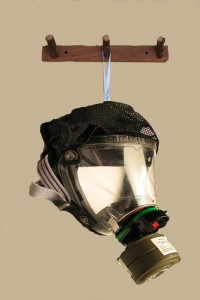 Along with cooler weather in general and a little more rain this Spring has come some relief from really dirty air in DFW.
Last year at this time, we'd already had 6 "exceedences" of the old 1997 85 parts per billion ozone standard in May, and countless exceedences of the tougher new 75 ppb standard that is supposed to be attained by 2018. As of today, we haven't had one even one monitor reading above 85 ppb and only a handful in the 75 to 85 ppb range.
For the last two years in a row, DFW has seen a decrease in air quality, and an increase in smog. Could 2013 be the year that trend is halted?
Weather takes a lot, or even most of the credit. Cooler temperatures and more moisture are not conducive to ozone creation. But unlike during the recession, new car sales seem to be taking off the way the Rick Perry-approved engineers at the Texas Commission on Environmental Quality wanted them to two to three years ago. It's possible that the replacement of older dirtier vehicles with newer, cleaner ones by the thousands has finally made a difference you can't see. There's also the impact of cleaner operations at the Midlothian cement plants thanks to citizen victories over the last decade, (although the kilns are rapidly turning back into garbage burners), fewer coal burning plants downwind, and other improvements up and down the southeast to northwest axis that carries our predominant winds from Houston to here.
On the other hand, last June was pretty quiet until the 24th, and then all hell broke loose, with ozone levels into the triple digits. 2012 turned out to be a very bad year for safe and legal air.
And there's the unknowns that nobody's really examining closely – at least not in public. How much ozone pollution is being caused by the natural gas infrastructure in the Barnett Shale that's been built over the last decade and gets bigger every week? How much is the gas industry polluting upwind of us in places like Freestone County between here and Houston? Does the continuing boomtown growth in DFW population cancel out the improvement in individual vehicle emissions?
From a regulatory point of view, no matter how good or bad this summer is, we don't get credit for it either way. Another bad year wouldn't be held against us. Likewise, no violations this entire year wouldn't buy us any more goodwill from EPA. We're in a limbo period, where everyone is just waiting around for the average readings from 2015 -2018 to accumulate and tell us what category of compliance with the new 75 ppb standard we're in. While it would certainly help the cause if the region had some forward momentum in lowering the levels of smog going into 2015, officially, it makes no difference at all – unless you're breathing air. Then, according to EPA's own scientists, anything above 65-70 ppb is damaging to human health.
Theoretically, the TCEQ is supposed to be putting together yet another "DFW clean air plan" to reach that 75ppb standard, to be implemented sometime between now and 2015. The last time it tried to reach such a regulatory goal – the 85 ppb standard – it ended up with a plan that worsened air quality here by starting way too late and basically doing nothing but watching as new cars were going to clean up the air in the middle of a recession. (By the way, the "official" regulatory date of that failure is coming up next week even though the failure was certain last summer. Stay tuned to see if TCEQ acknowledges it in any way).
It's the summer of 2013. Any big changes that need to be in a summer of 2015 clean air plan should be being discussed and set in motion now, especially if they need 2015 state legislative approval, or lead times for industry to adapt. However, state or regional officials have yet to call a meeting of the local advisory group that's supposed to be monitoring the development of that plan. No date is set for such a meeting.
We can hope that a confluence of circumstances is making it possible to have cleaner air in DFW, but as long as Rick Perry is Governor, it's unlikely such an important public health goal will override political agendas.
Sloshing Back and Forth Between Coal and Gas
 Around 2003 or so, the Dallas Morning News editorial board convened a roundtable of air pollution stakeholders and more or less facilitated a discussion of what could be done to clean up DFW's dirty air. You see, the area still hadn't complied with the 1997 national smog standard and more and more official air quality monitors were in violation of it. Pretty much, just like now.
There was a memorable moment when one of the "environmentalists" at the table noted that for decades the Texas utility industry had been primarily reliant on natural gas for its power source, then switched almost entirely to coal during the 70's and 80's, exactly when the nation's first national air quality standards were being written and enforced. "Part of the problem is that there doesn't seem to have been any planning for the consequences of the industry switching over from one source to the other just like that. It's like a frenzied mob group of stockbrokers running back and forth between bidders."
"That's the marketplace," huffed a utility industry representative. And indeed it still is. One frenzied run after another back and forth between the two largest sources of fossil fuel.
You know the scene in Pirates of the Caribbean, At World's End where the crew runs back and forth, from each side of the ship, until it eventually turns upside down? It's like that, only with money doing the running. And it never ends.
That DMN discussion was only a decade ago. What happened next shows how quickly those runs can reverse themselves and the conventional wisdom. Fracking technology delivered new shale plays that flooded the market with new gas. So much new gas, that the price of it dropped to historic lows. That caused a huge switch in the utility industry. Gas was cheaper, so the coal-powered plants started to close and be replaced by gas-powered plants. At the same time the chemical industry, which uses voluminous amounts of gas in production of plastics and other products, announced a new wave of domestic construction because of cheaper gas supplies in the US. Finally, in order to prop-up the low gas prices that that are killing profits, the gas industry itself promoted the fuel for transportation use and export.
And students, what happens when all these elaborate plans to take advantage of cheap gas begin to blossom? Demand increases. Cheap gas turns into not-so-cheap gas. And then coal begins to look pretty good again. All of a sudden it's the negative image of 2003, and all that money is starting to run toward coal as gas prices rise.
And what that means is that the higher methane levels causing climate change are replaced by higher CO2 levels causing the same climate change. This is why we need to get out of the rut we're in where our choices are determined by short-term financial gain and not long-term survival.
Government puts its finger on the scales in the marketplace all the time to help this or that industry. Without government guarantees, whole sectors of the economy would not be able to function in a completely unfettered market. This is what the CO2 cap and trade system was designed to do – make the marketplace respond to pressures put there by government in order to achieve a goal of reducing the stuff that will make the place we live less habitable. But it was all a communist plot,or something like that. So in the meantime, we continue to slosh back and forth.
From the Houston Chronicle comes this summary of the latest trends:
After years of declining greenhouse gas emissions, Texas and other states reported sharply higher levels of carbon dioxide in 2012 as electric generating plants began to use more coal when natural gas prices began to rise, according to a study released Thursday.
Citing research done by the Environmental Integrity Project, Texas once again led the nation in CO2 from power plants in 2012, emitting 251 million tons. Florida was a distant second at 120 million tons. Just five states accounted for one-third of the nation's CO2 power plant emissions. Besides Texas and Florida, they include Pennsylvania, Indiana, and Ohio. Needless to say. the old TXU plants in East and Central Texas run by corporate off-spring Luminant are the largest contributors.
The price of gas will continue to go up and coal will be competitive. Or maybe it will go down and coal won't be attractive. Maybe we'll be downwind of lots more coal plant pollution. Or maybe we'll all have a rig or compressor station in our backyard. Who can say? That's the marketplace! The question is, do you want to bet our survival on it?
How Mary Suhm Fracked Herself
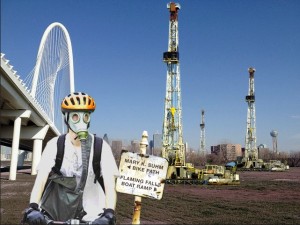 When you take on polluters, you take on the government that lets them pollute. The two are intertwined.
On Thursday, Dallas City Manager Mary Suhm announced that she was resigning. Just about every news account of her announcement connected it to a series of missteps over the last several years, most prominently, the February disclosure by the Dallas Observer that she had signed a previously unknown agreement with Trinity East promising to work with the company to overturn current policy and help secure permits to drill for gas in city parks.
Although superficially dealt with by an official airing in front of the Council where most members forfeited their roles as keepers of the public trust, the issue kept floating to the top of any discussion about not only the Trinity East permits, but the general issue of gas drilling in Dallas. Every City Council race questionnaire this election cycle had queries about not only the specific permits, but also about the performance of the City Manager in wrestling with the scandal. This wasn't going away.
Suhm had what she believed was a plausible public explanation for how she made an honest mistake in misleading the Council over the agreement….for five years. What was always lacking was an explanation for why she continued to lie to Dallas residents about it for that long. Not one word of any defense of her focused on why it was wrong for a city official to align herself against citizens fighting irresponsible drilling and not tell them about that alignment as the entire city went through a multi-year reassessment of urban drilling, first with a moratorium on new permits, then a gas drilling task force, then the permitting process for the Trinity East permits themselves.
instead she directed city staff to distort the system to enable illegal permits to appear legal. Zoning classifications appeared or disappeared depending on the forum. One-off exemptions were carved out as necessary. Park drilling? Perfectly fine under these "special" set of circumstances. Flood plain drilling? No problem either. Anything to make these square pegs fit in otherwise round holes.
Common decency and allegiance to democratic principles demands that she should have publicly disclosed the agreement with Trinity East the minute a review of current city drilling policy began. She did not. When it was involuntarily disclosed for her by the Observer, she looked exactly like the co-conspirator she was.
There's no question that the fight citizens' groups have waged against the Trinity East permits led directly to the disclosure of the agreement. Based solely on circumstantial evidence, it was clear that there was some kind of unpublicized deal that had been "cut" between City Hall and Trinity East. Looking for it became the political equivalent of looking for Dark Matter in the Universe. Everything happening pointed to its existence, but you couldn't actually see the thing itself.
But here's the punch line. Citizens only started to look for that deal after Suhm and the Mayor decided to fast-track the Trinity East permits in late November. It was that decision, made without any warning to the residents that had been involved in the drilling fight, and abruptly ending a year-plus long moratorium on new gas permits, that re-energized opposition and led to Suhm's resignation only six months later. Suhm fracked herself the minute she began to plot with the Mayor to undercut due process and try to pull a fast one on citizens. If they hadn't been in such a clumsy rush to get the Trinity East permits approved, none of this would have happened like it did.
Last week's municipal elections solidified a slightly more independent Dallas City Council, with new and re-elected members who openly oppose the Mayor's pro-drilling stance. Trinity East's permits, which needed a Council super-majority to be approved, look to be doomed. Rawlings' own political future is clouded – how many North Texas mayors have unpopular proposed refineries named after them? The landscape of city politics has changed over the last six months. Citizens fighting City Hall did that. But it was City Hall itself who set it in motion.
Dallas City Council Elections and Drilling: Mayor’s Plan Fails, What’s Next?
 The dust hasn't completely settled, but it's clear that Saturday's municipal election generally strengthened anti-drilling sentiment on the Dallas City Council.
This happened because of two things: 1) Residents elected anti-drilling candidates outright (Griggs and Medrano, with a run-off for Kingston), and 2) a couple of hard core supporters of the Mayor's and Mary Sumh's drilling plans were replaced by candidates who are more conditional in their support for how and where to drill than their predecessors (Kleinman replaces Koop, Griggs replaces Jasso).
Both of those factors can be traced directly back to all the constructive hell-raising citizens have been doing over the past two years or more. Every single candidate questionnaire had a query about gas drilling in Dallas. It came up at debates and forum and interviews. You made it an issue that even business-backed candidates had to address in a citizen-friendly way. You changed to tone, the content of the debate. You did that.
Our citizens' slate won two out of five races outright, with a chance to make it three out of five if Kingston wins the June 15th run-off. Unfortunately, Claudia Meyer lost her race to Vonciel Hill despite a lot of hard work and grassroots effort. And drilling opponent Leland Burk lost to Jennifer Staubach-Gates.
The June 15th run-off is now very important indeed, because it could give us up to 6 votes on the Dallas City Council against irresponsible urban drilling, with a possible 2-3 more swing votes coming over to our side depending on the permit and the site. You need 8 votes out of 15 to win. We're very close.
Besides the Kingston run-off with industry-backed Bobby Abtahi, there's also the District 5 run-off pitting Jesse Diaz against Rick Callahan – both very conditional drilling supporters who appear to be against park drilling.
So here's the Dallas Drilling scorecard as of today:
Opponents of Drilling
Greyson
Griggs
Davis
Alonzo
Medrano
June 15th run-off:
Kingston
Unconditional Supporters of Drilling:
Rawlings
Hill
Atkins
Caraway
Allen
Kadane
June 15th run-off:
Abtahi
Conditional Supporters – based on public statements
Staubach-Gates
Kleinman
June 15th run-off: Diaz or Callahan
Short-term, these election results look like they doom the zombie Trinity East permits. We only need four Council votes or more to uphold the City Plan Commission denial of those permits. We have at least five now, with the chance for 6 or more after June 15th. So the Mayor's plan to hold off on voting on these permits until after the election in hopes of finding more supporters has failed.
This is no small accomplishment. Last November, when the Mayor held a press conference and announced that he was breaking the informal moratorium that was holding back all permit requests until a new ordinance was written and pushing the Trinity East permits through for approval, it indeed looked like a "done deal." And as recently as April, some Dallas City Council members were telling their peers in Irving not to fret, because, despite the Plan Commission vote, the Trinity East permits were still a "done deal."
Well, folks that deal is done now. Well done. As in, put a fork in it. Congratulations. The Mayor tried to pull a fast one and he didn't succeed because of the fierce resistance he got from his own residents. We should know soon when the Trinity East vote will be, and when it's scheduled, we'll need you at City Hall once again to show the new city council that fierce resistance in person. Maybe that will make an impact on their future voting.
Longer term, the new Council will have more members who are opposed to all drilling in Dallas, not just in parks and flood plains, but they don't yet constitute a majority. They're at direct odds with the six Council incumbents who are avid supporters of drilling everywhere and anywhere. Somewhere in the middle – at least until the first vote or so – will be the three freshman members who are possible swing votes.
Their views will be increasingly important if one or both things begin to happen – there is movement to actually write a new gas drilling ordinance after the Trinity East permit denials are upheld, and/or Luminant follows through on its plans to drill and build a compressor station at North Lake and submits permit applications that will be at the center of yet another round of public controversy.
For now, let's concentrate on the June 15th run-off and getting a 6th anti-drilling vote on the Dallas City Council. Its not 8 yet, but it's pretty darn close and construction is still in progress.
Tomorrow is Election Day. People Like Us Need to Make It Earth Day Too.
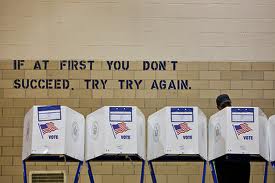 Some cynics don't think voting matters. They're wrong. It matters a lot. Especially local elections.
Because the pool of votes is smaller, each vote is magnified. Your vote literally counts for more. Because the elected official is a neighbor and governs from City Hall or the Courthouse instead of Austin or Washington, they're more directly accountable for their decisions. In many ways, local elections are the closest we come these days to what our founders believed all elections should be about.
That's why folks like us need to be more involved with them. Local elections are more susceptible to the determined energy of insurgents. They take less money to win and shoe leather passion can beat big bank accounts. They're winnable with the resource we have, or can realistically raise. They don't necessarily produce a final victory outright, but they can help you get there sooner than you would otherwise.
As it happens, that's exactly the same pragmatic philosophy behind Downwinders at Risk's emphasis on local organizing in North Texas. The more local it is, the more muscle we have.
But there's a huge disconnect between the feel-good, big-tent well-attended local festivals that surround Earth Day events now and the way those same festival crowds vote on Election Day a few weeks later. We need to change that.
That's why Downwinders at Risk and its 501c3 Education Fund are both spending money and effort on educating voters about the Dallas City Council election this cycle. Although gas drilling isn't officially on the ballot, it's what's at stake. Will Dallas follow the now-familiar path of being ridiculously subservient to the oil and gas industry, or can citizens force it to stake out a different course that's more balanced? Right now Dallas is front and center in the North Texas gas counter revolution. That's why we're there.
So far, citizens have won every round, despite the combined forces of the Dallas Citizens Council, City Hall, and the industry working against them. But those victories could be be temporary depending on tomorrow's electoral outcome. The Mayor has cynically put off the final vote on the Trinity East gas permits until he sees if he has an even more pro-drilling council to override the City Plan Commission denial.
If you live in a Dallas city council district with a competitive race, we strongly urge you to vote. We've publicized a breather's guide to the best candidates on the drilling issue that includes, Claudia Meyer in District 3, Philip Kingston in District 14, Scott Griggs in District 1, Leland Burk in District 13 and Adam Medrano in District 2. If you haven't volunteered your time or given money to any of these candidates it's too late now, but everything will be forgiven if you turnout and vote your passion tomorrow.
D Magazine, published by a principled disciple of William F. Buckley and catering to a demographic several tax brackets above ours, is running an on-line survey of Dallas city politics on the eve of Election Day. One of the questions they're asking is whether drilling should be allowed in urban areas. Last time we looked there was a resounding 75% "No!" in response. And yet, most members of the Dallas City Council actually are OK with not only drilling in Dallas, but drilling in parks, flood plains and putting refineries next to schools and huge recreation centers. There may be no other issue in recent memory where Dallas City Hall was more out of sync with its residents. That has got to change if we're going to win the war and not just the battles.
And the grassroots movement has to embrace and become skilled with the tool of local electoral politics. That's why, in the coming months, Downwinders at Risk will be exploring the creation of a Political Action Committee, or (PAC), focused exclusively on strategic local, North Texas races. It's time we got more involved in helping to decide who the deciders will be.
Meanwhile, do your part tomorrow to make Election Day Earth Day.
Get ‘Em While They Last….
Particulate Matter (PM) Pollution Linked to Hardening of the Arteries
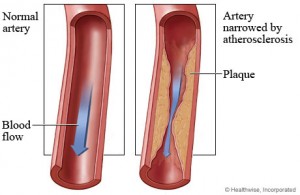 Residents who live in more polluted parts of their town may have as much as a 2% greater risk of strokes and heart attacks than people who live in areas with cleaner air. That's the conclusion of a new study that specifically links PM 2.5 – that is soot or particulate matter that is 2.5 microns or less in size – to accelerating atherosclerosis, or hardening of the arteries.
Researchers from the University of Michigan School of Public Health and the University of Washington followed 5,362 people between the ages of 45 and 84 from six regions in the U.S.: Baltimore, Maryland, Forsyth County, North Carolina, Los Angeles County, California, Northern Manhattan and Southern Bronx, New York and St. Paul, Minnesota.
After accounting for behaviors like smoking, which can independently affect heart disease risk, they found that the thickness of the carotid arteries that supply blood to the head and neck increased by 14 µm each year. Participants who were exposed to higher levels of air pollution in their home had blood vessels that thickened faster compared to others living in their area with lower exposure levels.
Thickening of blood vessels is a sign of hardening of the arteries, as inflammation lures in clotting factors and other immune agents to patch up worn areas; as these compounds build, the vessels stiffen and thicken, losing their ability to flex and adjust to the varying levels of pressure created by the blood flow.
High levels of a fine air pollutant called PM2.5 was specifically linked with faster thickening of the inner two layers of the carotid artery, a vessel that serves as a sentinel for the state of other arteries throughout the body. However, the study also showed that if levels of PM2.5 were reduced in the participants’ homes, the pace of thickening slowed.
Latest Stop in Slo-Mo Exide Train Wreck: Thursday 5-7pm
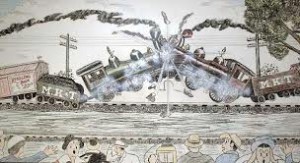 Coming down the hill from the west is a freight train full of woe for Exide. It's carrying at least five shareholder lawsuits aimed at the company for not disclosing its environmental liabilities, including those stemming from the operation of its Vernon, California smelter. That would be the same smelter California state officials shut down due to leaking lead waste and an unacceptable cancer risk to over 100,000 local residents. On board is a "restructuring specialist" who is supposed to see the company through its second bankruptcy in a decade. As of last week, Exide stock was selling for a cool 75 cents a share. The whole company is about to shoot off the rails.
Meeting it head-on coming from the east is the Exide's smelter site in Frisco, over 100 acres and fifty years of sloppy handling and disposal of hazardous lead, arsenic, cadmium, dioxin and other poisons. There are "pre-RCRA" sites aplenty – meaning they were there before any regulations could catch up with them, as well as more recent disasters like the illegal burying of hazardous waste in a non-hazardous landfill. Just last week the City of Frisco released a preliminary environmental assessment of the LEAST-contaminated parts of the smelter that revealed new potential contamination as well as the fact that the entirety of Stewart Creek had been re-routed around the smelter in 1964 – leaving the original channel underneath the MOST contaminated part of the smelter. Moreover, even though the smelter closed in November of last year, it's been routinely causing high levels of lead air pollution from the demolition and closure operations going on.
Caught in the middle are Frisco residents who just want to live without a lot of lead in their air for awhile, and don't want to see a new Superfund Site in their town. The state's Texas Commission in Environmental Quality is in its usual "Yes Man" role to industry and seemingly finds no fault in any of Exide's plans to leave pits and landfills full of smelter waste in Frisco permanently. Having made its sweetheart deal to close the smelter, the City of Frisco has taken a back seat to the company and TCEQ when it's come time to figure out how best to clean-up the site.
Thursday night Exide is sponsoring another one of its "community meetings" in which the community is invited to come hear company representatives put nice spin on everything as well as duck questions about its financial responsibilities and long-term plans. It's no substitute for a real public meeting but its the only game in town for Frisco residents who don't want to see a toxic waste dump site remain downtown.
Exide Community Meeting 5 to 7 pm Frisco Depot 6321 Paige Street – behind Babe's.
A Jim Schutze Primer on the CDC and Aerial Spraying
 You can't tell the players without a program. Read this take on the recent flare up between John Wiley Price and Dallas County Judge Clay Jenkins on the issue of aerial sprying for West Nile. Schutze is the only writer using the term "endocrine disrupter" in connection with what the authorities want to spray and who's trying to follow this issue BEFORE the summer arrives….
No It Isn’t.
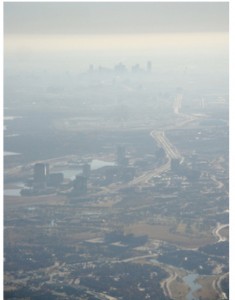 It's unfortunate the Dallas Morning News chose to drink the Kool-Aid and say, that despite DFW once again getting an "F" from the American Lung Association for its smog levels, it "isn't as bad as it looks" because the air is "getting cleaner" than it was in…1999.
And 20 years ago too probably, but what about compared to, say, 2010? In that more relevant comparison, the answer would be no, the air is not cleaner, it's in fact dirtier. The average concentration of smog has inched up over the past two years and the number of monitors in violation of the old 85 parts per billion ozone standard has increased from 2 to 7 in 2011 and 6 last year. That's not progress.
The DMN story also doesn't mention that the state has tried and failed twice with its "clean air plans" to reach the obsolete 1997 standard, and it forget to say we face a 2018 deadline to meet the new 75 ppb standard. But don't worry because the air is cleaner than it was in…1999! Even if it's still not safe or legal.