Air Quality
Even a Few Weeks of Cleaner Air Can Make A Big Difference
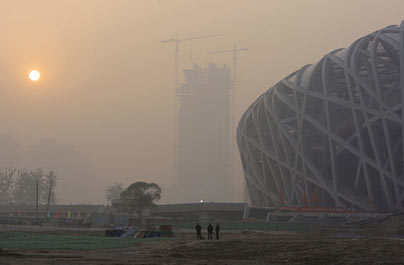 We can't tell you how many times a resident from DFW will go on a business trip or vacation to a less-polluted place and report an almost instant shedding of the ill effects of dirty air, only to have an almost equally fast re-acquaintance with those effects once they return. Could air pollution really make that much of a difference in so little a period of time?
As it turns out, yes.
Via an new study recently published in the Journal of the American Medical Association, researchers found that the Chinese government's decision to close down Beijing's polluting factories and take cars off the road during the 2008 Olympics resulted in a remarkable short-term improvement in cardiovascular health. It's the first major study to look at the immediate effects of air pollution in young healthy adults.
In a synopsis published by Environmental Health News, one of the authors describes the study and its importance:
"For the 5-month study from June to November, the researchers recruited 125 resident doctors with an average age of 24 from a centrally located hospital. Half were male, and all were healthy with no history of diabetes or cardiovascular disease.
The researchers measured heart rate, blood pressure and six markers of cardiovascular diseases in blood samples before, during and after the games. The markers included C-reactive protein (CRP), fibrinogen, von Willebrand factor, soluble CD40 ligand, soluble P-selectin concentrations and white blood cell count (WBC).
Two markers associated with blood clotting significantly decreased from pre-Olympic to the during-Olympic period: P-selectin levels dropped by 34 percent and von Willebrand factor levels were reduced by 13 percent. After the games, when the pollution control measures were removed, most markers rose back to pregame levels. But two markers – P-selectin and systolic blood pressure – worsened and showed a significant increase compared to the levels during the games.
Air pollution emissions were also measured at similar times. Levels of most air pollutants during the games decreased up to 60 percent compared to their pregame levels, depending on the type of pollutants. For example PM2.5 dropped 27 percent, nitrogen dioxide 43 percent and sulphur dioxide 60 percent. After the games when pollution controls were removed, emissions rose to higher levels than were measured before the games started.
This study suggests that even young healthy people can benefit from short-term air pollution reduction and supports efforts to quantify and understand the benefits and costs of air pollution control measures."
The next time a politician complains about the cost of air pollution controls, make sure and ask them if they're for preventative heart disease treatment. When they say yes, please remind them that keeping crap out of our air that would otherwise end up in our lungs is such preventative care.
Midlothian Cement Plants Linked to Higher Child Asthma Rates
On the left is a computer-modeling image from the Texas Commission on Environmental Quality showing the direction of the predominant downwind plume of pollution from the three Midlothian cement plants - from extreme NW Ellis County, blowing diagnoally across Tarrant County and into Wise County. On the right is the map from the original 2009 Cook Children's Hospital CCHAPS study indicating levels of childhood asthma in the Hospital's service area. It tracks closely with the direction of the plume and asthma levels increase in closer proximity to the cemnt plants. 
According to researchers Patricia Newcomb and Alaina Cyr from the UTA College of Nursing "…the bulk of Tarrant County asthma cases lie directly in the path of southeasterly winds that have historically carried high levels of particulate matter from working cement kilns in a neighboring county. Asthma prevalence increases in a linear configuration within the path of the 'cement plume' as residential location comes closer to the cement kiln area."
Exposure to Particulate Matter pollution, or soot, is a well-known known cause for asthma. It can also make a child's asthma worse.
"This latest study is one more piece of empirical evidence that we need to decrease pollution from the Midlothian cement plants to secure the right of our children to breathe without getting sick, " said Jim Schermbeck, Director of Downwinders at Risk, a local group originally founded in 1994 to oppose the burning of hazardous waste in the Midlothian cement plants.
Proximity to the pollution from the three Midlothian cement plants was the only environmental factor geographically associated with higher concentrations of childhood asthma, ruling out poverty and indoor air pollution. There also wasn't a strong correlation to urban gas drilling, although the authors concede that "urban drilling may play a part as well" in the region's higher than normal child asthma rates, and there was no direct comparison between the geography of drilling activity and area asthma levels.
In 2009, Cook Children's Hospital released its Community-wide Children's Health Assessment and Planning Survey (CCHAPS), the largest examination of childhood health in North Texas ever undertaken. It found that Tarrant County and the western side of the North Texas region suffer childhood asthma rates significantly higher than state and national averages.
In "Conditions Associated with Childhood Asthma in North Texas," published in the October edition of ISRN Allergy, Newcomb and Cyr revisit the Cook study and delve more deeply into its data. "The purpose of this study was to identify significant associations between asthma diagnosis, comorbid conditions, and social problems in children." The complete article can be accessed on the Cook Hospital CCHAPS website page devoted to asthma, under "Special Reports."
Midlothian is the home of the largest concentration of cement plant manufacturing capacity in the United States. It hosts three large cement plants – TXI , Holcim and Ash Grove – with a total of six kilns. They are the largest stationary sources of pollution in North Texas. Reports submitted by the plants themselves show they poured over a million pounds of Particulate Matter pollution into the North Texas air in 2009.
EPA recently announced that it was considering once again delaying the implementation of new federal emission rules, including stricter particulate matter pollution standards, from 2013 to 2015 that have been in the works for two decades. The delay would also water down proposed PM pollution standards. Schermbeck said Newcomb and Cyr's analysis shows the real world costs of such a rollback.
"It's a scientific fact, endorsed by EPA, that inhaling tiny bits of particulate matter can make people sick and even kill them. What this study makes clear is that the agency is senselessly condemning more Tarrant County kids to illness and suffering by delaying rules that were supposed to have been in place in the 1990's. It's time to start saving lives by reducing this kind of pollution."
Study: Green Spaces Make Pregnancy Easier
 Coming under "Confirming Things You Probably Already Knew," is this study via the folks at Environmental Health News:
"Living in homes surrounded by grass and trees can reduce pregnant women's exposures to traffic-related air pollution, according to a study in Barcelona, Spain. As green space around their homes increased, their exposure to fine particles and nitric oxides decreased. Particles and gases in vehicle exhaust can affect the development and health of fetuses, so this study suggests that green space in urban neighborhoods has a health benefit."
Over the last five years, study after study has provided proof that living near roadways increases your likelihood of having respiratory problems and other health problems. And yet, just like the regulations surrounding lead smelting or waste-burning haven't caught up to the most recent science, so traditional highway risk assessments don't yet acknowledge most of this new scholarship.
The design of the CF Hawn/SM Wright freeway redo that will help shape South Dallas for a generation or more is in its final stages of planning. There may be as little as 2-4 months until approval will be given by the Federal Highway Administration to proceed with a 6-lane thoroughfare instead of a more community-friendly four land boulevard that residents have voiced support for time and again.
Now is the time to call attention to a factor that may not have been examined very thoroughly, if at all, by TXDOT or local officials in designing the redo – before another wrong is inflicted on South Dallas by the city.
Another Waste Fire at a Waste Burning Cement Plant
Indian downwinders complain of air pollution from their local cement kiln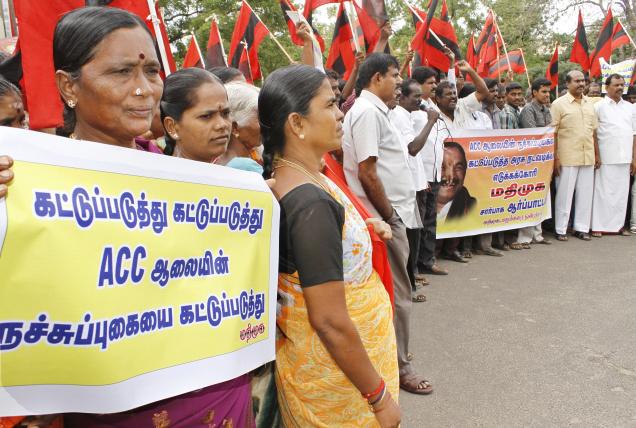
This time in India instead of Utah or South Carolina.
In Coimbatore, plastic and leather wastes stockpiled waiting to be burned as "fuel" at the Madukkarai cement works spontaneously combusted in a three hour fire that did not result in any known injuries at the plant.
However, thick columns of black smoke poured into the sky and that stuff, as the late Dr. Commoner would note, has to go somewhere. A lot of it will no doubt dind its way into the lungs of downwind residents. More than 200 tons of waste was gutted in the fire out of at total twice as large.
Despite local fire officials urging the cement plant to enclose the waste for some time, it had not done so. That is an apparent violation of state law. And readers, will it surprise you in the least to learn that the plant was already a longtime source of complaints from local residents?
Meanwhile the Fire and Rescue Services Department officials pointed out that storing combustible waste materials outside the plant without adequate protection was in violation of the Tamil Nadu fire service rule of 1990.
"It is a violation of section 250 of Tamil Nadu Fire Service Rules 1990 and we will issue a notice to the factory and will give them 15 days to store the waste materials inside a roofed structure with protective walls," said Subramanian.
Residents have been protesting against the cement factory for a long time and have submitted numerous petitions to the district administration. They claimed that the dust and smoke from the factory was causing major health complications, especially for senior citizens and children.
"We have raised the issue on numerous occasions and also submitted petitions to the district administration but till now no action has been taken," said C Palaniswamy, a resident of Kurumbapalayam.
There is a premeditated and orchestrated campaign by the cement industry to allow kilns to become garbage burners of all kinds of wastes. We've seen it manifest itself locally in Midlothian with the TXI permit that allows that plant to burn car parts and plastic wastes.
The more kilns that become gargabe burners, the more garbage of dubious content will pile up at kilns, the more often that garbage causes a fire. We've reported on three just since the summer alone. Being downind of an uncontrolled garbage fire isn't one of the talking points the industry boasts about when it's trying to sell kilns as the industrial equivalent of Kitchen disposals, but it's looking more like a standard feature rather than an option.
Risks from Freeway Air Pollution “Very Important” to Consider. Will Dallas?
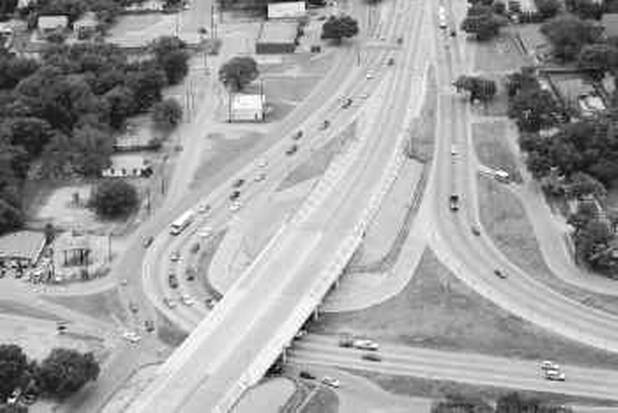 Over the past five years, there's been a significant increase in the amount of scholarship devoted to chronicling what kind of risks are posed by running freeways through communities and exposing adjacent residents to the cumulative air pollution of thousands of tailpipes. For the first time, urban planners are having to consider the public health consequences of transportation choices that still rely on the internal combustion engine.
"Researchers who affirm that children living near freeways are more likely to suffer from asthma are alerting urban planners about the importance of keeping homes away from busy roads.
The asthma-pollution link is especially vital as planners look at clustering jobs, transportation and homes as a way of limiting sprawl, the researchers said in the study published Monday, Sept. 24."
The study in question is from the University of Southern California's Keck School of Medicine. It found that higher air pollution levels less than 100 yards from freeways caused an estimated 27,000 additional cases of childhood asthma in Los Angeles County in 2007, almost 8% of the County's total that year.
Sarah Katz, a research associate at UC Irvine’s Institute of Transportation Planning, said clustering homes near transit, services and jobs is a newer trend in urban planning.
In view of that, Katz said, the USC report is essential reading for planners. The science on the health effects of roadway pollution is relatively new, and not all planners are familiar with it, she said.
“I hope this report gets a lot attention, because it is very important,” Katz said
Indeed. But is anybody at TXDOT reading these studies and paying attention? If so, why does Austin insist on turning the new CF Hawn freeway project in South Dallas, you know, the fixing of the "deadman's curve," into a 6-lane Carmageddon running straight up the middle of the community instead of the less frantic boulevard concept the neighborhood is requesting?
Because of studies like the one from USC, there's now plainly environmental justice and public health litmus tests that can be applied to every new freeway project. Environmental impact statements should have to take this new evidence of air pollution harm into account. But if government won't do that kind of accounting, then the people who are affected need to do it themselves. South Dallas shouldn't have to settle for a 1960's style concrete conduit that's going to act as one big funnel for air pollution when the trend is away from building such dinosaurs.
As His Replacement is Announced, Dr. Al Speaks Out in Austin
 Maybe the EPA knew their former Region 6 Administrator Al Armendariz would be doing a one-on-one interview with the New-York Times-connected Texas Tribune as part of its annual festival on Saturday, or maybe it's just coincidence that the Agency named Armendariz's replacement very late Friday evening.
Whatever behind-the-scenes coordination did or did not take place, the appointment of New Mexico's Ron Curry as the new Region 6 chief gave Armendariz a slightly more removed historical perspective, and maybe willingness to talk, than he might have had otherwise.
Here's a live blogging of the interview that the Tribune's Evan Grant did with Armendariz from the Tribune festival itself in the middle of a forum on energy and the environment (11 am to 12 noon). Elizabeth Souder's recap for the Dallas Morning News is behind the paper's paywall, but here's a peak:
Former EPA regional admin Armendariz said anti-EPA court cases delay the inevitable
AUSTIN — Recent court cases striking down Environmental Protection Agency rules are just delaying the inevitable, said former regional EPA administrator Al Armendariz, who quit after a video surfaced showing him comparing his approach to Roman crucifixion.
Armendariz, who resigned as Region 6 administrator earlier this year and now works on an anti-coal campaign with the Sierra Club, said the agency will just re-write and re-apply the cross-state air pollution rule on coal plant emissions and its rejection of Texas’ flexible air permit rules. Some conservative Texas politicians regarded court decisions knocking down those rules as major victories.
Further, Armendariz said, the court decisions don’t show that the EPA was wrong. No, he said, the decisions show that the courts are wrong.
“They point out to me the importance of getting the President to appoint justices on the federal judiciary that will follow the law,” Armendariz said at a conference held by the Texas Tribune.
“I’m confident those actions, as written, were written completely in compliance with the law, and when those rules are revised that the agency is going to win any future litigation,” he said.
Armendariz defended his former employer and praised his successor at the Saturday appearance. He said the EPA and the White House have been working to implement the Clean Air Act and Clean Water Act, laws passed by Congress decades ago but never fully applied.
He criticized Texas environmental regulators who enable polluters, and called on energy regulators and lawmakers to create a plan to meet the state’s electricity needs with renewables.
Armendariz resigned in April after criticism over his comments in a video. In the video, he makes an analogy about his philosophy of enforcement. He said: “It was kind of like how the Romans used to conquer little villages in the Mediterranean. They’d go into a little Turkish town somewhere, they’d find the first five guys they saw and they’d crucify them. And then, you know, that town was really easy to manage for the next few years.
“And so you make examples out of people who are in this case not compliant with the law. Find people who are not compliant with the law, and you hit them as hard as you can and you make examples out of them, and there is a deterrent effect there.”
Arendariz on Saturday said he had apologized because his analogy offended people, which wasn’t his intent. But he didn’t back off the idea of deterring illegal polluting by punishing lawbreakers.
“I do stand behind the concept of my comments,” he said. “When you find someone who is violating the law, you do, within the boundaries of the law, vigorously prosecute.”
He said doing so ensures that illegal polluters don’t gain an unfair advantage over companies following the rules.
Texas Tribune chief executive Evan Smith said some people regarded the video as confirmation that Armendariz had it in for the energy industry.
Armendariz said such criticism was unfair, since in the video, he says his enforcement philosophy is for companies breaking the law.
Nor did he act alone by going after polluters. He said EPA administrator Lisa Jackson and her Washington staff had been “very involved with what we were doing in Texas.”
But he said leadership at the Texas Commission on Environmental Quality, the state regulatory arm of the EPA, is lax.
“There are some fantastic staff at TCEQ, and I think they’ve got poor leadership. I think the Governor’s appointees at that commission are preventing the staff from doing its job,” he said.
TCEQ chairman Bryan Shaw has criticized the EPA’s recent rules that would tighten regulations on coal plant pollution and greenhouse gas emissions.
And he praised his successor at the EPA, Ron Curry, the first non-Texan to lead the region that covers Texas, New Mexico, Oklahoma, Arkansas and Louisiana. The president announced the appointment last week.
“Ron is pragmatic, he’s very smart. He understands the need for conservation and the need for economic development,” Armendariz said.
Armendariz also said people who don’t believe in climate change are doomed to become irrelevant, just as doctors who don’t believe smoking causes cancer.
“I think the science of climate change is really irrefutable and those folks who are continuing to deny that climate change is a problem are really on the wrong side of history,” he said.
Now, Armendariz leads the Sierra Club’s anti-coal campaign, which aims to keep coal in the ground. He said so-called clean coal plants, which pollute less than traditional coal plants and capture greenhouse gases, are too expensive to justify coal mining.
“Clean coal I think is technically feasible, but I think it’s completely unnecessary,” he said.
He conceded the country will continue to use coal for the next decade. But he said coal isn’t necessary to keep the lights on.
The Electric Reliability Council of Texas has said the state is in danger of outages in the next few years because power plant developers haven’t build enough new generation to keep up with growing demand. The prospect of shutting down coal plants because of stiffer environmental regulations has left some regulators nervous about blackouts.
Armendariz said the reliability problem is due to a “complete lack of leadership and forethought.” He called on regulators and lawmakers to solve the problem with long-term planning and a vision centered on renewables, such as wind and solar.
The High Cost of Fracking
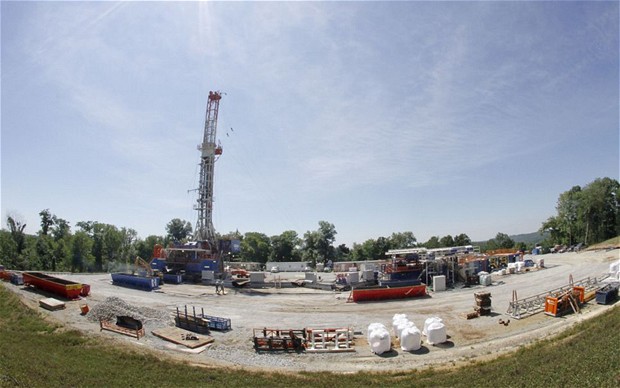 Yesterday, Environment Texas released a new compilation report in Dallas, titled, "The Costs of Fracking." There's not a lot of new information, but it does serve as a convenient catalog of the disadvantages of inviting the gas industry to town, as the Dallas City Council is considering via a new gas drilling ordinance. Every city council member should take a look, although we doubt they will.
The report covers the impact of fracking on public health, water, air, as well as the infrastructure demands of the gas industry. Among the tidbits:
"The truck traffic needed to deliver water to a single fracking well causes as much damage to local roads as nearly 3.5 million car trips. The state of Texas has approved $40 million in funding for road repairs in the Barnett Shale region, while Pennsylvania estimated in 2010 that $265 million would be needed to repair damaged roads in the Marcellus Shale region."
Fracking can affect the value of nearby homes. A 2010 study in Texas concluded that houses valued at more than $250,000 and within 1,000 feet of a well site saw their values decrease by 3 to 14 percent.
The average public health costs of air pollution from fracking operations in Texas’ Barnett Shale region reach $270,000 per day during the summer smog season.
Here's the press release. Here's the report.
Imagine That: Local Regulation of Polluters
 From San Francisco comes word that the area's largest Mercury polluter, the local Lehigh-Heidelberg Cement plant, may be the subject of tougher LOCAL air pollution regulations.
In 2011, the kiln spewed 260 pounds of Mercury into the local airshed and new regulations being proposed for the plant by the Bay Area Air Quality Management District would address not only this pollution, but emissions of dust, ammonia, dioxins, smog pollutants, and hydrocarbons.
In part, the new local rules are being spurred by EPA's own updating (and delaying) of its own air pollution rules for the nation's cement kilns. In part, local pressure from the public is driving their consideration. Bay Area for a Clean Environment collected over 1800 signatures demanding the new more stringent rules.
In California regional air boards are the prime shapers of air quality planning and policy, tailoring measures to their own geographical boundaries and problem areas. Imagine the 10-county DFW non-attainment area for smog (Collin, Dallas, Denton, Ellis, Johnson, Kaufman, Tarrant, Parker, Rockwall, Wise,) having its own air quality agency with the power to enforce new anti-pollution measures without having to get Governor Rick Perry's permission. Local control also means more opportunity for local citizens to have input rather than being blown off by ideologues in Austin intent on scoring political points rather than cleaning the air.
As we've noted before, if DFW officials really want cleaner air, they're going to have to get it themselves.
2011 was the Worst Year for Smog since 2006 in DFW. 2012 Is One Bad Air Day Away Matching It.
 Last year's air quality death spiral in DFW was sometimes explained away as an anomaly because of the severe drought the entire state was going through.
So what's the explanation this year?
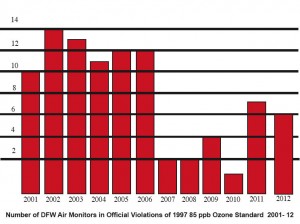
With yesterday's high ozone levels sending a 6th monitor into an exceedance of the old 1997 85 parts per billion smog standard, DFW is just one more bad air day away from matching last year's dreadful results. Today's ozone forecast says there should be no high levels of smog in DFW today, even as the temperature reaches for a record high. But then again, they weren't predicted Thursday either.
To give you some idea how rapidly things have gone downhill for air quality in DFW the past two years, just look at the annual numbers. From 2007 to 2010, we had a total of nine monitors register official exceedances of the 85 ppb standard. That's about two monitors a year average. This turns out to be the closest we've ever come to actually meeting the standard. Officials could argue with some justification that air quality was slowly getting better.
On the other hand, during the last two years, we've had 13 monitors record exceedances of the 85 ppb standard, an average of 6.5 a year, and 2012's ozone season is not yet over. You could add up all the exceedances from the four years between 2007 and 2010 and still not equal the number we've experienced in just the last 24 months.
This is not progress.
TCEQ and the gas industry have argued for some time that gas mining couldn't possibly be contributing to smog problems since smog levels were going down as drilling was increasing in DFW. But that's not true anymore. As gas drilling has moved further and further east – into the heart of the non-attainment area, we've seen in increase in ozone concentrations, in exceedances in monitors, and monitors in the eastern part of the Metromess exceeding the standard that hadn't done so in five to seven years.
Meanwhile all other major source categories for air pollution have been decreasing their emissions. Cars, power plants and cement kilns are actually releasing less air pollution now than they were ten or 20 years ago. Only one large specific source category has increased its annual tonnage significantly over that same time – oil and gas.
Is it just a coincidence that smog is getting worse as oil and gas pollution skyrocket – not only in the Barnett Shale that surrounds DFW on three sides, but by all the new oil and gas sources now southeast of Dallas as part of the Haynesville Shale play that are blowing their pollution toward us most of the ozone season? There are now so many gas compressors in Freestone County, less than 75 miles away from the Dallas County line, that their emissions represent the equivalent of over 4 new Big Brown coal plants. What do you think the impact on air quality would be of four large new coal plants located immediately upwind of DFW? Might it look a lot like it does in 2012?
Could it be that the dirty mining of "clean" natural gas is making it impossible for DFW to meet the old 85 ozone standard, much less the new 75 ppb one? That the Devil's Bargain so many former and current elected officials made with the gas operators to grab the cash and run is now coming back to bite them and us in the air quality butt? That was certainly the conclusion of the study we publicized this last Tuesday from the Houston Advanced Research Center:
"Major metropolitan areas in or near shale formations will be hard pressed to demonstrate future attainment of the federal ozone standard, unless significant controls are placed on emissions from increased oil and gas exploration and production….urban drilling and the associated growth in industry emissions may be sufficient to keep the area (DFW) in nonattainment."
It's time for local officials to replace those cash registers in their eyes with gas masks. Because of their rush to make money, they didn't pause to understand how so much new industrial activity could produce smog just like the bad ol' days. They were being paid not to understand. And now 5 to 6 million people who still can't yet breathe safe and legal air are paying the price.
Another Chapter of Cement Kilns As Garbage Incinerators
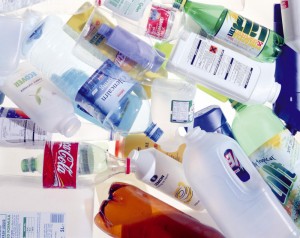 One of the reasons it's so disheartening to have EPA rollback the deadline for new cement plant air toxics standards and gut the PM pollution provision of those standards is because of the large and fundamental shift in what's being burned is taking place within the industry. Downwinders across the country need the protection of these new rules as soon as possible, as everything, including the kitchen sink, is being thrown into kilns.
There's a determined effort underway nationwide for cement plants to secure new permits or permit "amendments" or "modifications" to burn increasing amounts of municipal and industrial garbage, including lots and lots of plastics. With new regulation of hazardous waste burning in the US taking some of the fun and profit away from that practice, the trend is now headed toward burning all kinds of "solid waste" including hard to recycle bits of municipal and industrial garbage like plastics and car "fluff" – all the non-steel parts of a car or truck, including dashboard, electronics, interiors, brake linings, etc.
Locally, TXI's 2011 permit amendment – given without public notice or opportunity for comment – is the worst example of this national trend, although Holcim and Ash Grove are also burning tires, used oils, and other kinds of industrial waste already.
Now word comes of the CEMEX plant in Louisville also making plans to burn plastics and other kinds of garbage, but
"…industrial pollution has been an issue in southwest Louisville for decades. The plant is near the coal-fired Mill Creek power plant, and residents have long complained about dust and soot from both.
Denise Allgood, vice chairwoman of the Valley Village Homeowners Association, said she was not familiar with the proposal and said any change involving air pollution is likely to be sensitive.
The (pollution) that’s coming out of that place now is of great concern,” she said. “We’ve been told by the powers that be that’s it’s better than it has ever been, but I would hope that whatever (CEMEX) is considering, they are also considering the health and welfare of the people in this area.”
What could make the problem wortse? Burning plastics that release exotic new chemicals that can hitch a ride on all that old soot and dust. We're entering a whole new era of contamination by incineration once plastics-burning becomes widespread in the nation's cement kilns. That's a big reason why we need the added protection of the EPA rules.