Air Quality
TCEQ Can’t Handle the Truth Over DFW Air Plan Failure
 Here's further proof that Governor Perry has transformed the world's second-largest environmental agency into just another extension of his on-going political campaign.
After waiting for a couple of days for the Texas Commission on Environmental Quality to say something about the failure of its latest DFW clean air plan to reach a 1997 ozone standard by the end of this "ozone season," Downwinders put out a release on Monday criticizing the agency for leaving the air dirtier than when the plan was begun in 2010.
To succeed, the TCEQ plan had to bring smog numbers down at all DFW monitors to 84 parts per billion or below by the end of this last summer, using three-year rolling averages incorporating readings from 2011 and 2010. The agency blithely predicted it would do just that and even published computer-modeled estimates of what the averages would be at the end of 2012. According to TCEQ we were supposed to see record low ozone levels this summer. So low that there would be no violations of the 1997 ozone standard for the first time since it was implemented.
Although the official EPA regulatory deadline to judge the plan a success or failure is June 15th, 2013, it's fate has already been decided by the data collected the three previous summers. That's important to know. TCEQ doesn't get another summer to prove that it's brilliant plan to sit back and watch people buy cars will work somehow, someway. The Clean Air Act only allows them three years to get their act together per plan. The clock started ticking in 2010. It stopped ticking on November 1, 2012, at the traditional end of DFW's ozone season. That was the practical deadline. All that's left to do is type up the report to EPA and submit it come June 15th of next year. They've run of of time.
But unless you've gone through this process before, or had been following the plan closely, you wouldn't necessarily know this. That was the case with Andrew McLemore, a reporter for the Fort Worth Weekly, who'd been assigned to follow up on the Downwinders release and e-mail the TCEQ for a response.
 What TCEQ spokesperson Lisa Wheeler said to McLemore was that of course the agency never claimed to be able to meet the goal by 2012. We said we'd do it by June of 2013 – the regulatory deadline. Ohhhhh.
This is a great answer for a term paper that's late, but not so much when there's no more summers between now and June of next year to use in your clean air plan. Ozone data for November to June isn't going to do you any good because (unless global warming really accelerates) that's not the time of year we see high ozone numbers. And the plan has to use the highest of the high numbers. Telling McLemore that everyone had to wait until June to know the final results of the DFW air plan was like telling him to wait for the cake to cool for eight months after its' already been taken out of the oven. The thing is done. It's not getting any bigger, or sweeter-tasting, or rounder. It's not changing character or content. It is what it is right now.
TCEQ knows this. Lisa Wheeler knows that there will be no new numbers to add or subtract from that will make any difference. There will be no 2013 average that they can use to change the results from what they are at this moment. It's all already been determined by this summer's miserable showing, and the miserable showing before that in 2011. That's what makes this answer of theirs so incredibly cynical.
Wheeler apparently wanted to confuse McLemore, in essence saying, "Gee we really didn't fail yet – you have to wait until next June to conclude that. We still have time to change the outcome! " But because the data won't change, the results won't change either.
Don't take our word for it. TCEQ has a whole web page devoted to chronicling the proof that the DFW air plan has already failed – http://www.tceq.state.tx.us/cgi-bin/compliance/monops/8hr_attainment.pl
You'll notice this page, titled "Compliance with Eight-Hour Ozone Standard" has only three columns of data, one for 2010, one for 2011, and one for 2012. No column for 2013. You'll also notice that at the end of that three year cycle, there are two sites with running average that are at or above 85 ppb. The results are in. TCEQ's second clean air plan for DFW to reach the old 1997 standard in the last four years has failed. TCEQ just can't man-up and say so.
Not only has it failed. It's actually left DFW air dirtier than when it began. Here's why:
– Two monitors now have a three year running average (design value) of 85ppb or more. This is the same number as 2010, so no change at all on that front.
– The three year average for the region's highest reading actually went up 1 ppb from 2010 (86 ppb), to 2012 (87 ppb), with a spike of 90 ppb last year. Worse than 2010.
– Six monitors saw a violation of the 85 standard this summer by posting a 4th highest reading that was 85 ppb or above. Only one monitor did that in 2010. 2012 is five times worse than 2010 by this measuring stick.
– The location of those violating monitors is of concern because they moved further east from the northwestern corner of Tarrant County where they'd been "contained" – all the way into central Dallas, where the "Hinton St. monitor" near Mockingbird and I-35 recorded a 4th highest reading of 85 ppb or above for the first time since 2005. Also proof things have gotten worse, not better.
So the latest TCEQ DFW clean air plan achieved the following: More numerous and geographically-dispersed violations, with an increase in average levels of air pollution that takes it further away from the 84 it needs to achieve, instead of bringing it closer.
Heckava job.
To fully appreciate the agency's mendacity in its public approach to this failure, all you have to do is ask yourself how TCEQ would have reacted had it somehow achieved the miraculous decrease in air pollution its clean air plan promised. Go look at the front page of the TCEQ website. It has almost as many diatribes against the EPA as it does real environmental policy news, including opinion pieces written by TCEQ Commissioners. Do you think the agency would have waited until June 15th, 2013 to trumpet its success just because of a meaningless, bureaucratic deadline? Neither do we.
The TCEQ is never going to be a trustworthy source of information or expertise in the fight against DFW smog again while Governor Perry is in office. The sooner local officials wise-up and chart their own path, the better.
2nd TCEQ Clean Air Plan in Four Years Fails, Leaves Air Dirtier
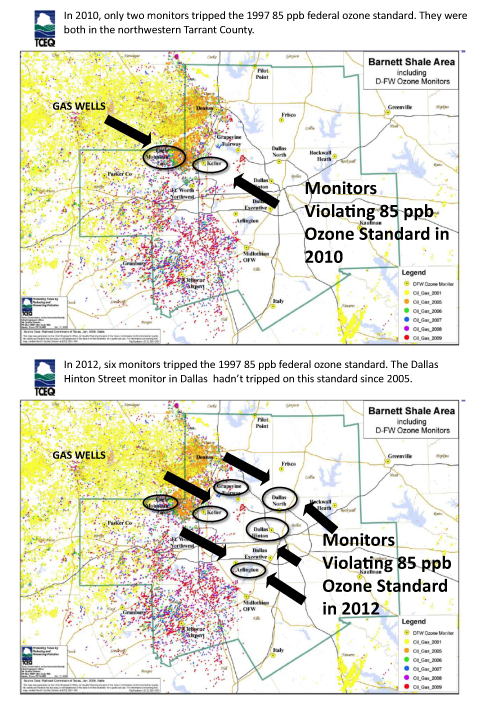 For the second time in four years a state-designed clean air plan to bring safe and legal air to DFW residents has failed, missing its goal by an even wider margin than on its first try, and leaving local air quality worse than when it started.
November 1st marked the official end of the eight-month 2012 ozone season. According to the Texas Commission on Environmental Quality, or TCEQ, its plan was supposed to deliver record-breaking clean air to DFW this summer on its way to bringing the region into compliance with the Clean Air Act for the first time in two decades.
Does Pollution Discriminate?
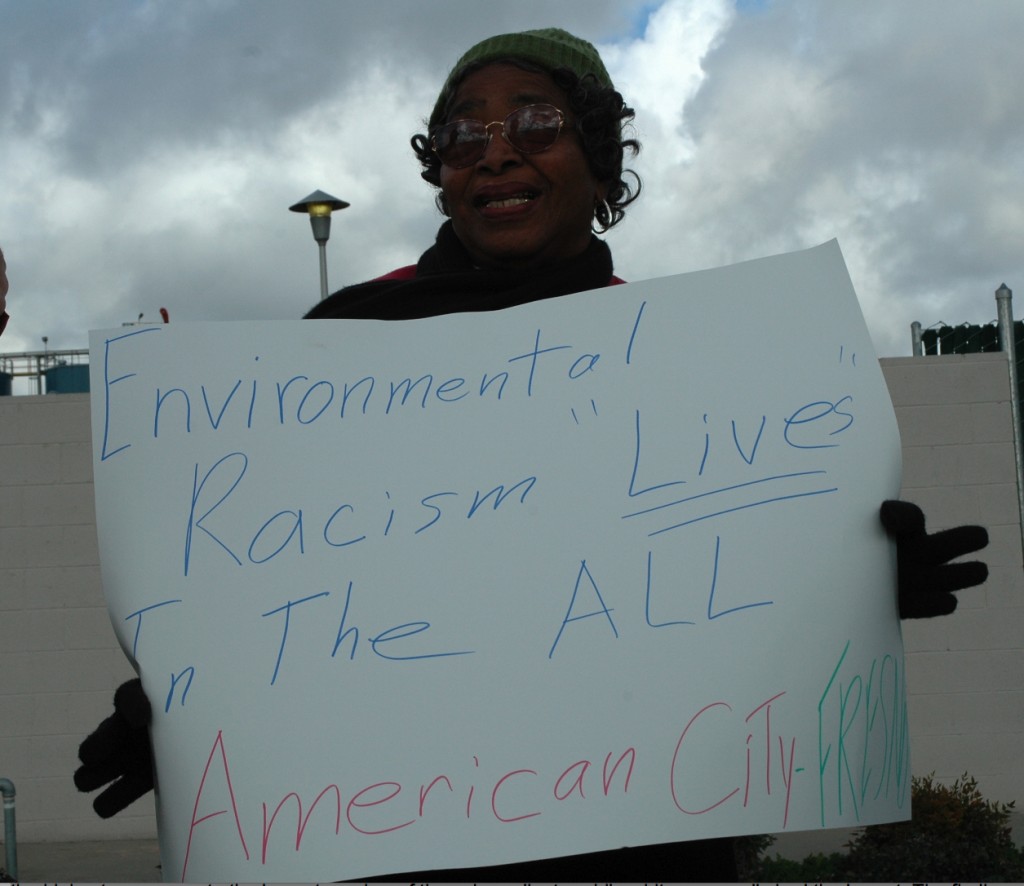 Yes. Or rather the forces that shape where pollution and people co-exist.
Historically we know that low-income and non-white urban areas are more likely to have polluting factories, Superfund Sites and illegal dumping. In large part, this is because the places within a city where "undesirable" heavy industries were allowed to locate were also traditionally also the only places where "undesirable" people, re: anybody that wasn't white or had a little money, were allowed to live. This is how you get massive segregated public housing complexes built across the street from huge lead smelters, as was the case in Dallas only a few decades ago. But maybe you thought that was all a thing of the past.
Today comes word of a new study out of Yale that confirms that people of color and the poor in the US suffer disproportionately from exposure to one of the most insidious kinds of pollutants – extremely tiny particles of poisonous soot called Particulate Matter 2.5 (that's soot that's 2.5 microns or less in size. A human hair is about 10 microns wide). Researchers looked at air monitoring and demographic data from five cities – Los Angeles, Pittsburgh, Cincinnati, St. Louis and Fresno. It is the first study to "reveal major racial and economic differences in exposures to specific particle ingredients, some of which are linked to asthma, cardiovascular problems and cancer." Not to mention strokes, and debilitating brain diseases like Parkinson's and Alzheimer's.
"Tiny particles of air pollution contain more hazardous ingredients in non-white and low-income communities than in affluent white ones, new research shows. The greater the concentration of Hispanics, Asians, African Americans or poor residents in an area, the more likely that potentially dangerous compounds such as vanadium, nitrates and zinc are in the mix of fine particles they breathe. Hispanics had the highest exposures to the largest number of these ingredients, while whites generally had the lowest. The findings of the Yale University study add to evidence of a widening racial and economic gap when it comes to air pollution. Communities of color and those with low education and high poverty and unemployment face potentially greater health risks even if their air quality meets federal health standards."
So how does that affect DFW? We need to let studies like this inform our decisions about city planning. In places that have a lot of pollution problems, it's probably a good idea not to keep adding more. Think of where the fracking in Dallas will be taking place – mostly in minority neighborhoods, along the floodplain, with other "undesirable" industries like landfills near-by. Think about the struggle over community control of the CF Hawn freeway re-do of Deadman's Curve in South Dallas where residents want fewer cars going slower instead of more cars going faster. Cars are a big source of PM pollution. Freeways are large conduits for PM pollution. In the last five years there's been a slew of studies showing more asthma and illness the closer you live to a major freeway. Guess which sub-populations get more freeways in their part of town?
There is an environmental equivalent of Affirmative Action that needs to be incorporated into city zoning and planning. One that considers the past historical inequities and current environmental body burden of affected neighborhoods. One that makes sure that society's "undesirables" do not keep getting piled on top of one another
Start the Weekend Off Right: “Don’t Frack My Fairway” Rig Protest Today
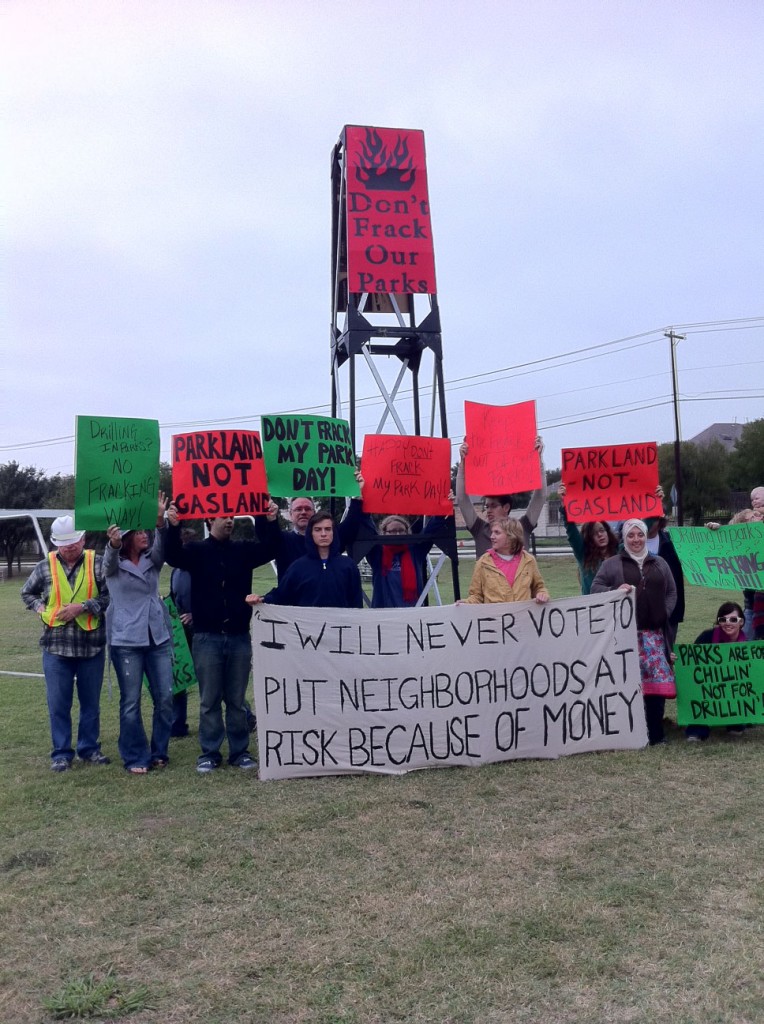 Looking for something to do this Friday late afternoon? Why not join concerned Dallas citizens for a fun little encounter with officialdom out at the newly made-over "Luna Vista" municipal golf course by North I-35.
Members of Dallas Residents at Risk – a coalition that includes Downwinders – will be showing up at the grand re-opening of what was formally known as the LB Houston Golf Course with their new 15-foot tall mock drilling rig in tow. They'll be trying to set it up next to the course clubhouse where ceremonies attracting City Councilmember Monica Alonzo, Dallas Park Board Vice President Gabriel Soto and Dallas Park and Recreation officials will be taking place.
The course is city parkland and at least three sites within the course have already been leased by the city to Trinity East for fracking – including one adjacent to the driving range.
After two years and a list of task force recommendations, the Dallas City Council is still wrestling with the problems created in 2006 when they took over $30 million from gas operators for leases on city-owned property. The decision was not publicized and there were no public hearings.
Despite not drilling on those sites in the intervening period, gas operators are continuing to seek permission to exploit them. Many of those leases are either in parkland like the Luna Vista sites, or in the Trinity River floodplain. City Council member Sheffie Kadane and others have endorsed park drilling, saying the land is underutilized.
Yes, it's going to be a little chilly. But we need to confront City Hall at every opportunity and this is a prime one. None of the city's press materials that feature beautiful pictures of the course mentions that those views will be marred by taller-than-15-foot drilling rigs. It's up to citizens to raise these issues.
When: 4:30 – 5:30 today/Friday Where: Luna Vista Golf Course Clubhouse, 11223 Luna Road, Dallas
Coming Soon: Be You Own Air Monitoring Station
 When the Fukushima nuclear power plant disaster struck Japan last year, there was a lot of gaps in information about radiation levels, and a lot of public distrust with official pronouncements about those levels.
As a way of getting around this, some entrepreneurs teamed up with software and hardware engineers and started building small portable Geiger counters that could be used by members of the public themselves. That's how the company Safecast was born. To date, the company's monitoring equipment has generated 4 million data points in Japan – reading that helped generate confidence about contamination levels.
After Fukushima, the company looked at other opportunities in the marketplace to fill a gap in consumer environmental health information. It decided that air quality reporting in the US and elsewhere suffered from a lot of the same problems as radiation reporting in Japan. The data is often licensed, unavailable, or just too slow to do much good. For example, the Texas Commission on Environmental Quality issues its "red" day ozone or smog alerts fully 2-3 hours after the first dangerous ozone readings are recorded at a local air monitor. You cannot get this information in real time – when it might do you and your children much more good.
Safecast plans to launch an effort that will more or less crowdsource air quality and fix that problem by giving real time, instantaneous information to users. It's a DIY approach to air pollution using the latest micro technology. The company hopes to create an international citizen-operated network of air quality monitors. It just received $400,000 from the Knight Foundation to work on prototypes and testing. All of the companies schematics will be available at no charge for easier distribution to citizens. Los Angeles is the first US city to get to use the new devices, but we'll be following their progress closely, hoping to bring this new grassroots effort to DFW, where we still suffer one of the nation's most serious and chronic smog problems.
EPA Interpretation of Soot Regs Under Fire
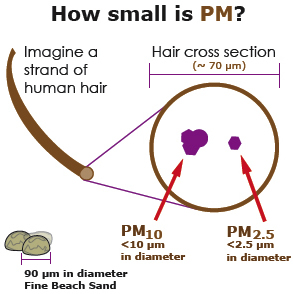 In an important challenge to the way EPA has gone about regulating the tiniest and most harmful forms of soot, or "Particulate Matter" pollution, attorneys for environmental groups seem to making some headway in the courts.
Currently, EPA is about to recommend new PM pollution rules that will reportedly lower the exposure standard for "PM 2.5" – that is, soot that's 2.5 MICRONS or less in size. A human hair is about 10 microns wide, so we're talking incredibly small particles that can easily find their way into your lungs, and then pass through directly into your blood stream.
However, when the Clean Air Act was amended in the early 1990's, the danger of PM pollution was confined to "PM 10" – particles 10 microns or less in size. So called "Coarse PM." But research over the last 20 years has pointed to the greatest danger to human health coming from the smallest kinds of PM pollution – the stuff that's 2.5 or smaller. It's been linked at very low levels of exposure not only to respiratory disease, but to heart attacks, strokes, and brain diseases similar to Parkinson's and Alzheimer's. In fact, the consensus among researchers now is that there is no level of exposure to PM 2.5 pollution that's not capable of doing some harm, that is, there is no "safe level" of exposure.
In another example of how regulations don't keep pace with science, EPA is still regulating PM 10 standards stricter than they are PM 2.5 standards, even though we now know that it's the smallest stuff that is more harmful. EPA is actually using another part of the Clean AIr Act to regualte PM 2.5 pollution than it uses to regulate PM 10 pollution. And the provision it uses for PM 2.5 allows states a lot more wiggle room than the tougher PM 10 provisions.
PM 10 pollution pouring out of a smokestack includes all PM 2. 5 pollution. But "PM 2.5 polluiton"excludes the larger coarser soot. Clear?
One of the three judges of the US Court of Appeals for the District of Columbia, David Tatel, had a hard time with the fact that EPA went outside it's own PM 10 rules to regulate a sub-set of more dangerous PM 10.
"I don't see why it makes much sense to separate out the fine particles," Tatel said. "I don't understand why the agency would do this.' Tatel indicated he did not believe the Clean Air Act required EPA to handle fine particulate matter differently than the coarser pollutants. References in the statute to PM 10 seemed to indicate Congress was referring to particulate matter in general, which would include PM 2.5, Tatel said."
This is exactly the argument EarthJustice lawyers were using. When the Clean Air Act says "fine particles" it means PM 10 and PM 2.5 – you can't regulate PM 10 without also regulating PM 2.5. But this is a law of physics that EPA is trying to undo. The Agency is actually arguing that Congress only meant to apply the standards to PM 10 pollution and no other "fine particles." It's also arguing that the challenge is a decade too late, since the original rules were passed in 1997. The judges didn't seem to be buying that defense either.
With brand new EPA regs for PM pollution expected to be announced shortly, one could reasonably assume this is mostly an academic exercise. but it's not. First, these old rules will still be in play for some time as the new ones are phased-in. It's important to get it right in the intervening period. These old regs affect PM emissions from cement kilns, boilers of all types, power plants and even cars and the public health impact of a stricter standard could be significant. Second, the interpretation EPA uses to establish the new rules could rest on whether the courts agree that it used the right provisions and language last time out.
We've been saying this a lot lately, but it's true. PM pollution is the most insidious, dangerous, and widespread form of air pollution in the world today. It is the ozone of the 21st Century in terms of how pervasive its effects are, and the size of the regulatory response to counter that harm.
Shocking Study: Air Pollution Regulations Improve Public Health
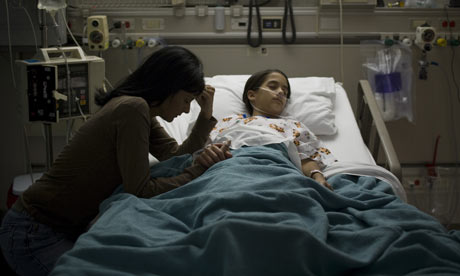 One of the most basic arguments of industry opponents of clean air regulations is that they really don't do that much to improve public health. Given all the studies concluding that increases in air pollution lead to increases in illness and death, this argument is every bit as plausible as denying global warming at this point. But that doesn't stop industry and their supporters in elected office quit trying.
Out of New York and via the Journal of Exposure Science and Environmental Epidemiology comes a three year study (2004-2006) that tracks decreases in ozone pollution to increases in public health, specifically fewer hospital admissions for respiratory problems. Overall, a decrease of about 9% in ozone pollution lead to an 11% decrease in hospitalizations. That's significant, bordering on one-to-one percentage point drop.
The study followed the progress of the EPA's NOx Budget Trading Program (BTP), a cap and trade system established for East Coat states to help them reduce their ozone, or smog pollution, that ran from 2004 to 2008, when it was replaced by the older, Bush-era version of the EPA's cross-stare pollution rules. It looked at all of New York in terms of eight regions throughout the state. Drops in smog averaged 9% but were substantially lower during the critical summer "ozone season."
According to the folks at the Environmental Health News:
"Regulations do work to lower pollution, which in turn can improve respiratory health.
Ozone levels decreased across the state of New York and hospital admissions for respiratory disease dipped in half of the regions studied after the EPA's regulatory program started. There were also notable decreases in hospital admissions for certain respiratory illnesses, most age groups and most health insurance groups.
The reduced admissions for those on public assistance suggests that low income residents may have benefited the most from air quality improvements. This would be an important achievement since this group often experiences the highest air pollution exposures.
These results are consistent with the limited number of other studies that compare pollution levels and health before and after required air pollution reductions."
It says more about the opposition to new regulations that we still have to have studies proving that less crap in the air means less illness and death. This has been a settled scientific fact for some time. But Industry pays big money for it to be a still-disputed political fact.
“You got your fracking fluid in my cement!” Kiln Disposal of Drilling Wastes.
 It was inevitable. Like chocolate and peanut butter. Like rats and the plague.
Two notoriously polluting industries find solace in each other's ability to scratch each other's dirty, irritating itches.
Cement plants are always looking for ways to get paid to burn other people's garbage. It takes a lot of energy to fire a 20-foot flame at 2000 degrees 24/7 in order to cook rock. It also takes a lot of "additives". That's why cement plants started burning other companies' hazardous wastes in the 70's and 80's. Because of a loophole in federal law, 50-year old cement plants with no modern pollution controls were allowed to charge for burning highly toxic wastes from refineries and chemical plants that were otherwise supposed to be going to fully-regulated hazardous waste disposal sites.
But those official sites cost more to use, and the cement plants cost so little. That's right, cement plants charged these polluters to dispose of their wastes, but not more than the incinerators or landfills with all the bells and whistles of "regulation." In this way, cement plant operators double dip – they don't have to shell out as much for fuel they'd have to buy, and they get paid a profit to be a Dispos-All for industry. And by the way, industry calls this "recycling."
Because of the persistence of Downwinders at Risk and other citizens' groups, this loophole has been slowly but surely closing, meaning less and less hazardous waste is being burned in US cement kilns. From a peak of almost 30 kilns burning toxics in the in the 1990's, we're now down to less than a dozen. But to take the place of this lucrative lost market, cement plants across the country are turning to "non-hazardous" waste to burn. Tires, but also municipal garbage, plastic wastes, used oils, shingles, car parts and other kinds of wastes. TXI's new permit allows the burning of a dozen different kinds of industrial wastes at its huge kiln in Midlothian.
While these wastes are classified as "non-hazardous," when they come in the front gate of a kiln, it turns out they can release a lot of toxic pollution when they're incinerated. Metals like lead and cadmium and arsenic that don't burn (consult your High School physics textbook) are present. So are PCB's that have Dioxin. But burning plastic or chlorinated wastes means you can generate Dioxins even without having them present in the wastes to begin with. There's also Mercury in some of the wastes from cars that TXI and other kilns wants to burn.
So you have the release of exactly the same kinds toxic pollution you were concerned about with the burning of officially-classified hazardous wastes. But now, it's taking place "legally," – or at least it is until the law hasn't catches-up with the consequences of this kind of low-rent disposal operation. Have a waste you want to get rid of? Send it to your local neighborhood cement plant. They'll burn anything.
Enter the Natural Gas industry. They've been getting a lot of bad PR lately about their own waste problems. They have billions of gallons of what they like to call "fracking fluid," and what the rest of us would call "hazardous wastes" that's so toxic it must be disposed of in a deep underground injection well after only being used once, isolated from the rest of the earth's environment forever. But because of some well-placed loopholes, this "fracking fluid" is not considered "official" hazardous waste under federal rules. It will just unofficially injure you with its toxins.
As it turns out, injecting billions of gallons of "non-hazardous" toxic liquid under extremely high pressure near deep underground faults is a sure way to generate earthquakes. And that's what's been happening. Not only in North Texas, but other places where there are lots of injection wells. There was another small one last night in Midlothian, right down the highway from a large deep injection well near Venus. Along with the fact that most fracking fluid cannot be or is not "recycled" now and can only be used once before disposal, the fracking fluid generated by the gas industry has turned into an embarrassing sore point.
If only there was some other way the gas industry could dispose of their drilling wastes. If only they could appear to be more environmentally-friendly and save money at the same time……
And there you have the genesis of a happy marriage made in polluter heaven. I have a facility that needs stuff to burn and mix, and I'm not that particular about what the stuff has in it. You have lots of stuff that needs to be burned, er, "recycled" and you spend less when you send it to a facility like mine not specifically built to do that job. Everybody wins!
"The use of drilling wastes and muds is most preferable in cement kilns, as a cement kiln can be an attractive, less expensive alternative to a rotary kiln. In cement kilns, drilling wastes with oily components can be used in a fuel-blending program to substitute for fuel that would otherwise be needed to fire the kiln.
Cement kiln temperatures (1,400 to 1,500 degrees C) and residence times are sufficient to achieve thermal destruction of organics. Cement kilns may also have pollution control devices to minimize emissions. The ash resulting from waste combustion becomes incorporated into the cement matrix, providing aluminum, silica, clay, and other minerals typically added in the cement raw material feed stream.
Recent studies have shown that it is feasible to use such drilling waste as substitute fuel in a cement plant. The drilling mud can be processed by a centrifuge to separate remaining water, compressed by a screw into a solid pump and conveyed.
The cement companies can contribute to sustainability also by improving their own internal practices such as improving energy efficiency and implementing recycling programs. Businesses can show commitments to sustainability through voluntary adopting the concepts of social and environmental responsibilities, implementing cleaner production practices, and accepting extended responsibilities for their products."
For veterans of The Cement Wars of the 1990's this rhetoric is certainly recycled. Cement Plants are Long, Hot and Good for America! Cement plants are the best disposal devices ever. They just make everything go "poof." That's why they were built specifically to dispose of wastes of all kinds – oh wait. nope. They were built to make cement. But how great is it that they can make an entire sideline business out of dealing with, and spewing toxic chemicals into the environment?
Even though the specific article deals with the Middle East, is there any question that a cement plant in Texas or Pennsylvania, or Ohio won't try to make the case for accepting drilling wastes, if they haven't already? The permit modification TXI received to burn plastics and car wastes from the State of Texas required no public notice at all. Citizens only found out after the fact. There are only about a dozen players left in the international cement market. If they're discussing this in Egypt and Saudi Arabia, chances are they're talking about it in Zurich, Heidelberg, and Midlothian too.
Developments like this are why its important to tell the EPA it's making a big mistake to delay and change its cement plant toxic emission rules. The industry's "inputs" are changing rapidly. Two years is too long. We need the protection of those new rules now. If you haven't already clicked and sent EPA an e-mail saying you oppose this delay, the "official" comment period is over, but it couldn't hurt for the folks in DC to see your "unofficial" opposition.
It's also a lesson in why "everything is connected." Don't live near a gas well? If you live in DFW, chances are you live downwind of a kiln that could be burning the wastes of gas wells.
What Kevin Said
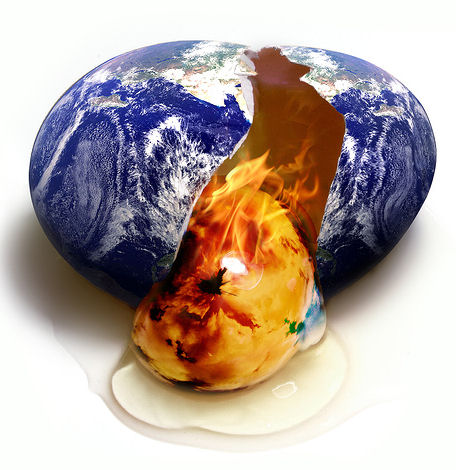 Kevin Drum talks about the politics of Climate Change, and why it never came up in last night's presidential debate.
GAO: Fracking is Overwhelming EPA, Has Many Unknown Risks
 GAO stands for Government Accountability Office. We bet you didn't think there was such a thing.
The GAO is in business to issue reports on how government works and doesn't work. It's the audit and investigative arm of the Congress. Today comes news that the Office has issued two new reports on fracking – one on how federal regulators are coping with the new responsibility of overseeing so much new drilling in so many new places all at once, and one on the possible risks posed by fracking to the public health and the environment.
GAO says fracking is overwhelming the resources of the federal agencies assigned to watchdog the process and industry:
"Federal and state agencies reported several challenges in regulating oil and gas development from unconventional reservoirs. EPA officials reported that conducting inspection and enforcement activities and having limited legal authorities are challenges. For example, conducting inspection and enforcement activities is challenging due to limited information, such as data on groundwater quality prior to drilling. EPA officials also said that the exclusion of exploration and production waste from hazardous waste regulations under RCRA significantly limits EPA’s role in regulating these wastes. In addition, BLM and state officials reported that hiring and retaining staff and educating the public are challenges. For example, officials from several states and BLM said that retaining employees is difficult because qualified staff are frequently offered more money for private sector positions within the oil and gas industry."
And the GAO says there are a lot of unknown risks to fracking based on the evidence so far:
Oil and gas development, whether conventional or shale oil and gas, pose inherent environmental and public health risks, but the extent of these risks associated with shale oil and gas development is unknown, in part, because the studies GAO reviewed do not generally take into account the potential long-term, cumulative effects. For example, according to a number of studies and publications GAO reviewed, shale oil and gas development poses risks to air quality, generally as the result of (1) engine exhaust from increased truck traffic, (2) emissions from diesel-powered pumps used to power equipment, (3) gas that is flared (burned) or vented (released directly into the atmosphere) for operational reasons, and (4) unintentional emissions of pollutants from faulty equipment or impoundments–temporary storage areas. Similarly, a number of studies and publications GAO reviewed indicate that shale oil and gas development poses risks to water quality from contamination of surface water and groundwater as a result of erosion from ground disturbances, spills and releases of chemicals and other fluids, or underground migration of gases and chemicals. For example, tanks storing toxic chemicals or hoses and pipes used to convey wastes to the tanks could leak, or impoundments containing wastes could overflow as a result of extensive rainfall. According to the New York Department of Environmental Conservation's 2011 Supplemental Generic Environmental Impact Statement, spilled, leaked, or released chemicals or wastes could flow to a surface water body or infiltrate the ground, reaching and contaminating subsurface soils and aquifers. In addition, shale oil and gas development poses a risk to land resources and wildlife habitat as a result of constructing, operating, and maintaining the infrastructure necessary to develop oil and gas; using toxic chemicals; and injecting fluids underground. However, the extent of these risks is unknown. Further, the extent and severity of environmental and public health risks identified in the studies and publications GAO reviewed may vary significantly across shale basins and also within basins because of location- and process-specific factors, including the location and rate of development; geological characteristics, such as permeability, thickness, and porosity of the formations; climatic conditions; business practices; and regulatory and enforcement activities."
So now we have the Director of the US Centers for Disease Control's Environmental Health agency saying that, "We do not have enough information to say with certainty whether shale gas drilling poses a threat to public health," along with the GAO saying the extent of the risks posed by fracking to our air, water, and land are largely unknown. How many more red flags do you need?