Smog
State Predicts DFW Will Fail New Smog Standard, But Air Quality Is Getting Better!
 By 2018 the Texas Commission on Environmental Quality predicts DFW will finally be in compliance with the federal ozone standard. The 1987 federal ozone standard. The 2012 ozone standard? Not so much.
That was the bottom line of last Tuesday's very defensive TCEQ staff presentation on the new effort to rein-in North Texas smog at the Council of Government's headquarters in Arlington, in what could be considered the kick-off meeting of yet another "State Implementation Plan," or SIP, for DFW. A plan drawn up by the state has to be submitted in place by June of 2015, with a goal of meeting the new 75 parts per billion ozone standard by the summer of 2018.
But even giving generous credit for the effect of new, lower sulfur gasoline standards, the TCEQ's computer model predicts the area will fall short of the 75 ppb goal at four very familiar monitor sites, with final estimates just a fraction above 75 ppb at Keller, readings of 76 ppb at Grapevine and Eagle Mountain Lake and as high as 77 ppb in Denton. To understand how optimistic even this result is however, you have to know that the Denton monitor is sitting at an average of 87 ppb as of this last summer. It took 10 years for that monitor to come down from an average of 97 ppb of ozone in 2003 to 87 ppb in 2013. With its new model, TCEQ is asking everyone to believe that ozone levels will come down another 10 ppb in less than five years.
As this excellent Denton Record Chronicle piece about the TCEQ effort points out, there's plenty of reasons to be skeptical. The agency has been wildly inaccurate in its past predictions. According to the last computer model the TCEQ ran, DFW was supposed to be enjoying record low ozone levels by now. It never happened, and in fact we're still in violation of the old 1987 standard of 85 ppb.
It's this lack of progress, particularly in the last thee years, that Downwinders and others cite when we're making the argument that more aggressive control measures are needed. In countering us, the state keeps insisting that – compared to 2003 – we're doing much better. And that's true -if you stretch things out over a decade we have gotten better. But compared to 2009 and 2010, we're doing the same or even worse. Look at the last three years of results and there's no way to conclude that DFW air quality is "getting better." It's just not true.
And all of this is really just a proxy for the fight over how much natural gas pollution is to blame for that stagnation. If there's no stagnation, there can be no cause of that stagnation. If there's a rollback in air quality, there must be a cause for the rollback. And many of us think that it just might be the pervasiveness of gas productions facilities within and surrounding DFW that are contributing factors.
Chris Kite, the TCEQ computer modeler that produced the new plan, used his presentation to mostly try to rebut specific quotes and arguments cited by Downwinders Director Jim Schermbeck about the lack of local air quality progress. It was a rare and raw indication of just how much TCEQ's Austin Headquarters considers Downwinders a threat. Too bad that even his own charts betrayed Mr. Kite's counter-thesis.
For instance, look at the numbers from 2008 to 2012 for average smog levels in DFW and see if you can cite the progress in this slide from the TCEQ PowerPoint:
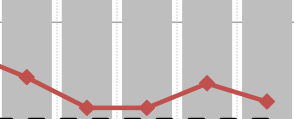
For the past two years, our average has been higher than the two years before that. That ain't progress. Especially if you look at the previous four years, 2006 to 2009:
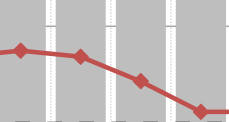
We're trying to think of what might have happened since 2008 to make it more difficult for the DFW region to attain a 1987 ozone standard at a time when emissions from just about every traditional source of smog pollution have been going down. Oh yeah, there was a huge natural gas field that opened up in the heart of the western part of the Metromess. But don't try telling the TCEQ that. They're convinced, absolutely convinced, that gas industry pollution couldn't possibly be responsible for any lack of progress in DFW air quality. Because hey, there hasn't been any lack of progress, and even if there wasn't, it wouldn't be due to the thousands of new gas sources. They're as sure of this as they are about their new computer model. Which is why the rest of us should keep an open mind.
TCEQ is hoping that coming close is good enough for EPA, that they can take advantage of something called "weight of evidence" that says that a clean air plan's parts are larger than its actual numerical sum and EPA reasonably expects the thing to succeed despite not all monitors hitting 74 ppb or below by 2018. In this way, Austin once again hopes to avoid any discussion about new control measures. But that's hanging your hat on a very precarious hook, given the agency's poor prognostication, and the EPA may demand a larger margin of safety.
In fact, an honest review of TCEQ's track record for past DFW clean air plans would necessarily place the "weight of evidence" in this new one on the agency itself to show that they'll get at least 10 ppb or more below the 75 standard just to make sure they come close to achieving compliance.
Can You Hear Me Now? EPA’s National “Listening Session” on New Coal Carbon Pollution Rules This Thursday
 Many of you have already seen the increasingly urgent pleas from the usual suspects for people to show up at this Thursday's national EPA "Listening Session" on new emission standards for Greenhouse Gas pollution. Try to ignore the New Age-by-way-of-George-Orwell alternative name for a public hearing, and the industry-friendly "listening" schedule of 10 am to 3 pm, and concentrate on the fact this is one of only a handful of such sessions taking place nationwide, and it's in Texas, our Texas.
Like it or not, public health-minded residents of DFW have the burden of showing up to national hearings like this just to prove we exist. Nobody expects there to be an viable environmental movement in the Belly of the Beast, especially outside Austin. However hard we work to change that image, it's still a popular one and in this case, it hits entirely too close to home. Because Texas is the world capitol for carbon pollution. We're Numero Uno, A Number 1. We're living in the barrel of the gun that's pointed right at the planet's head.
EPA recently reported that Texas released more GHG pollution in 2012 than the next two states – Indiana and Pennsylvania – combined. We're responsible for a full 12.5 % of the entire US annual total, almost 400 million metric tons of the stuff, ever year. Just take a look at the difference between us and the other 49.
Then use this handy-dandy EPA map of incredibly large sources of GHG pollution in the US. It allows you to zoom down to what's in each county of each state. Look at all the sources around DFW. Most are also large sources of other kinds of pollution. We're living in a sea of pollution created by these facilities.
So when EPA decides to schedule its one and only listening session in Texas on new rules to reduce this kind of pollution from some of the biggest sources in our own backyard, we need to show up because we're a disproportionate part of the problem.
We also need to be there because industry will be there, in force. The old TXU really wants to keep its obsolete, lignite-burning East and Central Texas coal plants running without any of these modern pollution control contraptions. Doesn't matter if they're aimed at Particulate Matter, or smog-forming pollution or GHGs, they just don't want them. You can bet they'll be bringing in folks from those coal plants to say what a terrible economic cost it would impose on the host communities and the company, and how it'll put the entire statewide grid in peril.
Someone has to be there to balance that testimony by pointing out that the economic, public health, and environmental impacts of this pollution reach far beyond Limestone County, Texas or even the US, and need to be considered on the agency's balance sheet as well.
Every yahoo with Americans for Prosperity, or other industry astroturf groups will be there because these kinds of national forums to bash Obama's energy policies are what they live for – and it's the only thin they do halfway competently. Likewise for the industry-aligned Freedom Works branch of the Tea Party.
And does someone want to start an office pool on how many Republican primary candidates will be appearing, trying to outflank each other on their Right? Expect to see and hear a lot about "Obama's War Against Coal" on Thursday. It's Texas.
Which is why even if you're not a fan of this Administration, you have to recognize that the first attempt to regulate greenhouse gases from coal plants should be encouraged, in Texas. It's a foot in the door to do more effective things, to start talking about GHG regulations in a serious way. It establishes a precedent. And that is what industry fears the most. You don't have to like the EPA to understand that the enemy of your enemy is your friend in this fight. And did we mention it's in Texas?
Finally, we just emerged from an ozone season that was mild by recent standards – but still harsh enough to keep us in violation of the old 1997 smog standard. We know the East and Central Texas power plants contribute to DFW's air quality problems. These new carbon regulations EPA is considering for existing power plants have the potential to reduce a variety of air pollution, not just GHGs. We know Austin and TCEQ are going to be of no help in addressing these sources in the next DFW clean air plan. If reductions are going to happen, they're going to have to be driven by the EPA, local governments, or the marketplace. We can't let this opportunity for meaningful reductions and better air pass us by. If for no other reason, you need to show up on Thursday and say you support the EPA's regulation of these facilities because you've given up on Texas doing so.
For lots of reason, it's in your own self interest to attend this thing, even if you real passion is gas field pollution, or smog, or cement plants or whatever. A victory in this category of regulation is a victory for all of us involved in clean air issues. And it's Texas.
National EPA "listening session" on carbon limits for existing coal plants
THIS Thursday, November 7, 10:00 a.m. to 3:00 p.m.
1st Floor Auditorium, J. Erik Jonsson Dallas Central Library, 1515 Young Street, Dallas, TX (map)
2013 DFW Smog Report: Failure….Again
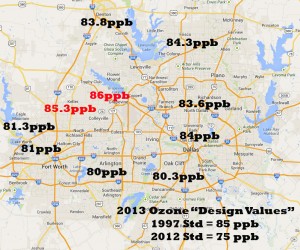 (Dallas)— On the eve of constructing yet another DFW clean air plan, the 2013 Ozone Season ended on Thursday the same way the previous 16 have ended: with North Texas out of compliance with the 1997 federal clean air standard.
Even a mild summer with lower temperatures and more rain couldn't save the numbers from exceeding an illegal three-year running average of 85 parts per billion at monitors in Keller and Grapevine.
According to Jim Schermbeck with the clean air group Downwinders at Risk, what makes this year’s violation particularly troublesome is that the 1997 standard has been replaced with a more protective one that's 10 ppb lower. “For the next DFW air plan to succeed, it will have to reduce smog to levels that no DFW monitors have ever recorded. I don’t know anyone outside of Austin who thinks the state is up to that task.”
That new plan has its official kick-off event next Tuesday, November 5th, beginning at 9am in Arlington at the Council of Governments Headquarters. It's the first briefing from the Texas Commission on Environmental Quality on the computer model it will be using to base the plan on. Everything about one of these plans is based on such a computer model, a model only the state can run. The plan must be submitted to EPA by June of 2015.
Even though extremely high ozone numbers were rarer this year, there were enough bad air days to cause the running averages of 10 out of 17 monitors, called "design values" to rise – not the kind of trend you want when you're next task is complying with a tougher standard.
Schermbeck was particularly concerned about a monitor near Mockingbird and I-35 in Central Dallas that’s seen its ozone average rise dramatically for three years in a row. “This is a monitor that had a "design value" of 67 parts per billion in 2010 – that is, it was in compliance with the new 75 ppb standard just three years ago. But now it’s up to 84 ppb and almost out of compliance with the 1997 standard. That's quite an increase in three years, and in a place where smog hasn’t been a problem for awhile.”
Every monitor inside the DFW metro area and even most "rural" monitors had a design value above the new standard of 75 ppb. Only Kaufman and Greenville made it under the wire, barely, with readings of 74 ppb.
As usual, the worst ozone levels were found in the northwest quadrant of the DFW area. This is a well-known historical pattern caused by the predominant southeast to northwest winds that blow pollution from the coast up through the coal and gas patches of East and Central Texas, over the Midlothian Industrial Complex and North Texas central urban cores into Northwest Tarrant Wise and Denton counties
This pattern has been the target of the last three state clean air plans, but has never been overcome. Schermbeck noted that last clean air plan to make a dent was the 2006 effort that produced lower numbers in steady fashion. Since 2008 however, air quality that was supposed to be getting better has gotten worse, or stagnated.
While cars have gotten cleaner during this time, and pollution from cement and coal plants has been reduced, there's one "source category" of pollution that's increased significantly since 2008: the gas industry.
In submitting the last DFW air plan to EPA in 2011, the Texas Commission on Environmental Quality estimated there were more tons of smog-forming Volatile Organic Compounds being released by the gas industry in the official DFW "non-attainment area" than by all the cars and trucks on the road combined. That wasn't true in 2008.
Moreover, this is new air pollution in a smog non-attainment area that doesn't have to be off-set by reductions in pollution elsewhere in DFW. Unlike every other large industry, the gas industry is exempt from this offset requirement of the Clean Air Act.
Denton's Airport monitor's 4th highest reading of 85 ppb this summer, the one that officially counts toward its running average, was the highest such reading in the entire state, including Houston.
There's no doubt Denton is in the middle of the local gas patch, as are the Keller and Grapevine monitors that had the highest design values this year. Given the decreases in pollution from other categories, are gas patch emissions keeping these numbers from coming down they way they were supposed to? Austin keeps saying no, but the evidence is compelling.
Just last year there was a study out of Houston showing how a single flare or compressor station could significantly impact local ozone levels by as much as 5 or 10 ppbs. TCEQ itself just produced a study this last summer showing how Eagle Ford Shale gas pollution is increasing ozone levels in San Antonio.
Local Barnett Shale gas pollution might explain these Tarrant and Denton county monitors' problems, but they don't explain the rise in numbers of the Dallas monitors, since the wind during ozone season comes in from the south to southeast.
What new pollution is coming from that direction? Gas industry pollution from numerous compressor stations and processing plants stations in Freestone, Anderson, Limestone and other counties just about 90 to 100 miles south-southeast of Dallas. If one adds up all the emissions these facilities are allowed under their "standard permits." it exceeds the pollution from coal plants like Big Brown. That's a huge hit from sources that weren't there 10 years ago.
In effect, DFW is getting squeezed between gas pollution being produced in the middle of its urban areas, and gas pollution blowing in from the south.
“Officials with Rick Perry's TCEQ would rather drink lye than admit gas pollution is causing smog problems for DFW” says Schermbeck, “but such an admission might be the only way to bring DFW into compliance with the Clean Air Act.”
“This is why local DFW municipal and county governments serious about air quality must divorce themselves from Austin's politicized science and begin to seek their own solutions. Austin really isn't interested in solving DFWs chronic smog problems. Heck, the Commissioners who run TCEQ don't even believe smog IS a health problem.”
Downwinders Had A Good Day in Court Battling EPA Over Cement Plant Rules
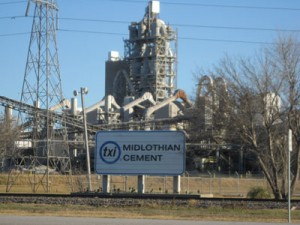 Downwinders has been trying to get new emission limits for cement plants since the mid-1990's. We're still trying.
The first real reform in those rules during the Clinton Administration were pathetically inadequate. Downwinders and other groups assisted by DC-based Earth Justice sued to get them strengthened. We won. When new rules finally emerged from EPA in 2009, they were much better. Many of you came out to the historic national hearing at the DFW Airport hotel to testify in favor of them.
These rules were on their way to being signed by President Obama when they got hijacked by industry at their stop at the Office of Management and Budget, which must review all new regulations. When they emerged, they were unrecognizable in many ways, with deadlines pushed back by years and the important Particulate Matter standard being significantly weakened.
Once again, we're back in court trying to get these watered down rules thrown out. Last week, the DC appeals court that usually takes up federal regulatory fights heard oral arguments from both sides, and even the Republican judges on the panel were skeptical of the Administration's rewrite job.
Reprinted in full below is an inside-the-Beltway account of the proceedings that gives you some idea of what's at stake and what a good day citizens and their representatives enjoyed in court. No date on when to expect a ruling. Even then, if we win, the rules go back to EPA to be rewritten again, albeit with more judicial constraint…theoretically at least.
Judges seem skeptical of EPA claims in cement emissions case
Jeremy P. Jacobs, E&E reporter
Published: Thursday, October 24, 2013
Public health advocates argued in court today that U.S. EPA unlawfully weakened and delayed air standards for cement manufacturers, appearing to gain some traction with a panel of federal appellate judges.
The Natural Resources Defense Council contends EPA caved to industry pressure when it revised its National Emission Standards for Hazardous Air Pollutants, or NESHAP, for portland cement kilns and pushed back its compliance date by two years.
EPA's standards apply to several pollutants, including particulate matter, mercury and other acid gases. The agency revised the particulate matter standard after a court ruling in 2011, but advocates claim the agency did more than the ruling required.
James Pew of Earthjustice, representing the NRDC, told the U.S. Court of Appeals for the District of Columbia Circuit that EPA "gratuitously weakened the particulate matter standard" and violated the "plain and literal meaning" of the Clean Air Act.
Further, he said, many of the issues EPA addressed with its changes "didn't come up" in the previous case.
The cement NESHAP has long been the subject of controversy and litigation.
The kilns are one of the top sources of man-made mercury emissions in the United States. Public health advocates forced EPA to set the standards in a 2010 lawsuit, and when the agency issued the standards later that year it said they would prevent 960 to 2,500 deaths per year.
Industry, however, quickly challenged the standards at the D.C. Circuit. In December 2011, the court ordered EPA to reconsider the standards by taking commercial incinerators that burn solid waste out of its calculations. However, the court largely left the standards in place, including their 2013 compliance deadline (E&ENews PM, Dec. 9, 2011).
When EPA recalculated the standard for particulate matter, the advocates claim the agency made it less stringent. Additionally, EPA reached a settlement with the portland cement industry to delay compliance to September 2015 for all pollutants — not just particulate matter (Greenwire, Dec. 7, 2012).
Public health advocates challenged both actions, as well as a shift from continuous monitoring to one-time annual stack testing for compliance — which also changed the particulate matter standard. The environmentalists also question the standard's inclusion of an "affirmative defense" that protects kilns from citizen lawsuits if they violate the standards during an unavoidable malfunction.
Each issue came up today before a three-judge panel, which included two judges who are considered potential future Supreme Court nominees. The panel appeared receptive to some of the advocates' arguments but not to others.
For example, Judge Brett Kavanaugh, one of the country's leading conservative jurists, appeared skeptical of EPA's decision to delay standards for mercury and other gases to 2015, even though the Clean Air Act says standards must take effect within three years. The 2010 standards for those pollutants, which weren't affected by the D.C. Circuit ruling in 2011, should be in effect now.
"I don't understand," said Kavanaugh, a Republican appointee. "I need help. I don't understand the interrelatedness."
Further, Senior Judge Harry Edwards, a Democratic appointee, said EPA could have easily linked the standards by saying it wasn't "practicable" to meet some without meeting the others. But EPA, Edwards said, never made that argument in the rulemaking.
"I'm really not following this," Edwards said. "Where does the agency make the finding … that compliance couldn't be done practicably?"
Matthew Oakes of the Department of Justice, representing EPA, countered that all the standards are related because the pollution control technology required to limit particulate matter also controls emissions of mercury and other gases. Therefore, it didn't make sense to require kilns to install technology for mercury, for example, before it knew the final particulate matter standard, he said.
That argument was echoed by Carter Phillips of Sidley Austin LLP, representing the cement industry, which intervened in the case.
"You cannot implement any of them in a one-off system," he said.
It was unclear which way the judges were leaning with regard to the advocates' arguments surrounding the particulate matter standard itself. But they appeared receptive to their challenge to EPA's affirmative defense.
Oakes argued that the advocates lacked standing to challenge the affirmative defense, meaning they had failed to prove how they would be injured by it. That notion was flatly rejected by the panel, which said the defense would allow kilns to, at times, exceed the standards, which would harm human health. Therefore, the advocates have grounds to bring the lawsuit, the judges said.
The panel was also skeptical of EPA's arguments on the substantive issue of whether EPA could create the affirmative defense in the first place. Judge Srikanth Srinivasan, President Obama's first appointee to the D.C. Circuit and a leading liberal judge, contended that the Clean Air Act didn't grant EPA that ability.
"This authority wasn't delegated to the EPA to begin with," he said.
Study: Low Levels Of Incinerator Pollution Linked to Premature Births
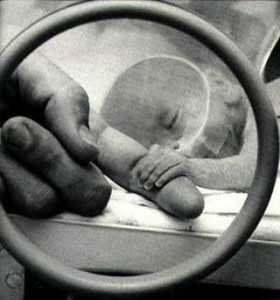 A new study being published in the November issue of Epidemiology concludes that even low levels of pollution from solid waste incinerators causes an increase in premature births downwind.
Italian researchers examined over 21,000 births to women living within four kilometers of one of eight solid waste incinerators operating in the Emilia-Romagna region.
"Each newborn was georeferenced and characterized by a specific level of exposure to incinerator emissions, categorized in quintiles of PM10, and other sources of pollution (NOx quartiles), evaluated by means of ADMS-Urban system dispersion models. We ran logistic regression models for each outcome, adjusting for exposure to other pollution sources and maternal covariates.
Preterm delivery increased with increasing exposure….A similar trend was observed for very preterm babies. Several sensitivity analyses did not alter these results. Maternal exposure to incinerator emissions, even at very low levels, was associated with preterm delivery"
Now, you can reassure yourself that we have no single-purpose solid waste incinerators around these parts the way they do on he East Coast or Midwest, so we don't have to worry about this kind of threat. But that's not entirely accurate.
We do have solid waste incinerators in North Texas, they're just called cement kilns. And we have more incinerator capacity than anyone else in the country when it comes to cement kilns.
And, as it turns out, these cement kilns are expanding their lists of available "fuel" to include solid wastes, as well as coal – medical, municipal, and "hard to burn" plastics, as well as car parts, shingles and carpet remains. It's all part of the new wonderful world of commercial garbage burning. If the kilns happen to make some money in the process of turning themselves into under-regulated incinerators, well, all the better for their operators.
For example, and try not to throw up, in the Philippines, the local cement plant is marketing the burning of "Holcimables." What are "Holcimables" you ask? They're "plastics – styrofoam, sando bags, cellophanes and foil packs – textile and rubber." Yes, the same company that operates a cement kiln in North Texas is burning styrofoam in the name of environmental-friendliness in the Philippines. You can bet the Italian incinerators included in this new study were burning some of the same kinds of wastes with the same ingredients.
Burning stuff is bad, whether it's in an incinerator or a cement kiln. And industry is making it very hard to tell the difference.
Study Reveals Cancer Hot Spots Downwind of Canadian Oil and Gas Processing Centers
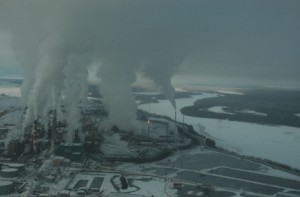 On the heels of the World Health Organization declaring air pollution a carcinogen, a study published this week from the University of California-Irvine and University of Michigan found higher levels of specific carcinogens in communities downwind of Canadian "oil, gas and tar sands processing zones", and higher rates of Luekemia and non-Hodgkin’s lymphoma among men living in those downwind communities.
Despite their rural location, the recorded levels of the carcinogens, including 1,3-butadiene and benzene, were higher than in some of the world's most polluted cities. Examining area health records that went back a decade showed the number of men with leukemia and non-Hodgkin’s lymphoma was greater in the communities closest to the pollution plumes.
The authors strongly recommended that the industrial emissions be decreased to protect both workers and nearby residents.
“Our study was designed to test what kinds of concentrations could be encountered on the ground during a random visit downwind of various facilities. We’re seeing elevated levels of carcinogens and other gases in the same area where we’re seeing excess cancers known to be caused by these chemicals,” said UC Irvine chemist Isobel Simpson, lead author of the paper in Atmospheric Environment. “Our main point is that it would be good to proactively lower these emissions of known carcinogens. You can study it and study it, but at some point you just have to say, ‘Let’s reduce it.’
Co-author Stuart Batterman, a University of Michigan professor of environmental health sciences, agreed: “These levels, found over a broad area, are clearly associated with industrial emissions. They also are evidence of major regulatory gaps in monitoring and controlling such emissions and in public health surveillance.”
Dr. Batterman is familiar to Downwinders old timers as being the first scientist to take on the state's laughable "Health Risk Assessment" of TXI's burning of hazardous waste at it Midlothian cement plant. In what became known simply as the "Batterman Report," his mid-1990's critique of the official document was devastating in its scope and depth. It became a template on how to deconstruct any TCEQ attempt to gloss over the dangers of living downwind of a large polluter.
In this new study, Dr. Batterman and his colleagues monitored emissions in the rural Fort Saskatchewan area downwind of major refineries, chemical manufacturers and tar sands processors owned by BP, Dow, Shell and other companies in the so-called “Industrial Heartland” of Alberta. Taking random one-minute samples in 2008, 2010 and 2012, the results were very similar over time – amounts of some of the most dangerous Volatile Organic Compounds were 6,000 times higher than normal. Higher than in Mexico City during the 1990s or in the still polluted Houston-Galveston area.
Simpson said the findings were important for other residential areas downwind of refineries and chemical manufacturers, including parts of Los Angeles.
“For any community downwind of heavy industrial activity, I would say it’s certainly prudent to conduct surveys of both air quality – especially carcinogens – and human health."
Cement Plants and Gas Plays Affecting Ozone Levels In….San Antonio?
 For decades DFW was the only major urban area in Texas to have its air quality challenged by the cement industry. Repeated modeling over the course of the last several local air plans showed that the concentration of the plumes from three huge cement plants in Midlothian could increase downwind ozone levels significantly. Part of this is the voluminous emissions produced by the kilns and part of it's location, location, location – the close proximity of these cement plants to the center of DFW. So much so that you can see their smokestacks from I-20 in Grand Prairie and Arlington.
Then beginning in 2006 or so, the area's air shed began to be reshaped by the presence of gas production facilities as the Barnett Shale was opened up to exploitation from fracking, a process freshly exempted from just about every federal environmental regulation with passage of the 2005 Energy Act. But unlike large "stationary sources" like cement plants, these gas facilities were spread out over a large area, right in the middle of the Metromess, and were except from the "off-set" requirements of other large polluters. Even though their collective emissions were as large or larger than any other single industrial source, their decentralization allowed their operators to release their tons of pollution into the air without ever having to consider its impact on local smog levels.
That one-two punch of local industrial pollution flies in the face of the office park business image of DFW. Houston has traditionally been the city where industry has made it harder to breathe. In North Texas, it's supposed to be all about cars and trucks. But those cars and trucks lay a mostly uniform blanket of ozone over the entire area, whereas the gas production facilities and the cement plants are concentrated fire hoses of smog-forming pollution that can impact specific monitors over and over again.
And all of this has taken place during a time when the official federal ozone standard has been a relatively high 85 parts per billion. Beginning in 2015, the standard becomes 75 ppb, and it might drop to 65-70 by 2020.
Texas cities like Austin and San Antonio have had little problem complying with the higher standard, but now face obstacles to coming in under the wire of a 75 ppb rule.
For one thing, the only other large concentration of cement plants in Texas besides Midlothian is located along the I-35 corridor from Buda, south of Austin to North San Antonio. Because prevailing winds have often carried the pollution from these plants away from central Austin or San Antonio, they haven't been seen as much of a threat. But now urbanization is increasingly creeping westward into the downwind path of these plumes, adding some heft to the emissions and combining with them to elevate ozone levels.
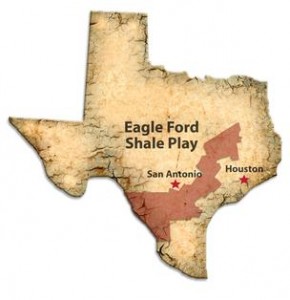
And then there's the Eagle Ford Shale gas play, the new Wild West of fracking in Texas, taking place directly upwind of central San Antonio. Unlike the urban drilling in the Barnett Shale, most of the activity in the Eagle Ford is taking place in unincorporated parts of South Texas counties. There haven't been any reliable emissions inventory of the pollution coming out of he Eagle Ford, but it's considerable. Anecdotally, there seems to be a lot of flaring that DFW never saw. Because of the amount of production taking place, as well as its location upwind during the summer "Ozone Season," Central Texas is starting to sweat about its impact on its own air quality.
That concern has prompted a regional modeling exercise which is supposed to determine how much, if any, impact the drilling in the Eagle Ford is having on the Alamo City's air. Back in July, we reported that the preliminary numbers of this study showed that gas production was capable raising local ozone levels by as much as 3 to 7 parts per billion by 2018 – exactly when all Texas cities must be in compliance with the new 75 ppb standard.
Maybe 3-7 ppb doesn't seem like much. And it isn't, unless you're already at or above the new 75 ppb standard and that amount will put and keep you over that red line. Like San Antonio in 2013. The July headline in the San Antonio paper was unambiguous: "Eagle Ford drilling is polluting San Antonio's air"
But it looks like someone at the San Antonio Council of Governments is taking a page from DFW and TCEQ officials and downplaying those preliminary numbers from last summer.
Previous studies show that emissions of ozone-forming chemicals from sources other than drilling have dropped significantly since 2007 despite the city's population growth, said Steven Smeltzer, AACOG's environmental manager. Smeltzer attributes the improvement to new vehicle standards and voluntary reductions by local industries.
Preliminary numbers from the AACOG study also indicate that much of the problem lies in the Eagle Ford. InsideClimate News obtained a copy of the data, which have not been made public. The data show that during the months when San Antonio experiences the highest ozone levels—April through October—oil and gas development produced about half the amount of ozone-forming emissions per day as all other industrial sources combined.
Bella said the data came from an early version of the study that wasn't as thorough as later drafts. "My sense is they're really not worth using…They're not solid numbers."
He declined to comment on whether the numbers are close to the latest estimates. What matters isn't the number, he said, but the process behind the study. If the science isn't right, then it's "garbage in, garbage out."
Yeah, we know. Believe it or not, citizens had to literally force the TCEQ to consider the effect of the pollution from Midlothian cement plants before they discovered, wow, they really do have an impact. Likewise, it took Dr. Al Armendariz's 2009 study of Barnett Shale pollution for the state to even consider local gas sources might be a contributing factor to the DFW smog problem – although TCEQ officials are still doing their best to deny it. The largest purveyor of junk science in Texas is the Texas Commission on Environmental Quality. Remember that in 2012, TCEQ's computer model told us to expect the lowest level of smog ever recorded in DFW. Instead we got the highest levels recorded since 2008 or so. So yeah, GIGO.
That's why it's disappointing to see the Council of Government official try to use the same strategy with this new study – whose final edits will be made by TCEQ, not an independent entity. Just like with TCEQ's Wednesday's ruling against 7000 Dallas County doctors that said there's no link between smog and public health, Rick Perry's agency can't afford to admit the state's gas plays are making the state's air illegal and unsafe.
Like San Antonio, almost every other category of pollution in DFW has decreased over the last 6 years – except gas industry pollution. It's the one category of emissions that's grown and grown and grown – to the point where the state itself admitted that the industry was releasing more smog-forming Volatile Organic Compounds than all the trucks and cars on the road in North Texas. As DFW continues to linger in violation of an almost 20-year old obsolete ozone standard, it's the gas industry that is the logical culprit for the backsliding. It's the one variable that's going the opposite direction as all the others. But despite the overwhelming evidence to the contary TCEQ is busy defending the Shale from any charges that it has the least bit of impact on area smog, even to the point of ignoring basic air modeling chemistry.
San Antonio officials may want to deny the link between the Eagle Ford and smog in their city, may want to down play it, and they'll have plenty of rhetorical help from Austin. But when it comes to TCEQ rhetoric versus the real world, the monitors in the field tell the tale. Negligence doesn't make your air cleaner.
Poultry Expert to Doctors: You’re Wrong, Ozone Doesn’t Cause Asthma
 Feigning allegiance to some sort of science the scientists themselves don't use, the Texas Commission on Environmental Quality rejected a petition by the Dallas County Medical Society to put new pollution control equipment on three large coal power plants upwind of DFW, saying there's no real conclusive evidence that smog causes respiratory problems like asthma.
It may come as a surprise to newcomers, but the largest state environmental agency in the U.S. has never recognized a connection between ozone pollution, or smog, and respiratory problems. Austin has fought the implementation of every new ozone standard ever proposed by EPA and played down any causal link suggested by recent studies. If you want to know what's behind the current push in the US House of Representatives to discredit the historical "6-Cities Study" – the basis for the original connection between smog and public health, look no further than the Texas Commission on Environmental Quality, where such mainstream science has never been accepted. It's not in industry's interest, or the pro-industry-constantly-running-for-something Governor, whose fingerprints so besmirch the TCEQ these days, even new file clerk positions are considered ideological appointments.
TCEQ Chairman Bryan W. Shaw said studies suggest that cutting ozone alone might not prevent asthma attacks.
“I’m convinced that it doesn’t make sense to get ahead of the science,” Shaw said. He later added, “I don’t want there to be this knee-jerk reaction.”
Commissioner Toby Baker said asthma has “a wealth of confounding factors.” To assume that a correlation between high ozone and asthma hospitalizations means ozone causes asthma is “frankly irresponsible,” Baker said.
That would be Bryan Shaw, A&M Poultry Science major, and Toby Baker, A&M Public Administration major. Both of them have the same amount of expertise in medicine and public health, which is to say none. But that doesn't stop them from discounting the doctor's own experience with layers of condescension.
“We’re still seeing harm to our patients on high ozone days,” Dr. Robert Haley, a professor at UT-Southwestern Medical Center, told the commissioners. “The fact remains that the Dallas-Fort Worth area has among the worst ozone levels in the nation, Dr. Robert Haley, a professor at UT-Southwestern Medical Center, told the commissioners.“
But the Commissioners had an answer for that concern too: just wait for our next DFW clean air plan! In 2015! To address smog problems that don't worry us at all! That will be just as effective as the last one! Which ended with higher ozone levels than when it started! Which is why we definitely do not need to better control the air pollution from big, obsolete coal plants!
See how that little bit of misdirection works?
The only way DFW will ever see real clean air progress while Rick Perry's TCEQ is in charge is if local governments do it on their own. No amount of professional public health concern is enough to outweigh the total Rick Perryization of the agency. Not even when it comes from 7000 Dallas County doctors.
Meanwhile, good on Public Citizen, Dr. Haley, and the Dallas Medical Society for creating the most high-profile intervention to date into DFW air pollution politics by the local medical community. And we'll hold Haley to his promise that the group is going to "continue to push for cleaner air," because folks could sure use the help – and not just with East Texas coal plants. Soon they'll be meetings of the North Texas Clean Air Steering Committee to discuss that next TCEQ air plan for DFW. It's a local air policy committee with no health professional as a member. Perhaps The Dallas Medical Society would like a seat?
And on Thursday November 7th, the EPA is hosting what it calls a "listening session" on proposed new rules for carbon emissions from all power plants including the East Texas coal-powered ones, at the downtown Dallas Library from 10 am to 3 pm. Implementing these rules would most likely internalize too many of the costs that are being absorbed by the environment now for these dinosaurs to keep operating profitably. So even though the docs lost the battle in Austin on Wednesday, the war is still capable of being won. Stay tuned.
The Dallas Gas Wars Are Getting Noticed
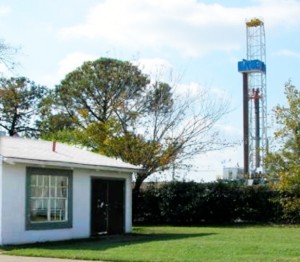 The Texas Tribune has a pretty good overview of the different ways Texas municiplaities are regulating gas drilling, including the contrast between industry-friendly Ft. Worth and a more skeptical Dallas:
Meanwhile, industry representatives and some lawyers point to Fort Worth, 40 miles west of Dallas, as a model for balancing economic and environmental concerns. Between 2006 and 2012, the city took in nearly $264 million in natural gas revenue, including lease bonuses, royalties and property taxes on mineral leases.
Fort Worth’s ordinance — which limits noise, keeps most drilling 600 feet from homes and spells out duties for local inspectors — has grown to more than 60 pages from five. Most recently, the city tightened rules on gas compressors.
But environmentalists point to the city as a model to avoid. It is pockmarked with more than 1,700 producing wells, with pad sites nestled beside sports fields, homes and schools.
“It’s gradually chipping away the quality of life,” said Don Young, a 62-year-old Fort Worth native and longtime activist, who worries that drilling has worsened air quality.
In 2011, a study commissioned by the city concluded that drilling exposed residents to harmful pollutants like acrolein, benzene and formaldehyde, but not at dangerous levels.
Ridley said Fort Worth had come up several times in the planning commission’s talks, but mostly when suggesting stricter regulations. “We arrived at what we thought was an effective means to protect people,” he said.
World Health Organization: Air Pollution Causes Lung Cancer
 As of Thursday, the air you breathe CAN kill you, at least according to the World Health Organization, which officially classified air pollution as a cause of lung cancer. The move came after the group released a report earlier this year estimating that over 220,000 people died from lung cancer worldwide from exposure to bad air. Most of those deaths are occurring in countries in Asia.
Mostly these deaths are due to Particulate Matter pollution, the ubiquitous tiny particles of soot that are produced when things burn, like gas in cars, coal or gas or waste in power plants and cement kilns, and diesel engines and flares in the the gas fields.
Researchers have been producing one study after another for years linking a variety of illness and diseases to various ingredients of dirty air and specifically, Particulate Matter. Parkinson's Disease and other nerve and brain-related ailments, heart attacks and strokes, and of course respiratory problems have all been blamed on PM, but this is the first time it's been classified as a carcinogen. Most scientists in the field believe that there's really no level of exposure to the pollution that's completely "safe."
PM levels in DFW are generally low, but they've been rising over the last couple of years, and those measured levels are based on all of two monitors for all of the Metromess, so they could mask hot spots downwind of large sources (think Midlothian, compressors, and busy freeways). The EPA has proposed a new federal standard that's much lower than the current one, but it has yet to be implemented.