“Animals are the Sentinels”
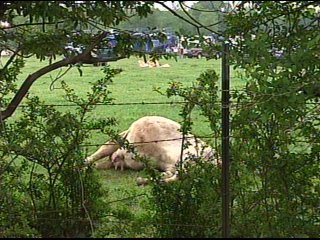 In the late 1980's Sue Pope became concerned about her horses and cows. Her favorite Arabian was developing "heave" muscles on its torso that Pope's vet said was the result of the horse straining to breathe. Her cattle were acting strangely and not developing as they should. These problems seem to come out of the blue, for no obvious reason Pope could figure out. She also noticed that she and her family didn't feel the same either and wondered if what was affecting her animals was also affecting them. She spoke with her neighbors, some of whom were also noticing strange things among their stock and themselves. They didn't have any answers either. That's when Pope started to look for causes outside the gate of her small Midlothain ranch.
And that was the beginning of what eventually turned into Downwinders at Risk. Because of her own experience it has been Sue Pope's belief that more than expensive monitors or dubious risk assessment studies, "animals are the sentinels" for human health. They are literally the canary furtherest down the coal mine.
When the ATSDR decided to review the monitoring information from Midlothain for it's "health consultation" beginning almost ten years ago, they were in part drawn by the large file of documented cases of animals illness, disease and deformities. There's more than one animal stock breeder who has moved to Midlothian over the last 25 years expecting that elusive "fresh country air" to benefit their animals only to find them suffering weird symptons never experienced before in previous locations.
Animals are sentinels, especially livestock, because they don't go to school or work, but stay in the same place all day and night, they graze exclusivley on local plants grown in the local soil. They drink the local surface and/or well water. Livestock have the most exposure and the most "exposure pathways" to whatever potentially harmful chemicals might be in the environment. If it's harming the animals, it's probaly harming people as well.
That's the context for a new article out in The Nation about animals gettign sick in the gas patch.
"Earlier this year, Michelle Bamberger, an Ithaca veterinarian, and Robert Oswald, a professor of molecular medicine at Cornell’s College of Veterinary Medicine, published the first (and, so far, only) peer-reviewed report to suggest a link between fracking and illness in food animals. The authors compiled case studies of twenty-four farmers in six shale-gas states whose livestock experienced neurological, reproductive and acute gastrointestinal problems. Exposed either accidentally or incidentally to fracking chemicals in the water or air, scores of animals have died. The death toll is insignificant when measured against the nation’s livestock population (some 97 million beef cattle go to market each year), but environmental advocates believe these animals constitute an early warning.
Exposed animals “are making their way into the food system, and it’s very worrisome to us,” Bamberger says. “They live in areas that have tested positive for air, water and soil contamination. Some of these chemicals could appear in milk and meat products made from these animals.”
In Louisiana, seventeen cows died after an hour’s exposure to spilled fracking fluid. (Most likely cause of death: respiratory failure.) In north central Pennsylvania, 140 cattle were exposed to fracking wastewater when an impoundment was breached. Approximately seventy cows died; the remainder produced eleven calves, of which only three survived. In western Pennsylvania, an overflowing waste pit sent fracking chemicals into a pond and a pasture where pregnant cows grazed: half their calves were born dead. The following year’s animal births were sexually skewed, with ten females and two males, instead of the usual 50-50 or 60-40 split.
In addition to the cases documented by Bamberger, hair testing of sick cattle that grazed around well pads in New Mexico found petroleum residues in fifty-four of fifty-six animals. In North Dakota, wind-borne fly ash, which is used to solidify the waste from drilling holes and contains heavy metals, settled over a farm: one cow, which either inhaled or ingested the caustic dust, died, and a stock pond was contaminated with arsenic at double the accepted level for drinking water."
People used to ask Downwinders why we decided to take on air pollution from the gas industry. The reason is that all of the red flags we saw over the years in Midlothian are also being raised around gas facilities – individually and/or collectlively. Many of the same chemicals, many of the same health effects from those chemicals, and then the warning from the animals.
Better than TCEQ monitors. Better than out-of-date risk assessments. Animals are some of the best Guinea Pigs we have in the laboratory of chemicals we all swim in. If we would only listen.
Good Friday: Exide Smelter Closing Today
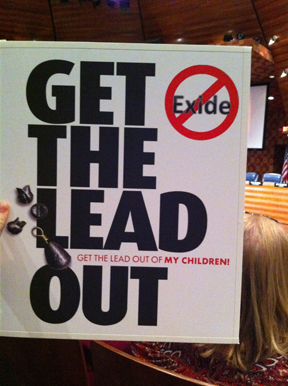 Sometimes, all it takes is the slightest push of an index finger, or a focused exhaling of breath.
Sometimes the house of cards is so precarious, so unstable, that any challenge, no matter how slight, can send the established structure to the ground.
A year ago a small, newly-formed citizens group that had just staged its first action was struggling to convince the City of Frisco to quit supporting co-existence with an outlaw lead smelter and instead kick it out of town.
Today, that smelter will stop operating.
Community activism rarely pays off as quickly or as spectacularly as it has with the curious case of the Exide lead smelter. But when it does, it's reason to pause and give thanks and remind ourselves that such things are still possible.
Because truth be told, this historic effort was directed by a group of Frisco residents that was never larger than 10 people strong. Please just think about that. Less than a dozen people challenging their local status quo are responsible for this huge victory for public health.
Downwinders' often tells its supporters that, like the Woody Allen quote about life, 90% of social change is about just showing up. The system so often goes completely unchallenged, that you'd often be surprised what happens when you just show up and start asking embarrassing questions. When you start poking at the house of cards.
As their campaign proceeded, this small group of committed people attracted the support of hundreds, and then thousands of their fellow residents. They forced the city to see the contradiction between the continued operation of a circa-1960's smelter and the reality of 2012 Frisco. They held up a mirror and re-framed the relationship between smelter and town. And the contradiction was so great, so at odds with the new perception of Frisco, that the established political support the smelter had enjoyed in town for decades dried up. Young couples with kids concerned about a lead smelter they never heard of before outnumbered Good Ol Boys in City Hall and the Chamber of Commerce. The old establishment was undone by the very demographics of change they'd unleashed a decade or so earlier.
There is still much work to do. A half-century of contamination blankets the smelter site, as well as an undetermined number of off-site "hotspots." Exide wants to leave a permanent landfill behind in the middle of Central Frisco, while the City is breezing along with plans to turn a piece of land right across the street from the smelter site into the city's largest park. Downwinders will be helping citizens monitor the cleaning-up of the smelter site for at least the next two years.
But as of today there is no more lead pollution coming out of the Exide smokestacks. No more daily fallout of poison. No more new layers of lead being laid down in the topsoil of Frisco. That is a pretty remarkable thing considering where we were 365 days ago.
So raise your glasses tonight to the hardy folks of Frisco Unleaded and the improbability of the impossible happening in record time. Here's to Colette McCadden, Henrik Ax, Shiby Matthew, Matt Vonderahe, Jeannette Sandin, Meghan Green, and Eileen Canavan, all residents who decided they would stick their neck out and start showing up and asking questions, much to the consternation of the Powers That Be. May they all have Frisco parks, and schools, and streets named after them.
It's not always this easy, but the fact that it was this time should give us hope about the power of pushing back.
A “Solar Happy Hour” Tonight
 Because you haven't really partied until you've partied with clean energy advocates.
The Sierra Club, along with the Blue Green Apollo Alliance, and the Clean Energy Works for Texas coalition, is hosting what they're calling a Solar Happy Hour, TONIGHT where everyone concerned with increasing conservation, wind and other renewables can get together informally and listent to the latest.
WHEN: Thursday, November 29th at 7:00pm
WHERE: Picasso's Pizza (12300 Inwood Rd, Dallas, TX 75244)
FEATURING:
- Dave Cortez, Coordinator from the Blue Green Apollo Alliance, discussing the next steps on our clean energy campaign leading into the P.U.C Sunset Review and the 83rd Legislative Session
- Stephanie Cole, Organizing Representative from the Sierra Club, discussing a new Beyond Coal campaign being in launched in Dallas next spring
If you need more information, contact the intrepid Lisa Trope, one of the Greencorps staffers who've been organizing all fall around energy issues in DFW at Lisa@greencorps.org. As always, drink and think responsibly.
Traffic Pollution Linked to Autism
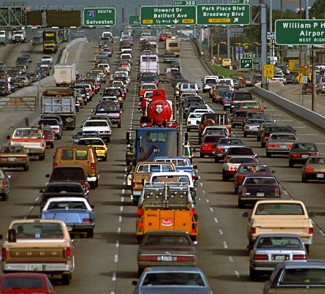 Along with a higher risk of asthma, children who are born and live their first year closer to major freeways also suffer a significantly elevated risk of autism. That's the conclusion of a new study by the Keck School of Medicine of the University of Southern California in Los Angeles.
"Compared to 245 California children who were not autistic, the researchers found that 279 autistic children were almost twice as likely to have been exposed to the highest levels of pollution while in the womb, and about three times as likely to have been exposed to that level during their first year of life.
They found that children exposed to the highest amount of "particulate matter' – a mixture of acids, metals, soil and dust – had about a two-fold increase in autism risk. That type of regional pollution is tracked by the Environmental Protection Agency.
Volk and her colleagues also saw a similar link between autism and nitrogen dioxide, which is in car, truck and other vehicle emissions.
'This is a risk factor that we can modify and potentially reduce the risk for autism,' wrote Dawson in an email to Reuters Health."
It's been estimated by the Centers for Disease Control that autism affects one in every 88 children born in the United States.
A new federal Particulate Matter standard is under consideration by the EPA and could be announced this year. It's been linked to other neurological diseases such as Parkinson's and Alzheimers.
UTSW Gulf War Research Yields More Evidence of Cumulative Chemical Harm
 The story is behind the DMN's paywall, but there's a new piece of the Gulf War Illness puzzle that's been provided by UT-Southwestern researchers lead by Dr. Robert Haley, and it has some relevance to those who think their own health problems can be traced back to chemical exposure.
Originally dismissed by many to be only a psychological condition, scientists now suspect that the multiple and varied symptoms reported under the Gulf War Illness category are from exposure to one or more toxins at levels that were supposed to be safe. Dr. Haley and his colleagues at UTSW recently published the results of a study that proves that nerve damage is the common denominator that impacts breathing, heart rate, sexual function, perspiration and other body functions associated with the diagnosis.
For the Chemically-Sensitive among you, or those of you living downwind of a polluting facility, see if this doesn't sound familiar:
“Many of these veterans have been told that there is nothing wrong with them,' Haley said Monday in an interview. “
"There can't possibly be anything wrong with you because the levels of poison you were exposed to were so low, we don't estimate that you'd be harmed by them at all." That's the mantra of the State's environmental and health agencies every time someone from Midlothian calls and says cement plant pollution made them sick. Same thing if you live around a gas well or compressor. They start from the smokestack or flare and work their way back to the person.
It's not an epidemiological argument. It's a lazy calculation based on laboratory science that's either old or doesn't exist. As the recent federal ATSDR report on Midlothian air pollution admits, science is still at least a decade away from being able to recreate the effects of being exposed to a multitude of pollutants at the same time, as so many of us are subjected to these days. We don't know, and we still can't calculate what it's like to live in a toxic soup.
Haley's studies and others start with the person and work their way back to the chemicals. They find "physical disorders" in a much higher proportion than a random sampling and seek to explain the cause. In this case, there is a match between those who have Gulf War Illness and a certain kind of pervasive nerve damage that can affect a wide range of bodily functions.
Having established that the symptoms of the Illness are indeed physiological, and not just in the Vet's heads, Haley sounds as if he is on the verge of releasing a much larger, longer-term study on the actual trigger mechanisms that produce the nerve damage he's identified.
"Haley suggested that he may soon address the cause, or causes, of Gulf War illness. 'We’re going to show proof of what causes this,” he said. “It will be a huge study with convincing evidence.”
That will be the headline-maker, because as the DMN article points out, Dr. Haley and the UTSW team have been narrowing the suspects down over the years and have a theory:
"He and other medical experts have repeatedly said they believe Gulf War syndrome was caused by exposure to pesticides and other chemicals in the Persian Gulf."
It's very possible that in the next 12 months we'll see the best study ever done on Gulf War Illness reveal that exposure to a variety of different kinds of environmental contaminants at supposedly "safe" levels has left 200,000 service men and women medically damaged. If that's the case, then it could turn out to be one of the most profound challenges to the toxicology of the status quo in the last 50 years. Stay tuned.
Red Alert for Dec 20th: Dallas Wants to Drill Like It’s 2009
 This is a heads-up to all Dallas residents: Dallas City Hall – the building, the people, everything – has climbed into a time machine and traveled all the way back to 2010.
This has allowed the City council and staff to ignore citizen demands for a more protective gas drilling ordinance, the defeat of a council member who advocated drilling, the creation and conclusion of a task force for helping write a new ordinance, and a bunch of public hearings over the last two years – all so that Dallas City Hall can now just go ahead and do what the gas operators originally asked it to do at the beginning.
The first Special Use Permit request from a gas well operator to allow drilling in Dallas since 2010 will be on the agenda at the December 20th Dallas Plan Commission meeting at City Hall. It concerns a new request to drill by XTO (Exxon-Mobil) at the old Navel Air Station in southwest Dallas, near the Grand Prairie line, that was submitted on November 16th.
Time it's taken the City of Dallas to write a new drilling ordinance in Dallas: 24 months and counting
Time it took XTO to get its new drilling request heard despite not having that new ordinance yet: 20 days
You can read about the sudden jump into municipal action here behind the DMN paywall.
"XTO’s latest requests are apparently on a fast track, headed to the City Plan Commission….
A new, tougher Dallas drilling ordinance is in the works but has not been approved or even published for review, so the existing ordinance would govern the XTO applications, based on the city’s legal view that one set of rules should apply throughout the process."
Every Dallas City Council member appoints a representative to the City Plan Commission. Dallas residents should call their own City Council member (info here), or their Plan Commission appointee (download a list and contact info here) and tell them to reject this XTO request and any others that try to get processed before a new drilling ordinance is in place.
Here's the media release that Dallas Residents at Risk put out this morning about the sudden turn around:
Dallas Officials Consider Throwing Away Years of Work on New Gas Drilling Ordinance and Simply Let Fracking Begin
Have Mayor Rawlings and the Dallas City Council made a decision to move ahead with existing, pending and even new gas drilling applications without taking any action on the new “fracking” ordinance that has been in the works since 2010?
Two weeks ago, Exxon-owned gas company XTO filed a new gas drilling application—because their previous bid to drill at Hensley Field was denied by the Dallas City Plan Commission two years ago. Then the City Council appointed a special Gas Drilling Task Force, whose members met every week for eight months to consider proposals for a new ordinance. They finished their work in February of this year and issued their official recommendations, yet the City Council has not even begun drafting a new ordinance. The only rumored exception: City officials may consider simply changing the existing ordinance to allow fracking in floodplains, which would be necessary for gas company Trinity East to move ahead with its plans to drill in floodplain areas along the Trinity River. Neighborhood groups and environmental advocates say that’s unacceptable.
"This is the largest retreat of leadership that I can ever remember on such an important public health and environmental issue,” said Jim Schermbeck, Downwinders at Risk. “After three years of citizen complaints, a task force created, convened and concluded, expert and public testimony, and all Dallas residents get is a pair of shrugged shoulders from Mayor Rawlings and the Council? It's a bad joke."
There have been several major scientific studies surrounding the risks of fracking since Dallas officials began debating the new ordinance. Community leaders worry that new evidence pointing to health and safety risks for residents living near drilling sites will simply be ignored.
“So what if there's a 66% higher cancer risk within a half mile of a gas well; so what if already bad Dallas smog is made worse; so what if we still have no idea what chemicals will be used for fracking in Dallas,” said Claudia Meyer of the Mountain Creek Neighborhood Alliance. “It's as if the Mayor and Council are closing their eyes, plugging their ears, and desperately hoping to make all these new facts go away by just pretending they never happened.”
The new drilling applications leave Dallas officials exactly where they started, with the City Plan Commission being asked to shoulder the responsibility of deciding on whether to allow fracking to go forward. Advocates say the Commission should decline this offer and let the City Council do what it said it was going to do: Draft and pass a new gas drilling ordinance first.
“If we were only going to end up where we started, what was the point of a task force, or public hearings or anything that's happened since permitting stopped because the City wanted a new drilling ordinance,” said Zac Trahan with Texas Campaign for the Environment. “This is complete and utter dereliction of duty and public trust by the elected officials of this city on one of the most important public health and environmental questions to face Dallas in decades."
Cutting-Edge Toxicologist Talks Toxic Soup
 Dr. Linda Birnbaum is an unsung hero of the modern environmental movement. For 33 years, she's been a leading researcher and writer on environmental toxicology issues, advancing understanding of specific poisons as well as the cumulative impact of the thousands of chemicals we're exposed to in daily life. First at the EPA, and now at the National Institute of Environmental Health Services, she's been at the leading edge of US environmental health research. Scientific American recently did a sit down interview with Birnbaum to talk about her work. Go and get caught up on why we can't trust current "safe" levels of much of anything.
Cuts in Methane and PM Pollution Can Slow Climate Change
 In an opinion piece in The Daily Climate, Michael MacCraken, the chief scientist for the DC-based Climate Institute advocates an end-run strategy to avoid the political logjam over large CO2 cuts as a way to fight global warming. He suggests concentrating on reducing Methane and Particulate Matter pollution as a way to "appreciably slow the rate of warming over the next several decades." He cites an earlier UN study that concluded:
"…a moderately aggressive international emissions control program focused on the short-lived compounds could roughly halve the projected warming between the present and 2050. While slowing the warming through this approach might seem to also offer additional time for cutting CO2 emissions, this is not the case. Instead, these actions are more appropriately viewed as partially making up for earlier policy delays.
For the United States to do its share, aggressive limits on CO2 emissions must be complemented by aggressive limits of emissions of short-lived species. In particular, the Environmental Protection Agency will need to be more aggressive in cutting short-lived emissions, particularly of methane from the oil and gas industry, and making its voluntary methane and black carbon programs mandatory.
With climate change so far along, the question now is no longer whether impacts can be avoided, but rather how bad they will become. What we do with respect to both mitigation and adaptation will control that outcome. The longer we wait, the worse the impacts and sharper the required energy transition."
While methane gradually breaks down in the atmosphere, forming carbon dioxide, it has 100 times the warming potential of carbon dioxide for the first 20 years it’s exposed to the environment. A study by Cornell University Environmental Biology Professor Robert Howarth found between four and eight percent of the methane produced by a fracking well is leaked into the atmosphere during the well’s lifetime. For all the immediate environmental benefits of natural gas, the methods used for its extraction could create a larger greenhouse footprint than oil or coal over time.
EPA is considering a new national PM pollution standard because of its public health impacts and should use the opportunity to win deeper cuts that offer so many "co-benefits." Every reduction in soot is now doubly important. Cars, cement kilns, coal plants, and just about any industrial boiler or furnace spews out PM. They all need to be targeted as part of a larger effort to bring this kind of pollution under better control.
This impact on global warming is also one more reason why Dallas residents should be demanding that the city incorporate some kind of "off-sets" policy regarding new oil and gas air pollution as part of a new City drilling ordinance. Not only can it hep reduce smog and some of the toxins released by the drilling and processing of natural gas; it can also provide some needed help for climate change at a time when the city is just squeaking by its own greenhouse gas reduction goals.
“Statistically Significant Increase” in Risk of Dying from Cancer in Towns Near Incinerators
 You know that argument you sometimes hear about how those ecologically-minded Europeans are burning everything in incinerators and cement plants, so it must be OK to do it here? Maybe not so much.
In one of the most ambitious and far-ranging efforts of its kind ever attempted, the newly-published results of a 10-year study from Spain's national Center for Epidemiology looked for 33 different kinds of cancer in dozens of Spanish communities that hosted "waste incinerators and installations for the recovery or disposal of hazardous waste." They found "a significant higher risk from all cancers in towns near these industries."
Cancer impacts were greater around waste incinerators and scrap metal operations – you know like the three giant Midlothian cement plants upwind of DFW that are burning larger and larger amounts of industrial wastes and the steel mill across the street from them melting scrap cars.
Researchers used standard computer modeling to estimate what cancer rates should be in the host communities and then compared them to what they actually were.
"Excess cancer mortality was detected in the total population residing in the vicinity of these installations as a whole and, principally, in the vicinity of incinerators and scrap metal/end-of-life vehicle handling facilities, in particular. Special mention should be made of the results for tumors of the pleura, stomach, liver, kidney, ovary, lung, leukemia, colon–rectum, and bladder in the vicinity of all such installations. Our results support the hypothesis of a statistically significant increase in the risk of dying from cancer in towns near incinerators and installations for the recovery or disposal of hazardous waste."
There has never been any kind of systematic study of cancer rates around and downwind of the Midlothian cement plants. From the Texas birth defect registry we know that certain reproductive organ birth defects that are associated with pollutants known to have been released from the plants are higher than the state average in Ellis County.
This study, as well as the recent warnings of the federal Agency for Toxic Substances and Disease Registry about the public health dangers of the pollution coming from the Midlothian cement plants arrives at a time when the plants are gearing up to add plastics, car interiors, and other kinds of garbage to their lists of "fuels" that will be burned. After losing the fight to be able to burn hazardous wastes willy-nilly in cement plants, the industry is turning to industrial and municipal garbage that can produce many of the same worrisome kinds of pollution. This is what makes the EPA rules governing the emissions of the nation's cement plants – rules that are still in play – so very important.
Does Pollution Discriminate? The Coal Plant Edition
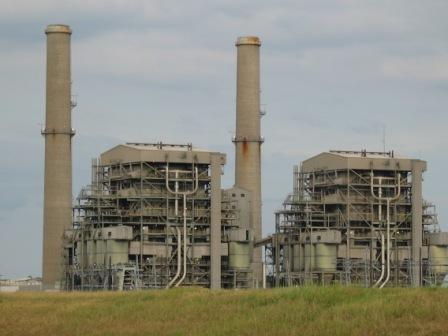 A new NAACP report examining the locations and impacts of all 378 coal-fired power plants in America found that those living near the plants were disproportionately poor and members of minority groups. More often than not, the worst-performing coal plants were also in predominately poor and minority communities.
"Coal Blooded: Putting Profits Before People" failed 75 plants on their environmental justice impacts and found those same plants were responsible for a heavier pollution burden. 14% of sulfur dioxide emissions and 13% of all smog-forming nitrogen oxide emissions from all U.S. power plants came from just those 75 power plants.
The four million people living near those 75 plants are among the poorest and more isolated communities of color. The average per capita income within three miles of the 75 failing plants is $17,500, and nearly 53 percent of the people are minorities.
One of those 75 failing plants is in Texas according to the report's graphics, but the plants aren't listed by state in the Appendix. All coal fired plants in the immediate DFW region have been closed for a while based on their advancing age and voluminous pollution, but that may not be the case in places like San Antonio or Austin. Stay tuned for a clarification.