Posts by Downwinders At Risk
Former Bush EPA Regional Administrator Endorses Off-Sets in Dallas Gas Ordinance
 Many of you know Richard Greene as the former Arlington Mayor who was tapped by President George W. Bush to become Regional Administrator of the EPA in Dallas in 2003. Unlike many other Bush appointees, Green was not an ideologue. He was an administrator. And he lived in the area he was serving, and had already had stints as an Arlington Planning and Zoning Commissioner and Arlington Star-Telegram publisher. It didn't hurt that he could call the President up and shoot the breeze about the baseball team they both had an interest in.
Greene was a supporter of Downwinders' Green Cement campaign, and promoted its use as part of the larger 2006-7 DFW clean air plan. His support gave legs to what was then just an idea, a concept. He helped transform it into the kind of de facto regional purchasing policy that contributed to TXI and Ash Grove's decisions to close their dirtier old wet kilns, and in the process reduce hundreds of thousands of tons of air pollution each and every year.
So it was a kind of a big deal when Greene took the time to write the Dallas Morning News a letter endorsing the idea of "off-sets" for air pollution from natural gas mining and processing – the newest de facto regional air quality strategy Downwinders is promoting to rein-in gas emissions that are rising rapidly. Published on September 12th here it is in its entirety:
City should set drilling example
As the City Council prepares to write a new ordinance regarding urban oil and gas drilling, Dallas has a unique opportunity to once again set a regional clean air example, while also tapping into a needed energy source.
Natural gas is an important part of the nation's energy mix. However, when it comes to metropolitan areas like D-FW that are in nonattainment of the Clean Air Act, those circumstances should be crafted so as to not allow new emissions to cancel out previous hard-won reductions.
The kinds of facilities that operators use to produce and process natural gas are diffuse over a large area. They're not centralized like a power plant or a factory, and so under current federal law these facilities, no matter how concentrated or connected, are not covered under the traditional offsets rule.
Dallas could change that with an innovative expression of local control. The city could require reasonable offsets for new industries that emit a significant amount of air pollution, including natural gas operators, as part of a new urban drilling ordinance.
Since local gas producers project little impacts from their operations, the burden should not be a deterrent to drilling here.
Richard Greene Arlington,
former EPA regional administrator
Remember, this is from George Bush's personal appointee to run the Regional EPA.
When citizens met with Dallas councilwoman Linda Koop – the council's go-to person on all things air quality – she had a hard copy with her. She reportedly had "no problem" with off-sets, but thought it might take more time to establish than the council has before voting on a final ordinance. Citizens expressed confidence it could be done sooner and at last word, she was trying to arrange a meeting between city and EPA staffs to talk about the mechanics of such an approach. Slowly but surely, common sense seems to be gathering momentum.
Many thanks to Mayor Greene for his support of what we think is a market-based innovative approach to solve a regional air quality problem. We hope his endorsement has the same impact as the last one.
Compare and Contrast
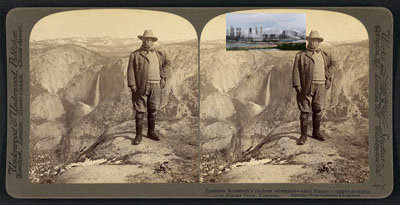 Read this obituary for Russell Train, the Republican conservationist creator of the Environmental Protection Agency, and then read the current Republican position on his creation.
RIP: The DMN “Energy and Environment” Blog
 We didn't notice it until after the fact, in part because its owners quit noticing some time ago, but the Dallas Morning News' "Energy and Environment" blog is no more.
Back in 2006-2007, it started out well enough, fueled by the opposition of the paper and the City of Dallas to Governor Perry's plans to fast-track as many as 17 new coal-fired power plants. It served as a platform for the paper's reporting of that story from Business Section reporter Elizabeth Souder, as well as writings from Editorial Board writer Colleen McCain, and Environmental Reporter Randly Lee Loftis.
But as that story went away, so did the blog's flow of entries. While Souder would post, Loftis was an infrequent contributor and McCain left the paper some time ago. Pieces had been coming in at a rate of one every 2-4 months. As a place to go to find out things about local DFW environmental goings-on, it had ceased to be relevant years ago.
Still, its demise is another sign of how scant the mainstream coverage of environmental issues is in the nation's fourth largest metropolitan area. Forget about the Star-Telegram – it doesn't even have a reporter assigned to do environmental beat coverage. Channel 8's Project Green is as much a self-promotional vehicle as it is information clearinghouse. Loftis remains the Last Environmental Reporter standing in DFW but the infrequency of his articles and absence at major events would challenge that title.
Only the alternative weeklies – The Dallas Observer and Ft. Worth Weekly – have maintained their coverage of environmental issues and risen to the crisis created by the invasion of urban gas drilling. They're providing much of the coverage that you might have seen in the dailies only a decade or so ago.
And of course, there's the citizen blogosphere. Here in North Texas we have Sharon Wilson's Blue Daze – probably the nation's closest thing to an online national grassroots meeting place for gas drilling skeptics and opponents. Sharon gets more hits in a day than many of the mainstream media's stories get in weeks. In her wake she's inspired a slew of homegrown fracking sites throughout the Barnett Shale and beyond that mix micro reporting on their neighborhood battles with macro analysis and links to national articles. Want to find out about fracking in Grand Prairie? You'd best take a look at Susan Read's Westchester-Grand Prairie Community Alliance. Need to get an update on the fight over Dallas' new gas drilling ordinance? You should check out the Dallas Residents at Risk page for the latest news you won't find anyplace else.
There's Green Source for calendar and event listings, and they've been upping their reporting of North Texas environmental controversies, taking on West Nile arieal spraying, Dallas gas drilling, and the Midlothian cement plants that are so near and dear to our own hearts here at Downwinders.
And there's us. We know we've been spotty of late, but we're bet getting back on track with regular daily postings to try and give you information that's interesting, and useful. Keep checking. We'll keep posting.
New Clean Energy Campaign Kicks-Off Wednesday Night
 In case you haven't heard, there's a privately-funded organization that's come to Texas designed to put young people with in interest in environmental organizing out in the field to do good works while getting paid a small stipend. It's called Greencorps, and while it's 20 years old, this year is the first time any Greencorp members have shown up in Dallas-Fort Worth.
In particular, newly graduated Biology major and GreenCorp member Lisa Trope is here on behalf of Sierra Club's Clean Energy Works campaign that seeks to promote wind, geothermal and solar alternatives to fossil fuels. She's trying to get people to sign a petition to have the Texas Public Utility Commission commit itself to renewable energy target amounts and dates – much like the legislature did a decade ago or more in an effort that saw the birth of the Texas wind energy industry.
Surrounded by gas mining and processing pollution and downwind from coal plant emissions, DFW could use all the clean energy it could get. Lisa is having her first organizing meeting tomorrow night – Wednesday, September 19th, from 7 to 9 pm at the Bachman Lake Public Library's Black Box Auditorium. Do you remember your first organizing experiences? Please attend, make Lisa feel at home, and welcome her into the small DFW community of people who give a damn.
Breaking: Human Body More Nuanced than Science Thought
 How many times have you heard a local neighbor of a downwinder say something like, "I've lived here all my life and never once got sick from that stuff," even while the block they live on might be a cancer hotspot?
There are lots of reasons for pollution not affecting everyne equally. One is the new science of "Epigenetics," which has discovered that an ancestor's exposure to environmental toxins that never affected them could skip a generation or two and result in disease or illness many decades past the original transgression.
Via the New York Times this week comes another explanation that concludes there are a lot more ways environmental toxins can affect DNA behavior other than corrupting the DNA itself. What scientists believed were mostly unused parts of the human genome turn out to be huge, complex switchboards for the controlling of all kinds of things related to DNA growth, maintenance, and damage.
"Now scientists have discovered a vital clue to unraveling these riddles. The human genome is packed with at least four million gene switches that reside in bits of DNA that once were dismissed as “junk” but that turn out to play critical roles in controlling how cells, organs and other tissues behave. The discovery, considered a major medical and scientific breakthrough, has enormous implications for human health because many complex diseases appear to be caused by tiny changes in hundreds of gene switches.
The findings, which are the fruit of an immense federal project involving 440 scientists from 32 laboratories around the world, will have immediate applications for understanding how alterations in the non-gene parts of DNA contribute to human diseases, which may in turn lead to new drugs. They can also help explain how the environment can affect disease risk. In the case of identical twins, small changes in environmental exposure can slightly alter gene switches, with the result that one twin gets a disease and the other does not."
The article makes the connection between past research that found a likelihood to get certain diseases among those with corrupted DNA patterns, but until now, no one knew that those patterns were from the operation of on/off switches for genes in the DNA. This research, by building a "Google Map" of these switches, fills in the blanks and provides lots of new evidence of how subtle changes that fall short of breaking or damaging DNA can still result in harmful health effects, perhaps including many that are initiated by environmental toxins.
2011 was the Worst Year for Smog since 2006 in DFW. 2012 Is One Bad Air Day Away Matching It.
 Last year's air quality death spiral in DFW was sometimes explained away as an anomaly because of the severe drought the entire state was going through.
So what's the explanation this year?
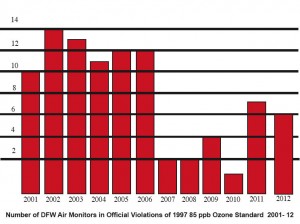
With yesterday's high ozone levels sending a 6th monitor into an exceedance of the old 1997 85 parts per billion smog standard, DFW is just one more bad air day away from matching last year's dreadful results. Today's ozone forecast says there should be no high levels of smog in DFW today, even as the temperature reaches for a record high. But then again, they weren't predicted Thursday either.
To give you some idea how rapidly things have gone downhill for air quality in DFW the past two years, just look at the annual numbers. From 2007 to 2010, we had a total of nine monitors register official exceedances of the 85 ppb standard. That's about two monitors a year average. This turns out to be the closest we've ever come to actually meeting the standard. Officials could argue with some justification that air quality was slowly getting better.
On the other hand, during the last two years, we've had 13 monitors record exceedances of the 85 ppb standard, an average of 6.5 a year, and 2012's ozone season is not yet over. You could add up all the exceedances from the four years between 2007 and 2010 and still not equal the number we've experienced in just the last 24 months.
This is not progress.
TCEQ and the gas industry have argued for some time that gas mining couldn't possibly be contributing to smog problems since smog levels were going down as drilling was increasing in DFW. But that's not true anymore. As gas drilling has moved further and further east – into the heart of the non-attainment area, we've seen in increase in ozone concentrations, in exceedances in monitors, and monitors in the eastern part of the Metromess exceeding the standard that hadn't done so in five to seven years.
Meanwhile all other major source categories for air pollution have been decreasing their emissions. Cars, power plants and cement kilns are actually releasing less air pollution now than they were ten or 20 years ago. Only one large specific source category has increased its annual tonnage significantly over that same time – oil and gas.
Is it just a coincidence that smog is getting worse as oil and gas pollution skyrocket – not only in the Barnett Shale that surrounds DFW on three sides, but by all the new oil and gas sources now southeast of Dallas as part of the Haynesville Shale play that are blowing their pollution toward us most of the ozone season? There are now so many gas compressors in Freestone County, less than 75 miles away from the Dallas County line, that their emissions represent the equivalent of over 4 new Big Brown coal plants. What do you think the impact on air quality would be of four large new coal plants located immediately upwind of DFW? Might it look a lot like it does in 2012?
Could it be that the dirty mining of "clean" natural gas is making it impossible for DFW to meet the old 85 ozone standard, much less the new 75 ppb one? That the Devil's Bargain so many former and current elected officials made with the gas operators to grab the cash and run is now coming back to bite them and us in the air quality butt? That was certainly the conclusion of the study we publicized this last Tuesday from the Houston Advanced Research Center:
"Major metropolitan areas in or near shale formations will be hard pressed to demonstrate future attainment of the federal ozone standard, unless significant controls are placed on emissions from increased oil and gas exploration and production….urban drilling and the associated growth in industry emissions may be sufficient to keep the area (DFW) in nonattainment."
It's time for local officials to replace those cash registers in their eyes with gas masks. Because of their rush to make money, they didn't pause to understand how so much new industrial activity could produce smog just like the bad ol' days. They were being paid not to understand. And now 5 to 6 million people who still can't yet breathe safe and legal air are paying the price.
Lead Exposure Linked to Gout
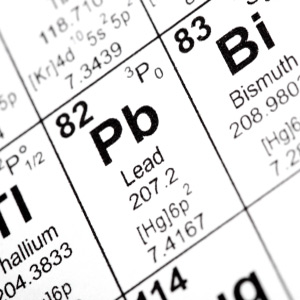 Since Downwinders was asked to help Frisco residents relocate a 50-year old lead smelter last year, there's been one study after another linking lead exposure to a variety of new health effects. This month it's gout.
"Even relatively low levels of lead in the blood may be linked to an increased risk of gout, a painful form of arthritis, researchers reported Monday.
"All of this suggests there's no such thing as 'safe' or 'acceptable' lead levels," said study leader Dr. Eswar Krishnan, of Stanford University School of Medicine in Palo Alto, California.
No one is going to be doing a health survey in Frisco anytime soon looking for increased rates of gout, or liver damage, or cancer, or lower IQ levels. Once a facility like the Exide lead smelter puts poisons into the air, they cannot be recalled, nor the damage they create. Because we don't know all the damage their poisons can create. But that doesn't keep companies or governments from approving the release of them into the air. Years later, studies are done and we all learn about a new kind of damage they can leave. But the damage cannot be removed, or mitigaged or even compensated, because there's no direct connection to Exide left to identify.
And that's why we must make sure we know what's being released into the air for us and our families to breathe before we're exposed to it.
Another Chapter of Cement Kilns As Garbage Incinerators
 One of the reasons it's so disheartening to have EPA rollback the deadline for new cement plant air toxics standards and gut the PM pollution provision of those standards is because of the large and fundamental shift in what's being burned is taking place within the industry. Downwinders across the country need the protection of these new rules as soon as possible, as everything, including the kitchen sink, is being thrown into kilns.
There's a determined effort underway nationwide for cement plants to secure new permits or permit "amendments" or "modifications" to burn increasing amounts of municipal and industrial garbage, including lots and lots of plastics. With new regulation of hazardous waste burning in the US taking some of the fun and profit away from that practice, the trend is now headed toward burning all kinds of "solid waste" including hard to recycle bits of municipal and industrial garbage like plastics and car "fluff" – all the non-steel parts of a car or truck, including dashboard, electronics, interiors, brake linings, etc.
Locally, TXI's 2011 permit amendment – given without public notice or opportunity for comment – is the worst example of this national trend, although Holcim and Ash Grove are also burning tires, used oils, and other kinds of industrial waste already.
Now word comes of the CEMEX plant in Louisville also making plans to burn plastics and other kinds of garbage, but
"…industrial pollution has been an issue in southwest Louisville for decades. The plant is near the coal-fired Mill Creek power plant, and residents have long complained about dust and soot from both.
Denise Allgood, vice chairwoman of the Valley Village Homeowners Association, said she was not familiar with the proposal and said any change involving air pollution is likely to be sensitive.
The (pollution) that’s coming out of that place now is of great concern,” she said. “We’ve been told by the powers that be that’s it’s better than it has ever been, but I would hope that whatever (CEMEX) is considering, they are also considering the health and welfare of the people in this area.”
What could make the problem wortse? Burning plastics that release exotic new chemicals that can hitch a ride on all that old soot and dust. We're entering a whole new era of contamination by incineration once plastics-burning becomes widespread in the nation's cement kilns. That's a big reason why we need the added protection of the EPA rules.
Study: Gas Drilling “Significantly” Increasing DFW Smog
 In the middle of another bad North Texas ozone season, a new study by a Houston research consortium concludes that Barnett Shale natural gas facilities "significantly" raise smog levels in DFW, affecting air quality far downwind.
According to the study, ozone impacts from gas industry pollution are so large, they'll likely keep North Texas from being able to achieve the EPA's new 75 parts per billion (ppb) ozone standard.
Author Eduardo P. Olaguer, a Senior Research Scientist and Director of Air Quality Research at the Houston Advanced Research Center, concludes that, "Major metropolitan areas in or near shale formations will be hard pressed to demonstrate future attainment of the federal ozone standard, unless significant controls are placed on emissions from increased oil and gas exploration and production….urban drilling and the associated growth in industry emissions may be sufficient to keep the area (DFW) in nonattainment."
Olaguer's article describing his study was recently published in the July 18th edition of the Journal of the Air & Waste Management Association. It's the first independent study to examine specific North Texas ozone impacts from the gas industry.
Environmental groups say air pollution from natural gas sources is already making it impossible for DFW to meet even the obsolete 15-year old standard of 85 ppb. So far in 2012, five monitors have violated that level of smog despite a state plan that Austin guaranteed would reduce ozone concentrations in DFW to record lows this year. Counting 2012's failure, DFW has been in continual violation of the Clean Air Act for its smog pollution since 1991.
"This study is proof we need a regional strategy of self-defense to reduce air pollution from the gas industry," said Downwinders at Risk Director Jim Schermbeck, whose group has been leading the fight to reduce smog-forming pollution from gas sources for two years now. "TCEQ and EPA are not doing enough to rein-in these facilities. Despite their official plans, our air is getting dirtier, not cleaner because gas pollution is still under-regulated. It's time for us to do more at the local level."
Schermbeck suggested the study could make a difference in the upcoming city council vote on a new Dallas gas drilling ordinance.
"Dallas has a chance to react positively to this new evidence by adopting the nation's first policy aimed at mitigating the tons of new pollution caused by gas mining in its new drilling ordinance. That would be a very large step forward in advancing regional clean air goals."
A city-wide coalition of neighborhood, homeowners, and environmental groups has been urging the Dallas city council to require gas operators to reduce as much air pollution as they release through funding of anti-pollution measures across the city. The Houston Center study gives them a lot of fresh arguments.
According to it, "…oil and gas activities can have significant near-source impacts on ambient ozone, through either regular emissions or flares and other emission events associated with process upsets,and perhaps also maintenance, startup, and shutdown of oil and gas facilities."
In fact, just routine emissions from a single gas compressor station or large flare can raise ozone levels by 3 parts per billion as far as five miles downwind, and sometimes by 10 ppb or more as far as 10 miles downwind.
Those impacts rival the size of smog effects traced back to the Midlothian cement kilns or East Texas coal-fired power plants by previous studies.
As the study notes, "Given the possible impact of large single facilities, it is all the more conceivable that aggregations of oil and gas sites may act in concert so that they contribute several parts per billion to 8-hr ozone during actual exceedances."
This conclusion directly contradicts the stance of the Natural Gas industry and the Texas Commission on Environmental Quality, both of which deny that Barnett Shale gas emissions are large enough or located in areas that can influence DFW ozone levels.
But the Houston study is based in part on data collected by industry, as well as information from the city-sponsored "Fort Worth Study," and citizen-sponsored testing in the town of DISH in Denton County. It also uses a kind of computer modeling that allows for a more realistic understanding of how large releases from gas facilities can increase ozone pollution than the one the TCEQ uses. It's the most sophisticated challenge yet to the state and industry's claim that gas emissions do not constitute a large threat to DFW air quality.
"This is reality-based science, not the ideologically-influenced happy talk that's coming out of TCEQ these days," said Schermbeck. "Local governments in North Texas, especially those that are traditional allies of clean air, need to pay close attention and act on it."
The report is available for downloading here.
The EPA Loss in Court You Didn’t Hear About, But Could Affect You More in DFW
 Let's face it, the EPA legal team has taken a bunch of hits lately. Losses in court over the Texas Flex permitting plan and national cross state pollution rules, among others, have gotten lots of headlines, but for various reasons may not be as awful as they first sound to environmentalists.
But there was a recent ruling that did hit home for metropolitan areas like DFW that are a) already in "non-attainment" of the federal ozone, or smog, standard, and, b) host lots of urban gas and oil drilling. You probably didn't hear about it, but it may have more of an impact on your air here because it once again left a large loophole in current law that allows the oil and gas sector to escape emissions "off-setting."
According to the Clean Air Act, every large industry that comes to set up shop in a non-attainment area like DFW must decrease as much pollution as it estimates it will increase. This is required so that new pollution doesn't just take the place of pollution that's been reduced from industries already operating in the area. Otherwise, there would be a large imbalance between new industries and established ones that would put air quality progress in peril.
And that's exactly what's happening in DFW.
For a decade now, gas mining in the Barnett Shale has added tons and tons of new air pollution to the North Texas airshed that has not had to be off-set with reductions. While emissions from this industrial sector grew, pollution from local cars, power plants and cement kilns actually decreased. Based on past experience DFW should be making headway toward cleaner air. But we're not. For the last two years, DFW air quality progress has stagnated and even begun rolling backwards. This year we already have five monitors out of compliance with a 1997 ozone standard, compared to just one in 2010.
So why aren't gas emissions subject to Clean Air Act "off-sets" just like a power plant or cement kiln? Because nobody writing the Clean Air Act in 1970, or its amendments in 1991, anticipated urban drilling on the scale we're experiencing it in DFW these days. Nobody foresaw the establishment of a huge gas patch in a large metropolitan area with connected, but widely diffused sources of emissions spread out over hundreds of square miles. They were thinking about "stationary sources" of pollution like coal-fired power plants, refineries and the like. The amounts needed to trigger off-setting are all oriented toward these massive facilities, not lots of smaller sources that eventually equal or surpass their output. As a result, there's a huge loophole that keeps the oil and gas industry from being regulated like any other industry in a non-attainment area.
EPA has recognized this loophole and tried to close it by ruling that facilities connected by process in the gas field may be treated as one large source of pollution – the term is "aggregate." And this is the definition that a court recently shot down in a Michigan case:
"The Cincinnati, Ohio-based 6th U.S. Circuit Court of Appeals held yesterday that EPA had no basis to find that the natural gas sweetening plant and sour gas production wells owned by Summit Petroleum Corp. in Rosebush, Mich., are "adjacent" under the statute and therefore a single source just because they shared some similar functions.
It is an important case for the oil and gas industry because it is the first appeals court ruling to address a recent EPA move seeking to more aggressively "aggregate" various nearby sources of air pollution at oil and gas facilities for permitting purposes.
The court ordered EPA on a 2-1 vote to consider again whether the facilities, spread over a 43-square-mile area, are "adjacent" under the "plain-meaning of the term," which focuses only on physical proximity."
Just in case there was any doubt about why the gas industry was challenging the EPA policy of aggregating, the next sentence of the article makes it clear:
"Industry groups object because it can bring the individual sources under the umbrella of more stringent Clean Air Act permitting requirements."
Now, of course adjacent in common law means next door. But what does it, or should it mean, in environmental law? The collective air pollution being generated by that 43 square mile complex could very well be "adjacent" to your lungs a short distance downwind. But the court didn't see it that way.
That means that going into the next clean air plan for DFW – one that will, at least theoretically be aimed at the new 75 parts per billion ozone standard – EPA will not be able to "off-set" the large amounts of air pollution generated by gas mining and processing in the North Texas non-attainment area.
And that's why we have to do it ourselves, one city and one county at a time. Starting in Dallas. Starting now.
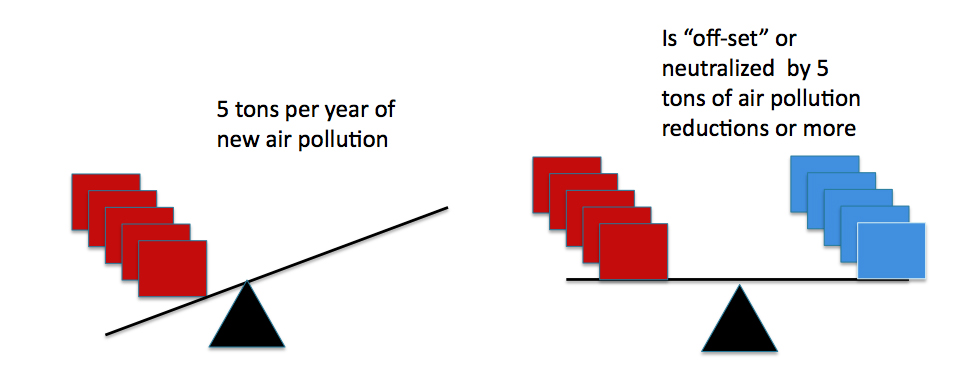
As part of the larger re-writing of the Dallas gas drilling ordinance, a very large and impressive coalition of homeowners groups, neighborhood associations, and environmental organizations have all endorsed the idea of Dallas requiring local off-sets for any pollution released by new gas facilities within the city limits. A company would have to pay for projects that would reduce as much pollution as it was estimated to release every year. Dallas would be the first city in the country to adopt such a policy, but it probably wouldn't t be the last. And it wouldn't take that many before you started seeing an impact on industry's emissions.
We have a model in the successful Green Cement Campaign of the last half decade, that also started in the Dallas City Council chambers with a first-in-the-nation vote. All it took was a dozen cities and counties passing green cement procurement ordinances to get the cement industry's attention. As of 2014, something like 300,000 tons of air pollution a year will have been eliminated because there are no more dirty wet kilns in North Texas.
We can do it again. This time with gas patch pollution. We have to. Nobody else is going to do it for us.