Particulate Matter
Transformational National Science Foundation Grant for 21st-Century Air Monitoring Gets a Call Back
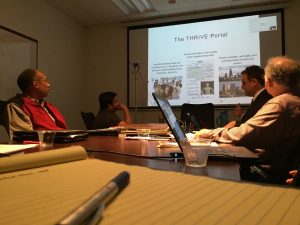 In a milestone for the local consortium Downwinders At Risk is working with to bring DFW air quality monitoring into the high-tech era, its $3 million request to the National Science Foundation for funding two pilot projects got a call-back last week.
Led by University of Texas at Dallas high tech guru Dr. David Lary, the group includes scientists and researchers from the University of North Texas and UNT’s Health Science Center, Texas Christian University, the cities of Dallas, Fort Worth Plano and Richardson, the Fort Worth Independent School System, the Dallas County Community College District, the Fort Worth League of Neighborhoods, Livable Arlington, Mansfield Gas Well Awareness, and Downwinders at Risk.
There were said to be over 200 applicants applying for the NSF’s “Smart and Connected Cities” grant when the deadline passed about a month and a half ago. The NSF isn’t revealing how many of them got a follow-up “Virtual Site Tour” of the proposal, but the number isn’t believed to be very large. Rumor has it that one of the main competitors to the DFW proposal is Argonne National Laboratories, a 70-year old gigantic research industrial complex born out the Manhattan Project.
 That a group that wasn’t even in business a year ago is now in the running with such a Colossus in a very competitive nationwide talent contest for valuable and scarce research dollars is pretty remarkable on its own. What makes it even more remarkable is that staff at the NSF itself actively discouraged the DFW project from even applying, because they didn’t think the proposal could compete with the scientific heavies already in the race.
But what the NSF staff underestimated was how much the DFW project challenges and changes the status quo from the bottom up. It’s hard to imagine a proposal that has the potential to deliver more benefits to more people. 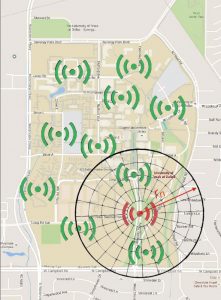
At the heart of the vision for the DFW grant proposal is the idea of an independent network of hundreds, then thousand of small e-sensors placed in a thought-out grid across the entire urban core of the Metromess. These sensors would be located every kilometer or even half-kilometer, block by block, down major thoroughfares, by schools and parks and daycare centers, by facilities that pollute.
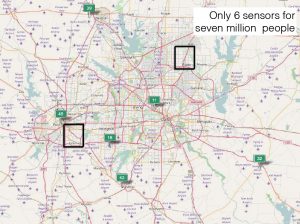
So instead of relying on a handful of clunky large official EPA/TCEQ monitors scattered over an area the size of a couple of New England states, you know have data from just outside your own door.
Moreover these sensors would be able to deliver information about air quality in real time to an app on your phone or computer. Contrast this with the two-and-a-half hour wait between sampling and result you see on the official monitor websites now.
But wait, there’s more. As part of the app, you’re made aware of local conditions via an avatar or virtual human, who you can design yourself from a number of attributes. It will present you a list of health symptoms the poor air quality might trigger. But this avatar is also interactive through the network “portal.” You can upload your own symptoms when you’re having a bad air day. The software will look for correlations – wind direction and speed, concentrations of pollutants and allergens in the air, etc. and alert you when days are shaping up to be like the ones that give you trouble.
In the same way many of us now check the weather forecasts, pollen counts, and ozone alerts to know if we need to take extra care with our lungs, you can use this network and software to fine tune that investigation to a degree never before possible.
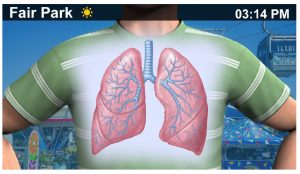 Want to be a neighborhood air pollution watch cop? Use the software to track down hotspots you didn’t even know existed, or enforce the permits issued to local facilities. The network of sensors allows you to track plumes in real time as they cross county and city boundaries.
This is all administered by an independent group of researchers, colleges, scientists, municipalities, and public health specialists, not the State of Texas or EPA. And it’s all made possible by the same leaps in technology behind smart phones, smart cars, and even smart refrigerators: the ability to cram larger and larger tech capacities into smaller microchips and sell them for less money.
While the aim is to grow a huge network of sensors, the submitted NSF grant proposal calls for establishing two separate smaller pilot project grids of 40 sensors a piece – one grid in Southeast Fort Worth and one in Central Plano.
As the proposal explained, the differences in these two communities represent different ways to use the sensor network.
SE Fort Worth is a predominantly African-American and Latino neighborhood with documented high childhood asthma rates, high absentee rates in its schools, and for much of the year lies downwind from the Midlothian cement plants.
There the network can demonstrate how it can become a household health consulting tool, as well as empower neighborhood groups to address micro and macro-level air quality problems. Downwinders at Risk’s role in SE Fort Worth is yoking the high tech sensor network with traditional community organizing. In effect, we’re creating a new citizens tool for cleaner air and a brand new guide on to how to use it to get results.
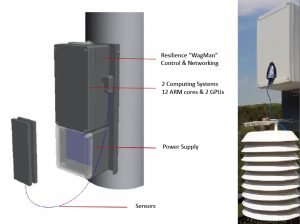 In Plano, city officials want to use the sensor network to help traffic flow and minimize vehicular air pollution. Smart technology is already being installed in the city’s infrastructure, so it’s not a huge leap to imagine installing their 40 sensors on a major roadway for 40 blocks in a row to see how traffic light timing and other variables can be adjusted to minimize internal combustion transportation pollution.
When you begin to realize that the system can not only report conditions, but learn from them and apply that learning to being able to guide not only your own personal health, but the public health policy for millions, you realize how transformational this technology can become. It has the potential to be the most important tool in fighting for cleaner air that we’ve ever seen – because it works from the bottom up and puts the power to change things in the hands of individuals instead of agencies.
We don’t always have to fight the bad guys head on – we can go around them. We can replace them. That’s what makes this network so sublimely subversive. It just leap frogs over an obsolete, regressive status quo.
We should know by the end of next month whether the participants in last week’s call were persuasive enough to convince the NSF to fund the DFW project. Regardless of that decision, the same consortium of colleges, cities and citizens groups is committed to building-out their own 21st-Century air quality monitoring network.
We Did It: After 15-Years of Persistent Organizing, Citizens Finally See Modern Controls on a Midlothian Cement Plant. And Now We Want It on All of Them
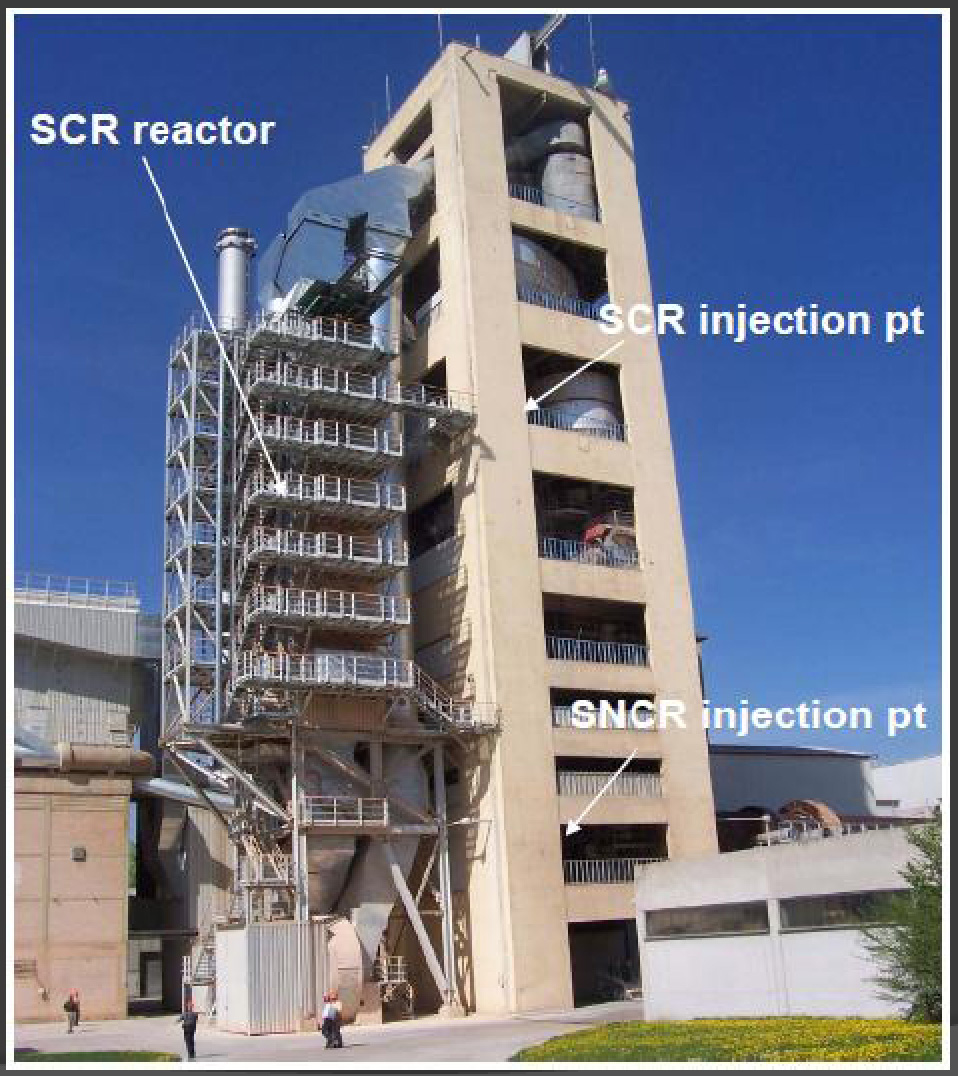
 Holcim is the first cement plant in the nation to voluntarily install an industrial catalytic converter called SCR on its smokestack, significantly cutting smog-forming air pollution in DFW.
But despite operating only 26 miles from EPA headquarters, the Agency and State of Texas still claim the technology isn't "feasible"
Downwinders is proud to announce Midlothian's Holcim cement plant is the first in the nation to voluntarily install pollution control equipment significantly cutting smog-forming air pollution, along with other dangerous emissions.
"Not many people may notice, but Friday is a big day for air breathers in DFW, as well as for everyone in the country who lives downwind of a cement plant," said Tamera Bounds, Chair of Downwinders at Risk, the clean air group that's been relentless in its pursuit of the technology for North Texas since 2001.
Friday marks the official deadline for Holcim's Midlothian cement plant to have its Selective Catalytic Reduction, or SCR system, up and running on one of its two giant kilns in order to be compliant with EPA emissions limits.
Although almost a dozen cement plants in Europe have installed the technology over the last twenty years and it's widespread in the American coal industry, Holcim is so far the only cement plant in the U.S. to install SCR on one of its kilns without a government mandate.
A pilot test using SCR at Midwest cement plant was required by a Department of Justice enforcement action in 2010. Results show smog-forming pollution was cut by at least 80% – roughly twice as much as pollution controls now in use in the US, including Midlothian. In Europe, SCR has a track record of removing 80-90% or more of the smog-forming pollution that has kept DFW in violation of the Clean Air Act since 1991. It also cuts the emissions of air toxics, particulate matter, and dioxins by double-digits.
With three cement plants and four kilns, Midlothian hosts the largest concentration of cement manufacturing in the US, and the largest "stationary" sources of air pollution in DFW. Since the late 1980's, the city has become a national battleground over cement plant pollution. First, over the use of hazardous waste as "fuel" for the local kilns, then over the closing of dirtier, obsolete "wet" kilns contributing to smog and climate change, and now over how fast new kilns can be updated to reflect 21st technology. 
Bounds and others say the installation of SCR on all four kilns in Midlothian would mean a huge benefit to public health for residents in Tarrant County, where the predominant winds push the plumes from the kilns. A 2009 Cook Children's Hospital study showed childhood asthma levels highest directly downwind of the cement kilns.
The demand for the technology is a central part of the group's push to replace the current State-sponsored anti-smog plan with a more effective, and protective, one from EPA. So far, Dallas County, the City of Dallas, two Congressional Representatives and a State Legislator agree with them. But incredibly, the Agency maintains the SCR technology Holcim has freely invested in to reduce pollution and is already operating less than 30 miles from its regional headquarters is not "technically feasible."
Downwinders and other groups in the DFW Clean Air Network regional alliance are challenging EPA's refusal to recognize a game-changing pollution control technology that could help DFW finally put its smog problems behind it a well as offering similar help to other parts of the country downwind of cement plants.
"It's rare these days to find the EPA embracing Texas' approach to ignoring advances in environmental science, but that's exactly what happening," said Bounds. "Both State and EPA officials are acting like 3rd Graders – closing their eyes and humming loudly, pretending this time-tested technology isn't operating right in front of them. But it does, and it's here to stay."
Bounds wants the EPA to take note of the cuts in pollution triggered by Holcim's operation of its SCR system and then hold ALL the Midlothian plants to the same modern standard. "You have a piece of equipment that is setting a higher bar for pollution control. Every cement kiln in DFW should have to meet that higher bar now. No other anti-pollution strategy makes sense."
It's been a long and circuitous route to getting SCR installed in a Midlothian cement kiln. Along the way, the region's clean air activists moved the entire nation closer to widespread use of this control technology.
North Texans first heard about the use of SCR in the cement industry through a citizens group fighting a proposed new cement plant in New York state in 2001.They'd commissioned a study from a NYC engineering firm identifying European cement plants that had already successfully installed the technology.
Downwinders tried and failed to include SCR in the anti-smog plan in 2003. It then used a 2005 settlement agreement with the State over the failure of that plan to get the then Rick Perry-controlled Texas Commission on Environmental Quality to perform an independent assessment of the technology. That landmark study produced results that are still reverberating today. In it, five independent experts chosen by Downwinders, the cement industry, and the State declared SCR to be ready for prime time.
"SCR is a commercially available technology. It offers the possibility of significant NOx reduction at the plants in Ellis County. As an 'add on' technology, which can achieve 90% or greater NOx reduction, with demonstrated performance at hundreds of coal fired power plants, SCR is a viable technology that is available for both dry and wet kilns."
That conclusion, from cement industry experts, in a TCEQ study, is now a decade old.
At the same time they were working to bring SCR to Midlothian, Downwinders also led the fight for new EPA emission limits on cement kilns that burn hazardous waste. A 2009 national hearing at DFW Airport attracted over 200 people. Those emission limits clamped down on air toxics. Holcim couldn't meet them without adding controls. They choose an SCR unit on one kiln and a thermal oxidizer (re: flame) on the other to try and stay in compliance. Even though Holcim installed SCR to address air toxics, or Volatile Organic Compounds and not smog pollution, the effect on emissions will be the same.
Meanwhile, the 2006 TCEQ study and subsequent push by Downwinders for SCR in Midlothian helped persuade the EPA to require the pilot test in 2010. That test, as well as Holcim's experience in Europe, set the stage for SCR's official debut on the Texas prairie on Friday.
"It's been a long fight, but change is hard," said Bounds, "and it doesn't happen in a straight line."
Help Us Celebrate This Victory That Was 15 Years in the Making
Please consider contributing $25 or more on "GIVING DAY" NEXT THURSDAY to keep us on the front lines of change another 15 years.
Giving Day is an all day online giving event sponsored by the Communities Foundation of Texas.
Downwinders will have our own online Giving Day page where you can click and give from 6 am through 12 Midnight next Thursday.
Every contribution of $25 or more is matched or extended by the Foundation.
This year, we need your support to keep our full-time staff in the field, as well as fund our 2nd annual Root and Branch Revue for activists, and assemble our North Texas Clean Air Forceof air-monitoring drones.
Oh yeah, we're also opening a school for organizers in January.
We're based in DFW. All our board members are from DFW. Our priority is DFW air. Your contribution stays in North Texas to fund the fight for clean air in North Texas.
We know you're being assaulted by Giving Day appeals from all the local non-profits, and there are lots and lots of good causes. We only request that you ask yourself how many other local groups can repeatedly pull off meaningful victories with so few resources?
We were able to bring SCR to Midlothian with your help. We need your help again next Thursday. We think we've earned it.
Thanks.
New Study: Premature Births Caused by Dirty Air Cost the US $4 billion a Year
 There are no shortages of studies linking bad air with birth defects and premature births. But until now no one has taken on the task of trying to add up the national toll in both lives and money.
In a study published in Environmental Health Perspectives on Tuesday, UCLA researchers estimated that almost 16,000 premature births across the country in 2010 — about 3 percent of the nationwide total of 475,368 — were related to exposure to high levels of "air polution" – in this case the insideous and ubiquitos Particulate Matter, or PM. These premie births cost the system $4.33 billion, including $760 million spent on prolonged hospital stays and long-term use of medications, as well as $3.57 billion in lost economic productivity due to physical and mental disabilities associated with preterm birth.
"For policy makers, decisions about regulating air pollution come down to a trade off between the cost of preventing air pollution and the health and economic benefits of limiting air pollution sources," study author Dr. Leonardo Trasande, associate professor in the Departments of Pediatrics, Population Health and Environmental Medicine at NYU Langone Medical Center. "Without data documenting the health effects of air pollution on preterm births, there's only one side to that discussion. So what we did was to quantify the disease burden and economic cost associated with preterm birth that could be traced to air pollution."
Developing fetuses are very vulnerable to pollutants of all kinds. That's why doctors tell women not to smoke during pregnancy. Exposures to high levels of air pollution increases toxic chemicals in the blood and can weaken the immune system, causing stress to the placenta and leading to preterm birth (defined as birth before 37 weeks of pregnancy)
PM pollution represents a threat because the particles are so tiny and fine they pass from your lung right into your blood stream and go where ever the flow takes them – to your heart, your liver, your brain. PM can also act as a kind of toxic suitcase for whatever other polutants came out of the same smokestack or exhaust pipe – metals, endocrine disruptors, etc.
Premature babies face greater risk of health issues including heart and breathing problems, weaker immune systems, anemia, jaundice and other complications. Longterm, while many preemies grow up healthy, they can be more likely face hearing or vision problems or developmental disabilities.
The study authors emphasized that this burden is preventable and say they plan to share their findings with policymakers in an effort to help shape regulations and laws designed to reduce air pollution.
"This really speaks to the need to continue with efforts to reduce air pollution from coal-fired power plants and vehicle exhaust," Trasande said. We have some of those in Texas.
EPA Rejects Texas’ BS and Submits Its Own Air Plan for Parks. Will It Do the Same For People?
 As you might have already heard, last week the EPA announced it was rejecting Texas' proposed rapid-response,140-year plan for restoring air quality and visibility in National Parks affected by pollution from the state's largest industrial facilities, primarily coal-fired power plants, aka, "the haze rule."
Instead, the EPA decided to implement its own, slightly more decisive plan for action. Whereas the state concluded it needed no new controls on any coal plants, the EPA is requiring modern Sulfur Dioxide (SOx) scrubbers on 14 different boilers at nine power plant sites across the state it estimates will remove 230,000 tons of the pollutant annually. That's 60% of the state's total SOX pollution, and 7% of the nation's.
These scrubbers not only capture SOx on behalf of more beautiful vistas in Big Bend, they also do a good job of preventing lots of Particulate Matter pollution from reaching the lungs of people that live in between the coal plants and parks. Although computer modeling was used by EPA to determine the effectiveness of the scrubbers it's requiring, it focused on results inside the parks. Getting results for metro areas like DFW involves a lot of data mining nobody has done, but there's no question that if reductions in air pollution are helping Oklahoma and West Texas parks, they're also helping out the air in North Texas. Just one look at the modeling maps produced by our recent UNT study of DFW ozone shows the immense impacts of these plants on DFW air quality.
For residents of DFW, the reductions in pollution are overdue and welcome news (the process leading up to this rule can be traced all the way back to 1977), and it certainly makes it even less likely that the big bad old TXU plants (Big Brown, Monticello and Martin Lake) can escape their obsolescence after bankruptcy proceedings.
But the way the EPA determined to go it alone in this case may be much more important to DFW's own air quality in the long run as the actual reductions it implements.
Not to put too fine a point on it, but EPA called BS on the way Texas was obscuring the data needed to write a good haze rule plan. This M.O. sounds awfully familiar to citizens watching the way the State has drafted its anti-smog plan for DFW, now officially approved by the TCEQ Commissioners and on its way to a public hearing in Arlington on Thursday, January 21st (6 pm, HQ of North Central Texas Council of Governments, 616 Six Flags Road).
And if EPA is willing to stand-up to Texas over air quality in parks, shouldn't it take at least as strong a stand on behalf of seven million souls in DFW?
About the same time EPA was announcing a federal takeover of the haze rule plan, Downwinders released its new video appealing for help from the EPA to reject the State's do-nothing smog plan for DFW. A big part of our case is its reliance on faulty analysis and downplaying or obscuring evidence that contradicts the state's ideological position that no new pollution controls for smog are needed in a region in its third decade of continual violation of the Clean Air Act and after a summer where smog averages increased…twice.
Which makes the language EPA uses to justify this takeover of the haze rule plan all the more relevant, and gives residents some hope should the Agency apply the same logic to the State's pathetic response to DFW's chronic smog problem.
EPA accuses Texas of hiding the most effective control strategies from EPA and Oklahoma (where the Wichita Mountains Wildlife Refuge is affected by Texas-based pollution seven times as much as Oklahoma-based SOx) by flooding its emissions inventory data with both large and small sources of SOx from across the state, washing out the impact of the larger coal plants.
"During the interstate consultation required by the Regional Haze Rule, Oklahoma and Texas discussed the significant contribution of sources in Texas to visibility impairment at the Wichita Mountains, but Texas concluded that no additional controls were warranted for its sources during the first planning period to ensure reasonable progress at the Wichita Mountains, or at its own Class I areas, the Big Bend and the Guadalupe Mountains National Parks.
In reaching this conclusion, Texas relied on an analysis that obscured the benefits of potentially cost-effective controls on those sources or groups of sources with the largest visibility impacts in these Class I areas by inclusion of those controls with little visibility benefit, but which served to increase the total cost figures.
This flawed analysis deprived Oklahoma of the information it needed to properly assess the reasonableness of controls on Texas sources during the consultation process and prevented Texas from properly assessing the reasonableness of controls to remedy visibility at Big Bend and the Guadalupe Mountains.
A few pages later EPA reiterates the charge,
Texas’ analysis was deficient and not approvable because the large control set it selected was not appropriately refined, targeted, or focused on those sources having the most significant and potentially cost-effective visibility benefits. We conclude this control set included controls on sources that would increase total cost figures, but would achieve very little visibility benefit…because Texas only estimated the visibility benefit of all the controls together, it was not able to assess the potential benefit of controlling those sources with the greatest visibility impacts, and potentially cost-effective controls. Therefore, the effects of those controls with the greatest visibility benefits were obscured by the inclusion of those controls with little visibility benefit. This only served to increase the total cost figure, making Texas’ potential control set seem less attractive.
In analyzing whether additional controls should be required for some of its sources under the long-term strategy provisions of the Regional Haze Rule, Texas relied on the same flawed analysis discussed above that it relied on to evaluate additional controls under the reasonable progress provisions to address visibility impairment at Texas’ own Class I areas. Texas’ analytical approach obscured the contributions of individual sources that Texas’ own analysis indicated could be cost-effectively controlled.
This deprived Oklahoma of the information it needed to properly assess whether there were reasonable controls for Texas sources and to properly establish reasonable progress goals for the Wichita Mountains that included the resulting emission reductions.
That's just about as plain an outline of a state government conspiracy to avoid complying with the Clean Air Act as the EPA puts in print. And it sets the stage to examine the State's DFW air plan using the same fine-toothed comb for rooting-out analytical crap meant to obscure inconvenient facts on the ground.
For example, the State's conclusion that no new controls for smog are warranted is based on an analysis of what's "reasonably available" that's every bit as flawed as anything dreamed up by Austin for dodging its responsibilities to national parks. It ignores modern controls already operating on cement kilns, gas compressors, and coal plants – to the point of not even mentioning the permitting of these controls by the TCEQ itself.
Moreover, hard as it is to believe, the state's conclusion on smog controls is based on no modeling of the impact of those controls on air quality. That was left up to Downwinders and its UNT study, using the state's own computer modeling. What that effort provided was nothing less than a road map for how to get the most cost-effective cuts in smog by reducing pollution from those kilns, coal plants, and compressors. This is information the state could have gotten if it wanted it, but it didn't want it because it disputed the ideological position that no new pollution controls for industry are justified. It knew if it looked, it would have to release the results. So it just didn't look.
Finally, the state is still claiming that its plan will get DFW "close enough," to the 75 ppb standard, clocking-in at 77.8 ppb. So the plan doesn't even accomplish its goal. That makes it completely indistinguishable from the last five state air plans for DFW. What the State is counting on is EPA giving them credit for a wish list collection of unquantifiable stuff under the regulatory category of "Weight of Evidence." This is exactly the same strategy used in past plans. Ride new changes in federal law as far as you can and convince the EPA that "trends" are in your favor to make up any slack.
Only this time, "trends" may be working against the State. The summer of 2015 saw an increase in regional smog averages, indicating that perhaps its do-nothing approach isn't working. If you combine this information with the fact that smog levels also rose during the last do-noting plan from 2011, you have some "trends" crying out for an EPA takeover.
Since the TCEQ has approved its DFW air plan for submittal to EPA, we won't have to wait long to find out what the Agency's response will be. Public comments are due by January 29th. Let's hope EPA's review of an air plan for people's health in the nation's fourth largest metropolitan area is as rigorous as it was for the one looking out for visitors to the Wichita Mountains.
Study: Combusted PM Pollution Up to Five Times as Lethal As Non-Combusted Kind. Burning is Bad.
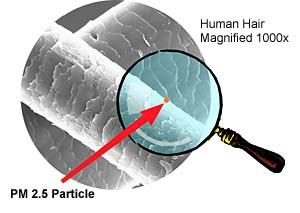 Long term exposure to small particulate pollution from combustion sources, specifically coal-fired power plants, is up to five time more likely to kill you through heart damage than other forms of natural or human-made "PM."
That's the conclusion of new comprehensive study comparing risks from breathing-in the tiniest specs of soot from combustion sources for over 450,000 Americans in 100 cities from 1984 to 2014. Published in the journal Environmental Health Perspectives this month to coincide with the Paris climate talks, the study has ten co-authors and promises to be a milestone in the long fight to reduce this form of pollution.
Combustion of any sort releases fine and ultra-fine particles of soot, or "Particulate Matter" in the often antiseptic regulatory-speak of environmental regulation. These specks differ from dust particles or fireplace soot in that they're much, much smaller and so can be inhaled deeper into the lungs, and then, even pass from the lungs into the blood steam to affect other organs and systems. It's their tiny size that makes PM pollution dangerous on its own. Over the last 30 years, scientists and public health officials have gone from being worried about PM 10 (10 microns or less), to PM 2.5 (2.5 microns or less – about 100th of the width of a human hair), to Ultra-fine Particles.
But soot from combustion also carries residues of whatever was being burned in the facility it came from, and this makes it doubly toxic. If you're burning coal, the soot might carry bits of Mercury, Arsenic, Cadmium and Lead, for example. The new study says that difference is what really drives up risk for people breathing-in coal plant PM.
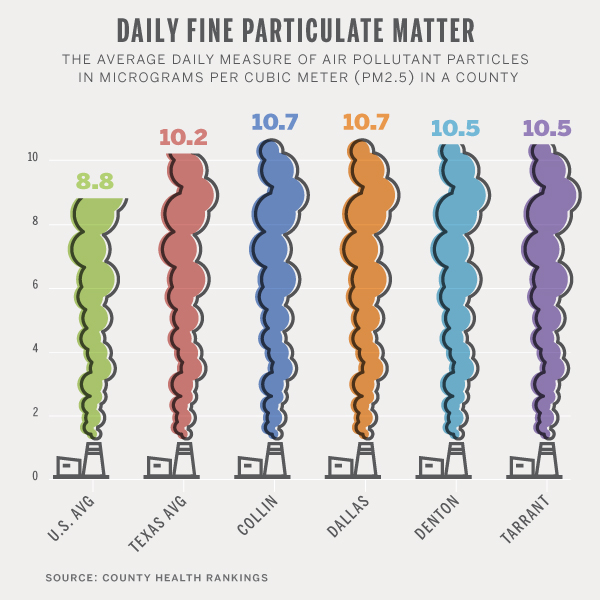
Locally, DFW is chock full of large industrial sources of combustible PM.
We're surrounded by five coal plants in an arc on its northeastern to southeastern side. That means we're downwind of their pollution, including their particulate matter pollution, most of the year. Their impact on local smog levels has recently been chronicled by Downwinders' study from UNT.
PM Pollution would follow approximately the same patterns although heavier particles fall closer to the source, while the really fine particles drift for hundreds or thousands of miles. Luminant’s 2013 Emissions Inventory submission reports 1400 tons of 2.5 particulate matter in a single year at its Big Brown plant. And that may be a severe underestimate. Big Brown’s two Units have exceeded the Texas SIP’s opacity limit of 30 percent on thousands of occasions over the past decade.
Luminant's Martin Creek plant released 2,018 pounds of mercury into the environment in 2013, according to the Toxic Release Inventory, and in fact Texas hosted the top three mercury polluters among all coal plants in the US that year.
Closer in, there's the three Midlothian cement plants with a total of four kilns now. Modernization and controls forced by 20 years of campaigning by Downwinders have brought the numbers down dramatically, but they're still huge facilities that deal in both a dusty raw material, and burning lots of coal and industrial wastes like tires and used oil, and even car parts, to turn that into a higher grade of raw material. When you burn exotic materials with coal, you turbocharge the toxicity of the PM pollution even more. In 2013, the last year the state has numbers posted online, the three cement plants released approximately 440 tons of 2.5 PM pollution.
But cement plants weren't included in the study and so the risk evaluations in it for DFW are underestimated.
Midlothian is also the home to the very large French-owned Amersteel (formally Chaparral Steel) secondary steel mill and steel mills were included as a source category in the study and were also associated with a higher mortality rate. Just about every 18-wheeler trailer you see on local highways loaded with crushed cars is headed to this facility – across the street from the TXI cement plant. Imagine the residues on the soot from melting down thousands of used cars into liquid metal. In 2013, the plant released 133 tons of PM 2.5.
But by far, the largest PM polluter in the DFW area, bar none is the Owens-Corning fibreglass plant in north Waxahahchie, along I-45. It released a whopping 300 tons of PM 2.5 pollution in 2013 alone. No other facility comes close – not the cement plants or the steel mill down 287. Not the GM plant in Arlington. It's not known how much of Owens-Corning PM is combusted however. It could be from the manufactiuring process.
Diesel engines in vehicles were also included, and the study found they has an association with higher mortality, but not nearly as significant as coal plants or steel mills. There's been a steady stream of studies tying highway pollution to respiratory and neurological illness among near-by populations, especially children. Most of the risk is assigned to PM pollution, and most of that is coming from diesels.
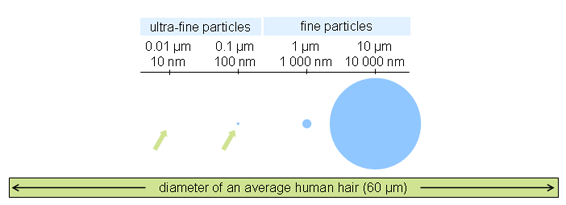
Just as important as the conclusion that coal-combusted particulate matter is significantly more dangerous than your average speck of dust is the study's indictment of current EPA risk assessments that operate on exactly the opposite assumption. The authors are critical that the Agency still weighs the risk of desert dust the same as combusted soot in computing long-term human health effects.
There are potentially enormous public heath and policy implications for North Texans in the study's conclusions.
First, the campaign to get the most modern anti-smog controls included in the latest DFW air plan has the side benefit of reducing PM pollution too. Selective Catalytic Reduction (SCR) on the cement kilns and coal plants decreases smog-forming pollution by up to 90%, and makes an effective additional PM catcher as well, increasing soot capture by 30-50%. The technology is particularly effective on the kind of PM that carries dangerous heavy metals like Mercury. Of course, retiring already-obsolete coal plants would eliminate the threat all together.
Likewise, electrification of compressors would not only lead to decreases in smog-forming emissions, but PM pollution from those sources as well.
Next, it means the already large public health costs of bad air in DFW just published by Dr. Robert Haley of UTSW in his own study are severely underestimated, since they were based on the EPA's own risk assessment software that doesn't weigh the harm of coal power plant PM differently from any other speck of PM 2.5. Adjust those numbers for the exposure to toxic soot and you could see a huge increase in lives lost, illness caused, and dollars spent.
Finally there are implications for almost very other source of combustion around – burning is bad. Where's there's a flame, a boiler, a furnace, a process that means burning something to get something in return, there's going to be PM pollution. What you burn is as important as how you burn it. Burn coal and get the residues of coal on the PM. Burn hazardous waste, and you get the residues from those wastes on the PM. Burn diesel fuel in your truck or car and get residues from that fuel mix packed away in your particulate matter.
As one of the major authors of the study said, if you want to do something about this kind of pollution – start with the most toxic forms of combusted PM. Those mostly come from large industrial sources – the coal plants, cement kilns, and compressors already in our sights because they're also smog polluters. We knew they were a problem. Now we know even more about why they're a bigger problem.
Expect Obama’s New CO2 Plan to Close Those Nasty East Texas Coal Plants? Don’t.
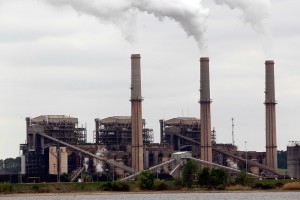 By this point, most of you will have been inundated with opinions and factoids about what President Obama's new "Clean Power Plan" will and won't do about climate change. Bottom Line: while it sets a precedent and an emissions floor for the largest sources of CO2, it does so in a way which turns out to be not so challenging for most states – including Kentucky deep in Coal County.
That's also true for Texas, where besides being Ground Zero for the fracking boom, we also have plenty of wind power and some solar. According to the EPA, the state must cut an annual average of 51 million tons of carbon to reach its target, a reduction of about 21 percent from 2012 emissions. We're well on our way to achieving most of that reduction with current or planned wind, gas, hydro, and solar. (In what might be a first concession that natural gas shouldn't be a long-term "bridge fuel," some analysts think tweaks performed by EPA prior to the Plan's release give more incentives to adopt real renewables earlier rather than leaning on gas in the interim.)
This is mostly good news. We want the wind and solar economies to grow. The trade-off is that, under Obama's Clean Power Plan, the rise of these technologies and their emissions reductions lets the obsolete East Texas coal plants off the hook because you don't need them to close to meet your CO2-cutting goals.
Five of those obsolete coal-fired power plants surround DFW's eastern side in a half circle (Big Brown, Martin Lake, Monticello, Limestone, and Welsh). They are, without a doubt, the worst examples of fossil fuel-generated pollution in Texas. They're huge emitters of Mercury, Particulate Matter (PM), Sulfur Dioxide (SOx), and Nitrogen Oxides (NOx).
These five East Texas coal plants are projected by the state to still be releasing 150 tons a day of smog-forming NOx pollution in 2018. Because of wind direction and volume, that pollution has a very large impact on DFW air quality – probably more than any other single phenomenon. We need those coal plants to either modernize or close ASAP to help solve our chronic smog problem. But from the initial survey of the policy, the Clean Power Plan is not going to force that outcome.
While the Plan probably signals the end of any new coal plants any time soon, or at least none without CO2 solutions like sequestration or capture, the fate of existing coal plants, especially in a state like Texas, is more ambiguous. More likely, they'll continue to linger on, beneficiaries of friendly state-created policies designed to nullify the requirements of the Clean Air Act, like loosening their PM limits by magnitudes.
Now, you might think that a federal goal that's been mostly accomplished without doing anything new would be a no brainer in Austin, but there are increasingly fewer and fewer brains in Austin. Because the state's environmental agencies are now completely ideologically driven, common sense just isn't a factor anymore. Instead of asking "how can we best solve this problem?" the response is now to deny there's a problem at all and go about ginning up anti-federal hyperbole to better position yourself in the Republican Primary.
Consequently, the Texas Commission on Environmental Quality is seriously considering not turning in a required state plan of how to get the reductions needed by the deadline of 2030. If the state doesn't submit one of its own, then the EPA would write one for them. This has the business community in Texas a little nervous, since they have a lot more influence here than in DC. But citizens, which kind of anti-climate change plan would you rather have Texas abide by – one written by a state agency that denies climate change is happening and is doing everything it can to obstruct policies to prevent it, or one written by a federal agency that's actually acknowledging the obvious and doing something about it?
Regardless of whose plan does what by when, the East Texas coal plants look to be able to ride this federal policy out thanks to an almost two-decade homegrown drive to open up the state to renewables. If we want these coal plants to stop causing problems for us, we're probably going to have to find other leverage points.
One of these leverage points is demanding the state of Texas follow the law and require the coal plants install modern Selective Catalytic Reduction controls as part of the new DFW clean air plan it submitted to EPA this summer for approval. SCR could reduce smog pollution from these plants by 90%. So far, Texas has refused to even acknowledge the need to do so. EPA has requested the state change its mind – without success.
If it wants to, EPA can reject the state's plan for not including these new controls on the coal plants. But we have to encourage them to do so – by petition, and by e-mail.
Consider the five East Texas coal plants the energy sector equivalent of the obsolete "wet" kilns in Midlothian that burned hazardous waste for 20 years. They're technological dinosaurs, on their last legs, but still churning out tons and tons of harmful air pollution as they plod their way to the bone yard. The Clean Power Plan insures they'll be the last of their kind, but it's not a silver bullet.
Study: PM Pollution is an “Environmental Neurotoxin” to Brain
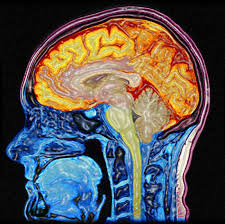
 It was just two months ago we featured the results of a study out of Boston that linked exposure to Particulate Matter, or PM pollution to brain aging and increased risk of dementia. Before that, we highlighted studies linking PM to autism and Parkinson-like symptoms. Now comes one more long-term, peer-reviewed report that connects ambient levels of the pollution to accelerated brain aging.
This one is from the University of Southern California and looked at over 1,400 women without dementia who were initially enrolled in a large health study from 1996 to 1998. Researchers measured their brain volume with M.R.I. scans in 2005 and 2006, when the women were 71 to 89 years old.
Using residential histories and air pollution monitoring data, they estimated their exposure to PM air pollution from 1999 to 2006. For each increase of 3.49 micrograms per cubic centimeter (μg/m3) cumulative exposure to PM, there was an associated 6.23 cubic centimeter reduction in the subject's brain white matter, the equivalent of one to two years of brain aging. The current EPA standard for 24 PM exposure is 35 μg/m3, while the annual average standard is 12 μg/m3, although many leading scientists now believe there's no "safe" level of exposure to PM pollution. That is, any amount of exposure is capable of doing some damage.
The association between pollution exposure and brain aging in the USC study remained after adjusting for many variables, including age, smoking, physical activity, blood pressure, body mass index, education and income.
“This tells us that the damage air pollution can impart goes beyond the circulatory system,” said the lead author, Dr. Jiu-Chiuan Chen, an associate professor of preventive medicine at the Keck School of Medicine at the University of Southern California. “Particles in the ambient air are an environmental neurotoxin to the aging brain.”
It's important to note that all of these women were subject to ambient levels of PM pollution, that is, levels that we're all being exposed to on a daily basis living in the modern world. Everyday kinds of exposure to this substance is making our brains age prematurely.
What makes PM pollution dangerous to human health is the fact that its soot particles are so tiny that they can actually cross from the lungs into the blood stream and travel anywhere in the body, including the brain. Soot is a toxic substance on its own, but when its carrying the residues of whatever was burned to produce it – benzene in a combustion engine, mercury from the coal in a power plant, dioxins from "hard to recycle plastic waste" in a cement kiln – it becomes even more dangerous.
While PM pollution remains an important factor in respiratory diseases, heart attacks and strokes, the more insidious effects to the brain it causes are raising its profile among policymakers and activists. They have implications for zoning highways near schools, parks, and residences, as well as pollution control measures at industrial facilities.
PM is one of the best examples of "the closer we look, the more trouble we find" phenomena in environmental health science. Advances in technology and medicine show that subtle changes in exposure to chemicals that went unnoticed before can have profound consequences to our species.
“Normal Levels” of Air Pollution Increase Risk of Dementia
 Supporters who saw us out and about for Earth Day events could come by the table and pick up a new flyer of ours that cites at least four recent studies linking dirty air to Autism and other developmental disorders in children.
Now comes a study that suggests the other end of the age spectrum is also adversely affected by the same phenomenon – that the brains of middle aged and older adults are subject to accelerated aging from exposure to "normal levels" of particulate matter (PM) air pollution in cities.
Writing in the May issue of "Stroke," researchers with the Cardiovascular Epidemiology Research Unit of Beth Israel Deaconess Medical Center in Boston described the results of a long term study of more than 943 men and women at least 60 years old and free of dementia and stroke histories. Those subjects living near "major roads" and exposed to "normal pollution levels" suffered cerebral shrinkage, ageing their brains by the equivalent of one year, and increasing their dementia risk. Small increases in particulate matter (PM) air pollution – an increase of only two microgram per cubic meter of air was sufficient to increase the risks.
"Exposure to elevated levels of PM2.5 was associated with smaller total cerebral brain volume, a marker of age-associated brain atrophy, and with higher odds of covert brain infarcts. These findings suggest that air pollution is associated with insidious effects on structural brain aging even in dementia- and stroke-free persons. "
Researchers said the exact causality was unclear, but that it might be that inflammation as a result of the deposit of fine particles in the lungs resulted in the increase in risk.
PM pollution is microscopic particles of soot – 1000th of the width of a human hair – emitted by combustion of all types: gasoline and diesel engines in vehicles, as well as boilers and furnaces in cement kilns, power plants and flares. PM 2. 5 refers to the size of the particle – at least 2.5 microns or smaller. The larger the road, the more traffic, the more internal combustion engines pass by releasing their PM pollution. Other studies – including the ones on our Autism flyers – have found a relationship between proximity to roads and brain disorders in children.
Professor of Neurology Dr Sudha Seshadri at Boston University School of Medicine said: "On average participants who lived in more polluted areas had the brain volume of someone a year older than participants who lived in less polluted areas." They also had a 46 per cent higher risk of silent strokes. "This is concerning since we know that silent strokes increase the risk of overt strokes and of developing dementia, walking problems and depression.”
Last year researchers suggested that commuters could cut their air pollution intake in half simply by using the side streets in major cities rather than main roads.
Dr Rossa Brugha, a paediatrician and pollution researcher at Queen Mary, University of London, said walkers and runners can make small adjustments to their route which could have major benefits on their health.
With the growing body of evidence that proximity to heavy traffic is detrimental to public health, the siting of new housing and schools should also be impacted by urban planners and developers, as well as give momentum to those who want to re-examine the need for large highway projects in densely-populated areas.
Even a Single Day of Air Pollution Increases Stroke Risk
 When environmental health advocates speak about the dangers of dirty air, the effects are often categorized as long term and cumulative. But the more scientists delve into the subtleties of the human body and what outside influences can do it, the more they realize that even short term exposures can be harmful. That's been especially true lately when looking at pregnant moms and the exposure to fetuses in certain stages of development. Not it turns out to true when looking at the other end of the age spectrum.
A new examination of 103 studies involving 6.2 million stroke hospitalizations and deaths in 28 countries published online at the BMJ (British Medical Journal) found that almost every type of industrial air pollution contributed to a higher risk of stroke. And the higher level of exposure to the pollutant, the higher the risk of stroke.
Increases in the levels of Nitrogen Dioxide, Sulfur Dioxide, Carbon Monoxide and fine Particulate Matter were all associated with increases in strikes and hospitalizations. Not surprisingly, the strongest correlations were on the day of actual exposure, but the effects of PM, otherwise known as soot, were longer lasting. Missing from the list is ozone, or plain old smog, which studies have shown increases asthma and heart attacks on its own.
According to the report, strokes account for five million deaths worldwide every year and cause en even greater number of disabilities.
The lead author, Dr. Anoop Shah, from the University of Edinburgh, said that there was little an individual can do when there's a bad air day going on but stay indoors
“If you’re elderly, or have co-morbid conditions, you should stay inside,” he said. But policies leading to cleaner air would have the greatest impact, he said. “It’s a question of getting cities and countries to change.”
Are Environmental Causes Behind a “Pandemic” of Child Brain Disorders?
 Anecdotally you may have heard commentary from a friend about the large numbers of kids in their child's age group who seem to have something wrong with their brain – ADHD or Autism for example. Turns out, there's some solid statistical evidence those conditions are on the rise.
According to the U.S. Centers for Disease Control, almost two million more children in the U.S. were diagnosed with developmental disabilities in the mid-Oughts than in the mid-1990's. This same decade saw autism climb nearly 300 percent, while that of attention deficit hyperactivity disorder increased 33 percent.
In total, the CDC concludes that 10-15 percent of kids born in America have some type of "neurobehavorial development disorder" and many more were have milder afflictions that don't necessarily rise (yet) to the level of an official diagnosis. These rising numbers are why some leading researchers are saying we're experiencing a "pandemic" level of child brain disorders.
Genetics are believed to account for as much as 30-40 percent of that increase (whether it's genetics or "epigenetics" isn't examined). However, study after recent study also suggests that environmental exposures play a significant role.
Last month, Journalist Elizabeth Grossman wrote about the insidious impact of toxins on the brains of children, either while they're still in the womb or in their early years as their brains are still developing. She describes both indoor and outdoor exposure pathways that offer a multitude of opportunities for kids or pregnant mothers to be exposed to chemicals that can have both subtle and profound impacts on brain behavior.
There are the bad ones we know so much about but can't seem to eliminate from the marketplace, like lead, that still turns up in plastic "softeners" and imported paints. But there's also the threat that grows from fine particulate matter with almost every new research effort published, as well as more ubiquitous chemicals used in fire retardants (PBDEs) plastics (BPA and phthalates), and "perfluorinated compounds" used in stain resistant coatings and pesticides.
Only since the 1980's have scientists realized how much more vulnerable the brains, and hormones, of kids are to the impact of toxins. Even "low levels" of exposures at the wrong time in fetal development can have big consequences. One research is quoted by Grossman as saying that "timing determines destination."
In terms of air pollution, there are now numerous studies linking Particulate Matter (PM) pollution to Autism, including one published as recently as December from the Harvard School of Public Health showing that mothers exposed to high levels of the pollution were twice as likely to give birth to children diagnosed with the disorder.
Pregnant moms exposed to high levels of Polycyclic Aromatic Hydrocarbons, or PAHs – another by-product of burning stuff – were five times more likely to raise children with Attention Deficit Hyperactivity Disorder according to a recent study published by Columbia University's Mailman School of Public Health.
When you combine these air pollution threats with the retardants on the furniture we buy, the residues of pesticides on the food we eat, and the plastics we eat and drink from, the world looks like a very hostile place for developing minds.
No matter the exposure pathway, the problem is the old familiar one of an outdated and slow-moving regulatory system dealing with a marketplace where thousands of new chemicals are introduced without proper health screenings for fundamentals like cancer, much less their more subtle impacts on children's brain development. The ability for chemicals to cause harm is outracing the mechanism in place to prevent them. We're still reacting to being poisoned instead of being proactive about preventing it.