Posts by Downwinders At Risk
Notice Something Missing So Far This Summer? Smog Alerts.
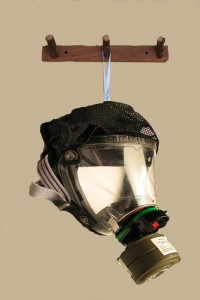 Along with cooler weather in general and a little more rain this Spring has come some relief from really dirty air in DFW.
Last year at this time, we'd already had 6 "exceedences" of the old 1997 85 parts per billion ozone standard in May, and countless exceedences of the tougher new 75 ppb standard that is supposed to be attained by 2018. As of today, we haven't had one even one monitor reading above 85 ppb and only a handful in the 75 to 85 ppb range.
For the last two years in a row, DFW has seen a decrease in air quality, and an increase in smog. Could 2013 be the year that trend is halted?
Weather takes a lot, or even most of the credit. Cooler temperatures and more moisture are not conducive to ozone creation. But unlike during the recession, new car sales seem to be taking off the way the Rick Perry-approved engineers at the Texas Commission on Environmental Quality wanted them to two to three years ago. It's possible that the replacement of older dirtier vehicles with newer, cleaner ones by the thousands has finally made a difference you can't see. There's also the impact of cleaner operations at the Midlothian cement plants thanks to citizen victories over the last decade, (although the kilns are rapidly turning back into garbage burners), fewer coal burning plants downwind, and other improvements up and down the southeast to northwest axis that carries our predominant winds from Houston to here.
On the other hand, last June was pretty quiet until the 24th, and then all hell broke loose, with ozone levels into the triple digits. 2012 turned out to be a very bad year for safe and legal air.
And there's the unknowns that nobody's really examining closely – at least not in public. How much ozone pollution is being caused by the natural gas infrastructure in the Barnett Shale that's been built over the last decade and gets bigger every week? How much is the gas industry polluting upwind of us in places like Freestone County between here and Houston? Does the continuing boomtown growth in DFW population cancel out the improvement in individual vehicle emissions?
From a regulatory point of view, no matter how good or bad this summer is, we don't get credit for it either way. Another bad year wouldn't be held against us. Likewise, no violations this entire year wouldn't buy us any more goodwill from EPA. We're in a limbo period, where everyone is just waiting around for the average readings from 2015 -2018 to accumulate and tell us what category of compliance with the new 75 ppb standard we're in. While it would certainly help the cause if the region had some forward momentum in lowering the levels of smog going into 2015, officially, it makes no difference at all – unless you're breathing air. Then, according to EPA's own scientists, anything above 65-70 ppb is damaging to human health.
Theoretically, the TCEQ is supposed to be putting together yet another "DFW clean air plan" to reach that 75ppb standard, to be implemented sometime between now and 2015. The last time it tried to reach such a regulatory goal – the 85 ppb standard – it ended up with a plan that worsened air quality here by starting way too late and basically doing nothing but watching as new cars were going to clean up the air in the middle of a recession. (By the way, the "official" regulatory date of that failure is coming up next week even though the failure was certain last summer. Stay tuned to see if TCEQ acknowledges it in any way).
It's the summer of 2013. Any big changes that need to be in a summer of 2015 clean air plan should be being discussed and set in motion now, especially if they need 2015 state legislative approval, or lead times for industry to adapt. However, state or regional officials have yet to call a meeting of the local advisory group that's supposed to be monitoring the development of that plan. No date is set for such a meeting.
We can hope that a confluence of circumstances is making it possible to have cleaner air in DFW, but as long as Rick Perry is Governor, it's unlikely such an important public health goal will override political agendas.
Why Exide Going Bankrupt Could Be a Good Thing
 A months-long deathwatch surrounding Exide Technologies got a little closer to its climax on Thursday with a Wall Street Journal story quoting "people familiar with the matter" as saying the company was preparing to file for bankruptcy for a second time in a decade sometime this summer.
The original article is behind the Journal's pay wall, but it provides some details as to how the mechanics of such move would work. For one thing, the company's European operations won't be affected at all, according to the story. That's a hint that the company wants to find a way to fully separate its substantial US environmental liabilities – including the toxic waste dump formally known as the Frisco lead smelter – from what it considers to be its more salvageable parts.
Exide is carrying approximately $700 million in debt and many financial analysts doubt its ability to repay a $56 million note due in September. Thus, the summer timing. There was also probably some consideration to cash out while there was still some cash left. Shares of he company were selling for a record low of 34 cents on Thursday. It's last quarterly report in December 2012 cited a $15.4 million loss compared to a profit of $68 million in 2011.
Meanwhile, the company is providing plenty of work for lawyers and bankers:
Restructuring lawyers at Skadden, Arps, Slate, Meagher & Flom LLP are working with the company, while law firm Akin Gump Strauss Hauer & Feld LLP is advising an independent board committee, the people said. Paul, Weiss, Rifkind, Wharton & Garrison LLP is working with some bondholders and Andrews Kurth LLP is working with convertible-note holders, these people said.
Turnaround firm Alvarez & Marsal is working with the company, investment bank Houlihan Lokey is working with some bondholders and Moelis & Co. is working with convertible-note holders, they added.
Even money that the company has already spent more on this effort than they have cleaning up their mess in Frisco.
While completely predictable, this development now puts the City of Frisco at a crossroads for which it's not prepared.
Exide had no intention of rehabilitating or cleaning-up its Frisco smelter site – the part that still has decades and tons of lead contaminated waste buried in the ground – to provide for normal redevelopment. Even assuming the company and City are completely successful in cleaning up the outer zone of smelter property that the City is buying, there's no such plans for the 100 acres or more of hardcore toxic smelter property that was the core of the operations – and which has Stewart Creek running through it. The same Stewart Creek that runs from Exide into the proposed Grand Park. No matter how much the City tried to put a pretty bow on this situation, it still left a big toxic turd floating in the punchbowl, for which there was no contingency plans.
The upside of an Exide bankruptcy is that now the company won't be able to hold the rest of the City hostage by keeping the site a toxic dump forever. Because it won't own it anymore. Going belly up means there are other options besides the ones Exide was dictating because of its ownership.
On the other hand, bankruptcy for a company such as Exide usually means its environmental liabilities are absorbed by the taxpayers via the federal Superfund Site list. Exide already owns an abandoned local lead smelter. Dixie Smelter in South Dallas closed in 1990 as a result of the city's crack down on inner city lead smelters. It's been a fenced-off no man's land ever since. This is what Frisco city officials dread now. Once it's listed for clean-up it may take decades for it to actually happen. The result is the same as if Exide never lost ownership – you still have a toxic waste dump with the Creek running through it on the way to your new regional park.
What to do? The big difference between this lead smelter site and the ones in Dallas is location. Although originally sited on "the other side of the tracks" in Frisco, the city has transformed itself into the North Texas suburb of choice, to the point where the smelter property is now surrounded by exclusive gated communities and malls.
The City should use this fact, and this brief moment before actual bankruptcy, to work with Exide, the EPA, private developers who specialize in reclaiming contaminated sites, and local banks to formalize a plan to completely clean up the entire Exide smelter site in return for being able to build a signature project that will connect Grand Park to Downtown Frisco. Imagine if the smelter and its waste wasn't there on the property – immediately on the North Dallas Tollroad, with a creek running through it, connected to the city's signature green space. It would be another Los Colinas.
The problem, and its a huge one, is to assemble the considerable money it would take to clean the property, while also raising the money it would take to actually build the project, and assume liability for whatever surprises might be found on site in the future. Frisco could do its part by giving generous tax breaks to the developers. EPA could do its part by easing regulatory requirements for transfer. Exide could do its part by selling the land to the City for $1 so that Frisco could concentrate its resources on rehabilitation, not purchase price. There is now considerable self-interest to work a deal that wasn't there before the Exide bankruptcy.
The point is, Frisco officials must be able to answer the question: What's the ultimate plan for Exide property? To let it sit as a toxic waste dump? To let it sit as a toxic waste dump next to a new park that features the same creek that runs through the toxic waste dump? Or is there something more that can and should be done?
City Hall showed a great deal of creativity in drawing up the agreement that resulted in shutting Exide's outlaw smelter operation down. It now needs to exert the same creativity in coming up with a rescue plan for the property the smelter left behind.
Turkey, Pollution and Authoritarianism
 Events in Turkey remind us there's a direct connection between authoritarianism and pollution. Polluters depend on closed doors, opaque operations and a heavy hand – the same conditions that allow authoritarian governments to thrive. Because of ownership connections, supply contracts and employment pools, there's often no delineation between where government ends and industry begins – witness the 21st Century "Red Army Inc." in China, or the state-approved Russian Oligarchies.
Corruption is institutionalized in such places. Pollution is just another form of state-sponsored crime that's overlooked by everyone that matters. With one large exception. When the crime is padding payrolls or skimming profits, it's not worth the trouble of ordinary citizens to speak out. It's a matter between the Powerful. But when the result of the crime is making your kids sick, or ruining your farm stock and land, then you have less to lose by fighting back.
And in a country run by an authoritarian government, what does fighting back mean? Well, it doesn't mean filing a complaint or going to court because those options are not allowed, or at least not allowed to be successful. Your options are very limited. That's why Chinese parents resort to kidnapping factory managers, and arson these days to protest new petrochemical plants. And it's one of the reasons why the events in Turkey took on a life of their own after being sparked by the brave stand of three people to save a park in Istanbul in the middle of the night.
One of the most serious misdiagnosis of the right is it's derision of everything "green" as the silly aspirations of white, middle-class youngsters with too-much-time-on-their-hands. Environmental health is a fundamental "freedom" issue. Invasion of your lungs and intestines with adverse foreign substances is the ultimate eminent domain issue. It's trespassing. Parents want to protect their kids from poisons. People want to breathe clean air and drink clean water. They want to look at things besides offices buildings and feel something besides concrete beneath their feet. To be Free, to Enjoy Freedom, human beings have to experience Free places – Smog Free, Pollution-Free, Sprawl-Free. This was the Libertarian-influenced force behind early American conservation and park-building – as championed by stout GOPer Teddy Roosevelt.
Oddly enough, it turns out that yearning isn't confined to Young White People in America, or even America itself. It seems to be a universal yearning that people in every continent have been increasingly expressing. To fight for environmental justice in Authoritarian-run countries is to be a true "Freedom Fighter." But most of the Right is deaf to this. The very constituencies you'd think it'd be championing – Chinese peasants getting shat on by their communist-in-name-only state-industrial complex – get ignored.
Now, granted Texas isn't a Turkey or a China, but you don't have to live in another country to see authoritarianism seeping into, and affecting, the politics of pollution. Exhibit A: the secret agreement between out-going Dallas city Manager Mary Suhm and Trinity East that was kept from the public for five years, even as it drove the city's agenda on gas drilling. That's a pretty clear example of the state and industry teaming up to become a single entity that had its own separate agenda from the public one either presented, as well as how the system is perverted to fit the deal instead of the public good.
To a lesser extent, severely restricting public comments at public meetings and the over-reacting to obnoxious hecklers is also part of this same strain. The less transparency for the deal makers, the better. The heavier the hand in quelling dissent, the better.
That's why fights over pollution are almost always fights over democracy too.
Residents Push Back on Frisco Smelter Clean-Up Standards; Report Raises Questions About Huge New City Park Next to “Potential Superfund Site”
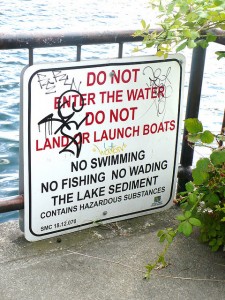 (Frisco)–Frisco residents directly challenged their city’s attempt to gloss over what they say is an important decision to use a less-protective testing method to find toxic contamination on the Exide smelter site, while also releasing a new report that chronicles how that contamination could disrupt plans to build the city’s ambitious “Grand Park.”
Saying city officials either don’t know what method is actually being used for finding “hot spots” of contamination, or isn’t being truthful about its use, members of Frisco Unleaded contrasted an official city denial from Assistant City Manager Ron Patterson with a March memo from the Texas Commission on Environmental Quality.
“Although you state in your response….“an industrial sampling protocol is not being used on the J Parcel,” you are incorrect,” says a letter sent by the group to Patterson and the Frisco City Council on Monday. “Please refer to the Texas Commission on Environmental Quality memo, dated March 8th of this year, accompanying our May 28th letter….TCEQ’s Danielle Lesikar clearly states that the 2 samples per acre testing method, “is a Commercial Industrial Standard,” and “only meets (the) Commercial-Industrial” standards. We’d appreciate if you’d forward documentation that disproves this statement….”
Members of the group say the difference is small but critical. Instead of eight soil samples per acre at the highly contaminated site, Exide is only sampling twice per acre, and so far less likely to find all the toxic material that needs to be removed to bring down high levels of lead, cadmium and other potential contaminants after almost 50 years of smelter operation.
Making sure there are no toxic surprises is important for redevelopment of the site itself, as well as the construction and use of the City’s new 275-acre Grand Park, located only 500 feet away from the smelter property and directly downstream of the Exide contamination via Stewart Creek, which is key to the park’s chain of lakes and water features. That’s the subject of the group’s new report.
“Poisoned Park? How Exide’s Lead Contamination Risks Frisco’s Grand Park,” was released to coincide with the last of three public “design meetings” for Grand Park at City Hall on Monday afternoon. In it, Frisco Unleaded compiles the long litany of abuse to Stewart Creek and the surrounding land by the smelter recorded by state and federal inspectors, including lining the banks of the Creek with toxic lead slag waste, dumping lead waste directly into the Creek, and locating waste dumps and pits in its floodplains.
“This poor Creek has been more or less an open sewer for the entire Exide smelter property for decades. There’s every indication that a lot of contamination is still there. And yet city officials are pretending that they aren’t trying to build a huge park centered along the course of this same Creek, immediately next door, and upstream of the Smelter. None of the previous design meetings have even raised the possibility of an environmental assessment of the threat Exide’s contamination poses to the Park,” said Frisco Unleaded board member Meghan Green.
Besides chronicling the past and current threats to the creek and potential ones to the new Park, the report features the boundaries of Exide’s hazardous waster permit superimposed on FEMA 100-year floodplain maps and USGS topographical maps to indicate how much of Stewart Creek has been affected by the Smelter, which literally sits on either side of its banks before flowing west under the Dallas North Tollway into what would be the new Grand Park.
“It’s important to get the most protective clean-up of the Exide property that we can” said Frisco Unleaded Chair Colette McCadden, “because all of the run-off from the property will be headed directly into the Park and the City itself has proposed building an entire Stewart Creek green belt corridor that would follow the Creek into the Park. This isn’t an industrial site that is sitting in isolation from people and activity. This is a site that’s next to Frisco’s largest park.”
“With the financial condition of the company deteriorating,” added Downwinders at Risk Director Jim Schermbeck, “it’s very possible the smelter site could end up on the EPA’s federal Superfund Site list, and then you’d have the a toxic waste dump site as a neighbor to Frisco’s most ambitious park.”
Among problems for Grand Park development pointed out by the report:
- Despite inspection reports citing known and potential contamination affecting Stewart Creek, no remediation has been performed there in 13 years.
- There’s not sufficient protection from flooding at the site, despite most of the facility being located in low-lying, flood prone areas.
- The FEMA 100-year floodplain runs directly through a landfill full of Exide lead slag, within just 100 feet of a “waste pile” of contaminated dredging from Stewart Creek, and within 200 feet of lead landfills that are in various states of disrepair.
- There’s been no extensive testing of soil, sediment or water within the boundaries of the new park, or between the Smelter and the park, where new contamination has recently been discovered.
The report makes four specific recommendations to insure park and public safety:
- City Officials should commission a full environmental assessment of the Grand Park Project before project planning and development go any further.
- The clean-up of the Exide smelter site should be to the most protective “Residential” standards to allow for open spaces use along Stewart Creek.
- All landfills, dumps and pits of lead waste should be removed from the Exide site to prevent future contamination problems from occurring.
- The water quality of Stewart Creek must be assured.
Frisco Promises a Stringent Clean-up Standard, Implements Cut-Rate One Instead
 (Frisco)— The local citizens group monitoring the clean-up of the former Exide lead smelter site in Frisco released a letter it’s sent to the Frisco City Council citing what they say is a contradiction between the City’s stated goal of meeting strict “residential” standards for toxic contamination removal, and the use of less-stringent “industrial-site” testing being used to identify that contamination.
Instead of testing for toxins eight times per acre, as required under the more thorough residential clean-up protocol, Exide is only sampling twice per acre, a methodology only used for industrial purposes.
“This is a classic bait and switch maneuver,” said Frisco Unleaded Chair Colette McCadden. “While publicly promising one “residential” standard for lead-in-soil clean-up of the “J parcel” that’s more protective of human health, Exide is actually using a much less rigorous testing methodology designed for sites that will see continued industrial activity. This is not an accurate description of future land use in the “J Parcel,” and is at odds with a commitment to a full residential standard clean-up.”
Frisco has committed to buying the outer ring of Exide property, referred to as the “J Parcel,” after a “residential or better” clean-up is achieved. The 2006 Comprehensive Plan for the city, as well as announcements last year from city officials, identified future land uses on the property that included office and commercial development, as well as a greenbelt along Stewart Creek. The site is directly across the North Dallas Tollway from the proposed location of the City’s huge new Grand Park that will host “water features” along Stewart Creek – directly downstream from the smelter site.
Frisco Unleaded states that the less protective industrial protocol is also at odds with the findings of a recent city-sponsored environmental assessment of the J Parcel, which reported new suspected contamination sites. The group linked the change in methodology to Exide’s deteriorating economic condition. Some analysts have predicted the company will file for bankruptcy for a second time in just over a decade. Last Friday, the company’s stock hit a nine year low of under 50 cents a share.
“We fear this downgrade in sampling protocol is an indication of the inadequate clean up citizens have predicted Exide would undertake because of its on-going financial difficulties. We need the City of Frisco to live up to its promise to provide expertise and oversight to prevent Exide from taking shortcuts that will come back to haunt redevelopment efforts.”
Frisco Unleaded is asking the City of Frisco to resolve the contradiction in favor of the residential standard for sampling and clean up by telling Exide it must abide by the agreements it signed. Frisco must approve the J Parcel clean-up before Exide gets nearly $40 million in cash for the land. McCadden says that gives the city a lot of leverage.
“Frisco city leaders should demand that Exide honor the agreement and work toward a real ‘residential or better’ clean-up of this property. We’re asking that they use that influence on behalf of Frisco residents.”
Sloshing Back and Forth Between Coal and Gas
 Around 2003 or so, the Dallas Morning News editorial board convened a roundtable of air pollution stakeholders and more or less facilitated a discussion of what could be done to clean up DFW's dirty air. You see, the area still hadn't complied with the 1997 national smog standard and more and more official air quality monitors were in violation of it. Pretty much, just like now.
There was a memorable moment when one of the "environmentalists" at the table noted that for decades the Texas utility industry had been primarily reliant on natural gas for its power source, then switched almost entirely to coal during the 70's and 80's, exactly when the nation's first national air quality standards were being written and enforced. "Part of the problem is that there doesn't seem to have been any planning for the consequences of the industry switching over from one source to the other just like that. It's like a frenzied mob group of stockbrokers running back and forth between bidders."
"That's the marketplace," huffed a utility industry representative. And indeed it still is. One frenzied run after another back and forth between the two largest sources of fossil fuel.
You know the scene in Pirates of the Caribbean, At World's End where the crew runs back and forth, from each side of the ship, until it eventually turns upside down? It's like that, only with money doing the running. And it never ends.
That DMN discussion was only a decade ago. What happened next shows how quickly those runs can reverse themselves and the conventional wisdom. Fracking technology delivered new shale plays that flooded the market with new gas. So much new gas, that the price of it dropped to historic lows. That caused a huge switch in the utility industry. Gas was cheaper, so the coal-powered plants started to close and be replaced by gas-powered plants. At the same time the chemical industry, which uses voluminous amounts of gas in production of plastics and other products, announced a new wave of domestic construction because of cheaper gas supplies in the US. Finally, in order to prop-up the low gas prices that that are killing profits, the gas industry itself promoted the fuel for transportation use and export.
And students, what happens when all these elaborate plans to take advantage of cheap gas begin to blossom? Demand increases. Cheap gas turns into not-so-cheap gas. And then coal begins to look pretty good again. All of a sudden it's the negative image of 2003, and all that money is starting to run toward coal as gas prices rise.
And what that means is that the higher methane levels causing climate change are replaced by higher CO2 levels causing the same climate change. This is why we need to get out of the rut we're in where our choices are determined by short-term financial gain and not long-term survival.
Government puts its finger on the scales in the marketplace all the time to help this or that industry. Without government guarantees, whole sectors of the economy would not be able to function in a completely unfettered market. This is what the CO2 cap and trade system was designed to do – make the marketplace respond to pressures put there by government in order to achieve a goal of reducing the stuff that will make the place we live less habitable. But it was all a communist plot,or something like that. So in the meantime, we continue to slosh back and forth.
From the Houston Chronicle comes this summary of the latest trends:
After years of declining greenhouse gas emissions, Texas and other states reported sharply higher levels of carbon dioxide in 2012 as electric generating plants began to use more coal when natural gas prices began to rise, according to a study released Thursday.
Citing research done by the Environmental Integrity Project, Texas once again led the nation in CO2 from power plants in 2012, emitting 251 million tons. Florida was a distant second at 120 million tons. Just five states accounted for one-third of the nation's CO2 power plant emissions. Besides Texas and Florida, they include Pennsylvania, Indiana, and Ohio. Needless to say. the old TXU plants in East and Central Texas run by corporate off-spring Luminant are the largest contributors.
The price of gas will continue to go up and coal will be competitive. Or maybe it will go down and coal won't be attractive. Maybe we'll be downwind of lots more coal plant pollution. Or maybe we'll all have a rig or compressor station in our backyard. Who can say? That's the marketplace! The question is, do you want to bet our survival on it?
Tools for Citizens
 The Texas Tribune is a completely online journalistic experiment. Of late, it's offered some cool interactive tools for the curious-minded:
1) Interactive Map of Ammonium Nitrate Sites in Texas
Wondering if your friendly neighborhood feed store is another "West" explosion waiting to happen? You can track down over 110 sites listed by the State Health Services Department as facilities storing the chemical Ammonium Nitrate in powder or liquid form. It also tells you where the nearest school and hospitals are in relation to the site.
2) Tracking Energy Industry Contributions Among Texas Politicians
Use this handy tool to trace which elected officials are the recipients of political campaign contributions from T. Boone Pickens, Oncor, Energy Future Holdings, and all the other major industry players since January of 2011. Not surprisingly, Greg Abbott leads all comers as he gears up to run for Governor.
Frisco Kids Play Within Feet of a Hazardous Waste Dump
This is a 23 second video shot on the corner of Eubanks and 5th Street in Frisco earlier this month. This corner is the northeast border for the property owned by the Exide lead smelter.
When it begins, the camera is looking south toward the now shuttered smelter. In fact, at the 3-second mark, you actualy see the smelter's smokestacks betwen two trees for a brief moment. In front of those trees is the fenceline separating the smelter property from the public. Immediately behind those trees is a berm that marks where the smelter's active landfill is.
This "non-hazardous" landfill holds approximately 9 million pounds of lead-contaminated waste. Lead itself is dangerous, but Exide got caught illegally burying hazarous waste in this non-hazardous landfill. The company's remedy is to dig the hazardous waste up, "re-treat it" and then re-bury it in exactly the same landfill. All this is to be done at the edge of the smelter's property at this corner of Eubanks and 5th.
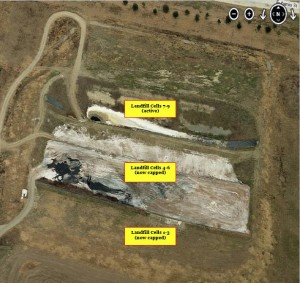
This is an aerial pic of the Exide active landfill operation at the corner of Eubanks and 5th Street. The line of the trees at the top right are the same ones you see in the video.
Besides this waste from production, Exide is now using the landfill to dispose of as much smelter demolition waste as possible. That makes it the most active spot on the smelter property at this point, with trucks full of waste coming and going besides the on-going "digging and "re-treatment" there.
And when Exide is finished stuffing all the lead-contaminated waste it can into this landfill, it hopes to leave it buried in Frisco forever.
Directly across the street from this illegal hazardous waste landfill is the "Play Ball" rec center for kids – a batting cage business. On nice days, you can usually find the south-facing/smelter-facing metal garage door wide open to allow for air circulation for the kids taking practice inside.You can also find their sibings and peers playing on the front driveway, only about 50-100 feet away from the lip of that landfill berm.
When the wind is out of the south, as it often is from March to October, the Play Ball batting cages and the kids there are are directly downwind of the smelter and the landfill operation. A lead-in-air monitor operated by the the Texas Commission on Environmental Quality is located on Eubanks. It's that skinny white pole in the middle of the frame at the 5-second mark. This monitor has repeatedly found concentrations of lead in the air higher than the EPA's new national lead in air standard – since the smelter closed.
So not only are these kids subject to being downwind of all of the smelter's demolition activity. They're also just across the street from the most heavily used part of the smelter now, with a much larger risk of getting contaminated.
Exide, the City of Frisco and the Texas Commission on Environmental Quality all would have you believe that everything is hunky-dory at the lead-smelter site. Look, the smokestacks are coming down! But in reality, this site is still posing risks for Frisco children who are still playing right across the street.
Behind Closed Doors Again
 On Wednesday the Dallas City Council met in executive session to talk gas drilling. Will there be a move to vote on the Trinity East permits before the new, slightly less drill-enamoured Council is seated on June 24th, or was this just another chance for the City Attorney to lecture members about how dire the consequences of denying these permits will be before they're joined by the rookies? Stay Tuned.
We Need More Claudia Meyers
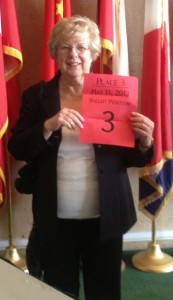 There are failures and then there are glorious failures. Just ask William Travis.
Claudia Meyer did not win her District 3 council race against Vonciel Hill on May 11th. Odds were heavily against her doing so. But Claudia knew this going in. And still she fought a good fight.
"I wanted you to see what real courage is, instead of getting the idea that courage is a man with a gun in his hand. It's when you know you're licked before you begin but you begin anyway and you see it through no matter what. You rarely win, but sometimes you do." ~Atticus to Scout in Harper Lee's "To Kill a Mockingbird"
Imagine you're a 71-year old retiree who's spent the last four years being exhausted by a fight with Dallas City Hall over gas permits in your neighborhood. And then you're drafted at the last possible minute to run against a Dallas Establishment darling, keeper of the Trinity Toll Road dream, with access to money and resources that you'll never be able to match. Most sensible people would have said thanks but no thanks. Thank goodness Claudia Meyer did not.
Without a serious opponent, Vonciel Hill would have glided to a third term, her homophobia and complete subservience to the Powers That Be mostly unchallenged. Claudia Meyer made sure that didn't happen. Hill had to go out and work for her victory. She had to at least pretend to be concerned about neighborhoods and issues she otherwise probably would not have bothered with. Opposing such a Citizens Council sycophant is a badge of honor.
Claudia also made Hill's literal worship of embattled City Manager Mary Suhm an issue, as well as Hill's support of Suhm's secret gas drilling deals. One can't help but feel this language, and similar campaign rhetoric in other council races, played a part in Suhm's decision to step down later this year. We know that the drilling scandal that she was at the center of, and which Claudia and Ed Meyer helped uncover, certainly did.
So while Claudia lost the battle on May 11th, she and the forces organized on her behalf have been winning the wars. Suhm is now history and for the first time in eight years, there won't be a "Strong Manager" form of Dallas City government. The fight Claudia help found and direct against the Trinity East gas permits has not only stopped them dead in the water, but shifted the entire council to a more anti-drilling stance. She wont be sworn in on June 24th, but Claudia Meyer's efforts will be well-represented on the new city council.
Not all of us have the gumption that Claudia did in taking her leap of faith. But we can do what we can do – and, let's face it, that's usually more than we end up doing.
We need more people willing to put their shoulder to the wheel of creaky social change. Its hard work. You don't always win. But there's a great deal of value in trying.
If you want to make sure that the Dallas City Council is as progressive as it can be; that it will reject irresponsible gas drilling permits and build a real quality of life agenda, then the consensus is that you should go out and volunteer for the Philip Kingston and Jesse Diaz Campaigns. Early voting begins June 3rd for a June 15th run-off election day. These races will be decided by even fewer votes than the races in May. Every single one counts. Stiffen that backbone, slip on those walking shoes, and finish the work Claudia started.