
Posts by Downwinders At Risk
The Most Toxic Place in Frisco? City Hall
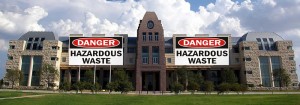 There have been times and places when Frisco's official municipal insularity has undoubtedly worked in its favor. It's focused, "go-our-own-way" style is probably a big reason why the city has carved such a high-profile niche among DFW suburbs.
But the last two years of wrestling with the Exide lead smelter has revealed all of the vices of such an approach when it comes to environmental hazards and public health.
Given the rapidity of events, it's easy to forget that only two years ago, the same city officials now in charge of pursuing a clean-up of the Exide site were lauding the smelter as a valuable member of the local business establishment and trying to find ways to keep it operating. Having a lead smelter spewing tons of toxic air pollution near the High School in the middle of town was OK with these folks. They'd overlooked decades of state and federal environmental violations by the smelter. They overlooked the destruction of a city water treatment plant by the smelter. Hey, Exide employed 100 people. And "what could the city do anyway?"
Only the intervention of citizens, campaigning with the well-known idea of the city being able amortize the facility out of existence, forced the city to finally confront the incongruity of the smelter's operation with its 2013 Frisco surroundings.
Frisco parents didn't sign their mortgages in blood to gain entry in a prized school district only to have their kids IQ suffer because of an obsolete lead smelter. To their credit city officials sensed that the curtain had been pulled back too far on their pretense to go on. They did a 180 and got the smelter out of town. But they did it the Frisco Way: the city manager and city attorney wrote a secret, complicated, $45 buy-out agreement with Exide that was passed by the Council without any public hearing and no debate.
After the unanimous vote, when someone asked Frisco Councilman John Keating if he'd support a community oversight committee to make sure we got the best clean-up of he smelter site, his response was "We're it." And just like that, it was supposed to all go away. Containment.
But lead smelters are messy places, especially outlaw operations like the one Frisco hosted for so long. Especially when they operate decades before most of the regulations governing them now were implemented or enforced. They're hard to contain unless you know what you're doing. And nobody could tell Frisco it didn't know what it was doing. It was Frisco!
The city didn't feel any obligation to let its residents know how it would handle the clean-up, how extensive the clean-up would be, what kind of technologies or strategies might be used. Perhaps most importantly of all though, city officials never asked themselves or their constituents the most basic of planning questions, "What's going to happen to the Exide site?"
The City's de facto answer seems to be: a toxic waste dump. It appears to be fine with letting Exide hold on to the core of the smelter property, where all the worst contamination is, where tons and tons of lead waste are buried or piled or dumped, all uphill from Stewart Creek that still runs right through the site. So amidst all the million-dollar homes and exclusive shopping malls there will be this large toxic no-man's land with scary warning signs and the need for continued monitoring for decades. City officials meet any skepticism of this plan with a shrug of their shoulders. "What can the City do?" For a town with a reputation for being "can-do." Frisco City Hall has lacked the imagination to see anything but the need for an extensive cover-up – literally and figuratively – when it comes to the Exide situation.
Instead of dealing straight-on with the challenge, officials decided to play a game of misdirection by emphasizing what a great new regional park it was building…..directly downstream of the still-contaminated smelter site. But please, mention of any current or potential contamination problems at these presentations by any city official is strictly prohibited. It's just so uncouth to keep bringing that up.
If you lived outside the bubble of Frisco City Hall, you could see the absurdity in this strategy. Putting a park downstream of a dirty Exide site is like putting puppies on the rail at the end of a roller coaster ride. You're just waiting for disaster to strike.
And it turns out those city officials knew it too. They just didn't want to tell their residents.
Six months before they signed that complicated $45 million secret deal, officials were aware there was extensive contamination of the Grand Park area by Exide. Maybe that's one reason they wanted to keep the agreement secret.
We've been told by more than one engineer that the City had a responsibility to turn over that information to the EPA and state when it got the results in November 2011. Instead it just sat on it. How many Frisco children have been needlessly exposed to hazardous material in and around Stewart Creek in the intervening 18 months? How could any Frisco official in good conscience keep this kind of thing from the public?
It took another year and a half for the City to follow-up with its "visual survey" of the entire 5-mile course of Stewart Creek, from the smelter to Lake Lewisville. Then, instead of taking equipment with them on that trip up the Creek that would be able to identify lead waste and give you some idea about its toxicity, including stuff you couldn't necessarily see at first glance, it was merely a sightseeing affair where "suspected" slag and chips that were out in the open were inventoried.
However, even that expedition was enough to confirm that the Creek had been acting as a sluice for Exide waste into the Lake. The City had those results three months ago.
All of this information was known in early June when Frisco Unleaded and Downwinders released a small report on the threat to Frisco's Grand Park from the smelter site. We did it at one of those Council presentations about the park where all of its virtues are discussed, but none of its environmental problems.
Not one city official spoke to the contamination problems facing the park. And it was clear that most were furious at citizens for once again raining on their Grand Park parade. It's as if Frisco city officials really believe that if you just don't mention the Exide toxic waste problem out loud, it can't hurt you.
It's one thing to apply that kind of magical thinking in denying Open Records Act requests and fluffing-up park presentations, but when it infects your ability to protect public health, it becomes a more serious matter.
Not only has the city hid information about hazardous materials that it had a duty to make public. It's been caught trying to actually hide the hazardous materials. When a TCEQ inspector advises the city in 2012 that there's a new pile of battery chips that's washed up, the city's response is to cover it up with "geo-membrane fabric" – even when the TCEQ inspector says that's not going to be sufficient. They don't want to dig it up. They don't want to do more testing to see the extent of contamination. They don't want to actually remove it. They want to cover it up. That's the city's entire M.O. when it comes to Exide these days. And that's what must change.
Had the city been up front with its own residents in real time about the smelter contamination, there would have been no press in June about how the smelter will impact Grand Park. The public would have already known. There would have been no wave of coverage about these City reports and TCEQ memo all of this last week. It would have been out in the open already. By trying to hide information from the public the city only insures it will always be in a reactive mode and behind the curve. It automatically gives more power to curious citizens to write the narrative, as this past month has shown. When your residents are finding this stuff out from us, instead of the local government that insists it's got everything under control, it's a sure sign that they don't have every thing under control
So far, only Frisco Unleaded and Downwinders have offered anything like a long-term answer to the most important question – what's going to happen to the Exide site? And we're even on the planning department's payroll.
But the City Manager, City Attorney and Mayor would all rather drink lye than admit they've been wrong about this problem, or that Frisco Unleaded might have a good idea or two. It's the toxic mix of arrogance, lack of vision, and conflict of interest that's doing the most to poison Frisco right now. Exide's messy waste problem is only a symptom of this kind of mind-set. Before the definitive clean-up can happen at Exide, there's got to be one at City Hall.
Population Media Center Opening Dallas Office, Looking for Director
Dallas-Ft. Worth is home to lots and lots of non-profits groups. But most are either large United Fund-size operations with sizable budgets, or run by folks who really don't need to get paid for their time. And almost none work with hardcore environmental or social change issues. Considering how large the region is, it's embarrassing that there's so little infrastructure for the kind of non-profit that does what we do here at Downwinders.
There are some signs of life however. For one thing the emphasis on the "purplization" of Texas means more east and west coast money will be coming to Texas, not only to fund partisan Democratic Party activity, but also to do broader social change work.
Then there are things like this. Apparently some determined people in the DFW are have decided that a lot of the problems they deal with everyday – traffic, pollution, water scarcity – all have a shared root cause. There are just too many people taking up too much room and too many resources for this little Earth to handle. For anyone who's seen the rise of the Metromess over the last 30-40 years, this is a no-brainer. There's the equivalent of a new DFW moving to the state every couple of years. While we have lots of space and welcome visitors, not all that space is suitable for sustainable living, and what we have is becoming less so because of he strain of so many newcomers.
These local folks have teamed up with a national group, the Population Media Center, and raised money to hire a Texas Chapter Director, who they plan on offering a real living wage to do their work for them. What's the Population Media Center you ask?
Population Media Center was founded in 1998 by William Ryerson, with the intention of using the extensive experience of experts in entertainment-education to spread the application of the Sabido methodology in addressing population and reproductive health issues. In the fourteen years since PMC’s inception, the organization has been a pioneer in the use of new methodologies for informing people about reproductive health issues and promoting behavior change.
Even if you don't plan to apply, it's worth checking out how a national group plans to come to the area and establish a presence with what kind of salary and benefits are being offered. To read more about the job, go the group's Carreerbuilder site. Good luck to all the applicants and we welcome the PMC to town and hope they can do some good works here. Lord knows DFW is the poster child of unchecked growth and the environmental problems it can cause.
A Smelter Runs Through It: New Documents Confirm Widespread Lead Smelter Contamination of Frisco’s Stewart Creek, including Grand Park
 (FRISCO)—Three new documents, including two reports paid for by the City of Frisco but never publicly released, confirm that the former Exide lead smelter is the source of battery chips and slag waste that line Stewart Creek from Frisco to Lake Lewisville, and concludes the smelter site remains a continuing source of contamination.
Samples taken in 2011 by a City of Frisco contractor found that 71% of Creek sediment collected had elevated levels of lead, cadmium or arsenic. A “visual survey” done for the City of smelter waste just three months ago found at least 45 “hot spots” of battery chips or slag along the entire five-mile route of the Creek, from the western edge of the smelter site all the way to its mouth at Lake Lewisville. Last year a state environmental inspector warned in an e-mail that she was concerned about the smelter’s battery chips making their way “into Stewart Creek and flowing to Grand Park where a parent who is also a Frisco resident pulls one out of their child’s mouth.”
Local group Frisco Unleaded received the documents last week as part of an Open Records Act Request to the Texas Commission for Environmental Quality. Members say the contents prove the public is right to be concerned about the impact of the smelter site on the City’s ambitious new Grand Park development. “These reports show why any activity downstream of the smelter, including the enjoyment of the new Grand Park, will be impossible without a comprehensive clean-up of the entire Exide site. This problem isn't just going to go away or fix itself," stated Meghan Green.
Green also called for the EPA to step in and take over a clean up that until now, has been directed by the state and city. "It’s clear that the toxins at the smelter are being washed into Stewart Creek with each rainfall and are surfacing and will continue to surface along the whole length of the Creek, which happens to also be a tributary into Lake Lewisville. To add insult to injury, Lake Lewisville is a source of drinking water for Dallas. To say that I'm concerned is an understatement. It’s time for the EPA to get more aggressive about protecting public health from this site.”
Although the smelter ceased operation in 2012 and demolition has taken place to remove most of the structures from the central Frisco site, the land itself is the burial ground for tons of lead waste in the form of pieces of used lead-acid batteries broken up for their contents and the slag waste produced from the smelting process. Frisco has arranged to buy an outer ring of the smelter property, but the core part of the operation remains in the hands of Exide, now going through bankruptcy. It’s that core, as well as the property Frisco is buying, that’s the source of the battery chips and slag migrating to Stewart Creek, which runs right though the middle of the Exide site.
That continuing threat to Stewart Creek, along with an assessment of historical contamination, is extensively chronicled in the City and State documents released by Frisco Unleaded today. They include:
1. A November 2011 “Limited Site Investigation” Of Stewart Creek by the City of Frisco
The City of Frisco specifically requested this investigation “to evaluate chemicals of concern in sediment in the vicinity of the Grand Park project.” Samples of sediment were collected at a total of 30 sites, and tested for Lead, Arsenic, Cadmium, Selenium, and Sulfates. 71% of the sediment samples tested for Lead, Cadmium and Arsenic exceeded the Texas Commission on Environmental Quality Ecological Benchmark.
2. March-April 2013, of Stewart Creek, Interim Report, City of Frisco
A year and a half after the Creek sediment sampling, contractors for the City of Frisco performed “a walking survey to identify and document the potential presence of visible battery chips and slag in Stewart Creek."
Chips and/or slag were observed in at least 45 different spots along the entire five-mile route of Stewart Creek from the smelter site in Frisco to the entrance of the Creek into Lake Lewisville, or an average of every 600 feet. The first sample was found at the mouth of the Creek as it flows into Lake Lewisville, a source of drinking water for the City of Dallas.
At least 29 hot spots of battery chips and/or slag were found within the boundaries of Grand Park, from Stonebrook Parkway on the south to the North Dallas Tollway, more than 4 times the number of any other segment along the survey. “Frequent occurrences of concentrated battery chips and potential slag material were observed in the Stewart Creek channel in Grand Park from Stonebrook Parkway to the Dallas North Tollway bridge.”
A Smelter Runs Thru It-Summary
3. TCEQ_battery_chip_emails from Texas Commission On Environmental Quality Staff on Recurring Battery Chip Contamination
In June of last year a TCEQ inspector wrote her supervisors that new concentrations of battery chips had shown up in previously clean-up areas of the smelter site. “These battery chips were believed to have washed up this year and accumulated down gradient along the tree line. Some of these chips were observed making their way down towards Stewart Creek. It looks like they’re being carried toward the trees and the creek with the rainwater. (Exide and City representatives) stated that the area was tested (prior to this new accumulation of battery chips) and it was below 250 ppm. I pointed out that there also wasn’t as many battery chips in those areas when the APAR was submitted. In the report, it states that the area would be covered with the geomembrane fabric and it sounded like this is what they want to do with these new battery chips as well (cover them with fabric). I pointed out that if I were to collect a sample that it would most likely exceed 250 ppm and there were just too many that had accumulated to be covered up with the fabric. As we all know, these chips move under rainy conditions. I told (the City representative) that our concern and I’m sure the city’s concern as well is if these battery chips made it into Stewart Creek and flowed to Grand Park where a parent who is also a Frisco resident pulls one out of their child’s mouth.”
One of her supervisors responds that chips will always come up with a rain: “Based on my experience from working on site contaminated with battery chips and slag, rubber battery chips that are buried will float to the surface (just tires in landfills). While working on sites associated with the West Dallas RSR lead smelter, with the exception of where chips were used as road based, every site that had surface chips on the surface were located over areas where slag and battery chips have been deposited in the past. Were subsurface investigations conducted in the areas of concern to determine the extent of contamination? Or did they only conduct surface investigations.”
Critics of the City’s approach to the smelter site clean-up cited the e-mail as a stunning example of Frisco’s caviler attitude about the contamination problem posed by the Creek. “We’ve often said the City is trying to figuratively cover-up the problem of Stewart Creek, but here’s an example of where they’re doing it literally,” said Jim Schermbeck of Downwinders at Risk, the regional clean air group assisting Frisco Unleaded.
Along with the City and State documents, Frisco Unleaded released the results of its own small sampling of battery chips members collected only last week from the public Right-of-Way on the BNSF railroad tracks leading into the smelter site. One of the chips had over 100 ppm of lead on it and 8.5 ppm of Arsenic. The Lead level is above the TCEQ Ecological Benchmark and the Arsenic level is just below it. Schermbeck said it was easy to collect the chips because they’re lying on the open ground.
Besides demanding that the EPA issue a “Imminent and Substantial Endangerment” order to begin addressing the Creek’s clean up, Frisco Unleaded and Downwinders called for the City of Frisco to release all of its Exide-related documents to the public and for the City of Dallas to begin interceding on behalf of its residents, whose drinking water is under threat from the smelter waste.
Green said that despite the City’s rhetorical promise to its residents to be transparent with them about the site, “that obviously hasn’t been the case since we had to get these city documents from the state. We deserve all the information the City Manager and Mayor have about this site. It’s our families, it’s our town, and it’s our tax money. The Mayor and Council need to make a commitment to residents that they’ll share everything they have about the site with the public. ”
Addressing the issue that could pull in Dallas and other cities, Schermbeck noted, “There’s now clear evidence that the Exide smelter has been a constant source of toxic contamination in Lake Lewisville for decades. The City of Dallas needs to wake-up and begin to lobby for the kind of environmental clean up that can put a stop to that contamination to its water supply.”
According to Schermbeck, it’s the new-found evidence of a continuing threat to the Creek and Lake that make this more than just another effort to clean up a past environmental mess, and warrants a serious escalation of regulatory responses. He noted that most toxicologists agree that there is no safe level of exposure to lead, especially for children, whose minds and bodies are still developing. “And yet, here’s this property on Creek’s edge, that’s proven to be a fountain of constant lead contamination flowing downstream through the middle of densely populated neighborhoods, and ending up in a source of municipal drinking water. It’s a clear and present danger to public health that deserves an immediate and potent remedy.”
+++++++++++++++++++
If you want to let Mayor Maso and the Frisco City Council know how you feel about their sitting on this inforamtion for almost two years, please send a qucik "Click N Send" e-mail to them via our "Featured Citizen Action of the Week." Thanks.
See North Texas Gas Problems Explode on Screen! GASLAND Part II Premieres on Monday
Most of you probably are already aware that Josh Fox's follow-up to "Gasland" will be premiering on HBO Monday night. What you might not know about "Gasland II" is that it heavily features North Texas. Former DISH Mayor Calvin Tillman, Earthworks organizer Sharon Wilson, and Parker County resident Steve Lipsky are all in there, and Lipsky's fight for his well water is a major story thread.
Like it or not, the Barnett Shale is where folks from the rest of the country and the rest of the world come to see what kind of damage fracking can leave in its wake.
Hard to believe it's been 3 years since Downwinders hosted the theatrical premiere of the original in October of 2010 with Fox showing up for a panel discussion that also featured former city councilwoman Angela Hunt afterwards at the Angelica. It was the first citywide show of opposition to gas drilling in Dallas and a full year before the packed Texas Theater showing where Mayor Mike Rawlings made his now famous pledge "to never put neighborhoods at Risk over money." But that was all so pre-secret deal ago.
This summer the City Plan Commission is meeting every two weeks to draft a new gas drilling ordinance for Dallas. By late August or early September, they're expected to be finished and have said they will then hold public hearings on the draft they'll submit to the City Council for a vote. Plans are under way to try and bring Josh Fox to Dallas for a theatrical premiere of his sequel as these public hearings kick-off. Nobody's sure if this can happen with Josh himself – he's become a genuine celeb since the first time around – but we're working on producing our own "sequel" to that very successful first showing. Stay tuned.
Meanwhile, you can send a quick e-mail to the Plan Commission members telling them what you'd like to see in a new gas drilling ordinance for Dallas by clicking here.
Another Study Links Autism to Air Pollution
 Women living in high air pollution areas while pregnant are up to twice as likely to have a child with autism as those living in low pollution areas, according to a study released June 18 by the National Institute of Environmental Health Sciences.
"What you see is the mothers with the 20 percent least exposure to pollutants, their children are least likely to have autism," lead researcher Dr. Andrea Roberts of the Harvard School of Public Health told The Standard-Times. "With each percentile of pollutant exposure, the presence of autism increased."
The study surveyed more than 300 women about the health of their children and compared the results to federal data on air pollution levels during the time and location of each mother's pregnancy. It's at least the second major study since March confirming a link between airborne pollution, but the evidence has been accumulating since 2006.
Autism is a disorder of brain development characterized by difficulty in social interaction, verbal and nonverbal communication and repetitive behaviors. Nationwide, 1 in 88 children have an autism spectrum disorder, according to the Center for Disease Control.
EPA Pushes Back Against Low-Dose Testing of Endocrine Disrupters
 Responding to a report last year that concluded the way EPA tests for harm from hormone-wrecking chemicals is out-of-date, the Agency itself published a review of its methodology last week that, not surprisingly, vindicated current practices.
In its annual "State of the Science" report, the EPA said that non-linear effects from exposure to endocrine disrupters have been documented, but concluded they were "rare" and did not constitute enough evidence to change the way the Agency assess toxic health harms.
“There currently is no reproducible evidence” that the low-dose effects seen in lab tests “are predictive of adverse outcomes that may be seen in humans or wildlife populations for estrogen, androgen or thyroid endpoints,” the agency report said. “Therefore, current testing strategies are unlikely to mischaracterize…a chemical that has the potential for adverse perturbations of the estrogen, androgen or thyroid pathways.”
Written by EPA officials with input from a team of scientists and managers from the Food and Drug Administration, the National Institute of Environmental Health Sciences and the National Institute of Child Health and Development, the draft was signed by Robert Kavlock, the EPA’s Deputy Assistant Administrator for Science.
Laura Vandenberg, the Tufts University researcher who headed up last year's study, "Hormones and Endocrine-Disrupting Chemicals: Low-Dose Effects and Nonmonotonic Dose Responses", responded by saying EPA's acknowledgement of endocrine disruption is a step forward, but added that the Agency had made some “odd, and possibly political decisions” in the new report.
"(The EPA's conclusions) fly in the face of our knowledge of how hormones work. They [endocrine disrupting chemicals] are overtly toxic at high doses but act like hormones, with completely different actions, at low doses.”
Vandenberg said the EPA used out-of-date studies on atrazine, when they should have used a new publication with dozens of authors from around the world showing the “consistent, low-dose effects of this chemical on amphibians, reptiles, fish, birds and mammals.”
Downwinders know that they are the recipients of low-level doses of hundreds, if not thousands of different chemicals trespassing into their lungs. They know that constant exposure to these chemicals, even at "safe levels" is harming them and their families. There are no computer models that can adequately reproduce what it's like to breath the air downwind of a waste-burning cement plant, a compressor station, or a trailer park masquerading as a lead smelter. Things happen on a molecular level that we are only now beginning to understand because we had no knowledge of the physiology of hormones or DNA when the toxicity tests EPA still uses were first imagined. Small stuff adds up.
But EPA is loath to admit this because it would mean turning the regulatory world upside down. If there are no "safe levels," there is no status quo. The system depends on the premise, however obsolete, that little bits of poison over a long period of time won't hurt most of us. It's this premise that Vendenberg and her colleagues were aiming at last year and it's this premise that EPA is defending in this newest report.
Take Another Hit – It Was the Best June for DFW Breathing Since 2007
 If this unseasonable cooler weather is making it seem like you're spending summer someplace other than DFW, it's also been the best "ozone season" in the region in seven years.
In the month that just ended, we only had four monitors on four days that violated the new 75 parts per billion smog standard that takes effect in 2018, and zero violations of the obsolete 1997 85 ppb standard. The maximum 8-hour reading was an 83 at the Denton Airport on June 3rd. Contrast that with last June: 54 violations of the 75 ppb standard and 27 violations of the 85 ppb standard over 9 days. Or 2011 – 24 violations of the 75 ppb standard, 7 violations of the 85 standard.
In fact, you have to go back all the way to 2007 when we had five violations of the 75 ppb standard but no "exceedences" of the 85 ppb, to find as good a June for air quality as we just had. And there are only a couple of other Junes – in 2010 and 2000 that even come close to being as full of safe and legal air. That's the good news.
The bad news is that these years were all followed by worsening air quality trends, that is, they turned out to be aberrations. So if this pattern holds, we'll have to wait until next summer to put it in context. As always, weather has a lot to do with how bad or good our ozone season is. The cooler and wetter, the better. The dryer and hotter, the worse. Just as this summer's cooler temps seem like they're out of place, by next June we could be thinking the same thing about our reprieve from smog.
The good news is that there's no questions that declining emissions in almost every category (we're looking at you oil and gas) have had a positive impact on the numbers. That's your doing. After 20 years of citizen effort, there's a lot less pollution from the cement plant complex in Midlothian, the coal plant belt in East Texas, and the millions of vehicles on and off the road.
For the EPA and the state, 2013 comes a year too late to help them recover from a terrible 2011 "clean air plan" that was supposed to get us down below 85 ppb by watching people purchase new cars. The clock officially ran out on that plan June 15th. Sales of new vehicles are dramatically up, so there's real displacement as old gas guzzlers get traded in for more efficient models. Whether those trade-ins are enough to cancel out the still-exploding growth rate of the area and rising gas and oil activity remains to be seen. That's why the EPA uses a three-year rolling average to determine transgressions against the Clean Air Act, to minimize the impact of anomalies.
You're just going to have to stay tuned to find out whether the summer of 2013 is the exception to the rule, or the re-writing of the rules.
Dallas Morning News Editorial On New Gas Ordinance
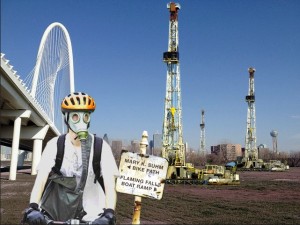 Gets a lot of things right, but also leaves out a lot, like floodplains, air pollution, compressor stations, and full disclosure.
The next City Plan Commission meeting on the drafting of the new ordinance is at 9 am,Thursday July 11th at Dallas City Hall in 5ES on the fifth floor. They're due to talk about operational conditions, i.e., hours, dust, noise, chemical disclosures, landscaping, monitoting an baseline testing.
Seems like a good time to mention that you can send the City Plan Commission a quick e-mail about what the new gas ordinance should contain by going to our "Featured Citizen Action of the Week."
Obama’s Speech Fracked Open
 The San Fransicso Chronicle has a take on how the Obama climate change speech jives with the reality in the country's Shale Gas fields – like the one you live in.

Robert Howarth, a Cornell University professor who argues that methane leaks from drilling negate other climate benefits of gas, said in an email to The Associated Press that he is "extremely disappointed in the President's position" and said the support for natural gas "is very likely to do more to aggravate global change than to help solve it."
Not so, Obama said.
Advances in drilling, the president said, have "helped drive our carbon pollution to its lowest levels in nearly 20 years," and "we'll keep working with the industry to make drilling safer and cleaner, to make sure that we're not seeing methane emissions."
Nation’s First Commercial-Sized Carbon Capture Plant Uses San Antonio Cement Kiln For Source
 On the same day President Obama was making news in launching his climate change initiatives aimed at power plants, a company called Skyonic was announcing it had obtained financing to build America's first full-size carbon capture facility adjacent to the Capital Aggregates cement plant in San Antonio.
If all goes as planned the technology will be retrofitted to the kiln and capture carbon dioxide, acid gases, and heavy metals from the kiln's pollution plume and turn them into products such as baking soda and hydrochloric acid.
The company recently raised over $120 million to complete the project. Investors include Canadian oil giant Cenovus Energy, ConocoPhillips, BP Ventures, Energy Technology Ventures, BlueCap Partners, Toyo-Thai Corporation Public Company Limited, Berg & Berg Enterprises, Northwater Capital Management, PVS Chemicals, and Zachry Corporation, owner of the kiln.
Skyonic had been operating two pilot projects in Texas, including one at the same kiln. but this new facility is a large upgrade, able to remove more than 300,000 tons of carbon dioxide annually. It hopes to make a profit in three years.
Cement plants are among the largest sources of greenhouse gases on the planet, and there are a variety of start-ups and established firms competing to find a low-CO2 way of making the product. Some are concentrating on changing the manufacturing process itself, and others, like Skyonics, are looking at end-of-pipe treatment or recovery.
It's a shame there's zero interest among local Midlothian cement plant operators to bring any of this new technology to North Texas. We have the largest concentration of cement manufacturing in the country, and so we're also likely to have the largest concentration of cement-generated greenhouse gas pollution in the country as well. There's also the fact that DFW is the largest urban area in the nation downwind of so many kilns, and any reductions in pollution among those kilns, especially in metals and acid gases, would be welcome.