air toxics
Time to Push Back and Make Some History
 Dallas Plan Commission Public Hearings on Trinity East Gas Permits, including the "Rawlings Refinery"
Thursday, 1:00 pm
6th Floor Dallas City Hall, City Council Chambers
When the Dallas Plan Commission held its January 10th vote to "reconsider" the denial of gas permits to Trinity East, it didn't allow any public testimony at all about the dangers posed by these proposed drilling and production sites.
Tomorrow it will. And we need you to come and add your body and your voice to this fight.
When the Mayor and City Manager first cooked up this scheme to ram through the last three gas permits in Dallas, they didn't expect to have any roadblocks. They scheduled a meeting five days before Christmas and thought they had it locked up.
They were wrong. You showed up anyway and the Plan Commission voted to deny the permits based on your impassioned pleas for public health and safety.
When City Hall didn't like the results of that vote, and pulled the "reconsideration" stunt in January, 100 of you showed up on a work day to shame the CPC publicly in a meeting that received a huge amount of media coverage.
Now they're holding the second public hearing on these gas permits. We need a larger show of strength to demonstrate we're gaining momentum
We need you to personally come and tell the Plan Commission why it's a bad idea to allow drilling in floodplains and parks and build a refinery next to the city's largest soccer complex where thousands of kids will be playing every weekend.
We know it's getting tiresome, but when you show up at these meetings and hearings, you're helping us win this fight.
Slowly, but surely, your concerns and questions about these Trinity East permits are weighing them down and making it harder for them to get rammed through.
For example, because of your work, we're about to see a bi-partisan call for the Mayor to reject the refinery permit near the Elm Fork Soccer complex. That news will be announced at tomorrow's press conference starting at 1:00 pm.
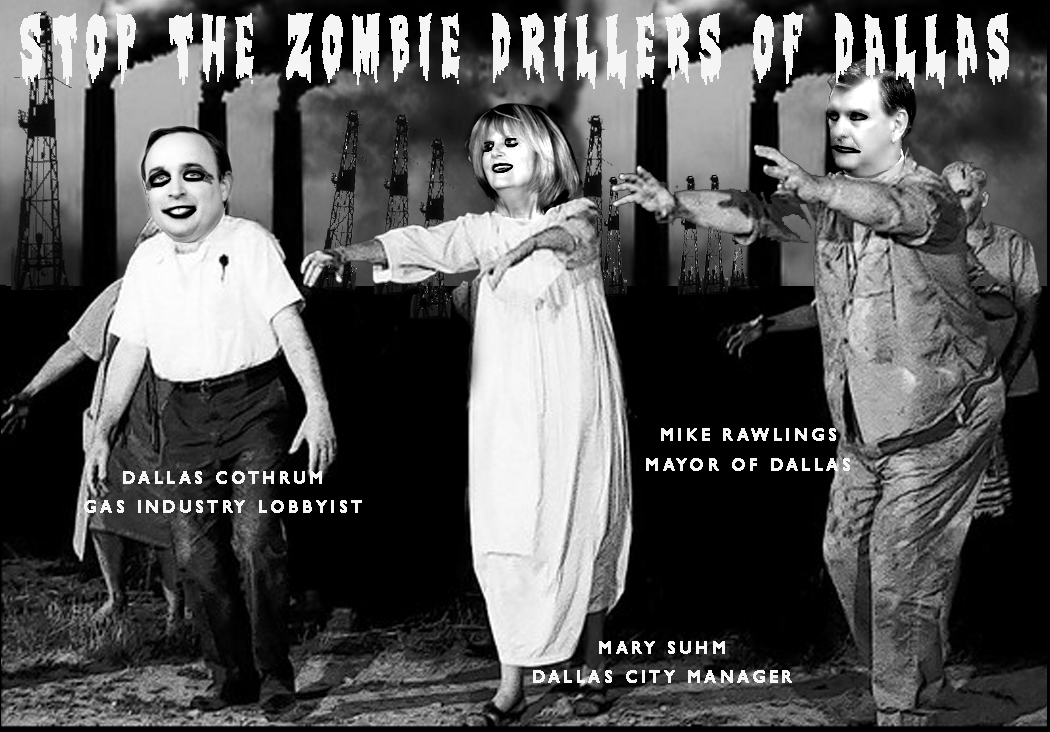
There's also more in the works challenging the process the City is using to keep these "zombie" permits alive.
The tide is turning. But you have to keep showing up.
Nothing can take the place of a room full of angry citizens. Tomorrow, don't just watch history on TV or read about it the next day. Make history. Thanks.
Zombie Gas Permits on the March Again
Public (re)-Hearing on the Last Three Dallas Gas Sites.……including the newly-discovered "Rawlings Gas Refinery"
This Thursday
1:00 pm
Dallas City Hall
6th Floor
City Council Chambers
Press Conference followed by City Plan Commission Mtg
This is the "do-over" hearing demanded by the Mayor in order to win approval of these permits – after the first one in December resulted in denial.
Come and defend this victory or they'll steal it away from us.
Dallas Residents at Risk, the alliance of groups that we work with on this issue, will be holding a press conference at 1:00 pm – just like we did before the much-publicized January 10th reconsideration vote – and then heading into the CPC meeting at 1:30. Show up early because we'll be talking about a surprising new development in this fight and bringing you up to date with the latest information.
It's important to demonstrate that opposition to these permits is growing, so if you haven't made it down to City Hall before, Thursday is the day to come.
If you're a regular, then you know how much warm bodies in the audience mean to the moment.
They would have been no news coverage on the 10th without all of us standing up and publicly "shaming" the CPC over its "reconsideration vote" in person. You can't do that by e-mail or petition. We need you there. We need you clapping for the good guys. We need you hissing the bad guys. We need you. There is no substitute.
Looking for material for your testimony? Here are some things we know now about these sites that we didn't when the CPC turned them down in December…..
* Neither the Park Board nor City Council ever voted to allow surface drilling in parks. In fact, city staff assured the City Council in 2008 that would be NO surface drilling in parks. So where did Trinity East get the idea it could have two of its drill sites on city park land (The newly-named Luna Vista Golf Course and near-by gun range)? That's a really good question that nobody at Dallas City Hall has attempted to answer.
* One of the Trinity East sites now contains a large gas refinery and compressor station in addition to a pad site for 20 wells. This facility will become the 10th largest air polluter in Dallas the moment it comes on line, releasing 75-100 tons of air pollution every year only 600 feet away from the City's new Elm Fork Soccer Complex on Walnut Hill.
* Last September, the City of Dallas denied a new permit to a rock crushing facility near the Elm Fork Soccer Complex because its 17 tons of annual air pollution was deemed too threatening for children's health. However, five months later, the city is advocating allowing the operation of a gas refinery and compressor station that is estimated to release some 75-100 tons of air pollution a year. Why is 17 tons of air pollution a health threat but 100 tons is OK? Another great question nobody at Dallas City Hall has answered.
* Trinity East knew when it signed its leases with the City that drilling in parkland and the floodplains was prohibited. So why is the City of Dallas still saying its afraid of a lawsuit by Trinity for backing out of the deal if the permits are denied?
We can win if we keep showing up and asking questions.
Please show up this Thursday.
Dallas-based Gulf War Illness Study Points to Low Level Chemical Exposure; DMN Ignores
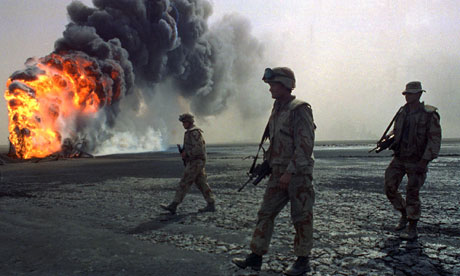 Shortly before Christmas, a long multi-year toxicological investigation of Gulf War Illness headed up by UT Southwestern's Dr. Robert Haley announced its final conclusions. This is a study that's received lots of attention, and many consider it the definitive work on the Illness to date. Because it involved a local Dallas medical institution and a renowned local scientist, the Morning News traced the study's progress year-to-year, with its penultimate update appearing right after Thanksgiving.
Reporting that the study had confirmed that actual physical nerve damage in veterans, and not psychological problems, was the underlying common denominator of the Illness' many different reported symptoms, including breathing difficulties, increased heart rate, decreased sexual function, perspiration and other body functions.
You see, a lot of Very Serious People didn't believe the Gulf War Vets who reported being Ill because they didn't exhibit any of the classic signs of any specific diseases or condition. As it turns out, those same Very Serious People thought the same thing about citizens who were regularly getting shat on by industrial pollution and experienced many of the same kinds of symptoms as the Vets.
Doesn't this sound awfully familiar to some of you?
“Many of these veterans have been told that there is nothing wrong with them,” Haley said Monday in an interview. “Our hope is that the physicians treating our veterans will read this study and recognize the symptoms, and that this will lead to better treatments.”
In the last sentence of the November DMN piece, Haley assured the reporter that the upcoming final chapter of his study would be decisive. Having shown that the Illness was in fact based in physiology and not psychology, Haley was ready now to point the finger at the trigger mechanism itself – what thing or things were causing this physiological response in so many Vets.
“We’re going to show proof of what causes this,” he said. “It will be a huge study with convincing evidence.”
In December, that final chapter was published in a peer-reviewed paper for a respected journal. The New York Times ran an article. And the conclusions were very controversial indeed.
"The paper, published in the journal Neuroepidemiology, tries to rebut the longstanding Pentagon position, supported by many scientists, that neurotoxins, particularly sarin gas, could not have carried far enough to sicken American forces.
The authors are James J. Tuite and Dr. Robert Haley, who has written several papers asserting links between chemical exposures and gulf war illnesses. They assembled data from meteorological and intelligence reports to support their thesis that American bombs were powerful enough to propel sarin from depots in Muthanna and Falluja high into the atmosphere, where winds whisked it hundreds of miles south to the Saudi border.
Once over the American encampments, the toxic plume could have stalled and fallen back to the surface because of weather conditions, the paper says. Though troops would have been exposed to low levels of the agent, the authors assert that the exposures may have continued for several days, increasing their impact."
So the Gulf War Vets not only suffered from some of the same symptoms as downwinders, but they get exposed in the same way downwinders do – a little bit every day. This is the insidious conclusion of the report – that amounts of poison that the regulatory agencies (in this case, the Pentagon) tell you should result in no harm, actually cause harm.
Some scientists studying Gulf War Illness disagree with Dr. Haley. They still hold fast that stress or other psychological conditions cause the Illness. But it's the conclusion of one of the best and most thorough studies of Gulf War Illness ever conducted.
However, you'd be hard-pressed to find anything about it in the Morning News. Unbelievably, the paper didn't cover the final, headline-making conclusion of a study it's been following meticulously for years now. We don't know if the challenge to the status quo was the reason, but it seems like a strange time for the News to wig out.
But taking Dr. Haley's conclusions and overlaying them with what we know about the toxic soup that downwinders often end up being exposed to on a routine basis, one can't help but see the similarities, right down to the "they must be imagining their symptoms" response of the Powers-That-Be. Whether it's the Pentagon, the TCEQ, or EPA, Dr. Haley's research challenges the way we diagnose and protect human health from low-level chemical invasions.
Was Lead Contamination the Major Cause of 20th Century American Crime?
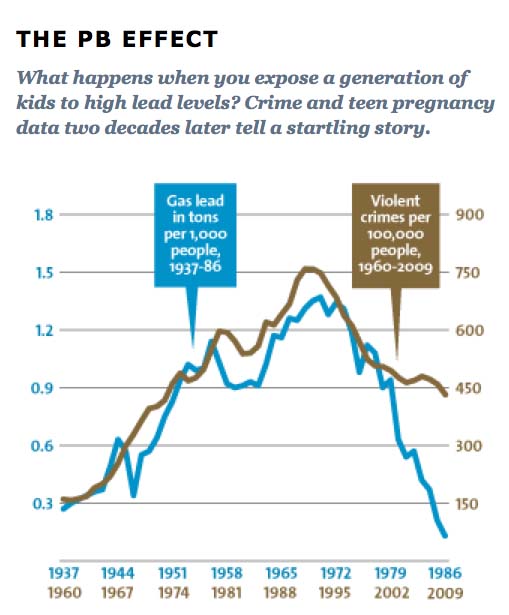 That's the hypothesis that Kevin Drum makes in the latest issue of Mother Jones, and he has a lot of evidence to back it up.
For years, scientists have known about the link between lead exposure in children and decreasing IQ levels. More recently, researchers have discovered more subtle effects in terms of anti-social behavior and AHHD diagnosis. Now, modern toxicology is to the point where most leading researchers say there is no level of lead a child can be exposed to that doesn't have the potential to effect his or her personality.
What if you were to use what we know now about the effects of lead contamination on young minds and playback the last 70 years of American history?
The biggest source of lead in the postwar era, it turns out, wasn't paint. It was leaded gasoline. And if you chart the rise and fall of atmospheric lead caused by the rise and fall of leaded gasoline consumption, you get a pretty simple upside-down U: Lead emissions from tailpipes rose steadily from the early '40s through the early '70s, nearly quadrupling over that period. Then, as unleaded gasoline began to replace leaded gasoline, emissions plummeted.
Gasoline lead may explain as much as 90 percent of the rise and fall of violent crime over the past half century.Intriguingly, violent crime rates followed the same upside-down U pattern. The only thing different was the time period: Crime rates rose dramatically in the '60s through the '80s, and then began dropping steadily starting in the early '90s. The two curves looked eerily identical, but were offset by about 20 years.
So Nevin dove in further, digging up detailed data on lead emissions and crime rates to see if the similarity of the curves was as good as it seemed. It turned out to be even better: In a 2000 paper (PDF) he concluded that if you add a lag time of 23 years, lead emissions from automobiles explain 90 percent of the variation in violent crime in America. Toddlers who ingested high levels of lead in the '40s and '50s really were more likely to become violent criminals in the '60s, '70s, and '80s.
Dr. Howard Mielke of Tulane, who's analyzed the blood lead data collected from Frisco and found the samples higher than the state average, makes an appearance in Drum's article because of a large new study overlaying neighborhood lead exposure to neighborhood crime in six American cities. They match up precisely.
Read the short version of the article here. Here's an interview with Dr. Mielke.
No one knew a lead additive in gasoline would produce such an impact. Because we didn't do the toxicology. Lead was introduced in gasoline in the 1920's when the modern industrial age was just hitting its stride. Now there are some 80,000 chemicals in the marketplace, only a handful of which have been tested thoroughly, including lead, because we're still not doing the toxicology BEFORE the chemical is used in widespread commerce.
Cancer. Birth Defects. Endocrine Disruptors. Why is it so inconceivable to some that the thousands of untested chemicals coursing through the veins of our economy can't have unintended consequences just like leaded gasoline, on their own or in combination with each other? What new epidemics are we instigating even now?
Where Were You?
 When the City of Dallas Decided
….to either let a vote stand, or steal it
….to defend air quality, or approve a new refinery that will be a top ten polluter
….to protect parks and floodplains, or make them industrial sites
….to listen to its residents, or a single gas company
The City Plan Commission Can Decide All These Things Today
Thursday 1:30 pm 6th Floor City Council Chambers
Dallas City Hall
1500 Marilla
Now is the Time for All Good Breathers to Come to the Aid of Our Air – And Your Rights
 Stand Up for the Right to Speak Out
The fight over gas drilling in Dallas is now as much a about the democratic process as it is about pollution:
– Public meetings scheduled five days before Christmas in hopes of lowering turnout
– Hiding a huge compressor station and gas processing plant that will be the 10th largest air polluter in Dallas inside a "drilling permit"
– And now, they want to steal a vote citizens won in December through "reconsideration" of that vote a tomorrow's Plan Commission meeting…without any opportunity for public comment.
But we assure you. There will be public comment.
Help us protect your rights as citizens and breathers
Join us Tomorrow
Because some things just need protesting
Thursday 1:30 pm
6th Floor City Council Chambers Dallas City Hall
And Today… you can send an instant e-mail to the Dallas City Council and the Dallas Plan Commission telling them you don't want them to "reconsider" the gas permits that were denied in December
Do this right now. Please. Thanks
Guess What? That “Drilling” Permit is Really for a Refinery
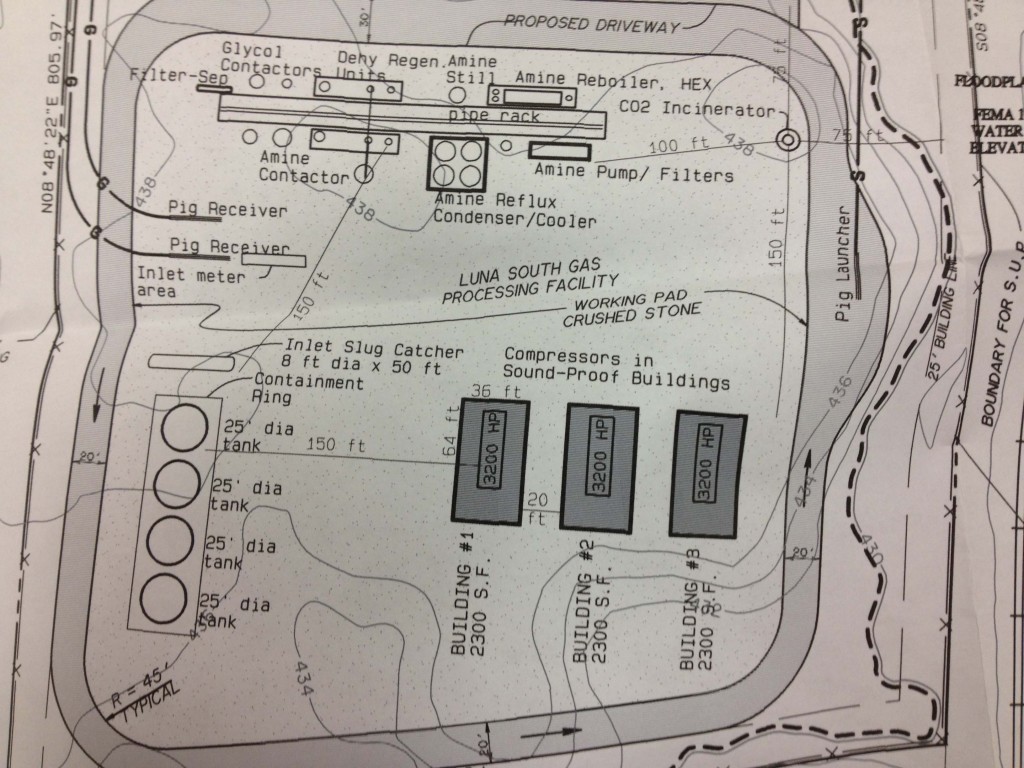 Under the guise of "gas drilling," Dallas City Hall and industry are pressing for approval of a permit that would locate a gas refinery only 600 feet from the new Elm Fork soccer complex, and immediately give birth to one of the ten largest air polluters in the City of Dallas, as well as one of its most toxic.
"There's a huge toxic Trojan Horse hiding in what the City and Trinity East describe as just a gas drilling permit," charged clean air activist Jim Schermbeck of Downwinders at Risk. "In fact, the Elm Fork permit allows for the building of a gas refinery that houses at least three giant compressors as well as an entire acid gas removal unit that strips off hydrogen sulfide, one of the most dangerous substances in the gas patch."
A motion to "reconsider" the Dallas City Plan Commission's 7-5 December 20th rejection of the Elm Fork permit and two other Trinity East gas sites is being advocated by CPC Chair and Mayoral appointee Joe Alcantar at this Thursday's meeting. If successful, the "reconsideration" would require the CPC to hold a second hearing and re-vote on the permits less than a month after denying them.
Opponents say the move is an act of desperation on the part of the Mayor and City Manager to protect a secret deal that was made between the City and Trinity East when the company first paid for mineral rights leases on city owned land. In interviews, the Mayor himself has said that a "deal was cut." Residents say the public was left out of that deal.
But after making calls to City Hall, Schermbeck is convinced that no one in Dallas city government is aware that the "gas drilling permit" being proposed by Trinity East is actually a permit to build a large gas refinery in the Trinity River floodplains.
"They're in way over their heads. City attorneys are still describing this as a drilling permit, but that's not what takes up most of the acreage on this site – it's all about the refinery."
During the December 20th City Plan Commission hearing on the permit, Trinity East representatives stated that the three proposed compressors alone – huge locomotive sized diesel-powered engines that produce thousands of horsepower in order to move gas through pipelines – would release 25 tons of air pollution each every year for an annual total of 75 tons.
That number would immediately place the facility among the city's ten largest air polluters according to the latest state emission totals from 2010. It would join power plants, asphalt and roofing materials manufacturers, and chemical plants as one of the city's biggest "stationary sources" of pollution.
However, Schermbeck thinks Trinity is low-balling their total air pollution impacts by not including other on-site refinery sources like its battery of storage tanks and "acid gas removal" operation that's designed to strip dangerous hydrogen sulfide off of natural gas streams through a series of acid baths and heat.
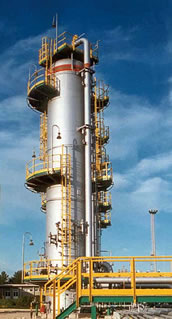
Hydrogen Sulfide is a harmful and toxic compound. It is a colorless, flammable gas that can be identified by its "rotten egg" odor. This invisible gas is heavier than air, travels easily along the ground, and builds up in low-lying, confined, and poorly ventilated areas. It acts as a chemical asphyxiant through inhalation exposure and its effects are similar to cyanide and carbon monoxide, which prevent the use of oxygen.
The equipment to strip off Hydrogen Sulfide from raw gas is large, complicated and dangerous. Site plans show a 200 foot long "pipe rack" with at least 20 "point sources" or stacks, apart from the compressors, where pollution could be released into the atmosphere.
"This isn’t a facility you want near parks or kids," said Schermbeck. "Yet, the City of Dallas seeks to put it just 600 feet away from its new huge soccer complex that’s meant to attract thousands of kids for hours every week."
Such a gas facility also challenges regional smog goals. A 2012 study from the Houston Advanced Research Center found that "routine emissions from a single gas compressor station can raise ozone levels by 3 parts per billion (ppb) as far as five miles downwind, and sometimes by 10 ppb or more as far as 10 miles downwind."
The Trinity East numbers don't reflect the release of greenhouse gas pollution either, which could be enormous from a facility the size of the refinery being proposed. Gas processing plants can release 20 to 80,000 tons of greenhouse gases a year. By comparison, the entire inventory of greenhouse pollution from all Dallas industrial sources in 2005 was 25,000 tons a year.
None of this information was brought up at the December 20th CPC hearing on the Elm Fork permit because the permit request in its current form was only a couple of weeks old when it went to the CPC and the compressors were a last-minute addition to an older, pending request.
Citizens were lucky to get a crowd to even show up five days prior to Christmas, and Schermbeck believes no one at Dallas City Hall bothered to notice that one of the so-called drilling permits was a refinery permit.
"Because it had no expertise of its own, and it was ignoring citizens, City Hall was completely reliant on the company's version of what the permit was for, and Trinity East probably didn't want to admit they were stuffing one kind of permit inside of another. The City didn't perform its due diligence. The result is that it's been completely played by the company."
Schermbeck recounted that he could find no one at City Hall who had any idea of how Trinity East arrived at their "25 tons a year" air pollution figure, knew what kind of specific pollutants that tonnage included, or, most importantly, thought it would be good to know this information before the city handed the company a permit to operate an inner-city gas refinery.
"Mayor Rawlings and the City Manager seem content to give Trinity East a blank check to pollute Dallas air," he said.
A closer look at the refinery site plans also reveals equipment that is fundamentally at odds with the way Trinity East and the gas industry has been portraying what kind of gas Dallas has underneath it.
Up to now, gas operators have been saying Dallas gas is "dry" and without a lot of extra hydrocarbons found in "wet gas" further west. But the acid gas removal units and Glycol conductors proposed for the Elm Fork refinery are built for wet gas.
Schermbeck suggests that perhaps either the City has been mislead about the nature of the gas it owns or the nature of the Trinity East site. He theorized that instead of the Dallas refinery being built for dry Dallas gas, it might be aimed at wet gas coming from the west.
"Dallas would get none of the royalties, but all of the pollution."
Mad? Go to this link now and send an e-mail to the Dallas City Council and City Plan Commission that says you oppose these gas permits and the "reconsideration" of their denial by the Commission:
https://www.downwindersatrisk.org/featured-citizen-action
Do it Now.
Another Win for Your Lake of Air
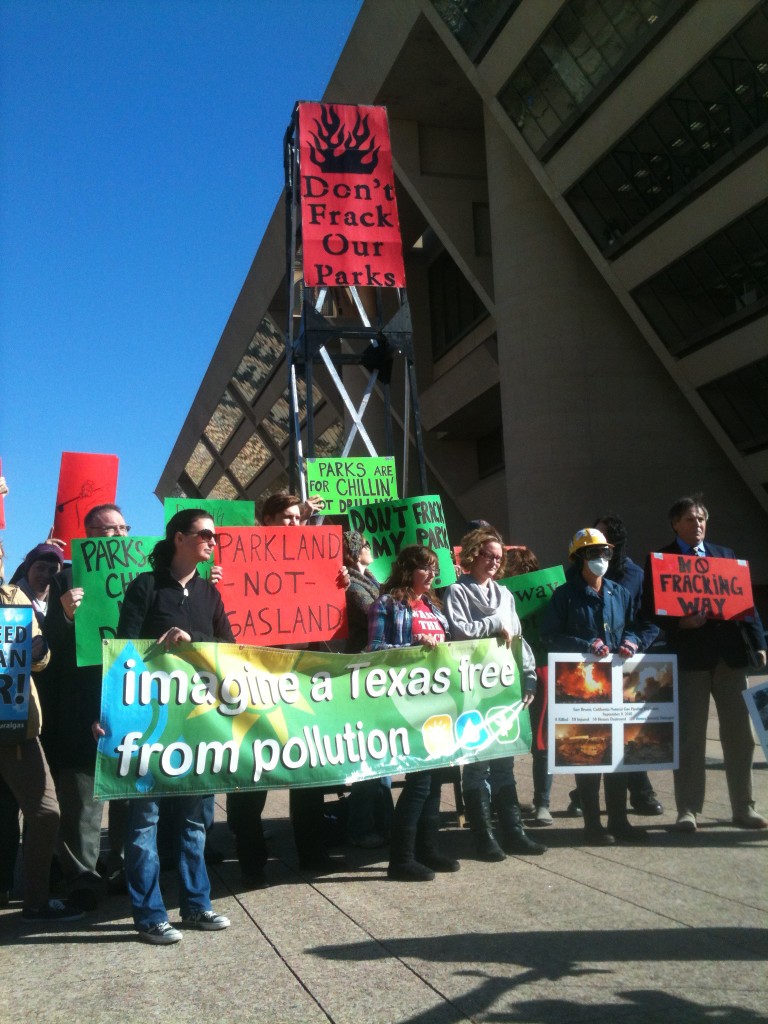 Late Thursday night Downwinders at Risk, as part of the Dallas Residents at Risk alliance, won a victory that citizens weren't supposed to win. Late Thursday night Downwinders at Risk, as part of the Dallas Residents at Risk alliance, won a victory that citizens weren't supposed to win.
Immediately after Thanksgiving, Dallas Mayor Mike Rawlings and City Manger Mary Suhm had plotted to speed the approval of the first gas drilling permit in Dallas. One left over from 2008 that would be exempt from the new drilling ordinance now in the works. One that included a compressor station and allowed for the drilling in city parks and flood plains. City Hall believed it had greased the tracks with threats of gas company lawsuits and given the City Plan Commission no choice but to approve the permit. Just to be sure, they scheduled the Plan Commission vote for December 20th, a time guaranteed to result in smaller crowds of opposition at City Hall. But something happened to make things go a little off-script. Responding to calls for help, enough Dallas residents showed up to articulately speak against the permit for more than an hour. They represented hundreds of neighborhood groups, the environmental community and public interest organizations like the League of Women Voters. If the raw numbers didn't match earlier attendance, the people that did show up represented real constituencies numbering in the thousands. When the vote was finally called at 7:30 pm Thursday evening, we won 7 to 5. The "grandfathered" gas drilling permit would not be approved by the Plan commission. To overturn this decision, the City Council must find 12 votes – a super majority – in favor of the permit at its mid-January meeting. This was not the result Dallas City Hall was counting on the Thursday night before Christmas. But thanks to supporters like you, it was the result that happened. Just as we mobilized opposition to Midlothian cement plant pollution, and helped organize Frisco residents to close down an obsolete and dangerous lead smelter, Downwinders is drawing a line in the Shale in Dallas and leading a push back against irresponsible urban drilling. And, against very long odds, we're winning….again. We do this to protect your lake of air. You ingest an average of 200 gallons of water every year, or about five bathtubs' worth. But you inhale approximately two million gallons of air every year – your own small lake of air.
In DFW, chances are your lake of air is going to have smog in it, along with some soot, some Sulfur Dioxide, Volatile Organic Compounds, as well as an assortment of other manufactured If your tap water was dirty brown and had lots of particles in it, you'd probably choose to drink bottled water. But when the air is dirty brown and has lots of particles in it, your lungs don't have a choice about the air they can use. Downwinders at Risk is here for one reason and one reason only: to defend your lake of air. Whether your air is threatened by smelters, gas rigs, cement plants or too-common smog, we're working to clean it up. For our efforts, Downwinders was proud to receive the first-ever GreenSource DFW award for Outstanding Grassroots Group in 2012. Looking ahead to 2013, your lake of air faces new threats, including worsening new permits by the Midlothian cement plants to burn large volumes of industrial garbage, and indiscriminate aerial spraying of pesticides by local governments. Downwinders at Risk will fight these threats with the combination of good science and citizen activism that's made us the foremost clean air group in DFW. But we need your help to do it. Our work depends on contributions from folks like you who appreciate what we do. Our annual budget is usually only around $30-50,000. We do all the work we do with an amount of money larger groups spend annually on office furniture or travel. We don't get money from a parent group in Washington or New York. Our board members are all from DFW. They're ordinary citizens like you, not rich patrons. Small donations make up a very large percentage of what we take in every year. We couldn't do what we do without you. In the time it took you to read this message, you've inhaled a couple of more gallons of air. Don't you think it should be clean air? You keep supporting us; we keep working for you – and surprising the opposition with victories that citizens in Texas just aren't supposed to be able to pull-off. That's our promise. Thanks for your consideration and Please click here to safely and securely donate online, or send checks to Downwinders at Risk, PO Box 763844, Dallas, TX 75376. Your donation is greatly appreciated and will be wisely spent. Thanks.
|

Public Health Action Alert – Exide’s “Community Meeting” on Wednesday
 Please come and insist that the clean-up of the Exide lead smelter be open to public notice and comment, and not done behind closed doors.
Exide is hosting a hastily called "public meeting" on demolition and dust control plans for its former Frisco lead smelter Wednesday night beginning at 7 pm at the Frisco Depot in the Historical District, 6499 Paige Street.
Among other things, Exide wants to permanently leave a waste landfill in central Frisco with approximately nine million pounds of smelter waste inside, instead of trucking it out.
The city is letting the company have its way, even though this landfill in downtown will be an impediment to economic development and a constant threat to groundwater and air contamination that will demand never-ending monitoring.
All of the decisions about the clean-up of the smelter site are taking place behind closed doors with no public input or notice.
Last Friday the company submitted its plan for the permanent hazardous waste landfill and got it approved the very same day without any public notice or comment.
Wednesday's meeting is about a demolition plan that has already been written by the company without listening to any public concerns. They're only letting residents know about it after the fact.
We know it's the holiday season – that's why Exide scheduled this meeting. The company hopes you've quit paying attention. We hope you haven't.
There's a lot of dangerous material on the Exide site. If it's not disposed of correctly, Frisco could have an economic and public health black hole in the middle of town forever, what USA Today called lead "ghost factories." That's why this is important.
Meanwhile, the city of Frisco is protecting your interests by…being a silent partner to Exide's plans. City Hall has defaulted to the state and the company's judgment and isn't acting as an independent watchdog.
The City is writing press releases with Exide, but it isn't asking hard questions about the clean-up, or hiring its own experts to double-check what Exide and the state are proposing. It isn't demanding public notice or comment on behalf of residents. In fact, the city is keeping information about the clean-up and smelter to itself, refusing to post it online or release it to residents or reporters.
Come to the Wednesday night Exide meeting to express your displeasure with a strategy that's putting the same people responsible for creating the Exide mess in charge of "cleaning it up."
At this point we need the same public pressure that caused the city to change course and close the outlaw smelter to help open the closed doors that are hiding the clean-up process from public view.
“Animals are the Sentinels”
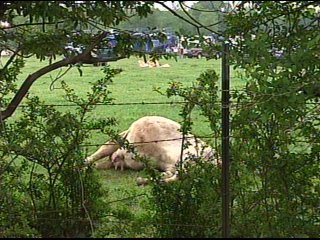 In the late 1980's Sue Pope became concerned about her horses and cows. Her favorite Arabian was developing "heave" muscles on its torso that Pope's vet said was the result of the horse straining to breathe. Her cattle were acting strangely and not developing as they should. These problems seem to come out of the blue, for no obvious reason Pope could figure out. She also noticed that she and her family didn't feel the same either and wondered if what was affecting her animals was also affecting them. She spoke with her neighbors, some of whom were also noticing strange things among their stock and themselves. They didn't have any answers either. That's when Pope started to look for causes outside the gate of her small Midlothain ranch.
And that was the beginning of what eventually turned into Downwinders at Risk. Because of her own experience it has been Sue Pope's belief that more than expensive monitors or dubious risk assessment studies, "animals are the sentinels" for human health. They are literally the canary furtherest down the coal mine.
When the ATSDR decided to review the monitoring information from Midlothain for it's "health consultation" beginning almost ten years ago, they were in part drawn by the large file of documented cases of animals illness, disease and deformities. There's more than one animal stock breeder who has moved to Midlothian over the last 25 years expecting that elusive "fresh country air" to benefit their animals only to find them suffering weird symptons never experienced before in previous locations.
Animals are sentinels, especially livestock, because they don't go to school or work, but stay in the same place all day and night, they graze exclusivley on local plants grown in the local soil. They drink the local surface and/or well water. Livestock have the most exposure and the most "exposure pathways" to whatever potentially harmful chemicals might be in the environment. If it's harming the animals, it's probaly harming people as well.
That's the context for a new article out in The Nation about animals gettign sick in the gas patch.
"Earlier this year, Michelle Bamberger, an Ithaca veterinarian, and Robert Oswald, a professor of molecular medicine at Cornell’s College of Veterinary Medicine, published the first (and, so far, only) peer-reviewed report to suggest a link between fracking and illness in food animals. The authors compiled case studies of twenty-four farmers in six shale-gas states whose livestock experienced neurological, reproductive and acute gastrointestinal problems. Exposed either accidentally or incidentally to fracking chemicals in the water or air, scores of animals have died. The death toll is insignificant when measured against the nation’s livestock population (some 97 million beef cattle go to market each year), but environmental advocates believe these animals constitute an early warning.
Exposed animals “are making their way into the food system, and it’s very worrisome to us,” Bamberger says. “They live in areas that have tested positive for air, water and soil contamination. Some of these chemicals could appear in milk and meat products made from these animals.”
In Louisiana, seventeen cows died after an hour’s exposure to spilled fracking fluid. (Most likely cause of death: respiratory failure.) In north central Pennsylvania, 140 cattle were exposed to fracking wastewater when an impoundment was breached. Approximately seventy cows died; the remainder produced eleven calves, of which only three survived. In western Pennsylvania, an overflowing waste pit sent fracking chemicals into a pond and a pasture where pregnant cows grazed: half their calves were born dead. The following year’s animal births were sexually skewed, with ten females and two males, instead of the usual 50-50 or 60-40 split.
In addition to the cases documented by Bamberger, hair testing of sick cattle that grazed around well pads in New Mexico found petroleum residues in fifty-four of fifty-six animals. In North Dakota, wind-borne fly ash, which is used to solidify the waste from drilling holes and contains heavy metals, settled over a farm: one cow, which either inhaled or ingested the caustic dust, died, and a stock pond was contaminated with arsenic at double the accepted level for drinking water."
People used to ask Downwinders why we decided to take on air pollution from the gas industry. The reason is that all of the red flags we saw over the years in Midlothian are also being raised around gas facilities – individually and/or collectlively. Many of the same chemicals, many of the same health effects from those chemicals, and then the warning from the animals.
Better than TCEQ monitors. Better than out-of-date risk assessments. Animals are some of the best Guinea Pigs we have in the laboratory of chemicals we all swim in. If we would only listen.