air toxics
Why Is a Local Cement Plant Storing 45 Tons of Ammonium Nitrate in its Limestone Quarry?
 According to today's Dallas Morning News, the Holcim cement plant in Midlothian is storing 45 tons of ammonium nitrate, the same substance that authorities believe caused the West blast, in its limestone quarry. Apparently no DMN reporter asked what a cement plant was doing with so much "fertilizer" on its premises. Using it as another weird "additive?" Storing it for some farmer friends? Why Holcim and not TXI or Ash Grove? Plus the DMN reporters apparently never even visited the site and described the area as void of houses and schools. In fact, Downwidners' founder Sue Pope and others live just north of the Holcim quarry – close enough for them to be affected by the blasts of rock when the cement plant mines the limestone in that same quarry. And there are at least two schools within a mile of the place.
We've got an inquiry pending with Holcim representatives asking about the presence of the chemical on site. If we get an answer we'll let you know. Meanwhile, we're left to wonder why it took a disaster in West to bring this strange development to light.
West to Dallas: Zoning is Important.
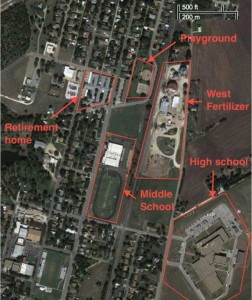 For many of us dealing with the Texas "environmental regulatory system" the shock isn't that something like the West disaster happened, it's the fact that similar accidents don't happen more frequently. Still, it seems like it combined a perfect storm of all-too familiar circumstances
1984 – the company moves two large pressurized tanks of liquid anyhydrous ammonia, a potentially lethal poison, from a site in nearby Hill County to its current location in West without notifying state authorities. It was 1992 before the state caught the mistake and made the company do the paperwork. It moved into an area whre there was already residential development.
1987 – the company was venting ammonia that built up in transfer pipes into the air despite explicit orders in its permit not to do so.
Mid-1990's – the plant’s neighbors complained often about ammonia odors from the company. A neighbor reported “strong anhydrous ammonia odor at her house on Jane Lane.” Another “alleged that strong ammonia odors had intermittently been coming from the West Chemical and Fertilizer facility.” That happened repeatedly, but each time a state inspector arrived, usually days later, he couldn’t smell any ammonia or find any leaks.
2004 – The company’s “grandfathered” status for the two large pressurized tanks of liquid anyhydrous ammonia expires. It was 2006 before an ammonia odor complaint sent an inspector to the company in 2006, a records check revealed the overdue permits.
2006 – a West police officer called a company employee to tell him an ammonia tank valve was leaking. The employee confirmed the leak and “took the NH3 [ammonia] tank out to the country at his farm,” according to a handwritten note. “West Police followed him.”
2006 – EPA fined cited West Fertilizer $2,300 for not implementing a risk-management plan, according to an EPA database.
2011 – In the required risk-management plan, West Fertilizer said the “worst-case scenario” would be an ammonia leak from a storage tank or hose. It didn’t specify the likely consequences. The company said the plant had no alarms, automatic shutoff system, firewall or sprinkler system.
2012 – the Office of the Texas State Chemist, which regulates fertilizer, visited the company 12 times and found "no problems" with the management of its material.
The Occupational Safety and Health Administration had not inspected the plant since 1985, when it gave out a $30 fine. Because of budget cuts, OSHA can inspect plants like the one in West about once every 129 years.
All the elements found in West – disregard for common sense, "grand-fathering" of incompatible zoning, no enforcement of current regulations – can be found just about anywhere you could throw a dart on a map of Texas. All it takes is a lightning strike, a mistake at a control board, or a wind-whipped ember. For evidence, look only to the stories being told by an ex-Exide employee about working conditions at the recently-closed lead smelter in Frisco.
But much more common still are the daily insults to workers and neighbors inflicted by "upsets," accidental releases, and routine pollution that no one has assessed for its full toxicological impacts. These are the non-spectacular injuries of under and no-regulation, and they overwhelm the headline-making ones. Together with the potential for catastrophe, this is why zoning is important. This is why paying taxes for inspectors is important. This is why industry cannot be trusted with its own regulation. This is why environmental protection is a DIY proposition.
There's been a lot of tsk-tsking over the wayward rural ways of West that allowed the accident to inflict so much damage, but countless North Texas officials have shown they're no more sophisticated. Many Barnett Shale communities allow drilling sites within just 100-500 feet of homes and schools, much less as processing plants and compressor stations. Currently, the majority of the Dallas City Council is in favor of putting drill sites in city parks and a gas refinery dealing with dangerous Hydrogen Sulfide only 600 feet from a giant children's athletic complex. Imagine the indignant questions should they get their wish and something terrible happens. "Who allowed a facility like that so close to those kids?"
We think we live in places where a West could not happen. We're wrong.
Why Frisco’s Lead Clean-up is Now Tied to California Courts
 Smelling green, lawyers suing on behalf of Exide shareholders have begun to flock to the Golden Gate state's courts to file lawsuits alleging the company lied to purchasers of stock about the substantial environmental liability of the company's Vernon smelter, recently cited as presenting the highest cancer risk of any industrial facility in Southern California.
At last count there were at least five separate law firms preparing to sue, alleging Exide has…
"…violated certain provisions of the Securities Exchange Act of 1934. Specifically, the complaint alleges that defendants misrepresented and/or failed to disclose that, among other things: (a) the Company was polluting the environment and exposing almost 110,000 residents near its Vernon, California battery recycling facility with potentially fatal levels of arsenic and other pollutants; (b) the Company knew that it would not be able to meet its debt repayment obligations and other pledges and promises based on actual and projected revenues and expenses; and (c) the Company knew that its environmental liabilities, debt obligations and potential insolvency did not support Exide’s statements to investors. According to this complaint, when these facts were finally revealed to the market, Exide’s shares plummeted by approximately 46%.
This isn't the first, or even the second or third time the company has had these kinds of problems. As it turns out, Exide has a history of financial shakiness and corporate irresponsibility:
Despite market dominance, Exide lost about 75% of its share value from 1996 to 1998. Some shareholders sued management, alleging misrepresentation, and the Florida attorney general and the SEC launched probes into whether the company sold used batteries as new. (In 1999 Exide settled with Florida without admitting wrongdoing, and it also settled with shareholders.) In 1998 management clumsily announced a recapitalization attempt and then changed its mind. Amid these problems, Hawkins resigned as chairman and CEO and former Chrysler exec Robert Lutz replaced him.
In 1999 Exide canceled a contract with Sears (4 million batteries a year) to focus on profits rather than volume. Later that year Exide sold its Speedclip division to Prestolite Wire. In 2000 it acquired the global battery business of Pacific Dunlop (now Ansell Limited), GNB Technologies. Exide also sold its remanufactured starter and alternator business (Sure Start).
In 2001 Exide agreed to a plea deal with federal prosecutors whereby the company would pay out $27.5 million in fines over five years. The company admitted to making defective batteries, covering up the defects, and bribing a Sears, Roebuck buyer. Burdened with heavy debt, Exide also announced in 2001 that it planned to issue 20 million new shares in a debt-for-equity deal. That year the company changed its name from Exide Corporation to Exide Technologies.
In 2002 Exide filed for Chapter 11 bankruptcy reorganization as a result of its acquisitions bender and poor conditions in the automotive sector. Later in the year Exide inked a deal to become the exclusive battery supplier to Volvo Truck Australia, giving the battery maker a 74% market share for heavy truck batteries in Australia.
Arthur Hawkins, the former CEO of Exide, was convicted in 2002 of fraudulently selling defective batteries to Sears Automotive Marketing Services. He was sentenced to 10 years in federal prison; the sentence was upheld in 2005. Three other Exide executives were convicted of various federal charges.
When Exide emerged from Chapter 11 bankruptcy in 2004, the company had cut its debt by a reported 70%. That year the company combined its motive power and network power operations into one segment, industrial energy.
While Exide exited Chapter 11, it still experienced corporate pain — the company continued to lose money, and it shut down its lead-acid battery manufacturing plant in Shreveport, Louisiana, in 2006. The plant served Ford Motor and other aftermarket customers. The Shreveport factory was operating since 1968. Production was shifted to other Exide facilities.
Guess what lucky North Texas community helped pick up Exide's slack?
So this is the corporate entity the City of Frisco reached an agreement with concerning the "outer ring" of the Exide lead smelter in that town, also other wise known as the "J" parcel. As it turns out, that agreement gives the company a big financial incentive to clean up that part of their property and hand it over to the City for development. Exide is counting on getting $45 million from the City when the clean-up of the "J Parcel is given the Good Housekeeping Seal. To put that amount in perspective, 2013 second quarter operating income for Exide was only $6.8 million.
So if Exide is as greedy and needy as their record indicates, that J Parcel will be spic and span. But that's not the land the smelter and all of Exide's tons of lead smelter waste is on. That's on the approximately 100 acres smack dab in the middle of the J Parcel and central Frisco that Exide will still own. And there's no City deal to make sure that contaminated property is ever cleaned up.
Now add the current round of financial troubles Exide is in and there's absolutely no incentive for the company to spend money on the kind of state-of-the-art clean-up Frisco residents say they want. In fact there's a huge disincentive. Frisco is a former Exide smelter site with no discernable assets and all sorts of long-term expensive liabilities. And if Exide goes belly-up, the City will find itself at the end of a long line of creditors, beginning with the shareholders who have the best lawyers, with little luck in recovering the money necessary to do a proper cleaning and closure.
The solution? Perhaps a little pro-active planning on Frisco's part could make sure the money is there to clean-up the worst of the worst contamination in a timely way. Requiring Exide to put up a bond pre-bankruptcy, or maybe taxing hazardous waste disposal by the pound are two possible paths that come to mind. Unless the City does something like this, and soon, it's central downtown development, and ambitious Grand Park plans will be forever held hostage to the fate of a company that's looking less and less viable with each passing day.
UPDATE: It was announced Wednesday that the State of California has ordered the Vernon smelter closed because the facility has "been continuously releasing hazardous waste into the soil beneath its plant because of a degraded pipeline" along with poisoning an unacceptable cancer risks.
Downwinders and Others File Stay Against EPA Over Weakened Cement Plant Rules
 Seventeen years and counting – that's how long Downwinders at Risk has been fighting to get the EPA to modernize their rules for waste-burning cement plants. And we're not giving up.
On Wednesday, a national coalition of environmental and community groups that included Downwinders at Risk asked a federal court to stay a decision by the U.S. Environmental Protection Agency to weaken and delay Clean Air Act protection against toxic pollution from cement plants.
By the agency’s own calculations, the delay will cause between 1,920 and 5,000 avoidable deaths and will allow cement plants to release an additional 32,000 pounds of mercury into the environment.
The complete list of groups seeking relief include Cape Fear River Watch, Citizens’ Environmental Coalition, Desert Citizens Against Pollution, Downwinders at Risk, Friends of Hudson, Huron Environmental Activist League, Montanans Against Toxic Burning, PenderWatch & Conservancy, and the Sierra Club, all of which have members who live and work in close proximity to cement plants and have suffered from cement plants’ excessive pollution for many years. Earthjustice filed the stay motion on their behalf in the U.S. Court of Appeals for the D.C. Circuit. A copy of the groups’ motion can be found here: Cement Motion to Stay Rule
Cement plants are among the nation’s worst polluters, emitting vast quantities of particulate matter, mercury, lead, and other hazardous air pollutants.
“As if gutting and delaying the rule were not bad enough, EPA has essentially created a compliance shield for the industry, making it impossible for citizens to hold facilities accountable for their toxic emissions. These changes in the cement rule are irresponsible and reckless,” said Jennifer Swearingen, of Montanans Against Toxic Burning.
“Los Angeles is ringed by cement plants, and three of them operate near my home in Rosamond,” said Jane Williams, of Sierra Club and Desert Citizens Against Pollution. “The pollution from these plants hurts the people in this community and robs us of the outdoor lifestyle we came here to enjoy. We can’t wait two more years to get relief from these plants’ pollution. I don’t want anyone in these communities to be among the people this pollution is going to sicken and kill.”
Our own Midlothian is the cement capital of the United States and so Downwinders at Risk' Director Jim Schermbeck had something to say about the move. “The EPA seems to have learned nothing from having cement plants exploited as inadequate hazardous waste incinerators. As cement plants are once again becoming the nation’s Dispos-All, and new wastes are generating new emissions, the Agency is weakening air pollution controls and making it easier for cement kilns to poison their neighbors. It was wrong to turn kiln into incinerators in the 1980s and it’s wrong to try and do so again in the 21st century – especially accompanied by a roll back in regulations."
In North Carolina groups are fighting a massive proposed cement plant. “A gigantic foreign cement company wants to build one of the world’s biggest plants here,” said Allie Sheffield, of PenderWatch and Conservancy, a group that works to protect the coastal ecosystem in Pender County, North Carolina. “If this plant is built, EPA’s new rule will let it emit twice as much lead, arsenic, and particulate matter into our air and waters. At this point, I have to ask – why do they call it the Environmental Protection Agency?”
William Freese, of Huron Environmental Activist League, lives near what the EPA’s Toxic Release Inventory lists as the dirtiest cement plant in North America for point source pollution. “This makes one wonder how the EPA, in violation of U.S. Court of Appeals’ order, can allow this company to do keep polluting for two more years. By the time they get around to finally doing what’s right, they won’t have any environment to protect,” Freese said.
“Federal law required EPA to put limits on this pollution more than a decade ago,” Earthjustice attorney James Pew said. “But under one administration after another, the agency has refused to put limits in place. Real people suffer as a result of EPA’s scofflaw behavior, and now they are going to court to say ‘enough is enough.’”
The 1990 amendments to the Clean Air Act required EPA to limit cement plant’s emissions of hazardous air pollutants such as mercury. In 2000, a federal court had to order EPA to set these standards after the agency refused to do so.
In 2010, in response to a lawsuit filed by Earthjustice on behalf of community groups living in the shadow of cement plants, EPA finally set the standards that the Clean Air Act had required it to set more than a decade before. These standards would have significantly reduced cement plants’ emissions of soot, mercury, lead, benzene and other toxic pollutants by September of this year.
Rather than acting to clean up their pollution, cement companies attacked EPA’s new rule in court and in Congress. The attacks failed. The court denied their request to vacate or delay the standards, and legislative efforts to do the same failed to gain support on the Hill.
In 2013, however, the EPA voluntarily gave the cement industry the very relief it had failed to get in court or in Congress. It delayed emission reductions that were already more than a decade overdue for another two years, until 2015. Additionally, EPA weakened particulate matter standards and eliminated requirements that would have required cement plants to monitor and report their emissions to the public.
Citizens are down but not out. And we will never rest until we see cement plants regulated the way they should be when they burn so many different types of waste. We can fight this fight because of your support over the years. Please help us keep fighting by putting a bill in the tip jar. We need your help to raise our 2013 budget to keep our staff in the field working for your lungs. Thanks.
If Exide Goes Bankrupt, What Happens to the Lead-Filled Landfills of Frisco?
 Last week the Exide battery company, owner of the now defunct Frisco lead smelter, hired a financial "restructuring" specialist firm by the name of Lazard, although the media coverage that followed the move suggested the more apt moniker could be Lazarus.
"Exide Technologies has been in the midst of a turnaround for awhile now and, like a car stuck in a snowbank, it hasn't been able to gain traction. Yesterday's price action on its stock suggests the market thinks it's going to end up in the ditch."
The news came on the same day the Los Angeles-based law firm of Glancy, Binkow & Goldberg said it would look into claims on behalf of Exide stockholders about possible violations of federal securities laws. Specifically, the firm’s investigation concerns allegations Exide issued misleading statements or failed to disclose material adverse facts concerning the company’s operations.
Nationwide, the company has been pulling back, selling off assets and closing plants. At last count, it had one operating smelter left in the US, and Exide just received noticed from the State of California that it will have to significantly reduce its pollution or it will be forced to close for causing a cancer hazard.
Meanwhile, the company is in the middle of a forced withdrawal from its Frisco smelter site, removing most buildings and surface structures, but leaving millions of pounds of lead contaminated smelter waste behind in a variety of landfills and dumps. It got some needed cash when the City of Frisco purchased surrounding acreage that was never the site of any production, but Exide is retaining ownership of the core smelter site – the very most toxic part.
Besides begging the question of whether this is the kind of company you want owning 100 toxic acres in the middle of your town – what happens if Exide doesn't own it? If the company goes bankrupt, who's responsible for insuring a thorough clean-up of the site, or doing anything else with it…ever?
You have to ask yourself if you were buying Exide's assets, would you really want a former smelter site with no smelter and lots of potential clean-up problems? On the other hand, the only path toward redevelopment of any kind hinges on the location of the land being in one of the region's hottest markets, so maybe a buyer that could invest in a clean-up could see some return from exploiting its proximity to everything else in Frisco.
If there's no buyers for Exide, the party of last resort is you the taxpayer via the EPA's Superfund Program. But that only guarantees you a spot on a waiting list. It could be left abandoned and toxic for decades after it's been officially listed.
You only have to look at Exide's former Dixie Smelter site in South Dallas to get an idea of what's in store for Frisco if the company is left to its own devices. Chain link fencing, warning signs, and a ring of groundwater monitoring wells surrounding a blank slate of land.
Which is to say that the City of Frisco has a spectacular self-interest in seeing that this entire smelter site gets the most protective, and most economically-desirable, clean-up that can be won. And so frustrating that the City signed over its rights to intervene in the formal closure permitting process.
If Frisco residents want a more pro-active role in insuring a proper and protective clean-up of a potential Superfund Site directly upstream from the City's proposed Grand Park, they're going to have to find a way for themselves or the City to act in self-defense on some other front besides the regulated closure process. Otherwise, they're just going to be helpless spectators to the last thing manufactured at the Exide site: a permanent toxic no-man's land.
Workers are Frontline Downwinders Dying for That New Sofa
 Before you're initiated as a citizen into the reality of the politics of environmental health, before you lose your civics virginity, you want to believe such things are not possible. Surely things aren't that bad. The company wouldn't let it get that bad. The EPA wouldn't let it get that bad. Not in.. (fill-in the year) But more often than not, it IS that bad. And not just bad, but novel-worthy bad. Bad in ways you couldn't imagine when you started out. That's how bad this story is.
Sheri Farley walks with a limp. The only job she could hold would be one where she does not have to stand or sit longer than 20 minutes, otherwise pain screams down her spine and up her legs.
“Damaged goods,” Ms. Farley describes herself, recalling how she recently overheard a child whispering to her mother about whether the “crippled lady” was a meth addict.
For about five years, Ms. Farley, 45, stood alongside about a dozen other workers, spray gun in hand, gluing together foam cushions for chairs and couches sold under brand names like Broyhill, Ralph Lauren and Thomasville. Fumes from the glue formed a yellowish fog inside the plant, and Ms. Farley’s doctors say that breathing them in eventually ate away at her nerve endings, resulting in what she and her co-workers call “dead foot.”
A chemical she handled — known as n-propyl bromide, or nPB — is also used by tens of thousands of workers in auto body shops, dry cleaners and high-tech electronics manufacturing plants across the nation. Medical researchers, government officials and even chemical companies that once manufactured nPB have warned for over a decade that it causes neurological damage and infertility when inhaled at low levels over long periods, but its use has grown 15-fold in the past six years.
Such hazards demonstrate the difficulty, despite decades of effort, of ensuring that Americans can breathe clean air on the job. Even as worker after worker fell ill, records from the Occupational Safety and Health Administration show that managers at Royale Comfort Seating, where Ms. Farley was employed, repeatedly exposed gluers to nPB levels that exceeded levels federal officials considered safe, failed to provide respirators and turned off fans meant to vent fumes.
There's an 8-minute film with Ms. Farley and other characters from the NYT story on the same page as the printed piece. Both are devastating in their directness. Everyday Farley and her co-workers would go to work and be enveloped in that yellow glue fog for 8-10 hour shifts. sometimes it only took weeks after being hired before the most severe neurological symptoms began to appear. This is in North Carolina, not China, or Mexico.
Even though the piece focuses on the workers at this one facility, what are the odds that people living adjacent to it were also being enveloped in the yellow glue fog? If a company doesn't care about its workers, it's not going to care about its neighbors either. Catch the warning about the harm of breathing in low levels of the glue over a long period of time?
There are many other takeaways from this piece, including
– How much attention OSHA pays to physical hazards that are well-understood like ladders and stairs, but not so much to chemicals in the workplace that affect us in more insidious ways – like robbing you of the use of your limbs.
– Why it's important to think things through to avoid a "Regrettable Substitute" like the yellow glue that was supposedly better for the ozone layer than what was formally used, but turned out to be a public health disaster on the ground. This is why we need the Precautionary Principle to test and verify the toxicity of the chemical BEFORE you release it into the marketplace. We know, completely radical idea.
– How ineffective "the system" was at protecting workers from chemical hazards that were way, way over the top – 860 times what the industry group recommended. And conversely, why workers need strong and effective unions to protect them.
Even if you think you've lost your ability to be shocked, this story will shock you.
Exide’s Crappy California Smelter Raising Cancer Risks
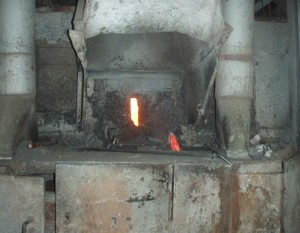 We've linked to the sad and horrible stories coming from ex-employees of the Frisco Exide Lead smelter that paint a disturbing picture of what went on when the public and regulators weren't looking. But this is Texas, where you practially have to have dead bodies piled up along your fenceline to get the state to do much about polluters and their pollution. What might happen if Exide were to have a rogue smelter in less-polluter-hospitable place, like, say, California?
A battery recycling plant in Vernon is being told to reduce its emissions after recent tests showed it is posing a danger to as many as 110,000 people living in an area that extends from Boyle Heights to Maywood and Huntington Park.
The South Coast Air Quality Management District announced late Friday that Exide Technologies, one of the largest battery recyclers in the world, must also hold public meetings later this spring to inform residents that they face an increased cancer risk and outline steps being taken to reduce it.
Air district officials said Exide's most recent assessment showed a higher cancer risk affecting a larger number of residents than any other of the more than 450 regulated facilities in Southern California over the 25-year history of a program to monitor toxic air contaminants. The primary contaminant in this case was arsenic.
There has been "nothing close to this … never," said Sam Atwood, spokesman for the air district.In a statement, Exide officials said they planned to work with the district on emissions reductions "that we expect will meet or exceed" requirements. "Exide takes its environmental responsibilities seriously…."
Yes, so seriously, they've waited until they got caught to address these arsenic emissions. According to the most recent estimates, the company is posing a risk of 156 cancers per million population. The EPA standard is one in a million.
Under California's regulations, when cancer risk from a facility reaches 10 per million, public notification is required. When it hits 25, facilities must take steps to reduce their emissions. Exide was six times over that limit.
Since the 1987 Toxic Hot Spots program went into effect, only about 20 facilities in Southern California have ever reported risks that were greater than 25 in 1 million. More than 95% of the facilities the air district regulates have risks under 10 in 1 million.
California will force Exide to produce a "Risk Reduction Plan" within 6 months that will have to outline how the company will reduce its arsenic emissions. Failure to do so could result in $25,000 a day fines and a shut down order from a judge.
Meanwhile, Exide is doing everything possible in Frisco to make sure that city will have lead-waste landfills along Stewart Creek and near downtown forever – refusing to remove the hazardous waste that's been found in them in favor of "treating" it in place in town and saying it wants to "cap" all the dumps and landfills, even though many are on slopes and one is even partially in the flood plain.
Our bet is that Exide will choose to close its California smelter rather than install state-of-the-art controls, and then Frisco will have yet another community to commiserate with over the company's toxic leftovers.
Your’re Downwind of Lots of Burning Trucks
 A funny thing happened to Dallas Morning News automobile columnist Terry Box while he was out test driving a new Dodge pick-up truck – it self-immolated and burned to ashes on the side of the road. As he writes about it, his experience is both funny and terrifying. But something he noted in how cars and trucks are made these days caught our eye:
"Open the hood of your late-model car or truck, and you’ll see a half-acre of plastic — actual engine pieces like valve covers, caps and containers for various liquids.
Thirty years ago, most of the pieces under the hood were metal and resistant to fire.
A fire in a modern vehicle burns fast and furiously. What’s intact for the moment can be gone or enveloped in toxic smoke in a matter of seconds."
Yep. When we've described the lovely new cement additive called ASR – Auto Shredder Residue – we've often talked about all the vinyl seats, dashboard and switches that get stipped out of a car and shredded, then thrown into a cement kiln. We really haven't talked about all the plastic in the engine compartment that would also be included in this new "fuel" that TXI has already been permitted to burn at its Midlothian cement plant.
As more and more of every car is made of "soft materials" – that is, not metal – more and more of it becomes fodder for cement kilns. This is material that could be recycled but isn't, and as long as it's cheaper just to burn it, there won't be amrket for recycling it.
Here's the thing, burning plastic creates bad kinds of pollution, including the creation of Dioxin, one of the most potent posions ever discovered by science. The same "toxic smoke" Terry Box saw pouring off of his burning Ram pick-up is created when you throw the same plastic parts into a cement kiln. The cement industry would like you to think that all of that is taken care of by the polluton control measures installed at the kilns, but it's not. There's no real time Dioxin montoring, much less any kind of monitoring for the host of other exotic fumes coming off burning plastic of various kinds. They barely even know what or how to test for such pollutants, but that doesn't keep the cement industry from marketing its kilns as "Long, Hot, and Good for America"™
If you're an old-timer, you might remember an earlier episode or two that occurred when the cement industry, including TXI, assured everyone that it could burn hazardous waste and make it completely disappear into water vapor. Remind us, how did that turn out?
Dallas Morning News Says Enough is Enough: Deny Gas Permits
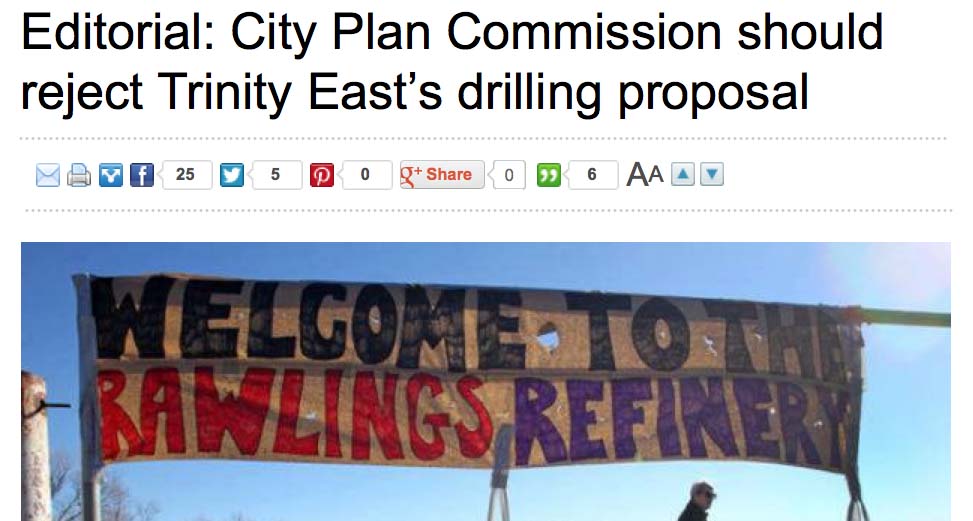 Win, lose or draw at Thursday's City Plan Commission vote, there is no question that, slowly, but surely, residents have built a consensus of public opposition to the Trinity East permits. For the latest proof, look no further than Wednesday's lead editorial in the Dallas Morning News advocating denial. It's the first time the paper has taken such a position. We know some of you can't get over the DMN paywall, so as a public service, here's the whole peice.
Groups Call for Full Open Public Hearing for Dallas Gas Permits Vote on Thursday
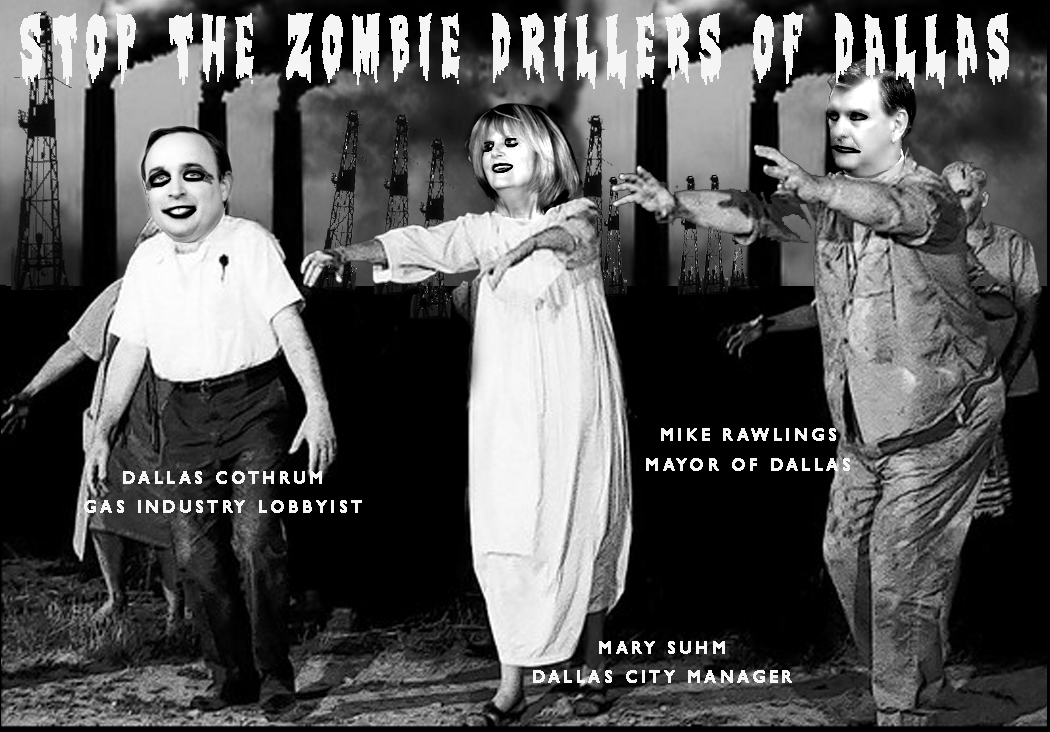 Here's the full text of a letter that was sent to all Dallas City Plan Commission members last week:
Commissioners and Chair,
Despite the request to the City Council made by members of the Commission on February 7th to change city policy in order to accommodate the Trinity East gas permits by your March 21st meeting, there has been no effort to do so.
For this reason alone, we urge you to take no action on these permits next week, or uphold your December 20th denial. These permits would allow surface drilling on park land and in floodplains, contrary to current city policy.
However, information and circumstances that have come to light since the December 20th vote to deny these permits make them even more objectionable.
We know that the proposed Trinity East processing facility and compressor station will be at least the 10th largest source of air pollution in the city, with a strong probability that emissions would grow to be much greater, out of the regulatory reach of the City of Dallas as they grow.
We know that city staff is working to locate this large air polluter next to the new Elm Fork Athletic Complex, in direct contradiction to recent city staff and City Council actions to protect the area around the Complex from lesser air pollution threats.
We know that, despite the title of the facility itself, the scale of operations, and the equipment it proposes to install, city staff refuses to classify Trinity East’s “Luna South Gas Processing Facility” as a gas processing facility under current City of Dallas zoning law.
We know that Trinity East misled the CPC at your February 7th meeting when its representative told you that gas well casings always protect underground aquifers. In fact, Trinity East had a casing failure at a previously undisclosed well in Irving, only a few miles away from the proposed Dallas sites, and with the City of Dallas participating in the lease agreement.
We know that on January 10th, Trinity East representatives told the Commission that its processing facility and compressor station would handle only the gas from its three Dallas sites—despite its Manager stating in published interviews that it was the centerpiece of a larger regional plan that incorporated Trinity East wells in at least two other cities.
We know that the city staff has a conflict of interest in performing an unbiased due diligence of the Trinity East permits because the City Manager had already pledged to support approval of the permits in a previously-undisclosed 2008 agreement. This is the reason there has not been a comprehensive review of the environmental and public health impacts of these permits by the City of Dallas staff, as there have been for other proposed polluting facilities in the same area as the Trinity East sites.
We know that a complaint has been filed with the Dallas County District Attorney’s Office alleging possible Open Meetings Act violations leading up to the January 10th CPC meeting that could make a second, “reconsidered” vote on the Trinity East permits illegal.
We know that a vote to approve these Trinity East permits is a vote condoning five years of the public, the Commission, the Park Board, and the City Council being intentionally mislead by the City Manager concerning the circumstances of these specific sites. It is perhaps the most important vote you will cast as a City of Dallas Plan Commissioner.
If you do decide to take a second vote on the Trinity East permits at your March 21st meeting, we request that you adopt special public hearing procedures that will guarantee a Dallas resident’s right to speak.
Based on the experience of the Commission’s February 7th meeting, the CPC format of 15-minutes per-side is clearly not adequate to allow everyone who wishes to give testimony on this high profile and controversial issue to be heard.
Because the CPC only meets during weekdays, many of us take off from our jobs or home responsibilities to attend. Our time should be respected. When a government entity announces a public hearing, it should be willing to listen to everyone who makes the effort to attend and speak. You owe us that courtesy.
The only time citizens have become angry during CPC meetings has been when they were completely shut-out of any opportunity to provide public comment (January 10th), and when public comment was shut down prematurely with many dozens of speakers still lined up to give testimony (February 7th). We make no apology in standing up for our right to speak out.
To avoid future frustrations, any definitive vote on the Trinity East permits taken on March 21st should be preceded by an inclusive, open-ended public hearing that gives each person their say. Toward that end, we propose that the CPC adopt the City Council rules for public hearing and allow everyone who wants to testify a total of 3 minutes each. The hearing would remain open until the last person spoke. Commission members would still be able to ask questions of specific presenters. This offers freedom of speech without sacrificing any of your tools to elicit further information from the participants.
We know that some of you must be as frustrated as ourselves in having to revisit this issue time and again, but there is a way to definitely put it to rest. Let the December 20th denial of the Trinity East permits stand.
Thank you for your consideration.
Raymond Crawford
Dallas Area Residents for Responsible Drilling
Jim Schermbeck
Downwinders at Risk
Sharon Wilson
Earthworks’ Oil & Gas Accountability Project
Marc McCord
FracDallas
Ed Meyer
Mountain Creek Neighborhood Alliance
Molly Rooke
Greater Dallas Chapter, Sierra Club
Zac Trahan
Texas Campaign for the Environment