Nitrogen Oxides
As His Replacement is Announced, Dr. Al Speaks Out in Austin
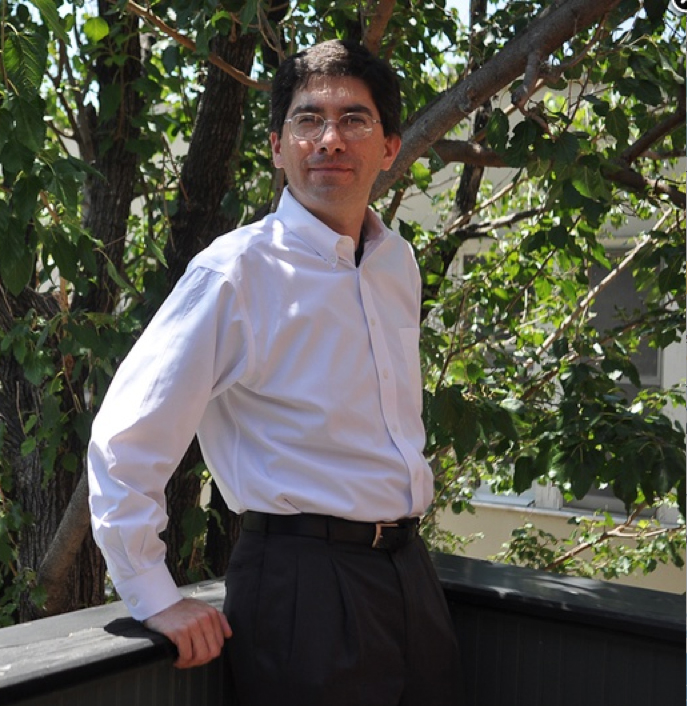 Maybe the EPA knew their former Region 6 Administrator Al Armendariz would be doing a one-on-one interview with the New-York Times-connected Texas Tribune as part of its annual festival on Saturday, or maybe it's just coincidence that the Agency named Armendariz's replacement very late Friday evening.
Whatever behind-the-scenes coordination did or did not take place, the appointment of New Mexico's Ron Curry as the new Region 6 chief gave Armendariz a slightly more removed historical perspective, and maybe willingness to talk, than he might have had otherwise.
Here's a live blogging of the interview that the Tribune's Evan Grant did with Armendariz from the Tribune festival itself in the middle of a forum on energy and the environment (11 am to 12 noon). Elizabeth Souder's recap for the Dallas Morning News is behind the paper's paywall, but here's a peak:
Former EPA regional admin Armendariz said anti-EPA court cases delay the inevitable
AUSTIN — Recent court cases striking down Environmental Protection Agency rules are just delaying the inevitable, said former regional EPA administrator Al Armendariz, who quit after a video surfaced showing him comparing his approach to Roman crucifixion.
Armendariz, who resigned as Region 6 administrator earlier this year and now works on an anti-coal campaign with the Sierra Club, said the agency will just re-write and re-apply the cross-state air pollution rule on coal plant emissions and its rejection of Texas’ flexible air permit rules. Some conservative Texas politicians regarded court decisions knocking down those rules as major victories.
Further, Armendariz said, the court decisions don’t show that the EPA was wrong. No, he said, the decisions show that the courts are wrong.
“They point out to me the importance of getting the President to appoint justices on the federal judiciary that will follow the law,” Armendariz said at a conference held by the Texas Tribune.
“I’m confident those actions, as written, were written completely in compliance with the law, and when those rules are revised that the agency is going to win any future litigation,” he said.
Armendariz defended his former employer and praised his successor at the Saturday appearance. He said the EPA and the White House have been working to implement the Clean Air Act and Clean Water Act, laws passed by Congress decades ago but never fully applied.
He criticized Texas environmental regulators who enable polluters, and called on energy regulators and lawmakers to create a plan to meet the state’s electricity needs with renewables.
Armendariz resigned in April after criticism over his comments in a video. In the video, he makes an analogy about his philosophy of enforcement. He said: “It was kind of like how the Romans used to conquer little villages in the Mediterranean. They’d go into a little Turkish town somewhere, they’d find the first five guys they saw and they’d crucify them. And then, you know, that town was really easy to manage for the next few years.
“And so you make examples out of people who are in this case not compliant with the law. Find people who are not compliant with the law, and you hit them as hard as you can and you make examples out of them, and there is a deterrent effect there.”
Arendariz on Saturday said he had apologized because his analogy offended people, which wasn’t his intent. But he didn’t back off the idea of deterring illegal polluting by punishing lawbreakers.
“I do stand behind the concept of my comments,” he said. “When you find someone who is violating the law, you do, within the boundaries of the law, vigorously prosecute.”
He said doing so ensures that illegal polluters don’t gain an unfair advantage over companies following the rules.
Texas Tribune chief executive Evan Smith said some people regarded the video as confirmation that Armendariz had it in for the energy industry.
Armendariz said such criticism was unfair, since in the video, he says his enforcement philosophy is for companies breaking the law.
Nor did he act alone by going after polluters. He said EPA administrator Lisa Jackson and her Washington staff had been “very involved with what we were doing in Texas.”
But he said leadership at the Texas Commission on Environmental Quality, the state regulatory arm of the EPA, is lax.
“There are some fantastic staff at TCEQ, and I think they’ve got poor leadership. I think the Governor’s appointees at that commission are preventing the staff from doing its job,” he said.
TCEQ chairman Bryan Shaw has criticized the EPA’s recent rules that would tighten regulations on coal plant pollution and greenhouse gas emissions.
And he praised his successor at the EPA, Ron Curry, the first non-Texan to lead the region that covers Texas, New Mexico, Oklahoma, Arkansas and Louisiana. The president announced the appointment last week.
“Ron is pragmatic, he’s very smart. He understands the need for conservation and the need for economic development,” Armendariz said.
Armendariz also said people who don’t believe in climate change are doomed to become irrelevant, just as doctors who don’t believe smoking causes cancer.
“I think the science of climate change is really irrefutable and those folks who are continuing to deny that climate change is a problem are really on the wrong side of history,” he said.
Now, Armendariz leads the Sierra Club’s anti-coal campaign, which aims to keep coal in the ground. He said so-called clean coal plants, which pollute less than traditional coal plants and capture greenhouse gases, are too expensive to justify coal mining.
“Clean coal I think is technically feasible, but I think it’s completely unnecessary,” he said.
He conceded the country will continue to use coal for the next decade. But he said coal isn’t necessary to keep the lights on.
The Electric Reliability Council of Texas has said the state is in danger of outages in the next few years because power plant developers haven’t build enough new generation to keep up with growing demand. The prospect of shutting down coal plants because of stiffer environmental regulations has left some regulators nervous about blackouts.
Armendariz said the reliability problem is due to a “complete lack of leadership and forethought.” He called on regulators and lawmakers to solve the problem with long-term planning and a vision centered on renewables, such as wind and solar.
Imagine That: Local Regulation of Polluters
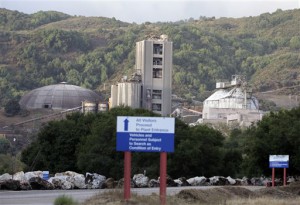 From San Francisco comes word that the area's largest Mercury polluter, the local Lehigh-Heidelberg Cement plant, may be the subject of tougher LOCAL air pollution regulations.
In 2011, the kiln spewed 260 pounds of Mercury into the local airshed and new regulations being proposed for the plant by the Bay Area Air Quality Management District would address not only this pollution, but emissions of dust, ammonia, dioxins, smog pollutants, and hydrocarbons.
In part, the new local rules are being spurred by EPA's own updating (and delaying) of its own air pollution rules for the nation's cement kilns. In part, local pressure from the public is driving their consideration. Bay Area for a Clean Environment collected over 1800 signatures demanding the new more stringent rules.
In California regional air boards are the prime shapers of air quality planning and policy, tailoring measures to their own geographical boundaries and problem areas. Imagine the 10-county DFW non-attainment area for smog (Collin, Dallas, Denton, Ellis, Johnson, Kaufman, Tarrant, Parker, Rockwall, Wise,) having its own air quality agency with the power to enforce new anti-pollution measures without having to get Governor Rick Perry's permission. Local control also means more opportunity for local citizens to have input rather than being blown off by ideologues in Austin intent on scoring political points rather than cleaning the air.
As we've noted before, if DFW officials really want cleaner air, they're going to have to get it themselves.
2011 was the Worst Year for Smog since 2006 in DFW. 2012 Is One Bad Air Day Away Matching It.
 Last year's air quality death spiral in DFW was sometimes explained away as an anomaly because of the severe drought the entire state was going through.
So what's the explanation this year?
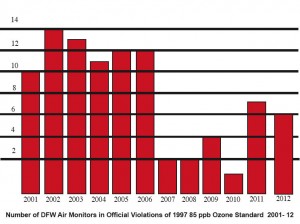
With yesterday's high ozone levels sending a 6th monitor into an exceedance of the old 1997 85 parts per billion smog standard, DFW is just one more bad air day away from matching last year's dreadful results. Today's ozone forecast says there should be no high levels of smog in DFW today, even as the temperature reaches for a record high. But then again, they weren't predicted Thursday either.
To give you some idea how rapidly things have gone downhill for air quality in DFW the past two years, just look at the annual numbers. From 2007 to 2010, we had a total of nine monitors register official exceedances of the 85 ppb standard. That's about two monitors a year average. This turns out to be the closest we've ever come to actually meeting the standard. Officials could argue with some justification that air quality was slowly getting better.
On the other hand, during the last two years, we've had 13 monitors record exceedances of the 85 ppb standard, an average of 6.5 a year, and 2012's ozone season is not yet over. You could add up all the exceedances from the four years between 2007 and 2010 and still not equal the number we've experienced in just the last 24 months.
This is not progress.
TCEQ and the gas industry have argued for some time that gas mining couldn't possibly be contributing to smog problems since smog levels were going down as drilling was increasing in DFW. But that's not true anymore. As gas drilling has moved further and further east – into the heart of the non-attainment area, we've seen in increase in ozone concentrations, in exceedances in monitors, and monitors in the eastern part of the Metromess exceeding the standard that hadn't done so in five to seven years.
Meanwhile all other major source categories for air pollution have been decreasing their emissions. Cars, power plants and cement kilns are actually releasing less air pollution now than they were ten or 20 years ago. Only one large specific source category has increased its annual tonnage significantly over that same time – oil and gas.
Is it just a coincidence that smog is getting worse as oil and gas pollution skyrocket – not only in the Barnett Shale that surrounds DFW on three sides, but by all the new oil and gas sources now southeast of Dallas as part of the Haynesville Shale play that are blowing their pollution toward us most of the ozone season? There are now so many gas compressors in Freestone County, less than 75 miles away from the Dallas County line, that their emissions represent the equivalent of over 4 new Big Brown coal plants. What do you think the impact on air quality would be of four large new coal plants located immediately upwind of DFW? Might it look a lot like it does in 2012?
Could it be that the dirty mining of "clean" natural gas is making it impossible for DFW to meet the old 85 ozone standard, much less the new 75 ppb one? That the Devil's Bargain so many former and current elected officials made with the gas operators to grab the cash and run is now coming back to bite them and us in the air quality butt? That was certainly the conclusion of the study we publicized this last Tuesday from the Houston Advanced Research Center:
"Major metropolitan areas in or near shale formations will be hard pressed to demonstrate future attainment of the federal ozone standard, unless significant controls are placed on emissions from increased oil and gas exploration and production….urban drilling and the associated growth in industry emissions may be sufficient to keep the area (DFW) in nonattainment."
It's time for local officials to replace those cash registers in their eyes with gas masks. Because of their rush to make money, they didn't pause to understand how so much new industrial activity could produce smog just like the bad ol' days. They were being paid not to understand. And now 5 to 6 million people who still can't yet breathe safe and legal air are paying the price.
Study: Gas Drilling “Significantly” Increasing DFW Smog
 In the middle of another bad North Texas ozone season, a new study by a Houston research consortium concludes that Barnett Shale natural gas facilities "significantly" raise smog levels in DFW, affecting air quality far downwind.
According to the study, ozone impacts from gas industry pollution are so large, they'll likely keep North Texas from being able to achieve the EPA's new 75 parts per billion (ppb) ozone standard.
Author Eduardo P. Olaguer, a Senior Research Scientist and Director of Air Quality Research at the Houston Advanced Research Center, concludes that, "Major metropolitan areas in or near shale formations will be hard pressed to demonstrate future attainment of the federal ozone standard, unless significant controls are placed on emissions from increased oil and gas exploration and production….urban drilling and the associated growth in industry emissions may be sufficient to keep the area (DFW) in nonattainment."
Olaguer's article describing his study was recently published in the July 18th edition of the Journal of the Air & Waste Management Association. It's the first independent study to examine specific North Texas ozone impacts from the gas industry.
Environmental groups say air pollution from natural gas sources is already making it impossible for DFW to meet even the obsolete 15-year old standard of 85 ppb. So far in 2012, five monitors have violated that level of smog despite a state plan that Austin guaranteed would reduce ozone concentrations in DFW to record lows this year. Counting 2012's failure, DFW has been in continual violation of the Clean Air Act for its smog pollution since 1991.
"This study is proof we need a regional strategy of self-defense to reduce air pollution from the gas industry," said Downwinders at Risk Director Jim Schermbeck, whose group has been leading the fight to reduce smog-forming pollution from gas sources for two years now. "TCEQ and EPA are not doing enough to rein-in these facilities. Despite their official plans, our air is getting dirtier, not cleaner because gas pollution is still under-regulated. It's time for us to do more at the local level."
Schermbeck suggested the study could make a difference in the upcoming city council vote on a new Dallas gas drilling ordinance.
"Dallas has a chance to react positively to this new evidence by adopting the nation's first policy aimed at mitigating the tons of new pollution caused by gas mining in its new drilling ordinance. That would be a very large step forward in advancing regional clean air goals."
A city-wide coalition of neighborhood, homeowners, and environmental groups has been urging the Dallas city council to require gas operators to reduce as much air pollution as they release through funding of anti-pollution measures across the city. The Houston Center study gives them a lot of fresh arguments.
According to it, "…oil and gas activities can have significant near-source impacts on ambient ozone, through either regular emissions or flares and other emission events associated with process upsets,and perhaps also maintenance, startup, and shutdown of oil and gas facilities."
In fact, just routine emissions from a single gas compressor station or large flare can raise ozone levels by 3 parts per billion as far as five miles downwind, and sometimes by 10 ppb or more as far as 10 miles downwind.
Those impacts rival the size of smog effects traced back to the Midlothian cement kilns or East Texas coal-fired power plants by previous studies.
As the study notes, "Given the possible impact of large single facilities, it is all the more conceivable that aggregations of oil and gas sites may act in concert so that they contribute several parts per billion to 8-hr ozone during actual exceedances."
This conclusion directly contradicts the stance of the Natural Gas industry and the Texas Commission on Environmental Quality, both of which deny that Barnett Shale gas emissions are large enough or located in areas that can influence DFW ozone levels.
But the Houston study is based in part on data collected by industry, as well as information from the city-sponsored "Fort Worth Study," and citizen-sponsored testing in the town of DISH in Denton County. It also uses a kind of computer modeling that allows for a more realistic understanding of how large releases from gas facilities can increase ozone pollution than the one the TCEQ uses. It's the most sophisticated challenge yet to the state and industry's claim that gas emissions do not constitute a large threat to DFW air quality.
"This is reality-based science, not the ideologically-influenced happy talk that's coming out of TCEQ these days," said Schermbeck. "Local governments in North Texas, especially those that are traditional allies of clean air, need to pay close attention and act on it."
The report is available for downloading here.
Gas Patch Pollution Linked to First Alamo City Ozone Violation
 Ever since smog was an issue in Texas starting in the last 1980's, the two largest metropolitan areas have been duking it out for worst air in the state. Houston was the undisputed champion for awhile, but as of the last couple of years, Dallas-Ft. Worth has been neck and neck, and last, year, even posted worse numbers than Bayou City. No other city even came close.
Until now.
For the first time ever, San Antonio has a monitor in violation of the national ozone standard. It's the new standard of 75 parts per billion, so it's still way ahead of Houston and Ft. Worth that are still have chronic problems meeting the old 1997 85 ppb standard. But it's still a milestone.
What factors helped push SA over the line? Well, theres the significant growth of the larger metropolitan area itself, and out-of-state power plants that will now not be better controlled because of Team Perry's victory over the cross state pollution rules, and oh yeah, gas patch air polluion from the Eagle Ford Shale that's up wind of San Anontio:
"Increased air pollution from the oil and gas boom of the Eagle Ford Shale is believed to be a factor, in addition to local sources and pollution coming from Mexico, East Texas and the East Coast."
Nation’s Only Public Hearing on Roll Back of Cement Plant Rules Scheduled for Aug 16th in DFW
 Environmentalists are angry at EPA for giving the public less than two weeks notice prior to the nation's only hearing on a rollback of new air pollution rules for cement plants that the agency says could save thousands of lives annually, including many in DFW.
One of those who came in 2009, and vowed to show up again on the 16th was Ft. Worth resident Margaret DeMoss, who was instrumental in getting her city to adopt a "green cement" policy to reduce pollution from obsolete Midlothian cement kilns in southern DFW.
She also noted that in 2009, when the rules were being proposed, there were three national hearings coast to coast. Now that the rules are being weakened, there's only one.
"It's outrageous that the EPA would schedule this hearing at the last minute and in only one location in the nation; lot of other regions suffer downwind from cement kilns. Who will speak for them?"
Downwinders at Risk and other community groups repeatedly sued to get them enforced. That effort resulted in 2010 emission rules that were hailed as the largest single advance in air quality for the US cement industry, and were universally supported by citizens living near and around the nation's cement plants.
They had already passed all necessary regulatory review, just overcome their last legal hurdle, and were on their way to President Obama for his signature and implementation by 2013 when they got yanked by the administration's Office of Management and Budget earlier this year.
When the rules re-emerged, their enforcement was pushed back to 2015 and their strict Particulate Matter pollution provisions were considerably weakened.
According to EPA's own health impact studies for the rules, that two-year delay will cause at least 2000-5000 premature deaths nationwide.
Despite a halt in the burning of hazardous wastes at local cement plants in 2010, MIdlothian remains the home of the largest concentration of cement manufacturing in the entire U.S.
Three large cement plants – TXI, Holcim, and Ash Grove – are still the largest point sources of air pollution in North Texas, generating thousands of tons of air pollution.
Since DFW is downwind of Midlothian, Metroplex residents are exposed to more cement plant pollution than any other metropolitan area in the country, and represent a disproportional number of these 2-5000 annual deaths that EPA estimates will occur because of its rules delay.
"If these revisions are adopted, DFW residents will be paying a high price for the Administration's retreat," said Schermbeck. "That's why we must make our objections heard now."
He urged those that want to speak at the August 16th hearing to reserve a five-minute slot with EPA coordinator Pam Garrett by e-mailing her at garrett.pamela@epa.gov or calling (919) 541-7966
The Next Big Dallas Environmental Fight? Garbage Burning
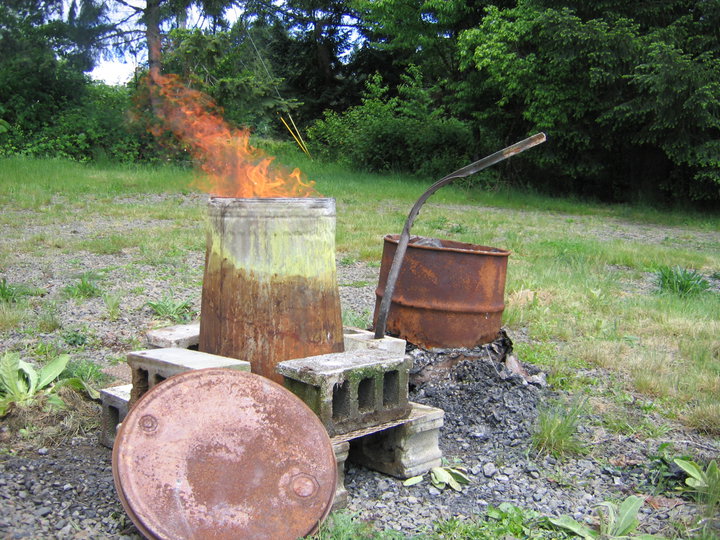 Many folks in the DFW environmental community think the battle over "flow control" at the McCommas Bluff landfill in Dallas is merely a prelude the the bigger goal of locating a large "materials recovery" operation there that will include a waste-to-energy power plant that can generate cash for City Hall as well as electricity. Once confined to the land-starved East Coast and Midwest, garbage burning is coming to Texas under the cover of recycling schemes that want to use it to make a buck instead of paying a landfill to take it.
A wave of garbage-burning permits have been approved across the country over the last 2-3 years at various cement plants, including the TXI kiln in Midlothian, south of Dallas, which can now burn plastic wastes and the non-steel parts of cars, including brake linings, electronic switches, vinyl covers, mats, and dashboards. Now the groundwork is being put in place to extend that practice into municipal garbage burning using power plants.
The sale pitch sounds great. The waste companies and city will be "completely committed" to recycling and reusing as much waste as possible. They'll only burn a "small percentage of leftover waste" that would otherwise go to a landfill. It has "significant BTU value" and it "reduces pollution" when you burn it! Why bury it when you can use it to make power that people need. It's really just like recycling!
Except it isn't. It's garbage burning. It's burning plastics. It's burning "fibers." It's burning teated lumber. It's burning "a small list of alternative fuels" and when there's not a enough of that stuff to generate the required power, the list expands. And it produces more air pollution, and distributes that air pollution over a much larger area, affecting many more people, than the same amount of garbage continuing to go to a landfill.
The 20-year fight over burning hazardous wastes at TXI and the other Midlothian cement plants began with the companies telling residents that they were "recycling flammable liquids" in kilns that reached almost 2000 degrees, and burned up 99.99% of all the waste. Soon, the cement kilns were mixing in non-flammable solids like toxic metals, and wastes with chlorine, and contaminated water that had little or no BTU value at all. And far from removing 99.99% of the bad stuff, the kilns added a toxic soup of chemicals to their already voluminous amounts of air pollution.
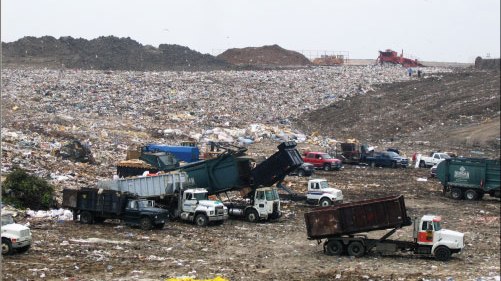 A landfill's toxic plume is usually slow-moving, flows only downhill, and can be tracked as it goes through soil. An incinerator's plume is blowing toxic air pollution wherever the wind is blowing, traveling as far the the wind will carry it, and changes from day to day, often eluding monitors if they're not in exactly the right place. Then, after all that, there's the problem of what to do with all the toxic ash. Send it to a landfill. Which practice puts more people in harm's way? Which one affects public health more? Which is the more sustainable alternative?
As a means of getting tuned up for the fight ahead, which some rumors put as near as this fall or winter, let's examine a little study partially sponsored by the American Chemical Council that was published the other day with the intent of setting the stage for widespread garbage, sorry, "refuse" burning.
It comes from UT – where another study on energy just got a lot of unfavorable publicity. This time It's Dr. Michael Webber who's Associate Director of the Center for International Energy and Environmental Policy in the Jackson School of Geosciences, Co-Director of the Clean Energy Incubator at the Austin Technology Incubator, Fellow of the Strauss Center for International Security and Law at the LBJ School of Public Affairs, and Assistant Professor of Mechanical Engineering at the University of Texas at Austin. Whew.
He's also a member of the "Pecan Street Project" in Austin, which is a "citywide, multi-institutional effort in Austin to create the electricity and water utilities of the future by the innovation and implementation of smart grids, smart meters, and smart appliances. The Pecan Street Project team includes UT, the City of Austin, Austin Energy, the Environmental Defense Fund, the Austin Technology Incubator, and eleven corporate partners."
See? Already the guy has impeccable credentials.
And what is Dr. Webber and the American Chemical council selling today?
"If 5% of residual waste from recycling facilities were diverted to energy recovery, it would generate enough power for around 700,000 American homes annually."
First, you understand that Dallas alone has more than 700,000 homes, and so we're talking about burning 5% of the entire nation's leftovers to get electrical energy for a city smaller than Dallas…for a year.
Second, does anyone know how many waste incinerators would have to be built and and what cost, or how they'd be financed? Nope. But we digress….
"The study found that while single-stream recycling has helped divert millions of tons of waste from landfills in the U.S. – where recycling rates for municipal solid waste are currently over 30% – Material Recycling Facilities (MRFs) currently landfill between 5% and 15% of total processed of the material treated as residue.
According to the researchers this residue is primarily composed of high energy content non-recycled plastics and fibre.
The report proposed that one possible end-of-life solution for these energy dense materials is to process the residue into Solid Recovered Fuel (SRF) that can be used as an alternative energy source capable of replacing or supplementing fuel sources such as coal, natural gas, petroleum coke, or biomass in many industrial and power production processes."
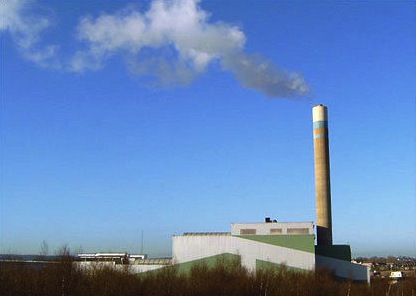 You will be unsurprised to learn that a cement kiln was involved in "testing" how well the
 garbage, sorry, SRF burned. Because it can reach temperatures of almost 2000 degrees!
But the results are not exactly spectacular in the way the Chemical Council probably anticipated.
Sulfur Dioxide (Sox) pollution was reportedly reduced over what coal alone would have emitted by some 20 to 44% (the study rounds this number up to "roughly 50%"). OK. but that's what SOx "scrubbers" are for. The study doesn't say whether the kiln used for the experiment had scrubbers on it. Not a lot of them do right now, but most power plants do and any new power plant or cement kiln would have to have them as well. Both the TXI and Holcim dry kilns have scrubbers already, and the new Ash Grove dry kiln will as well. These scrubbers can reduce SOx pollution by over 80%. So can we agree that we're better off just adding scrubbers to facilities instead of setting fire to plastic garbage to reduce this kind of air pollution?
On the other hand Nitrogen Oxide (NOx) pollution reportedly went up 25% to as much as 93%, when garbage was burned compared to coal. This spike was explained away by saying the kiln didn't have a proper delivery system for the garbage to reach the kiln. That's untested speculation by the authors that may or may not be true. Any increase in smog-forming NOx pollution would be hard to sell in an area like DFW that's been in violation of federal smog standards for over 20 years.
CO2 emissions were reportedly reduced by a paltry 1.5% – the equivalent to getting a million cars off the road! But that's another small number when you realize that just treating the CO2 from the three Midlothian cement plants here in North Texas would get you that number or something even bigger.
When you burn plastic you get dioxins – one of the most toxic substances in the world. The Chemical Council knows this. But there was no testing for dioxins, or phthalates, or any of the more exotic kinds of air pollution one would expect to see when you burn plastics and other kinds of garbage. This is one of the primary objections citizens would have about this practice, and yet there was no testing for it.
These results may not seem that great to you, but they impressed both the Chemical Council and Dr. Webber.
"In this case, one person's trash truly is another person's treasure. Americans send tons of waste to landfills each and every day, meaning that one of America's most abundant and affordable sources of energy ends up buried in landfills," commented Cal Dooley, president and CEO of ACC.
"It's time we got smart and made energy recovery a central part of America's energy strategy," he added.
Meanwhile Dr. Webber added: "The findings from our study demonstrate how engineered fuels can make a meaningful contribution to our nation's strategy while reducing carbon and sulfur emissions compared to some forms of energy,"
Let's translate: "Your trash is our potential treasure. We can't portray ourselves as "Green" if we don't find some way to make plastics more eco-friendly. Plus, we can make a buck packaging our garbage for you to burn it. Our findings show that under these very controlled circumstances, and with not too many questions asked, burning garbage can make some minimal pollution reductions that other readily available alternatives could make better, while also increasing the kind of pollution that most people don't want."
This fight over garbage burning will be as big, if not bigger than the fight over gas drilling. It will involve environmental justice issues, toxic pollution, private-public contracts, sustainability, and real recycling vs the fake kind. And lots and lots of doublespeak. Get your waders on.
What To Expect When You’re Expecting Gas Drilling
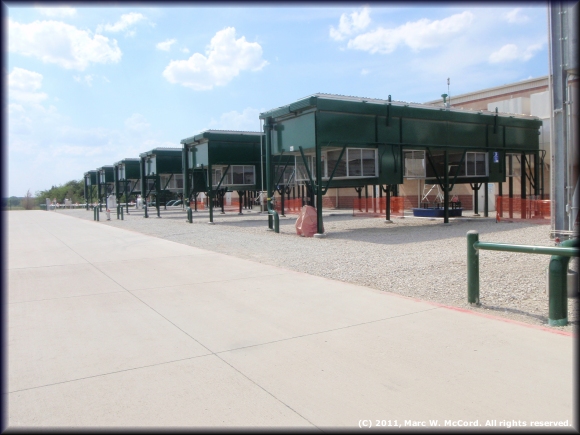
If you're a Dallas resident and you want to find out more about the kinds of new facilities that might be located near you if gas drilling is allowed in your city per the new ordinance the Council is debating on August 1st, here's a item of interest from West Virginia, where operators are already fracking.
"Sulfur dioxide, carbon monoxide and formaldehyde are some of the chemicals Chesapeake Energy is likely to pump into the air in Ohio County from its numerous drilling sites, company information states.
Earlier this year, Chesapeake officials confirmed plans to build local compressor stations that may release these and other chemicals into the atmosphere. Now, the company is identifying "potential to emit" levels for several potentially hazardous materials from its well drilling sites.
The amounts of the particulates that may be released at the four sites slightly vary. The carbon monoxide projections, for example, range from 40 tons per year to 61.5 tons per year to be released from a single site.
In addition to the pollution from the well sites, Chesapeake also will release emissions from its local compressor stations. Chesapeake, in a legal advertisement earlier this year, confirmed the "potential to discharge" the following amounts of these materials on an annual basis from the operations at the compressor stations: carbon dioxide – 93,800 tons; nitrogen oxides – 82.96 tons; carbon monoxide – 16.87 tons; methane – 86.64; carbon dioxide equivalent – 95,667 tons; benzene – 0.33 tons; and formaldehyde – 3.22 tons."
Formaldehyde and Benzene are both carcinogens. Carbon Dioxide is the primary greenhouse gas pollutant, and methane is right behind. Nitrogen Oxide is the primary component of smog in DFW. All this – 93,000 tons a year of air pollution – from just one gas compressor. Where in Dallas would you propose to put a facility that spews that much air pollution? And how would you keep it from adding to the chronic air quality problem the City already has? And then what about the fact that the operators might not need just one, but three, or five, or ten of these compressors in Dallas? It's not uncommon to build complexes that house as many as a dozen or more locomotive-size compressors in the Barnett Shale, which includes at least the western half of Dallas.
When you allow drilling, you're allowing everything else that follows drilling, including compressors and their pollution, storage tanks that leak copious amounts of the same kind of pollution, pipelines that can use eminent domain to run through your front yard, and a host of other hazards, some of which we know about, some of which we no doubt have not yet discovered. Gas mining is not conducive to neighborhoods or attracting new, non-polluting development. If Dallas City Hall doesn't know this now, it most certainly will learn it later.
Another Day, Another White House Retreat on Clean Air
 In an election year, apparently no environmental initiative is safe from the Obama White House.
You may have missed this because it was one of those late Friday government announcments that officials like to use to bury bad news, but the EPA is going to consider softening those much-ballyhooed coal plant Mercury emissions rules that it fought so hard to get only last year. And because "consider" in this case means "we're going to do it," you can add these rules to the growing list of those clean air efforts in this supposedly environmentally-friendly administration that have bitten the dust because of political interfernce.
One of the reasons this rule is being rewritten is to satisfy the less-than-state-of-the-art White Stallion coal and pet coke-fired power plant being proposed for Matgorda Bay, whose owners have campaigned against the new rules since Day One. They say the rules are too strict and can't be met, despite being based on the track record of top performers in the utility industry. You will be unsurprised to learn that the Texas Commission on Environmental Quality is a co-facilitator in that campaign, up to the point of being so enthusiastic in its unquestioned support that it had to be ordered by a state judge to reconsider the first air permit it gave the plant because of the lack of any public participation.
White Stallion is going to be built less than 20 miles from the boundary of the eight-county Houston "non-attainment area" for ozone, or smog. Regulations on new sources of industrail pollution are tighter inside such areas than outside. That's pretty much all you need to know about the owner's commitment to using best technology. It's the same problem DFW used to face with the Midlothian cement plants and Ellis County until Donwiwnders petitioned, and EPA agreed, to include them in the North Texas non-attainment area.
Anything that makes it harder for Houston to meet clean air standards, also makes it harder for DFW to do the same. But this rollback is also a shame because of this administration's gap between promise and performance when it comes to critical upgrades in national polluiton standards – ozone, particulate matter, cement kilns and now coal plants. When push comes to shove, there seemingly isn't any polluter this White House won't do a favor for between now and November.