Posts by Downwinders At Risk
TCEQ Can’t Handle the Truth Over DFW Air Plan Failure
 Here's further proof that Governor Perry has transformed the world's second-largest environmental agency into just another extension of his on-going political campaign.
After waiting for a couple of days for the Texas Commission on Environmental Quality to say something about the failure of its latest DFW clean air plan to reach a 1997 ozone standard by the end of this "ozone season," Downwinders put out a release on Monday criticizing the agency for leaving the air dirtier than when the plan was begun in 2010.
To succeed, the TCEQ plan had to bring smog numbers down at all DFW monitors to 84 parts per billion or below by the end of this last summer, using three-year rolling averages incorporating readings from 2011 and 2010. The agency blithely predicted it would do just that and even published computer-modeled estimates of what the averages would be at the end of 2012. According to TCEQ we were supposed to see record low ozone levels this summer. So low that there would be no violations of the 1997 ozone standard for the first time since it was implemented.
Although the official EPA regulatory deadline to judge the plan a success or failure is June 15th, 2013, it's fate has already been decided by the data collected the three previous summers. That's important to know. TCEQ doesn't get another summer to prove that it's brilliant plan to sit back and watch people buy cars will work somehow, someway. The Clean Air Act only allows them three years to get their act together per plan. The clock started ticking in 2010. It stopped ticking on November 1, 2012, at the traditional end of DFW's ozone season. That was the practical deadline. All that's left to do is type up the report to EPA and submit it come June 15th of next year. They've run of of time.
But unless you've gone through this process before, or had been following the plan closely, you wouldn't necessarily know this. That was the case with Andrew McLemore, a reporter for the Fort Worth Weekly, who'd been assigned to follow up on the Downwinders release and e-mail the TCEQ for a response.
 What TCEQ spokesperson Lisa Wheeler said to McLemore was that of course the agency never claimed to be able to meet the goal by 2012. We said we'd do it by June of 2013 – the regulatory deadline. Ohhhhh.
This is a great answer for a term paper that's late, but not so much when there's no more summers between now and June of next year to use in your clean air plan. Ozone data for November to June isn't going to do you any good because (unless global warming really accelerates) that's not the time of year we see high ozone numbers. And the plan has to use the highest of the high numbers. Telling McLemore that everyone had to wait until June to know the final results of the DFW air plan was like telling him to wait for the cake to cool for eight months after its' already been taken out of the oven. The thing is done. It's not getting any bigger, or sweeter-tasting, or rounder. It's not changing character or content. It is what it is right now.
TCEQ knows this. Lisa Wheeler knows that there will be no new numbers to add or subtract from that will make any difference. There will be no 2013 average that they can use to change the results from what they are at this moment. It's all already been determined by this summer's miserable showing, and the miserable showing before that in 2011. That's what makes this answer of theirs so incredibly cynical.
Wheeler apparently wanted to confuse McLemore, in essence saying, "Gee we really didn't fail yet – you have to wait until next June to conclude that. We still have time to change the outcome! " But because the data won't change, the results won't change either.
Don't take our word for it. TCEQ has a whole web page devoted to chronicling the proof that the DFW air plan has already failed – http://www.tceq.state.tx.us/cgi-bin/compliance/monops/8hr_attainment.pl
You'll notice this page, titled "Compliance with Eight-Hour Ozone Standard" has only three columns of data, one for 2010, one for 2011, and one for 2012. No column for 2013. You'll also notice that at the end of that three year cycle, there are two sites with running average that are at or above 85 ppb. The results are in. TCEQ's second clean air plan for DFW to reach the old 1997 standard in the last four years has failed. TCEQ just can't man-up and say so.
Not only has it failed. It's actually left DFW air dirtier than when it began. Here's why:
– Two monitors now have a three year running average (design value) of 85ppb or more. This is the same number as 2010, so no change at all on that front.
– The three year average for the region's highest reading actually went up 1 ppb from 2010 (86 ppb), to 2012 (87 ppb), with a spike of 90 ppb last year. Worse than 2010.
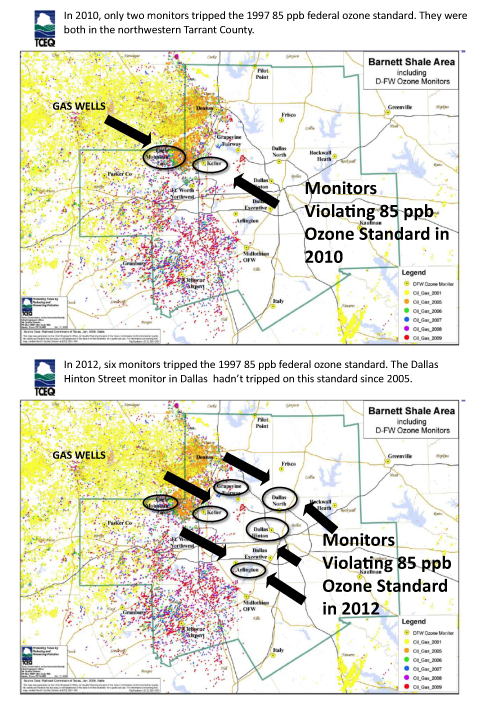
– Six monitors saw a violation of the 85 standard this summer by posting a 4th highest reading that was 85 ppb or above. Only one monitor did that in 2010. 2012 is five times worse than 2010 by this measuring stick.
– The location of those violating monitors is of concern because they moved further east from the northwestern corner of Tarrant County where they'd been "contained" – all the way into central Dallas, where the "Hinton St. monitor" near Mockingbird and I-35 recorded a 4th highest reading of 85 ppb or above for the first time since 2005. Also proof things have gotten worse, not better.
So the latest TCEQ DFW clean air plan achieved the following: More numerous and geographically-dispersed violations, with an increase in average levels of air pollution that takes it further away from the 84 it needs to achieve, instead of bringing it closer.
Heckava job.
To fully appreciate the agency's mendacity in its public approach to this failure, all you have to do is ask yourself how TCEQ would have reacted had it somehow achieved the miraculous decrease in air pollution its clean air plan promised. Go look at the front page of the TCEQ website. It has almost as many diatribes against the EPA as it does real environmental policy news, including opinion pieces written by TCEQ Commissioners. Do you think the agency would have waited until June 15th, 2013 to trumpet its success just because of a meaningless, bureaucratic deadline? Neither do we.
The TCEQ is never going to be a trustworthy source of information or expertise in the fight against DFW smog again while Governor Perry is in office. The sooner local officials wise-up and chart their own path, the better.
What Texas House Speaker Joe Straus Really Thinks of “Smokey Joe” Barton
 Texas Monthly's Paul Burka has written about some e-mails that went flying back and forth among Texas Republican lawmakers as the bitter re-districting battle took place over the last 12-15 months. Some of them have become public. One of these reveals what Texas House of Representatives Speaker Joe Straus thinks about Midlothan-area Congressman "Smokey" Joe Barton and his supporters in their attempts to gerrymander a new, more Republican district for the Congressman (since Arlington is getting a bit too purple for his taste). Welcome to the reality based community Speaker.
2nd TCEQ Clean Air Plan in Four Years Fails, Leaves Air Dirtier
 For the second time in four years a state-designed clean air plan to bring safe and legal air to DFW residents has failed, missing its goal by an even wider margin than on its first try, and leaving local air quality worse than when it started.
November 1st marked the official end of the eight-month 2012 ozone season. According to the Texas Commission on Environmental Quality, or TCEQ, its plan was supposed to deliver record-breaking clean air to DFW this summer on its way to bringing the region into compliance with the Clean Air Act for the first time in two decades.
Does Pollution Discriminate?
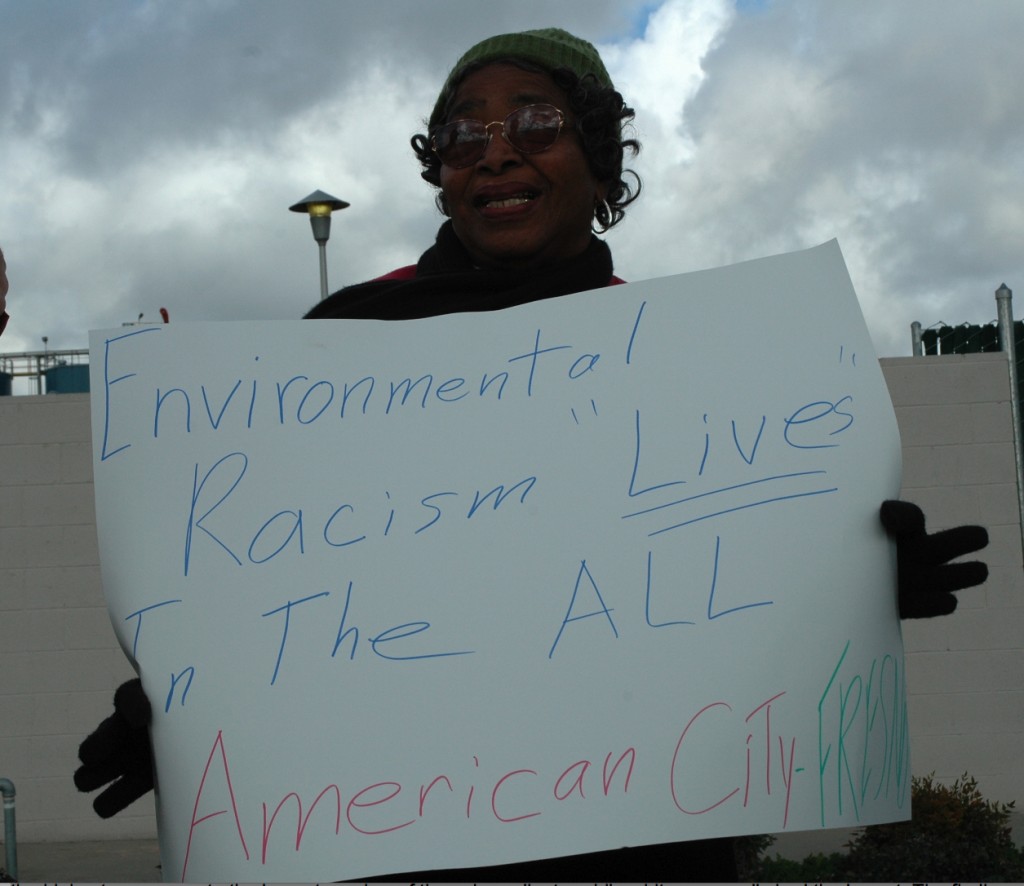 Yes. Or rather the forces that shape where pollution and people co-exist.
Historically we know that low-income and non-white urban areas are more likely to have polluting factories, Superfund Sites and illegal dumping. In large part, this is because the places within a city where "undesirable" heavy industries were allowed to locate were also traditionally also the only places where "undesirable" people, re: anybody that wasn't white or had a little money, were allowed to live. This is how you get massive segregated public housing complexes built across the street from huge lead smelters, as was the case in Dallas only a few decades ago. But maybe you thought that was all a thing of the past.
Today comes word of a new study out of Yale that confirms that people of color and the poor in the US suffer disproportionately from exposure to one of the most insidious kinds of pollutants – extremely tiny particles of poisonous soot called Particulate Matter 2.5 (that's soot that's 2.5 microns or less in size. A human hair is about 10 microns wide). Researchers looked at air monitoring and demographic data from five cities – Los Angeles, Pittsburgh, Cincinnati, St. Louis and Fresno. It is the first study to "reveal major racial and economic differences in exposures to specific particle ingredients, some of which are linked to asthma, cardiovascular problems and cancer." Not to mention strokes, and debilitating brain diseases like Parkinson's and Alzheimer's.
"Tiny particles of air pollution contain more hazardous ingredients in non-white and low-income communities than in affluent white ones, new research shows. The greater the concentration of Hispanics, Asians, African Americans or poor residents in an area, the more likely that potentially dangerous compounds such as vanadium, nitrates and zinc are in the mix of fine particles they breathe. Hispanics had the highest exposures to the largest number of these ingredients, while whites generally had the lowest. The findings of the Yale University study add to evidence of a widening racial and economic gap when it comes to air pollution. Communities of color and those with low education and high poverty and unemployment face potentially greater health risks even if their air quality meets federal health standards."
So how does that affect DFW? We need to let studies like this inform our decisions about city planning. In places that have a lot of pollution problems, it's probably a good idea not to keep adding more. Think of where the fracking in Dallas will be taking place – mostly in minority neighborhoods, along the floodplain, with other "undesirable" industries like landfills near-by. Think about the struggle over community control of the CF Hawn freeway re-do of Deadman's Curve in South Dallas where residents want fewer cars going slower instead of more cars going faster. Cars are a big source of PM pollution. Freeways are large conduits for PM pollution. In the last five years there's been a slew of studies showing more asthma and illness the closer you live to a major freeway. Guess which sub-populations get more freeways in their part of town?
There is an environmental equivalent of Affirmative Action that needs to be incorporated into city zoning and planning. One that considers the past historical inequities and current environmental body burden of affected neighborhoods. One that makes sure that society's "undesirables" do not keep getting piled on top of one another
Causality or Coincidence: Oil & Gas Agency Info Tech “Stuck in Mid-90’s”
 Here's a radio report by KUHF out of Houston that features DFW's own Rita Beving and Rep. Lon Burnam talking about the sorry state of IT at the Railroad Commission. You can't get a good map of a pipeline, look up violations, or report problems in a timely way. One of the RRC Commissioners themselves is quoted as saying their information technology is stuck in the mid-1990's. There was an important election around then that has had a big impact on how state government is run, but we can't quite recall…
The Dose No Longer Makes the Poison, But We Regulate It As if It Does
 It may come as a shock, but the EPA and industry view exposures to toxic chemicals in basically the same way that a famous 16th-Century occultist named Paracelsus did over 500 years ago: The amount of exposure to a chemical determines its toxicity; the higher the dose, the more toxic it is. The lower the dose, the more benign. "The dose makes the poison."
This approach says there's a linear one-to-one relationship between volume and harm. It's the basis of all federal, state and local environmental health regulation. It's what drives government "risk assessments." It's what allows there to be such things as "safe levels" of things that don't sound very safe.
But, what if this approach didn't capture all of what was going on physiologically between poison and victim? What if there were different effects happening at the cellular level? What if, like the Renaissance-born theory of Newtonian physics, it couldn't account for phenomenon on a smaller-scale because it didn't have the ability to see it? What if there were certain poisons that,
"depict a weird world of endocrine disruption that is as different from traditional toxicology as quantum mechanics is from the staid clockwork of Newtonian physics. When even minuscule quantities of BPA and other disrupters interact with hormone receptors at crucial moments in development — activating, jamming, hijacking or otherwise messing with their normal function — they can give rise to strange-looking experimental results, especially when other hormones are thrown into the mix."
From the journal Nature comes a case study in why no self-respecting thinking person would trust the current regulatory system to give them the final word on whether any given chemical exposure is "safe" or not.
A citizen can't underestimate the kind of threat this research presents to the Environmental Industrial and Legal Complex. Every permit ever written and awarded. Every environmental law every passed. They all depend on a Paracelsusian view of the world. Prove a different world exists and it turns everything upside down.
"A growing number of academic researchers are making just such a claim for endocrine disrupters, a large group of synthetic chemicals able to interact with cellular hormone receptors. These compounds, which range from the common weed killer atrazine and the plasticizer bisphenol A (BPA) to the antibacterial agent triclosan (used in cleansers) and the vineyard fungicide vinclozolin, don't play by the usual rules of toxicology. On the basis of conventional high-dose testing, regulators have set maximum acceptable levels for each of them that assume all doses below that level are safe. But academic researchers who have studied a wider range of doses, including very low ones found in the everyday environment, say that their experiments usually do not generate the tidy, familiar 'ski-slope' dose-response graphs of classic toxicology. Instead, most endocrine disrupters have 'non-monotonic' dose-response curves, meaning that their slopes change at least once from negative to positive, or vice versa, forming 'U' shapes, inverted 'U's or even stranger shapes that resemble undulating Chinese dragons."
It's not just endocrine disruptors that are challenging tradition. We're already seeing the contradiction between the latest science and regulations when it comes to old-fashioned poisons like lead and soot. There's a scientific consensus among the frontline researchers that there's no safe level of exposure to either one of these toxic substances, And yet, permits are still being written to allow what regulators claim are "safe levels" of them to be spewed into the air and our lungs.
Locally, UT Southwestern epidemiologist Dr. Robert Haley's groundbreaking work on Gulf War Syndrome has found similar effects in studying exposure of veterans to very low doses of nerve agents. Levels of substances that weren't supposed to make people sick individually seem to have a harmful synergistic effect when combined.
The more we can see what's happening at the smallest levels of things – whether its the vibrations of atoms in the chair you're sitting in, or the nuance of chemicals in the cells of a developing fetus – the more we find out that things are more complicated than they appear. Science is pushing us in the direction of a "Precautionary Principle" approach to regulating human chemical exposure. That's a radically different perspective that undermines the billions invested in the status quo allowing continual low level poisoning. After 500 years, maybe it's time to find a new model.
Groups Petition EPA to Include Frackers in Toxic Release Inventory
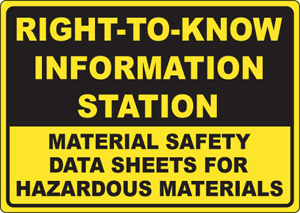 A dozen environmental and citizens groups filed a petition with EPA on Wednesday to close a loophole in the law and include oil and gas pollution in the annual system of self-reporting emissions and releases with which most US industrial polluters already have to comply.
The Toxic Release Inventory, or TRI, was created in the wake of the horrible Union Carbide plant accident in Bhopal, India, that killed 2500 people immediately, and caused another 16,000 deaths in the months and years since. It's supposed to keep track of all hazardous and toxic chemicals on-site or released by industry at every facility regulated – power plants, cement plants, refineries, chemical plants of all kinds, lead smelters, etc. TRI numbers are self-reported once a year by the companies operating the facilities, based on EPA formulas. These numbers are then made available to the public via the EPA's own TRI Explorer site, or independent groups like RTK.net run by the OMB Watch folks.
However, the TRI leaves out a very large industrial segment – oil and gas drilling. This exemption might have made some sense 30 years ago, but it doesn't now, especially given the dramatic rise in modern-day fracking techniques that use large volumes of hazardous and toxic materials.
If EPA regulators went along, that would fold in not just drilling but also related activities at the wellhead, before oil and gas is ready for transport to customers and refiners. Under environmentalists’ petition, companies would be forced to report chemicals released in drilling and completing wells as well as compression operations and processing at fractionators that split gas into separate components.
Disclosures also would be required from hydraulic fracturing operations, in which mixtures of water, sand and chemicals are pumped underground to release natural gas and oil from dense rock formations.
Eric Schaeffer, director of the Environmental Integrity Project that spearheaded the campaign, stressed that the foundation of the TRI was a deeply held belief that the public has a right to know what kind of pollutants are being released from neighboring facilities.
We’re asking the EPA to “honor those values,” Schaeffer said. “EPA has the power to add other sectors that ought to be reporting, and we’re asking them today to exercise the authority.”
Jane Davenport, a senior attorney with the Delaware Riverkeeper Network, said the reporting mandate should apply broadly.
“The oil and gas industry should not get a pass from statutes that apply to other industries,” she said, noting that the industry already enjoys some exemptions from provisions in the Clean Water Act and other environmental laws.
This may not sound like a radical step, but don't discount the power of public disclosure. TRI numbers from the Midlothian cement plant helped Downwiders show that the kilns were the largest industrial and toxic polluters in North Texas, proved the companies were not telling the truth when they said there were no toxic emissions from waste-burning or cement-making, and allowed citizens to track the volumes of pollution coming out of the kilns and analyze those numbers for trends. That's why the oil and gas industry will be fighting tooth and nail to keep the loophole open. Even something as innocuous as disclosing your own chemical information is threatening to operations that have enjoyed historic protections from the public spotlight.
Start the Weekend Off Right: “Don’t Frack My Fairway” Rig Protest Today
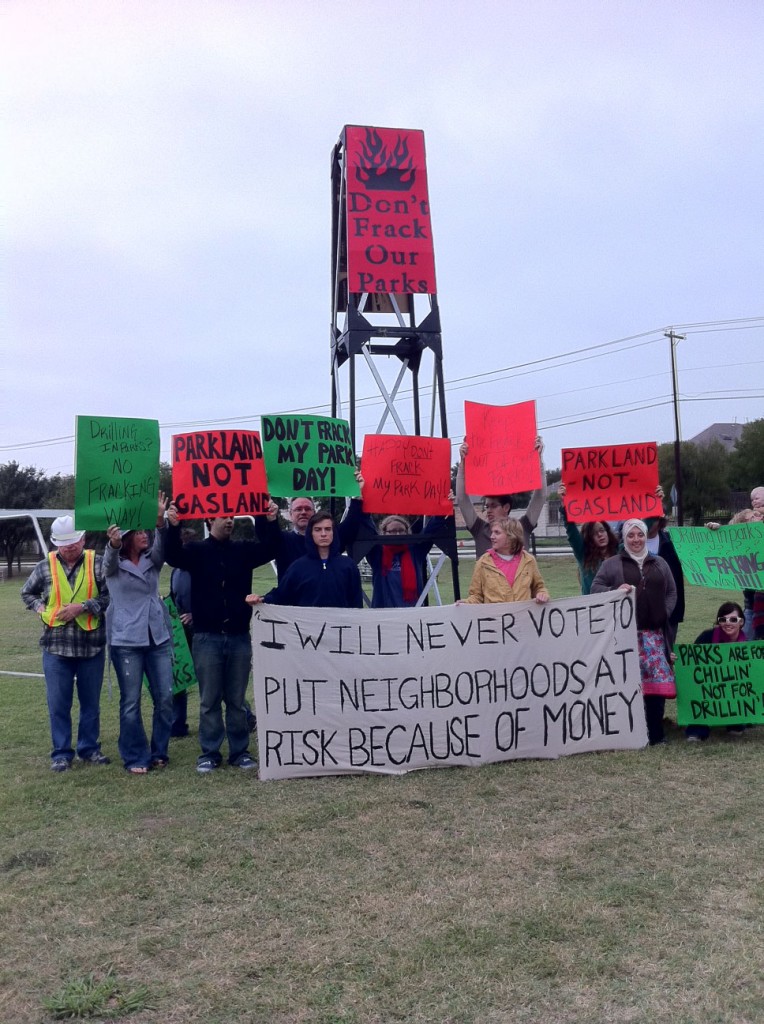 Looking for something to do this Friday late afternoon? Why not join concerned Dallas citizens for a fun little encounter with officialdom out at the newly made-over "Luna Vista" municipal golf course by North I-35.
Members of Dallas Residents at Risk – a coalition that includes Downwinders – will be showing up at the grand re-opening of what was formally known as the LB Houston Golf Course with their new 15-foot tall mock drilling rig in tow. They'll be trying to set it up next to the course clubhouse where ceremonies attracting City Councilmember Monica Alonzo, Dallas Park Board Vice President Gabriel Soto and Dallas Park and Recreation officials will be taking place.
The course is city parkland and at least three sites within the course have already been leased by the city to Trinity East for fracking – including one adjacent to the driving range.
After two years and a list of task force recommendations, the Dallas City Council is still wrestling with the problems created in 2006 when they took over $30 million from gas operators for leases on city-owned property. The decision was not publicized and there were no public hearings.
Despite not drilling on those sites in the intervening period, gas operators are continuing to seek permission to exploit them. Many of those leases are either in parkland like the Luna Vista sites, or in the Trinity River floodplain. City Council member Sheffie Kadane and others have endorsed park drilling, saying the land is underutilized.
Yes, it's going to be a little chilly. But we need to confront City Hall at every opportunity and this is a prime one. None of the city's press materials that feature beautiful pictures of the course mentions that those views will be marred by taller-than-15-foot drilling rigs. It's up to citizens to raise these issues.
When: 4:30 – 5:30 today/Friday Where: Luna Vista Golf Course Clubhouse, 11223 Luna Road, Dallas
Bi-Annual Sierra Club Legislative Self-Defense Class
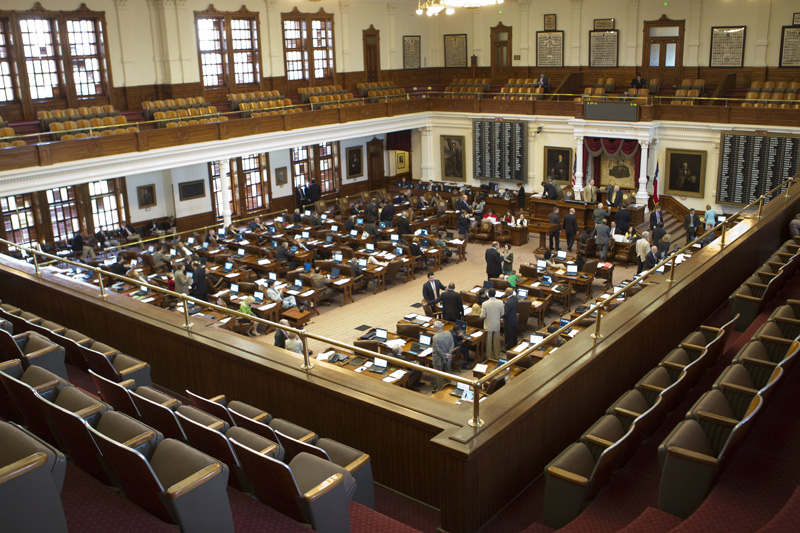 Texas environmentalists are a hardy lot. They have to be given the state's political leadership over the last two decades. Being from Texas, we know what lost causes look like, and how to most gloriously lose them. Being environmentalists, we understand that you have to wade through a lot of biowaste to get any energy produced.
In fact, what's really remarkable about the last 20 years is not how many times environmentalists have been defeated in Texas, but how much they've won through opportunistic skirmishes and battles. We could be much worse off than we are if it hadn't been for citizens fighting back against the very worst ideas and planting seeds of change that have grown and taken root enough to hold when floods of foolishness threaten them.
And of course, there's hardly any bigger flood of foolishness in Texas these days than the convening every two years of the Texas Legislature.
Schools are falling apart, medical care coverage is sketchy, and we'll all be paying toll fees to match our cable bill soon, but never fear, the Legislature will find a way to take a perfectly sensible idea like "sustainable energy" or "environmental health" and make it an object of scorn and ridicule for 120 days.
That's why it's important to be prepared and arm yourself with knowledge about the Lege in advance of its next get together this coming January through May. For a very long time now, the most inexpensive and painless way to do that has been to attend the Sierra Club's bi-annual one-day legislative workshop in Austin. This year it's on Saturday, November 10th – just days after the election.
For only $25 bucks ($5 for students) – and that includes lunch – you can learn all you wanted to know but were afraid to ask about how Texas legislative sausage will get made in 2013. This year, both the Public Utility Commission and Railroad Commission are up for Sunset Review. That means their organizational charters and missions are being looked over from scratch, and all kinds of opportunities for mischief and good stuff present themselves. For people in the Barnett and Eagle Shale plays, the RRC process could make their lives a little better or much, much worse. Same is true for the PUC, which is now backsliding on renewable energy goals.
Even if you don't think you have a dog in this next year's fight, you can always count on some industry-friendly lawmaker throwing a grenade that many of us will have to fall on or disarm to prevent something more dreadful than what we have from happening. Be parepared and be effective. It's only a tank of gas and $25. Register here
Coming Soon: Be You Own Air Monitoring Station
 When the Fukushima nuclear power plant disaster struck Japan last year, there was a lot of gaps in information about radiation levels, and a lot of public distrust with official pronouncements about those levels.
As a way of getting around this, some entrepreneurs teamed up with software and hardware engineers and started building small portable Geiger counters that could be used by members of the public themselves. That's how the company Safecast was born. To date, the company's monitoring equipment has generated 4 million data points in Japan – reading that helped generate confidence about contamination levels.
After Fukushima, the company looked at other opportunities in the marketplace to fill a gap in consumer environmental health information. It decided that air quality reporting in the US and elsewhere suffered from a lot of the same problems as radiation reporting in Japan. The data is often licensed, unavailable, or just too slow to do much good. For example, the Texas Commission on Environmental Quality issues its "red" day ozone or smog alerts fully 2-3 hours after the first dangerous ozone readings are recorded at a local air monitor. You cannot get this information in real time – when it might do you and your children much more good.
Safecast plans to launch an effort that will more or less crowdsource air quality and fix that problem by giving real time, instantaneous information to users. It's a DIY approach to air pollution using the latest micro technology. The company hopes to create an international citizen-operated network of air quality monitors. It just received $400,000 from the Knight Foundation to work on prototypes and testing. All of the companies schematics will be available at no charge for easier distribution to citizens. Los Angeles is the first US city to get to use the new devices, but we'll be following their progress closely, hoping to bring this new grassroots effort to DFW, where we still suffer one of the nation's most serious and chronic smog problems.