Posts by Downwinders At Risk
As All (Regulatory) Hell Breaks Loose in Frisco, Council Must Decide Between “Kia and Cadillac” Clean-ups
 For over a year now, Downwinders and Frisco Unleaded members have been urging the City Council and regulators to treat Exide's on-site "non-hazardous waste" landfill as a hazardous waste dump. Our characterization was based on the evidence already in the files, combined with Exide's own track record. But a new round of discoveries validates our conclusion.
On September 28th, the Texas Commission on Environmental Quality issued 10 violations concerning Exide's disposal and treatment of hazardous waste.
Those violations include samples taken from the closed parts of the "non-hazardous waste" landfill that turn out to be extremely hazardous. The particular cells sampled contain waste from operations as far back as 1998. That means we're looking at thousands of tons of illegally-disposed hazardous waste where there wasn't supposed to be any at all.
Exide has been arguing that any discrepancies between the toxic contents of their landfill and its "non-hazardous waste" designation was a recent problem because of a bad treatment recipe. Turns out, not so much.
In fact, after taking samples from the still-open parts of the landfill back in Spring, the state found they too violated toxicity standards. Reportedly, the TCEQ engineers have been trying to recreate Exide's "treatment process" without any success. Looking back over all the (post-closure) test results, the truth is that that "treatment process" probably never worked in the first place.
The September 28th violations also include open piles of lead slag waste on the edge of the landfill itself and stacks of 2-ton "superbags" of lead waste slag lying around various parts of the smelter site – all testing at hazardous levels for lead and other toxics, and all completely unauthorized as hazardous waste sites.
Among the most mysterious discoveries is that Exide sent over 3,300 tons of this same lead slag waste to be buried at the huge landfill in Lewisville at the corner of 121 and I-35 in May of 2012.
Exide labeled the waste "non-hazardous" as it went through the landfill's gate, but that label wasn't correct. Exide didn't adequately test the waste for cadmium, despite knowing the waste could easily test positive for the toxin. There is now going to be a whole chapter of the Exide clean-up taking place in Lewisville.
You can read the very dry TCEQ inspection report on the City of Frisco's website here. No word yet on fines or punishment. You can read the Dallas Morning News coverage here.
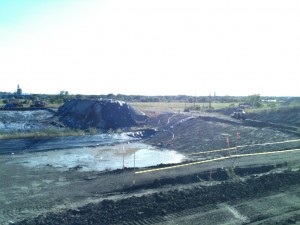
Now that it's official that Frisco has a hazardous waste dump, the City Council must decide by December 9th if it wants to keep that dump permanently, or dig up and haul off its toxic contents. That's the day the city must put in its monetary claim to the judge overseeing the Exide bankruptcy case.
This summer the city hired a consultant that gave it two options for dealing with the Exide site in case the company could not pay for the clean-up, which now appears likely.
The city could ask for $25 million to be set-aside for a 40-acre permanent toxic waste dump surrounded by a mile long "slurry wall" to keep the content from leaking out into Stewart Creek and Grand Park. Tha's the "Kia" option.
Or it could ask for $135 million to be set aside for a clean-up that would dig up all the waste, haul it off to a licensed hazardous waste landfill, and leave the property fit for commercial development and green space. That's the "Cadillac" option.
Even though it's probable that Exide won't have the money itself to finsih the clean-up, it's important for the Council to publicly take a stand for the complete "Cadillac" clean-up of Exide. A landfill would pose a permanent risk to both Stewart Creek abd Grand Park. Financing the plan without using Exide money will be a challenge, but then so was buying the company out and closing it down, and putting together the package that recently brought the Cowboys training facility to Frisco.
You can click here at our Citizen Action of the Week page to send a read-to-go e-mail to the Frisco City Council requesting they choose the comprehensive "Cadillac" option, You can also add your own comments too.
Besides finding massive violations in and around its Frisco landfill, the Texas Commission on Environmental Quality and EPA have also recently rejected Exide's proposed clean-up of the smelter property.
Among the largest issues was disagreement over the classification of groundwater flowing underneath the Exide site, which straddles two forks of Stewart Creek and sits in the steam's natural valley.
Both the state and EPA are insisting that the flow of Exide groundwater is so high that the entire property should be held to stricter clean-up standards – 100 times better than what Exide was proposing. This is also a standard that Frisco Uneaded and Downwinders has been pushing for.
Other issues in the rejection include the demand by the agencies that the company also address contamination in Stewart Creek, the appearance of mysterious barrels of toxic and long-ago banned PCB's, and more investigation of what kind of fill the entire complex was built on (hint: it might be the same stuff that's also going into the "non-hazarous waste" landfill).
In all there are 34 separate items that the state has given Exide to change, report on, follow-up, or sample. The TCEQ's rejection letter can be accessed and downloaded through the City of Frisco website here.
This is all good news. Frisco Unleaded has been arguing that the entire Exide site should be cleaned-up to levels that would allow residential and green space use.
On the other hand, it might all be academic because of the fact that Exide is in bankruptcy court. We'd have a standard but no money to get the job done.
That's why the decision the council makes on December 9th is so important. It must decide to ask the bankruptcy court for the amount to cover either a permanent toxic waste landfill in downtown Frisco forever, or a clean-up that will leave the site available for prime real estate development. Please send the City Council a message that you don't want them to be cheapskates with public health.
Your Tax Dollars at Work: TCEQ Argues Air IS NOT a Natural Resource
 So this is how ideological things have become at the Texas Commission for Environmental Quality. Even though the agency won a fight in court to keep a group of parents represented by the Texas Environmental Law Center from being able to sue the state for not regulating Greenhouse Gases, TCEQ lawyers are working overtime to make the judge in the case retract this statement:
“The Court will find that the Commission’s conclusion, that the public trust doctrine is exclusively limited to the conservation of water, is legally invalid. The doctrine includes all natural resources of the State."
To the untrained eye, this might seem a pretty innocuous piece of prose. Water, air, land, these are pretty much the very definition of "natural resources." But them are fightin' words to Rick Perry's environmental watchdogs. Concede this point to the hippies, and there's a slippery slope leading all the way down to effective regulation and supervision of airborne threats to the public health. Unacceptable.
You see under state law, only water is legally treated as a natural resource in Texas, subject to what's called the "public trust doctrine," which requires government to protect and maintain certain shared resources fundamental for human existence.
TCEQ lawyers are saying air just isn't so fundamental to humans as the wet stuff, although the last time we checked, most people could only last 2 to 5 minutes without it.
State lawyers late last month argued in front of the Texas Third Court of Appeals that Judge Triana’s comments were beyond the scope of the case and should be vacated.
Terry Clawson, an agency spokesman, said….“The T.C.E.Q. has concerns with how the district court opinion addressed the matter of public trust doctrine,” Mr. Clawson added. “The scope of this doctrine is a very important issue, which deserves to be fully vetted.”
The agency complained to the court that Judge Triana’s statements were seen by the plaintiffs “as a victory,” even noting that environmental groups had called her ruling “a blockbuster” for their cause in news releases.
But David Spence, a professor of business and law at the University of Texas at Austin, said the scope of public trust was more symbolic than practical.
“In a sense it’s a kind of low-stakes argument,” Mr. Spence said. “The public trust doctrine in the U.S. is a fairly weak thing.”
Each state applies the principle differently, and few have used it with much force. The doctrine has generally been successful only at protecting open beaches for public use, Mr. Spence said.
So which is it – practical or symbolic? For both citizens and the TCEQ, the two are one in the same. Rick Perry's appointees cannot afford to let citizens get their foot in the legal door to establish a principle that may result in one day overriding their own authority, however abstract it appears that threat is now.
Likewise, in a state government as hostile to citizen concerns as this one, what do you have to lose in trying to establish a, er, beachhead, in terms of seeing safe and legal air as a finite "natural resource" that should be protected? Indeed, one of TCEQ's predecessor's names was the Texas Natural Resources Conservation Commission. It regulated air pollution in Texas – presumably because it was a Natural Resource. This "Hail Mary!" legal strategy seems at least as effective as going down to Austin every two years expecting things to get better.
The appeals court is expected to rule soon. It could remove the statement entirely from the record the way TCEQ wants, or merely say is a statement and not a legal precedent, which is what even the plaintiff's lawyers expect. Stay tuned.
New National Report: Texas is Source of Over 50% of Total US Fracking Pollution
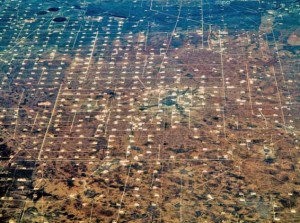 While most of the national publicity surrounding fracking over the past couple of years has involved documenting its encroachment into the Midwest and East Coast, a new first-of-its-kind report demonstrates why Texas is still the center of the oil and gas industry's universe.
Last week the Environment America Research & Policy Center released "Fracking by the Numbers: Key impacts of Dirty Drilling at the State and National Level." As far as we can tell, it's the first systematic collection of quantifiable state-by-state data on the environmental costs of fracking in the entire US – the amount of water used in drilling operations, the amount of air pollution produced, the amount of acreage devoted to leases, etc.
Of course, the numbers all come from either the annual self-reporting industry performs for state and federal regulators, or those regulators themselves, so there's a good chance they're being under-estimated. Nevertheless, the total numbers are still huge and shocking. And what really catches the eye in the state-by-state breakdowns is just how much the operations around us here in Texas contribute to those huge and shocking numbers. We're not just the Belly of the Beast. We're the belly, upper and lower intestines, bowels, and open-throated mouth of the beast.
Number of Wells:
Of the almost 82,000 wells drilled across the country since 2005 (when the Energy Act with the "Halliburton Loophole" included was passed and signed), fully 34,000 have been drilled in the Lone Star State. The second closest state is Colorado with a little over 18,000.
Think things have slowed down and moved elsewhere? Of the 22,300 wells drilled since 2012, 13,500 of them have been in Texas. Colorado again comes in second with 1,900.
Acres of Land Damaged:
130,000 acres out of a US total of 360,000 acres. Colorado is second with 50,000.
Amount of Water Used
Out of a national total of 250,000,000,000 gallons of water used to frack wells, Texas accounts for 110,000,000,000. Pennsylvania is second at 30,000,000,000 gallons.
Amount of Waste Water Produced
Out of a national reported total of 280,000,000,000 gallons (that's 280 billion) of unusable toxic wastewater that needed to be disposed of permanently in injection wells, Texas accounts for 260,000,000,000 gallons. North Dakota is a distant second with 12,000,000,000.
Air Pollution
None of these figures includes totals from other kinds of facilities in the gas cycle, like compressors or pipelines, or storage tanks – just drilling pad operations.
Particulate Matter
Approximately 8,000 tons in Texas out of nationwide total of 13,000.
Nitrogen Oxide (smog-forming)
100,000 tons in Texas out of 170,000 for the entire US.
Carbon Monoxide
153,000 tons in Texas out of a US total of 250,000 tons.
Volatile Organic Compounds (smog-forming and toxins)
14,000 tons in Texas out of 23,000 nationwide.
Sulfur Dioxide (acid rain, respiratory irritant)
300 tons in Texas out of a total of 600 tons nationwide.
Greenhouse Gases
40,000,000 tons in Texas out of a US total of 100,000,000.
When a single state accounts for more than half of the wells, the waste water, and the entire country's air pollution burden from fracking, you understand why campaigning against the industry's practices in Texas is the political equivalent of fighting behind enemy lines. It makes recent victories like the defeat of the Trinity East permits and the adoption of a tougher draft Dallas gas ordinance all the more remarkable, and important.
Beginning in 2006, many of us were caught off-guard by the invasion of wells that swept eastward into the metropolitan DFW area. We didn't know enough to know what questions to ask, or we didn't want to ask them. Now, living in the largest urban gas play in the US, and inventorying these kinds of mind-numbing statistics, we don't have any excuses. Fracking represents one of the most profound environmental and public health challenges ever to confront DFW or Texas. The most important question now is what we intend to do about it.
TXI Stock Takes a Dive, New North Texas Cement Plant on Way?
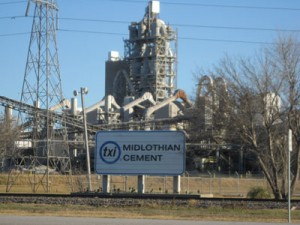 Last Wednesday TXI stock didn't do as well as Wall Street thought it should for the quarter and the result was about a 10% drop in value over one day's trading. On a Thursday conference call, CEO Mel Brekhus defended the company's prospects, including the opening of its new Central Texas plant, saying it "was the most successful of any he had been involved with in his career." We imagine that's right since the only other plant the company has built recently was Kiln #5 in Midlothian which faced opposition from Downwinders and others in the early part of the last decade.
But most intriguing from DFW residents' point of view was the hint that Brekhus casually dropped toward the end of the call that the company was thinking about "increasing capacity" in North Texas. You know what that's code for – a new cement kiln.
Midlothian has been home to the nation's largest concentration of cement manufacturing for a long time, but such an addition would solidify its position for decades to come. That's because these days kilns come in one size – very, very large. A new TXI kiln would be massive in all respects. Air pollution would go up considerably, possibly canceling out some gains that have been made by the shutting down of the seven older wet Midlothian kilns that were ground zero for waste-burning from 1986 to 2008. Particulate Matter, smog-forming pollution and more exotic poisons like Dioxins would increase substantially.
Moreover, TXI might be looking for new ways to make money besides making cement – just like they did when they turned their kilns into hazardous waste incinerators for profit. Around the world the cement industry is focusing a lot of effort into becoming waste incinerators for municipal solid wastes, medical wastes and "unrecyclable plastics." Just like they did when they were burning hazardous waste, they charge customers for the right to burn their garbage. TXI recently expanded their list of fuels to include car parts and plastics. Might a new kiln increase the need to develop even larger markets for waste to burn?
It could be PR talk for the investors or reflect real corporate thinking at TXI headquarters. As part of their planning, executives would be advised to also think about the opposition to such a plant now. Midlothian is a different place than it was even 13 years ago, much less 25. People who've moved there recently might not want to see a new source of air pollution, especially one devoted to being a garbage burner. It's not quite the company town it was. And instead of facing a fledgling group, they'd be up against an organization that knows how to win the war. Stay tuned.
Climate Change as Human Health Issue
 Overlooked in the local press was a late September study from the University of North Carolina that correlated reductions in greenhouse gas (GHG) emissions with decreases in worldwide air pollution deaths. "It's pretty striking that you can make an argument purely on health grounds to control climate change," one author told the British Guardian newspaper.
According to the study, an aggressive plan to cut GHGs, which relies on cutting back on fossil fuels would result in 300,000-700,000 premature deaths a year avoided in 2030, 800,000 to 1.8 million avoided in 2050, and 1.4 million to 3 million avoided in 2100.
A key finding was that the value of the health benefits delivered by cutting a ton of CO2 emissions was $50-$380, greater than the projected cost of cutting carbon in the next few decades. The benefits do not accrue from reductions in CO2 per se but because of associated pollutants released from burning fossil fuels.
It is possible to reduce pollutants in fossil fuel emissions more cheaply without switching to low carbon sources of power – for example with scrubbers on coal plants that remove NOx and SOx; or by cars switching from diesel to petrol – but the authors say it is striking that the value of health benefits outweigh the costs of cutting carbon.
That is, you could cut the most harmful emissions without also cutting GHGs, but the costs of the benefits to cutting everything still outweigh the health costs incurred by letting the status quo remain, so why not also get a less hostile climate in the bargain?
Mid-Day Workshop Tuesday on Corporate Research for Beginners
 Late word came of a Center for Health and Environmental Justice phone-in training workshop on corporate research, scheduled for Tuesday from 11am to 1pm our time here in DFW. There's no cost but the number of phone lines are limited, so you might want to RSVP ASAP.
There's a pretty good line up of research experts doing the talking, including Phil Mattera, Director of the Corporate Research Project, and Sofia Plagakis, an Environmental Right to Know Policy Analyst with the Center for Effective Government. It's advertised as a good way to get to know your corporate opposition, including ways to research earnings, learn who the major shareholders are, and take advantage of all the public data bases there are these days.
This is aimed at beginners, but with this kind of expertise, even cynical veterans shoud come away with some new tips.
Ed Ireland is Down to the Scientific Stems and Seeds
 Maybe the Barnett Shale Energy Education Council thought it was being cute by sending their latest "study" out on the day Gasland II had its theatrical premiere in North Texas.
Or maybe they knew what an egg they were laying. It's a basic rule of PR that you don't send things out on a Friday that you actually want people to see. And if you were the industry, even you might be a little embarrassed about this thing too. As of Tuesday afternoon, the group was so proud of it, they hadn't even posted it on their on website. As far as we can tell, it's details have only appeared within stories from in-house publications like the Star-Telegram.
Imagine the pitch on paper, if there was one. "We'll fund our own research so that it'll have maximum credibility. And since we can't find a reliable academic institution to do it for us, we'll have to contract to something called ToxStrategies out of Houston. We won't do any new research at all. We'll just regurgitate the state's own lame monitoring data. We'll take the seven stationary monitors that have screened for air toxics in North Texas – you know, the ones that ony take samples every sixth day (when they were operational), and let that represent the entire Barnett Shale. We'll only look at some Volatile Organic Compounds readings. We won't connect any gas drilling or production taking place to a timeline to show what activity was actually going on around these monitors, so they'll be no way to correlate our presence with increases or decreases in pollution. And of course, since we're using TCEQ monitoring data, we can also use their unsupported claims that there are "safe levels" of benzene and other carcinogens when the most recent science is in direct opposition to that discredited idea."
And that's about it. Old TCEQ monitoring data that may or may not have any correlation to drilling activity is used to once again say, "Look Ma, no health effects!" Think of it as the "Titan Study Part 2."
Industry and regulators always want to start at the smokestack end of things and draw assumptions of human health from that end. As long as pollution is below certain levels that they just know are "safe" (until one day' they're not), they connect the dots and say there is no human harm occurring. They really don't want to actually go out and test that theory among real people on the ground living next to these facilities. They might find it doesn't hold up very well. That's why they want to stick to reviews of monitoring data.
Citizens always want to start from the other end – real life. Let's test that hypothesis about safe levels of poisons and see what the rate of asthma, cancer, miscarriages there are in the neighborhoods around and downwind of these sources. Are the rates of illness higher or lower the closer you get to a facility? Is there any correlation between the types of illnesses and any chemical in the atmosphere or water, no matter how safe the exposure level? And you know what, when it comes to fracking, there seems to be a lot of difference between what the studies that rely on real life say versus what the studies that rely on measurements say, like this "new' old effort released about a quarter to five on a Friday afternoon.
But hey, It can't be the BSEEC without the BS.
Big D’s BFD
 Did you feel the ground shifting under your feet yesterday around 5 pm? It was another one of those local earthquakes caused by fracking. The epicenter was Dallas City Hall. Damage to the gas industry's rhetoric and credibility was extensive.
By a vote of 14 to 1, the Dallas Plan Commission pronounced the permissive "Fort Worth Model" of regulating the drilling and production of natural gas in the Barnett Shale dead. The passing was definitive. As John Cleese might say, "This paradigm is no more…it has ceased to be…this is an EX-paradigm."
It didn't go down without a fight. Up until the very final hours of debate over language in the City's proposed new gas ordinance, staff was still offering weaker versions of rules to Commission members because "that's the way Fort Worth did it." They were all rejected in favor of stricter standards as part of what has the potential to be the most protective ordinance in the Barnett Shale.
Now all we have to do is get eight Dallas City Council members to help us realize that potential.
The draft passed yesterday isn't 100% of what residents want, and in one case doesn't even match the level of protection Dallas itself started out with in 2007. It still provides paths through the bureaucracy for drilling in parks and flood plains, instead of outright bans, and despite staff assurances, the chemical disclosure language isn't foolproof. But to see it only through the lens of what it's not yet doing is to ignore the huge impact of what it already does. Coming from the largest city in the Shale, the Dallas draft immediately offers a modern, tougher alternative to Ft. Worth's submissiveness for dealing with the problems of mining gas in urban environments. To quote our Vice-President, it's a B.F.D. Some of the highlights include:
1) A 1,500 property line-to-property line setback from neighborhoods and other protected uses, matching the most protective setbacks in the Barnett Shale. It can only be reduced to a minimum of 1000 feet with a variance, and that's only possible with 12 out of 15 council votes. Notice of any permit must go out in English and Spanish to all mailing addresses within 2000 feet and the applicant must hold a neighborhood meeting where the project is fully explained.
2) Electrification of all motors and engines on a drilling site. If operators want to make an exception and use combustion engines, they have to show why electrification isn't feasible, and the City has to agree.
3) Tough restrictions on where gas compressor stations can locate – only in heavy industry zoning districts, with the same 1,500 foot setbacks from neighborhoods and all other protected uses, fully enclosed, and they must use electric engines, not diesel or gas. Thanks to some quick pushback by residents and their allies on he Commission, we were able to win back all the rules that staff had excluded in their first take only 24 hours before the vote.
4) A ban on any injection wells in the City of Dallas.
5) A ban on fracking waste pits.
6) Requirements for a road repair agreement before a permit is even considered. This is above and beyond any other insurance or bonding requirement.
7) A recommendation to the Council that it establish a local air pollution off-sets program that would include natural gas facilities. Such a program would be the first of is kind in the nation and close a Clean Air Act loophole that exempts these facilities from participating in the federal off-sets program for smoggy "non-attainment areas."
8) Baseline testing of water, soil, air, and noise at every proposed site.
9) Individual non-toxic "tagging" of all fracking fluids used. Every operator will be required to put their unique chemical signature within the concoction they're pumping into the ground so that if any of it goes where it shouldn't, the offending well can be identified. It's DNA testing for fracking.
10) A recommendation to the Council that during drought conditions, it either charge substantially more for city water that's being used for fracking, or ban the use of city water for fracking all together.
11) A recommendation that the Council demand an additional letter of credit from operators beyond any other insurance or bond to cover uninsurable intentional acts of contamination, i.e. dumping waste into the Trinity River.
We're not in Cowtown anymore.
(There's not an online version of the final language up yet. We'll let you know when there is so you can look this thing over yourselves).
City attorney Tammy Palomino, always a reliable source of information, stated on the record that she believed the draft's language about chemical disclosure would cover all trade secrets, but we're not so sure. That's why we'll be asking the Council to add five simple words to this section that Ms. Palomino didn't: "with no exceptions for trade secrets."
Instead of banning drilling in the floodplain, the proposed ordinance makes it impractical, though not impossible. An operator would have to get a fill permit from the city, and approved by the Army Crop of Engineers, to build a mound that would elevate the entire drilling pad site out of the floodplain. Anyone who's seen the footage from Colorado's flooded gas plays over the last couple of weeks can identify the folly of this approach. What's to keep flood waters from eroding the elevated mound and taking the entire pad site down stream? Only the lack of a kind of levee-to-levee flood we've seen in Dallas before.
Park drilling provided the day's lesson in pretzel logic. A "protected use" includes a recreation area, "except when the operation site is on a public park, playground, or golf course." Then it's perfectly fine to have rig next to the swing set. Got it?
This is less protective than the original Dallas Park decision that preceded the notorious Suhm secret agreement with Trinity East. It called for the leasing of a park's mineral rights but banned surface drilling in any park. You could go under but not on. That's still the most sensible compromise but it went floundering for support yesterday.
Instead, the Park Board will have to request the City Council to hold "Chapter 26" public hearing, after which there must be a 3/4 vote of approval by the Council that officially concludes there's no other possible feasible use for the park land other than gas drilling.
Listening to the comments from many Commissioners right before the vote, one got the feeling that if they had to do it all over, they might not be so equivocal. Nevertheless, they all voted for the more convoluted approach. It's the most flawed part of the ordinance, especially in light of the outcry over allowing any drilling in any public park during the Trinity East fight.
With those exceptions, it was a banner day for residents who've been fighting this good fight for over three years now. It was the kind of day that after Trinity East's main lobbyist whined that the company just couldn't get the electrical hook-ups they needed (in the middle of Northwest Dallas by a major Interstate) during the public hearing right before the final vote, an influential conservative Commissioner successfully moved to amend the completed draft to make the section on mandatory electrification of compressor stations stronger. Ouch.
It was the kind of day when the only ally industry could muster among the 15 Plan Commissioners was the sometimes coherent Betty Culbreath, Dwaine Caraway's brand new gift to Dallas residents. Culbreath said she couldn't vote in conscience for a document that required so much from industry. She felt so passionate about the issue, she missed most of the Commission workshops over the past month or so where the ordinance language was debated. It'd be laughable except the council member who appointed her is now the Chair of the Council's Environmental Committee.
There's no official news about the timeline or process the Council will use to consider the draft now that it's been delivered to them. Despite the mostly winning day residents had on Thursday, its sobering to remember that we only got six votes to deny the Trinity East permits. We need at least two more to make sure this good ordinance stays intact, or gets even stronger.
Such a lopsided Commission result gives us a great running start to get those votes. Backsliding by Council members will be hard to pull-off publicly, although let's face it, some seem immune to embarrassment on this issue.
Cowtown circa 2008 will always be the industry's preferred template for regulation, because they mostly wrote the rules. Residents in the Shale now have a much more citizen-friendly 2013 Big D model they can use for counterpoint – if we can win ACT III of the Dallas Gas Wars.
Dallas City Staff Trying to Pull a Fast One on Eve of Final Gas Ordinance Hearing and Vote
 Thursday's Dallas Plan Commission hearing on a new gas ordinance just got a lot more interesting. At 12 noon today, citizens received the staff proposal for language dealing with compressors stations in Dallas – among the largest, most polluting, most dangerous kinds of facilities in the natural gas fuel cycle.
Staff is attempting to carve out more areas of the cities where compressors can locate, as well exempt them from the already-approved 1,500 foot setbacks from neighborhoods required for drilling wells themselves, as well as exempt them from the vote two weeks ago to require mandatory electrification of all motors and engines.
In other words, city staff probably has a proposed compressor in mind – maybe in the Northlake development or elsewhere – they're trying to write the rules around – just like they tried to do for the Trinity East permits.
What are the changes staff is recommending be adopted tomorrow by the Commission?
1) Staff wants to allow Compressors to call themselves"light industry" and locate in more places in Dallas
Instead of confining them to only Industrial Manufacturing Zoning districts, as was voted on by the Commission two weeks ago, staff has gone ahead and included a brand new category of zoning that would also allow compressors – something called "Industrial Research" districts.
In Dallas, an Industrial Manufacturing district is for "Heavy Industrial Manufacturing Uses with Accompanying Open Storage and Supporting Commercial Uses." That fits compressor stations to a T, since they can emit up to 250 tons per year of air pollution with a "Standard Permit" from the state. They're also subject to tremendous pressures and explosions. They belong in a heavy industrial district.
According to the City of Dallas' own zoning code, the "Primary Use" of facilities in an Industrial Research district is "Research and Development, Light Industrial, Office, and Supporting Commercial Uses."
We know from experience that the only research going on in or around compressor stations in North Texas are experiments on the public health. Staff gives no rationale for allowing compressors to operate in areas of light industry – like warehouse districts – where they would instantly become the nastiest neighbor.
This last minute change is reminiscent of what staff was doing to protect the Trinity East permits before anyone knew about the secret agreement former City Manager Mary Suhm made with the company. Could there now be another company or site the staff is trying to leave open for compressors that wouldn't otherwise be available by sticking to just the Industrial Manufacturing districts the Plan Commission voted for two weeks ago?
2) Staff wants to exempt Compressors from the 1,500 foot setback already agreed to for drilling sites.
Instead of using the distance between operations and neighborhoods the Plan Commission has already agreed is appropriate for well pad sites, staff wants to reduce the distance between larger, more polluting, more permanent compressors stations to just 1000 feet.
This makes no sense at all. For all the real and potential problems at a well drilling site, they're miniscule compared to the pollution footprint of a compressor station. Moreover, the most intense potential releases of air pollution occur at a well site over a period of weeks, or, at most months. Once compressors are built, they're staying put and operating 24/7. If you have a 1,500 foot setback protecting neighborhoods from well sites, shouldn't you also at least provide that same level of protection from a facility that will be pumping out more pollution and also poses a risk of explosion, if not more? But, for some reason, staff wants Dallas residents to be less protected from these kinds of operations.
We need your help at tomorrow's public hearing tomorrow to argue that we need at least the same setback for compressors as we do for well sites.
3) Staff wants to exempt compressors from the requirement to electrify all engines and motors
At their September 12th meeting, the Plan Commission also voted to require electric motors on all gas production facilities. No distinction was made between drilling site motors and generators, and compressors engines. Industry has argued that they can find electric alternatives to every combustion engine including the giant, locomotive-sized engines that run compressors. Since compressor stations are among the largest industrial air polluters, replacing diesel engines with electric ones makes even more sense in a "non-attainment area" for smog like DFW than requiring electrification of all the motors and engines on a drill pad site.
The staff's recommendation that compressors be exempt from required electrification looks to be another special favor staff wants to grant the industry.
These changes, along with others that we're just now receiving word about, are serious enough to cause us to change our plans for tomorrow's public hearing.
Citizen groups be hosting another pre-hearing press conference at 1:00pm in the Flag Room outside the City Council chambers on the 6th floor where we'll be able to itemize the most severe challenges to our goal of getting the most protective gas ordinance in North Texas. THIS IS THE LAST PUBLIC HEARING ON THE ORDINANCE. WE NEED YOUR HELP. Please be there at 1 pm to hear what's at stake and what we need to be calling for in our testimony tomorrow afternoon.
Now is not the time for complacency…..
Help Finish Act II of the Dallas Gas Wars on a High Note This Thursday
 Act I was the rear-guard fight to keep the horrible Trinity East permits from getting approved.
Act II has been about getting the most protective ordinance language for any future drilling we can from the members of the Dallas Plan Commission.
Act III will be about what kind of new drilling ordinance the Dallas City Council actually passes into law.
This Thursday at Dallas City Hall, Act II will come to a close with the final workshop and public hearing by the Plan Commission on a new Dallas gas drilling ordinance.
As usual, the public hearing is slated for 1:30 pm in the Council Chambers on the 6th floor. Immediately afterwards, the Commission will vote to send a draft ordinance to the full City Council.
Why is it important for you to come to this last hearing? Still pending or being reconsidered by the Commission is final language on park drilling, drilling in flood plains, insurance and bonding requirements, chemical disclosure requirements, and adding a 1500 foot setback to compressor station permits.
Because we don't know how many City Council members actually support building the most protective ordinance in the Barnett Shale, we must try to get the strongest language now at the Commission level, so that we have the momentum heading into Council consideration.
Council members are less likely to weaken strong provisions already written in by the Commission. On the other hand, any weaker provisions will likely be left weak unless citizens campaign for changes. So the draft of the ordinance submitted by the CPC on Thursday will be a very important starting point for the Council.
Make no mistake, your presence on Thursday is important and being watched. When you show up, you're saying you want a strong ordinance. By staying away, you're telling the Powers That Be that you'll set this round out. Don't let that happen at the exact moment industry is beginning to realize what we're accomplishing in Dallas. The ratio of drill, baby, drill proponents to citizens who want more aggressive protections crept up at the last public hearing on the 12th. Don't let it get any higher. We need you on Thursday to give a rousing send-off of the proposed draft ordinance to the Council.
Specifically, we must use the recent flooding of the gas fields in Colorado to call for a complete ban on drilling in the flood plain, or at least require those pad sites to be fully elevated out of the flood plain. Currently, only the rig must be elevated, leaving storage tanks and other pad site equipment vulnerable. Given what we've seen in Colorado, it'd be a big mistake to keep it that way.
What basic protections do we need in this ordinance?
1) A 1,500 foot setback for well pad sites from neighborhoods and other "protected uses."
2) COMPLETE disclosure of all chemicals used or stored on a well pad site – no exceptions for trade secrets.
3) A ban on drilling in parks
4) A complete ban on drilling in flood plains, or a requirement that the entire pad site must be elevated out fo the flood plain
5) Making sure the 1,500 setback from neighborhoods and other protected uses applies to compressor stations in addition to well pad sites
6) A ban on using City of Dallas water for fracking during droughts, and charging more for water used for fracking, since it's being permanently taken out of the hydrological cycle.
One last public hearing at the Plan Commission this Thursday and then it's all up to the City Council. Come and make sure it's a happy ending to Act II. And if we do well, we hear there's a special movie night on Friday to come and celebrate what we hope will be the most protective gas ordinance in the Barnett Shale.