Smog
2011 was the Worst Year for Smog since 2006 in DFW. 2012 Is One Bad Air Day Away Matching It.
 Last year's air quality death spiral in DFW was sometimes explained away as an anomaly because of the severe drought the entire state was going through.
So what's the explanation this year?
With yesterday's high ozone levels sending a 6th monitor into an exceedance of the old 1997 85 parts per billion smog standard, DFW is just one more bad air day away from matching last year's dreadful results. Today's ozone forecast says there should be no high levels of smog in DFW today, even as the temperature reaches for a record high. But then again, they weren't predicted Thursday either.
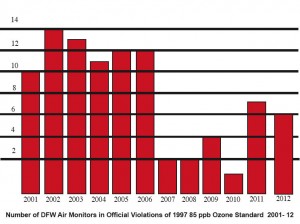
To give you some idea how rapidly things have gone downhill for air quality in DFW the past two years, just look at the annual numbers. From 2007 to 2010, we had a total of nine monitors register official exceedances of the 85 ppb standard. That's about two monitors a year average. This turns out to be the closest we've ever come to actually meeting the standard. Officials could argue with some justification that air quality was slowly getting better.
On the other hand, during the last two years, we've had 13 monitors record exceedances of the 85 ppb standard, an average of 6.5 a year, and 2012's ozone season is not yet over. You could add up all the exceedances from the four years between 2007 and 2010 and still not equal the number we've experienced in just the last 24 months.
This is not progress.
TCEQ and the gas industry have argued for some time that gas mining couldn't possibly be contributing to smog problems since smog levels were going down as drilling was increasing in DFW. But that's not true anymore. As gas drilling has moved further and further east – into the heart of the non-attainment area, we've seen in increase in ozone concentrations, in exceedances in monitors, and monitors in the eastern part of the Metromess exceeding the standard that hadn't done so in five to seven years.
Meanwhile all other major source categories for air pollution have been decreasing their emissions. Cars, power plants and cement kilns are actually releasing less air pollution now than they were ten or 20 years ago. Only one large specific source category has increased its annual tonnage significantly over that same time – oil and gas.
Is it just a coincidence that smog is getting worse as oil and gas pollution skyrocket – not only in the Barnett Shale that surrounds DFW on three sides, but by all the new oil and gas sources now southeast of Dallas as part of the Haynesville Shale play that are blowing their pollution toward us most of the ozone season? There are now so many gas compressors in Freestone County, less than 75 miles away from the Dallas County line, that their emissions represent the equivalent of over 4 new Big Brown coal plants. What do you think the impact on air quality would be of four large new coal plants located immediately upwind of DFW? Might it look a lot like it does in 2012?
Could it be that the dirty mining of "clean" natural gas is making it impossible for DFW to meet the old 85 ozone standard, much less the new 75 ppb one? That the Devil's Bargain so many former and current elected officials made with the gas operators to grab the cash and run is now coming back to bite them and us in the air quality butt? That was certainly the conclusion of the study we publicized this last Tuesday from the Houston Advanced Research Center:
"Major metropolitan areas in or near shale formations will be hard pressed to demonstrate future attainment of the federal ozone standard, unless significant controls are placed on emissions from increased oil and gas exploration and production….urban drilling and the associated growth in industry emissions may be sufficient to keep the area (DFW) in nonattainment."
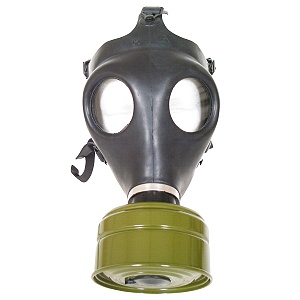
It's time for local officials to replace those cash registers in their eyes with gas masks. Because of their rush to make money, they didn't pause to understand how so much new industrial activity could produce smog just like the bad ol' days. They were being paid not to understand. And now 5 to 6 million people who still can't yet breathe safe and legal air are paying the price.
Study: Gas Drilling “Significantly” Increasing DFW Smog
 In the middle of another bad North Texas ozone season, a new study by a Houston research consortium concludes that Barnett Shale natural gas facilities "significantly" raise smog levels in DFW, affecting air quality far downwind.
According to the study, ozone impacts from gas industry pollution are so large, they'll likely keep North Texas from being able to achieve the EPA's new 75 parts per billion (ppb) ozone standard.
Author Eduardo P. Olaguer, a Senior Research Scientist and Director of Air Quality Research at the Houston Advanced Research Center, concludes that, "Major metropolitan areas in or near shale formations will be hard pressed to demonstrate future attainment of the federal ozone standard, unless significant controls are placed on emissions from increased oil and gas exploration and production….urban drilling and the associated growth in industry emissions may be sufficient to keep the area (DFW) in nonattainment."
Olaguer's article describing his study was recently published in the July 18th edition of the Journal of the Air & Waste Management Association. It's the first independent study to examine specific North Texas ozone impacts from the gas industry.
Environmental groups say air pollution from natural gas sources is already making it impossible for DFW to meet even the obsolete 15-year old standard of 85 ppb. So far in 2012, five monitors have violated that level of smog despite a state plan that Austin guaranteed would reduce ozone concentrations in DFW to record lows this year. Counting 2012's failure, DFW has been in continual violation of the Clean Air Act for its smog pollution since 1991.
"This study is proof we need a regional strategy of self-defense to reduce air pollution from the gas industry," said Downwinders at Risk Director Jim Schermbeck, whose group has been leading the fight to reduce smog-forming pollution from gas sources for two years now. "TCEQ and EPA are not doing enough to rein-in these facilities. Despite their official plans, our air is getting dirtier, not cleaner because gas pollution is still under-regulated. It's time for us to do more at the local level."
Schermbeck suggested the study could make a difference in the upcoming city council vote on a new Dallas gas drilling ordinance.
"Dallas has a chance to react positively to this new evidence by adopting the nation's first policy aimed at mitigating the tons of new pollution caused by gas mining in its new drilling ordinance. That would be a very large step forward in advancing regional clean air goals."
A city-wide coalition of neighborhood, homeowners, and environmental groups has been urging the Dallas city council to require gas operators to reduce as much air pollution as they release through funding of anti-pollution measures across the city. The Houston Center study gives them a lot of fresh arguments.
According to it, "…oil and gas activities can have significant near-source impacts on ambient ozone, through either regular emissions or flares and other emission events associated with process upsets,and perhaps also maintenance, startup, and shutdown of oil and gas facilities."
In fact, just routine emissions from a single gas compressor station or large flare can raise ozone levels by 3 parts per billion as far as five miles downwind, and sometimes by 10 ppb or more as far as 10 miles downwind.
Those impacts rival the size of smog effects traced back to the Midlothian cement kilns or East Texas coal-fired power plants by previous studies.
As the study notes, "Given the possible impact of large single facilities, it is all the more conceivable that aggregations of oil and gas sites may act in concert so that they contribute several parts per billion to 8-hr ozone during actual exceedances."
This conclusion directly contradicts the stance of the Natural Gas industry and the Texas Commission on Environmental Quality, both of which deny that Barnett Shale gas emissions are large enough or located in areas that can influence DFW ozone levels.
But the Houston study is based in part on data collected by industry, as well as information from the city-sponsored "Fort Worth Study," and citizen-sponsored testing in the town of DISH in Denton County. It also uses a kind of computer modeling that allows for a more realistic understanding of how large releases from gas facilities can increase ozone pollution than the one the TCEQ uses. It's the most sophisticated challenge yet to the state and industry's claim that gas emissions do not constitute a large threat to DFW air quality.
"This is reality-based science, not the ideologically-influenced happy talk that's coming out of TCEQ these days," said Schermbeck. "Local governments in North Texas, especially those that are traditional allies of clean air, need to pay close attention and act on it."
The report is available for downloading here.
The EPA Loss in Court You Didn’t Hear About, But Could Affect You More in DFW
 Let's face it, the EPA legal team has taken a bunch of hits lately. Losses in court over the Texas Flex permitting plan and national cross state pollution rules, among others, have gotten lots of headlines, but for various reasons may not be as awful as they first sound to environmentalists.
But there was a recent ruling that did hit home for metropolitan areas like DFW that are a) already in "non-attainment" of the federal ozone, or smog, standard, and, b) host lots of urban gas and oil drilling. You probably didn't hear about it, but it may have more of an impact on your air here because it once again left a large loophole in current law that allows the oil and gas sector to escape emissions "off-setting."
According to the Clean Air Act, every large industry that comes to set up shop in a non-attainment area like DFW must decrease as much pollution as it estimates it will increase. This is required so that new pollution doesn't just take the place of pollution that's been reduced from industries already operating in the area. Otherwise, there would be a large imbalance between new industries and established ones that would put air quality progress in peril.
And that's exactly what's happening in DFW.
For a decade now, gas mining in the Barnett Shale has added tons and tons of new air pollution to the North Texas airshed that has not had to be off-set with reductions. While emissions from this industrial sector grew, pollution from local cars, power plants and cement kilns actually decreased. Based on past experience DFW should be making headway toward cleaner air. But we're not. For the last two years, DFW air quality progress has stagnated and even begun rolling backwards. This year we already have five monitors out of compliance with a 1997 ozone standard, compared to just one in 2010.
So why aren't gas emissions subject to Clean Air Act "off-sets" just like a power plant or cement kiln? Because nobody writing the Clean Air Act in 1970, or its amendments in 1991, anticipated urban drilling on the scale we're experiencing it in DFW these days. Nobody foresaw the establishment of a huge gas patch in a large metropolitan area with connected, but widely diffused sources of emissions spread out over hundreds of square miles. They were thinking about "stationary sources" of pollution like coal-fired power plants, refineries and the like. The amounts needed to trigger off-setting are all oriented toward these massive facilities, not lots of smaller sources that eventually equal or surpass their output. As a result, there's a huge loophole that keeps the oil and gas industry from being regulated like any other industry in a non-attainment area.
EPA has recognized this loophole and tried to close it by ruling that facilities connected by process in the gas field may be treated as one large source of pollution – the term is "aggregate." And this is the definition that a court recently shot down in a Michigan case:
"The Cincinnati, Ohio-based 6th U.S. Circuit Court of Appeals held yesterday that EPA had no basis to find that the natural gas sweetening plant and sour gas production wells owned by Summit Petroleum Corp. in Rosebush, Mich., are "adjacent" under the statute and therefore a single source just because they shared some similar functions.
It is an important case for the oil and gas industry because it is the first appeals court ruling to address a recent EPA move seeking to more aggressively "aggregate" various nearby sources of air pollution at oil and gas facilities for permitting purposes.
The court ordered EPA on a 2-1 vote to consider again whether the facilities, spread over a 43-square-mile area, are "adjacent" under the "plain-meaning of the term," which focuses only on physical proximity."
Just in case there was any doubt about why the gas industry was challenging the EPA policy of aggregating, the next sentence of the article makes it clear:
"Industry groups object because it can bring the individual sources under the umbrella of more stringent Clean Air Act permitting requirements."
Now, of course adjacent in common law means next door. But what does it, or should it mean, in environmental law? The collective air pollution being generated by that 43 square mile complex could very well be "adjacent" to your lungs a short distance downwind. But the court didn't see it that way.
That means that going into the next clean air plan for DFW – one that will, at least theoretically be aimed at the new 75 parts per billion ozone standard – EPA will not be able to "off-set" the large amounts of air pollution generated by gas mining and processing in the North Texas non-attainment area.
And that's why we have to do it ourselves, one city and one county at a time. Starting in Dallas. Starting now.
As part of the larger re-writing of the Dallas gas drilling ordinance, a very large and impressive coalition of homeowners groups, neighborhood associations, and environmental organizations have all endorsed the idea of Dallas requiring local off-sets for any pollution released by new gas facilities within the city limits. A company would have to pay for projects that would reduce as much pollution as it was estimated to release every year. Dallas would be the first city in the country to adopt such a policy, but it probably wouldn't t be the last. And it wouldn't take that many before you started seeing an impact on industry's emissions.
We have a model in the successful Green Cement Campaign of the last half decade, that also started in the Dallas City Council chambers with a first-in-the-nation vote. All it took was a dozen cities and counties passing green cement procurement ordinances to get the cement industry's attention. As of 2014, something like 300,000 tons of air pollution a year will have been eliminated because there are no more dirty wet kilns in North Texas.
We can do it again. This time with gas patch pollution. We have to. Nobody else is going to do it for us.
Gas Patch Pollution Linked to First Alamo City Ozone Violation
 Ever since smog was an issue in Texas starting in the last 1980's, the two largest metropolitan areas have been duking it out for worst air in the state. Houston was the undisputed champion for awhile, but as of the last couple of years, Dallas-Ft. Worth has been neck and neck, and last, year, even posted worse numbers than Bayou City. No other city even came close.
Until now.
For the first time ever, San Antonio has a monitor in violation of the national ozone standard. It's the new standard of 75 parts per billion, so it's still way ahead of Houston and Ft. Worth that are still have chronic problems meeting the old 1997 85 ppb standard. But it's still a milestone.
What factors helped push SA over the line? Well, theres the significant growth of the larger metropolitan area itself, and out-of-state power plants that will now not be better controlled because of Team Perry's victory over the cross state pollution rules, and oh yeah, gas patch air polluion from the Eagle Ford Shale that's up wind of San Anontio:
"Increased air pollution from the oil and gas boom of the Eagle Ford Shale is believed to be a factor, in addition to local sources and pollution coming from Mexico, East Texas and the East Coast."
Study Links Utah’s “Wintertime Ozone” with Gas Patch Pollution
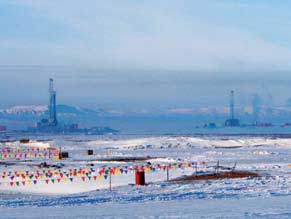 The rural Unita Basin in Utah has had some of the worst smog in the nation – in the middle of winter, with snow on the ground. That's not supposed to happen, but 10,000 gas wells, along with car and truck traffic combine to make it happen. A new $5 million study confirms that the smog-forming gas patch pollution is a major cause. "That seems to be a pretty strong link," said the study's main researcher.
Isn't the fact that there's that a smog problem in rural Utah where none existed before fracking began sufficient evidence of the link between fracking and smog to warrant cities already suffering smog problems like Dallas to take precautions before the open the door to fracking in the city limits?
The Perry-TCEQ Plan for Cleaner Air: More Coal
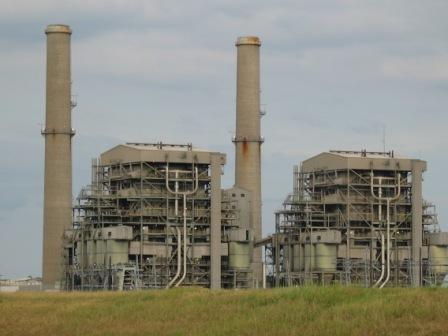 When it rains, it pours, or in this case, spews.
After getting a favorable ruling that struck down the EPA's flexible permit system last week, Team Perry seemingly scored another victory for its friends with Tuesday's ruling against the cross-state pollution rule.
Written by the Obama Administration to replace a similar Bush Administration rule that also got struck down by the courts (but is now back in at least partial effect…it hurts to think about this sometimes), the cross-state pollution rule was an attempt to federalize the problem of continental air pollution, much of it caused by big ol' dirty coal plants like the ones in East and Central Texas.
Texas can't regulate the coal plant pollution that wafts in from Illinois or Kentucky. Likewise, New York can't regulate Ohio facilities that send air pollution over its state lines. A federal solution covering all 50 states is required. Tuesday's ruling agreed, but concluded EPA hadn't given Texas and other states more time to come up with their own strategies to cut air pollution from coal plants. Maybe EPA was influenced by the fact that at the same time this strategy was being proposed, Governor Perry was rolling out plans to help streamline the permitting of 17 new coal plants in Texas.
Neither one of these rulings is as dreadful as it might seem at first. Both can be appealed. And both have mitigating circumstances that cushion the blow. With the flex permit case, all the facilities in Texas got standard operating permits eventually, making the ruling on the flex program itself moot. With the cross-state pollution rules, the Obama EPA itself said that two-thirds of all the health benefits from the rules had already been achieved with the partial implementation of the Bush rules they were meant to replace.
However, the cross state rules were not only supposed to be good in their own right, they also are the underpinning for a couple of other national pollution initiatives, including helping communities meet the new Ozone standard of 75 parts per billion, and the new, lower Particulate Matter pollution standard. Without the rules, these standards will be harder to achieve. And guess who's own plans begin to get mucked up by that failure? You guessed it, the state of Texas.
Because in the case of DFW's chronic smog problem, the Texas Commission on Environmental Quality had already factored compliance with the rule into its already obsolete 2012 clean air plan for the Metromess. That was one of the reasons we were going to see the lowest ozone levels ever recorded in DFW this summer. Without that backstop, it's going to be hard not only to just meet the old 1997 ozone standard of 85 ppb – something DFW has yet to do despite two official tries now over the last seven years – it's going to be hard to meet the much lower standard of 75 ppb.
If you've seen the TCEQ propaganda of the last couple of years, it touts how much pollution totals in Texas have decreased. The Commission uses these numbers to then promote the Perry Team philosophy of limited government intervention, suggesting that it's the TCEQ and Perry responsible for those declines. They are not. For the most part, what the state is touting are the results of federal programs that have decreased pollution systematically across the country – everything from new fuel and pollution standards for cars and trucks, to new federal standards for specific industries, like refineries and chemical plants. Throw in the things that federal citizen suits and pressure got done despite TCEQ – think cement plant pollution reduction in DFW for example – and you have most, if not all of the things reducing pollution in Texas that TCEQ is claiming credit for.
Without the cross state pollution rules, the oldest and dirtiest coal plants in Texas will continue to operate for the foreseeable future. And when the wind blows, some of their pollution will be breathed-in by DFW residents. In the short term, this is Team Perry's trophy for all you hard-working Texas residents – more crap in your lungs.
If the state keeps clearing away all the federal programs that have actually reduced pollution over the last 20-30 years, those total pollution numbers won't be going down much longer. They'll be holding even and then going up. Left to their own devices, Team Perry would have us living in a polluter's Pottersville. And then who will the Governor blame?
Industry’s Man in the White House
 Not very many citizens realize the process that proposed environmental regulations have to go through in any administration in order to get out and published in he Federal Register in one piece. Not only does the regulation have to pass through the EPA's own cost-benefit analysis and survive various Congressional and court challenges, it must also pass through a murkier and more subjective test administered by the Office of Management and Budget, or OMB.
OMB is the very last stop an environmental regulation makes. There are no environmental scientists at OMB to judge the necessity of the regulation. No, OMB's job is to make sure the regulation doesn't hurt industry too much. That may seem like a worthwhile goal, but without any kind of strict guidelines for how to judge that, the conclusion is often open to a lot of interpretation. Industry knows that OMB is its last shot at stopping a regulation that otherwise has broad support form the public and even EPA. Among the non-profit environmental activists in DC, OMB is known as the place regulation go to die.
That's how last year's decision to leave the new ozone standard at 75 parts per billion, rather than the 70 ppb that EPA scientists had advocated – got done. Same thing for a weaker Particulate Matter standard this year. And we can't prove it yet, but we bet OMB had something to do with the rollback in cement plant emission rules being proposed suddenly by EPA/.
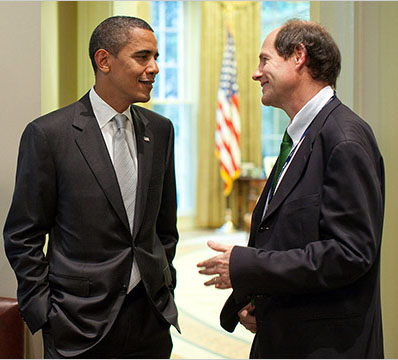
The face of the Obama Administration's OMB has been Cass Sunstein, head of the OMB's Office of Information and Regulatory Affairs (OIRA), a powerful department that holds sway over federal agency rulemakings. Having done his damage in the first Obama Administration, he recently announced he was leaving his job and returning to academia. But not before the DC publication "The Hill" got its hands on the e-mails Sunstein sent on behalf of the US Chamber of Commerce to get last year's ozone pollution standard weakened. In effect, he becomes a lobbyist on behalf of industry within the administration after industry has already lost the public health debate.
"The response to The Hill’s FOIA request shows Sunstein played an active role in alerting White House aides to business’s concerns about tightening the ozone standards. Internal communications show that ahead of the September decision, Sunstein circulated strong criticism of the ozone rule from a pair of powerful business groups, the National Association of Manufacturers (NAM) and the Business Roundtable, as well as House lawmakers opposing the tougher standards."
On July 15 of last year, Sunstein sent DeParle and two other aides a copy of a letter from the Business Roundtable to Daley, saying it was “worth reading.” The business group also released the letter publicly at the time.
On July 26, Sunstein sent a wider group of aides — including senior energy adviser Zichal and Phil Schiliro — a column titled “The Latest Job Killer From the EPA” that Business Roundtable President John Engler penned in The Wall Street Journal.
An un-redacted portion of the message from Sunstein states, “I am sure you saw this but just in case.
On Wednesday, Aug. 31, Sunstein forwarded several aides — including Stephanie Cutter, now a top Obama campaign official — an op-ed that NAM President and CEO Jay Timmons penned in The Hill attacking the ozone rule."
Wake-Up and Breathe the Air Quality Progress/ Update X2
 6:00 pm Update: Rockwell hasn't hit 125 ppb yet, but it's hovered in the "red" high teens for three hours according to the latest update from TCEQ, which only goes up to 4 pm. Frisco, Arlington Airport and the old Redbird Airport monitors still seem likely to have their fourth and so, official violation the 1997 ozone standard of no more than 85 ppb for an eight hour stretch.
3:30 pm Update: In the time it took to write this, Rockwall has seen its ozone levels rise to 119 parts per billion. The very old original ozone standard was 125 ppb over a one-hour period. That's considered not just a red alert day – that's getting deep purple. We already had one of those in Arlington in June. Rockwall is on its way.
Original Post:
DFW's luck with the wind has ended.
Breezes have slowed and pivoted to the East, carrying coal plant and natural gas mining pollution. At 11 am the Rockwall smog monitor was already at 91 parts per billion; the next hour it was 111 ppb. The new federal standard is 75 ppb. Now a broad front of five monitors are in the 90's, from Frisco to Arlington. Of those five, two are just one more "exceedance" of the old 1997 standard of 85 ppb – a standard that despite two clean air plans from Austin, DFW has never managed to meet. if they trip today, that would bring the total number of DFW monitors officially out of compliance with that '97 standard to five.
As late as last December, the Texas Commission on Environmental Quality was maintaining with a straight face that there would be NO MONITORS OUT OF COMPLIANCE WITH THE 1997 OZONE STANDARD. Whenever you'd point out that we just had the worst year for ozone since 2007, or that such a goal would require the lowest ozone levels ever recorded in DFW, TCEQ staff would shrug their shoulders and say, "That's what the computer model tells us," as if that was that. In their own way, TCEQ has become the technocratic equivalent of those who beleive in the inerrent word of the Bible. The Bible Says It, I Believe It, and That Settles It. Substitute the word "model" for "bible," and you have the philosophy driving the TCEQ response to DFW's chronic dirty air. 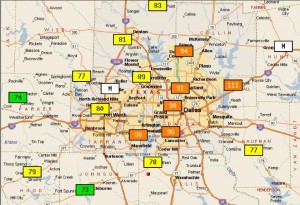
Of course, it matters what variables you put in that model, and how much weight you assign them, and how you run it. And if you're an extension of Rick Perry's permanent campaign machinery. In that case, the model has to say things will get better – because otherwise your critics would say the state needs EPA help to clean up the air; needs to not recommend new pollution control measures – because otherwise it would contradict your anti-government crusade; and needs to ignore the most potent source of new emissions in the last 20-30 years from what is historically the most powerful industry in Texas.
If you have all that going for you, well then why sure, every summer is a new chance to once again prove how the invisible hand of the marketplace can take care of everything. And if it doesn't? Well, it was the EPA's fault for interfering with the marketplace. You can never lose.
The biggest purveyor of junk science in Texas is TCEQ. It's become exactly what it criticizes. Local DFW governments say they are dependent on the agency to provide them with "expertise" they just can't afford. But what's the value of that expertise when: 1) It's always wrong, and, 2) TCEQ is acting directly against local interests by letting ideology trump good science?
In 2010, just one or two monitors were violating the 1997 standard. Last year it was seven. By the end of the day today it could be five. The smog is getting thicker, and TCEQ is playing with its inerrant models.
3rd DFW Ozone Monitor Officially Trips the 1997 Standard
 What were we saying about smog problems marching east with the gas drilling?
Yesterday's dirty air left the Dallas North site – south, and downwind of LBJ's mess – with its fourth exceedance of the 1997 85 parts per billion (ppb) ozone standard. That means it's an official violation of that standard since every monitor gets three strikes before being called out. It joins the Grapevine and Dallas Hinton Street monitors in violating a 15-year old standard that has been declared unprotective of human health and replaced with a tougher standard of 75 ppb. 16 of 20 DFW ozone monitors have already violated that new standard this year, but those don't start counting against us until around 2015-16 when it takes full effect. At the same time, violations of the '97 standard it replaced don't count either. So DFW remains in a kind of smoggy purgatory. This wil be the 21st year we won't be in compliance with the federal clean air smog standard.
Last Wednesday, fracking proponents on the Dallas City Council kept refering to the Texas Commission on Environmental Quality as if it was some kind of immutable final word on all things environmental. Alas, the TCEQ is not infallible. With DFW air quality, it's never even been right. TCEQ's 2012 clean air plan for DFW was supposed to give us historically clean air with NO VIOLATIONS of the 1997 ozone standard. Now we've had three with another two months of ozone season left.
For the record, in 2010 we had one monitor with four violations of the '97 standard. That was as close as we've come to complying with it. Last year we had seven. This year we have three and still counting. Despite all of these violations contradicting the state's predictions, TCEQ still insists in calling this air quality progress. It's not. It's continued non-compliance with an old standard that most of the rest of the country already meets.
Nation’s Only Public Hearing on Roll Back of Cement Plant Rules Scheduled for Aug 16th in DFW
 Environmentalists are angry at EPA for giving the public less than two weeks notice prior to the nation's only hearing on a rollback of new air pollution rules for cement plants that the agency says could save thousands of lives annually, including many in DFW.
One of those who came in 2009, and vowed to show up again on the 16th was Ft. Worth resident Margaret DeMoss, who was instrumental in getting her city to adopt a "green cement" policy to reduce pollution from obsolete Midlothian cement kilns in southern DFW.
She also noted that in 2009, when the rules were being proposed, there were three national hearings coast to coast. Now that the rules are being weakened, there's only one.
"It's outrageous that the EPA would schedule this hearing at the last minute and in only one location in the nation; lot of other regions suffer downwind from cement kilns. Who will speak for them?"
Downwinders at Risk and other community groups repeatedly sued to get them enforced. That effort resulted in 2010 emission rules that were hailed as the largest single advance in air quality for the US cement industry, and were universally supported by citizens living near and around the nation's cement plants.
They had already passed all necessary regulatory review, just overcome their last legal hurdle, and were on their way to President Obama for his signature and implementation by 2013 when they got yanked by the administration's Office of Management and Budget earlier this year.
When the rules re-emerged, their enforcement was pushed back to 2015 and their strict Particulate Matter pollution provisions were considerably weakened.
According to EPA's own health impact studies for the rules, that two-year delay will cause at least 2000-5000 premature deaths nationwide.
Despite a halt in the burning of hazardous wastes at local cement plants in 2010, MIdlothian remains the home of the largest concentration of cement manufacturing in the entire U.S.
Three large cement plants – TXI, Holcim, and Ash Grove – are still the largest point sources of air pollution in North Texas, generating thousands of tons of air pollution.
Since DFW is downwind of Midlothian, Metroplex residents are exposed to more cement plant pollution than any other metropolitan area in the country, and represent a disproportional number of these 2-5000 annual deaths that EPA estimates will occur because of its rules delay.
"If these revisions are adopted, DFW residents will be paying a high price for the Administration's retreat," said Schermbeck. "That's why we must make our objections heard now."
He urged those that want to speak at the August 16th hearing to reserve a five-minute slot with EPA coordinator Pam Garrett by e-mailing her at garrett.pamela@epa.gov or calling (919) 541-7966