Smog
TCEQ Lets Industry Avoid $90 Million in Fines, Asks Drivers to Pick Up the Tab
 Here in DFW, we've paid the price of continuing dirty air for the state's bias toward blaming all air quality problems in DFW on cars. As cars got so much cleaner, all of our smog problems were supposed to literally go "poof." This was almost the entire basis of the just-failed TCEQ clean air plan, and it didn't work. Turns out, there might be more causing our smog problems than just cars.
Nevertheless, the bias persists because the ideological slant of the TCEQ's boss, Governor Perry, won't allow it to pursue a more balanced approach. Via the Houston Chronicle comes the latest way it's getting expressed in bad public policy – by letting pollution control measures be paid off by fees on individual drivers instead of fines assessed against large polluters that are targeted specifically for that purpose.
"The Texas Commission on Environmental Quality is asking the federal government for permission to waive fines for the region's 260 chemical plants, oil refineries and other large facilities.
The commission argues that it should not have to collect those fines because it already is raising money for smog-fighting programs through vehicle inspection fees and sales taxes for diesel equipment, among other revenue sources.
For years, the fees and taxes have funded a program that helps cover the cost of replacing or retrofitting dirty, old vehicles and equipment, such as locomotives, haul trucks and tugboats. The program has helped to improve air quality in the state's smoggiest cities."
The cover story for doing this is that the Commission would much rather the fine money be spent on actual pollution controls at the offending facilities – though there is nothing, especially the TCEQ, to make them do so – and that consumers would just pay the price down the line. We don't know what's more insulting – the incredibly thin and flimsy veneer of these excuses, or that the TCEQ expects any one to believe this clap-trap, which comes right out of our failed Governor's presidential campaign. What ever happened to getting tough on crime?
As for industry, well, it's just downright unfair Houston industry has to pay any fines at all for being out of compliance with a Carter-era ozone standard! Those that have seen the slides of Houston air pollution blowing into DFW will be particularly bedazzled by this plea from a corporate attorney,
"Jed Anderson, a Houston-based attorney who represents industry in regulatory matters, said the commission's proposal is a fairer distribution of the burden because cars and trucks produce so much smog-forming emissions. Even then, he said Houston should not have to pay at all, saying the amount of pollution that blows into Texas from other countries is enough to push the region out of compliance for ozone."
Funny, that's what TCEQ and their DFW local flunkies say about y'all. In fact, at the turn of the current century, DFW tried to get a pass for violating the ozone standard because, if you didn't count the stuff coming in from Space City, we would have, you know, theoretically been able to meet it.
Sorry Mr. Joe and Joann Six-Pack, but if you drive an inspected car that gets 70-90% pollution removal and deposits a thousand or so pounds of air pollution a year, you're not a constituent of TCEQ, you're the enemy.
On the other hand, if you operate a facility that not only pollutes the air with millions of pounds of pollution because you won't install the best equipment, but has also been breaking the law, "Right this way, Monsieur." Environmental Defense Fund's Dr. Elena Craft says in the Chronicle piece, "The commission is basically doing everything it can not to collect fines from industry" – and everything in its power to once again put the onus on drivers.
The Environmental Agenda of a Second-Term Obama Administration
 Yeah, we don't know what it is either. We suspect not even Lisa Jackson knows. But of course, that doesn't keep the chattering class from speculating about what will or won't happen in the next four years on the energy and environment front. So without further ado….
Here's a pretty banal piece from the Hearst Chain that includes the premise the president is free "to approve natural gas exports and the controversial Keystone XL pipeline without fear of alienating environmentalists he needed at the ballot box."
Ah, but here's a piece from USA Today that quotes heavily from Romney supporters in industry to suggest the president will reject the pipeline and propose a slew of anti-oil and gas regulations.
Then there's this much longer and better Bloomberg piece that actually focuses on EPA rules already in the, er, pipeline, such as new lower Particulate Matter ambient air standards, the possibility of the lower ozone standard Jackson was originally going to propose before she got mugged by the White House re-election campaign, and new greenhouse gases limits for power plants.
It also mentions the possibility – brought up by industry lobbyist and Dallas native Scott Segal, no less – of a carbon tax as part of a solution to the "fiscal cliff" now getting so much post-election coverage, and talks about whether Lisa Jackson is staying or going.
Liberal thinktankers at Think Progress just posted this article advocating the "Five Essential" environmental rules that should be the focus of Obama's second term.
Finally, not mentioned in any article so far, but on the minds of kilnheads across the country, is the fate of the inane proposed revisions in cement plant emissions rules that were the subject of an August EPA national hearing at the Arlington City Hall that many of you attended. A final decision on those is due by December.
TCEQ Can’t Handle the Truth Over DFW Air Plan Failure
 Here's further proof that Governor Perry has transformed the world's second-largest environmental agency into just another extension of his on-going political campaign.
After waiting for a couple of days for the Texas Commission on Environmental Quality to say something about the failure of its latest DFW clean air plan to reach a 1997 ozone standard by the end of this "ozone season," Downwinders put out a release on Monday criticizing the agency for leaving the air dirtier than when the plan was begun in 2010.
To succeed, the TCEQ plan had to bring smog numbers down at all DFW monitors to 84 parts per billion or below by the end of this last summer, using three-year rolling averages incorporating readings from 2011 and 2010. The agency blithely predicted it would do just that and even published computer-modeled estimates of what the averages would be at the end of 2012. According to TCEQ we were supposed to see record low ozone levels this summer. So low that there would be no violations of the 1997 ozone standard for the first time since it was implemented.
Although the official EPA regulatory deadline to judge the plan a success or failure is June 15th, 2013, it's fate has already been decided by the data collected the three previous summers. That's important to know. TCEQ doesn't get another summer to prove that it's brilliant plan to sit back and watch people buy cars will work somehow, someway. The Clean Air Act only allows them three years to get their act together per plan. The clock started ticking in 2010. It stopped ticking on November 1, 2012, at the traditional end of DFW's ozone season. That was the practical deadline. All that's left to do is type up the report to EPA and submit it come June 15th of next year. They've run of of time.
But unless you've gone through this process before, or had been following the plan closely, you wouldn't necessarily know this. That was the case with Andrew McLemore, a reporter for the Fort Worth Weekly, who'd been assigned to follow up on the Downwinders release and e-mail the TCEQ for a response.
 What TCEQ spokesperson Lisa Wheeler said to McLemore was that of course the agency never claimed to be able to meet the goal by 2012. We said we'd do it by June of 2013 – the regulatory deadline. Ohhhhh.
This is a great answer for a term paper that's late, but not so much when there's no more summers between now and June of next year to use in your clean air plan. Ozone data for November to June isn't going to do you any good because (unless global warming really accelerates) that's not the time of year we see high ozone numbers. And the plan has to use the highest of the high numbers. Telling McLemore that everyone had to wait until June to know the final results of the DFW air plan was like telling him to wait for the cake to cool for eight months after its' already been taken out of the oven. The thing is done. It's not getting any bigger, or sweeter-tasting, or rounder. It's not changing character or content. It is what it is right now.
TCEQ knows this. Lisa Wheeler knows that there will be no new numbers to add or subtract from that will make any difference. There will be no 2013 average that they can use to change the results from what they are at this moment. It's all already been determined by this summer's miserable showing, and the miserable showing before that in 2011. That's what makes this answer of theirs so incredibly cynical.
Wheeler apparently wanted to confuse McLemore, in essence saying, "Gee we really didn't fail yet – you have to wait until next June to conclude that. We still have time to change the outcome! " But because the data won't change, the results won't change either.
Don't take our word for it. TCEQ has a whole web page devoted to chronicling the proof that the DFW air plan has already failed – http://www.tceq.state.tx.us/cgi-bin/compliance/monops/8hr_attainment.pl
You'll notice this page, titled "Compliance with Eight-Hour Ozone Standard" has only three columns of data, one for 2010, one for 2011, and one for 2012. No column for 2013. You'll also notice that at the end of that three year cycle, there are two sites with running average that are at or above 85 ppb. The results are in. TCEQ's second clean air plan for DFW to reach the old 1997 standard in the last four years has failed. TCEQ just can't man-up and say so.
Not only has it failed. It's actually left DFW air dirtier than when it began. Here's why:
– Two monitors now have a three year running average (design value) of 85ppb or more. This is the same number as 2010, so no change at all on that front.
– The three year average for the region's highest reading actually went up 1 ppb from 2010 (86 ppb), to 2012 (87 ppb), with a spike of 90 ppb last year. Worse than 2010.
– Six monitors saw a violation of the 85 standard this summer by posting a 4th highest reading that was 85 ppb or above. Only one monitor did that in 2010. 2012 is five times worse than 2010 by this measuring stick.
– The location of those violating monitors is of concern because they moved further east from the northwestern corner of Tarrant County where they'd been "contained" – all the way into central Dallas, where the "Hinton St. monitor" near Mockingbird and I-35 recorded a 4th highest reading of 85 ppb or above for the first time since 2005. Also proof things have gotten worse, not better.
So the latest TCEQ DFW clean air plan achieved the following: More numerous and geographically-dispersed violations, with an increase in average levels of air pollution that takes it further away from the 84 it needs to achieve, instead of bringing it closer.
Heckava job.
To fully appreciate the agency's mendacity in its public approach to this failure, all you have to do is ask yourself how TCEQ would have reacted had it somehow achieved the miraculous decrease in air pollution its clean air plan promised. Go look at the front page of the TCEQ website. It has almost as many diatribes against the EPA as it does real environmental policy news, including opinion pieces written by TCEQ Commissioners. Do you think the agency would have waited until June 15th, 2013 to trumpet its success just because of a meaningless, bureaucratic deadline? Neither do we.
The TCEQ is never going to be a trustworthy source of information or expertise in the fight against DFW smog again while Governor Perry is in office. The sooner local officials wise-up and chart their own path, the better.
2nd TCEQ Clean Air Plan in Four Years Fails, Leaves Air Dirtier
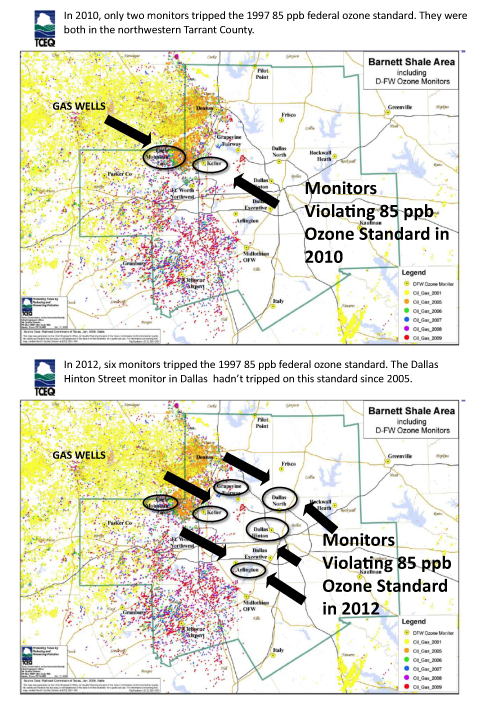 For the second time in four years a state-designed clean air plan to bring safe and legal air to DFW residents has failed, missing its goal by an even wider margin than on its first try, and leaving local air quality worse than when it started.
November 1st marked the official end of the eight-month 2012 ozone season. According to the Texas Commission on Environmental Quality, or TCEQ, its plan was supposed to deliver record-breaking clean air to DFW this summer on its way to bringing the region into compliance with the Clean Air Act for the first time in two decades.
Shocking Study: Air Pollution Regulations Improve Public Health
 One of the most basic arguments of industry opponents of clean air regulations is that they really don't do that much to improve public health. Given all the studies concluding that increases in air pollution lead to increases in illness and death, this argument is every bit as plausible as denying global warming at this point. But that doesn't stop industry and their supporters in elected office quit trying.
Out of New York and via the Journal of Exposure Science and Environmental Epidemiology comes a three year study (2004-2006) that tracks decreases in ozone pollution to increases in public health, specifically fewer hospital admissions for respiratory problems. Overall, a decrease of about 9% in ozone pollution lead to an 11% decrease in hospitalizations. That's significant, bordering on one-to-one percentage point drop.
The study followed the progress of the EPA's NOx Budget Trading Program (BTP), a cap and trade system established for East Coat states to help them reduce their ozone, or smog pollution, that ran from 2004 to 2008, when it was replaced by the older, Bush-era version of the EPA's cross-stare pollution rules. It looked at all of New York in terms of eight regions throughout the state. Drops in smog averaged 9% but were substantially lower during the critical summer "ozone season."
According to the folks at the Environmental Health News:
"Regulations do work to lower pollution, which in turn can improve respiratory health.
Ozone levels decreased across the state of New York and hospital admissions for respiratory disease dipped in half of the regions studied after the EPA's regulatory program started. There were also notable decreases in hospital admissions for certain respiratory illnesses, most age groups and most health insurance groups.
The reduced admissions for those on public assistance suggests that low income residents may have benefited the most from air quality improvements. This would be an important achievement since this group often experiences the highest air pollution exposures.
These results are consistent with the limited number of other studies that compare pollution levels and health before and after required air pollution reductions."
It says more about the opposition to new regulations that we still have to have studies proving that less crap in the air means less illness and death. This has been a settled scientific fact for some time. But Industry pays big money for it to be a still-disputed political fact.
GAO: Fracking is Overwhelming EPA, Has Many Unknown Risks
 GAO stands for Government Accountability Office. We bet you didn't think there was such a thing.
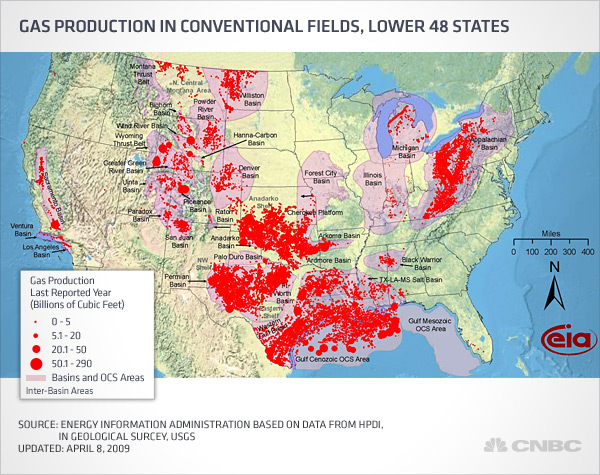
The GAO is in business to issue reports on how government works and doesn't work. It's the audit and investigative arm of the Congress. Today comes news that the Office has issued two new reports on fracking – one on how federal regulators are coping with the new responsibility of overseeing so much new drilling in so many new places all at once, and one on the possible risks posed by fracking to the public health and the environment.
GAO says fracking is overwhelming the resources of the federal agencies assigned to watchdog the process and industry:
"Federal and state agencies reported several challenges in regulating oil and gas development from unconventional reservoirs. EPA officials reported that conducting inspection and enforcement activities and having limited legal authorities are challenges. For example, conducting inspection and enforcement activities is challenging due to limited information, such as data on groundwater quality prior to drilling. EPA officials also said that the exclusion of exploration and production waste from hazardous waste regulations under RCRA significantly limits EPA’s role in regulating these wastes. In addition, BLM and state officials reported that hiring and retaining staff and educating the public are challenges. For example, officials from several states and BLM said that retaining employees is difficult because qualified staff are frequently offered more money for private sector positions within the oil and gas industry."
And the GAO says there are a lot of unknown risks to fracking based on the evidence so far:
Oil and gas development, whether conventional or shale oil and gas, pose inherent environmental and public health risks, but the extent of these risks associated with shale oil and gas development is unknown, in part, because the studies GAO reviewed do not generally take into account the potential long-term, cumulative effects. For example, according to a number of studies and publications GAO reviewed, shale oil and gas development poses risks to air quality, generally as the result of (1) engine exhaust from increased truck traffic, (2) emissions from diesel-powered pumps used to power equipment, (3) gas that is flared (burned) or vented (released directly into the atmosphere) for operational reasons, and (4) unintentional emissions of pollutants from faulty equipment or impoundments–temporary storage areas. Similarly, a number of studies and publications GAO reviewed indicate that shale oil and gas development poses risks to water quality from contamination of surface water and groundwater as a result of erosion from ground disturbances, spills and releases of chemicals and other fluids, or underground migration of gases and chemicals. For example, tanks storing toxic chemicals or hoses and pipes used to convey wastes to the tanks could leak, or impoundments containing wastes could overflow as a result of extensive rainfall. According to the New York Department of Environmental Conservation's 2011 Supplemental Generic Environmental Impact Statement, spilled, leaked, or released chemicals or wastes could flow to a surface water body or infiltrate the ground, reaching and contaminating subsurface soils and aquifers. In addition, shale oil and gas development poses a risk to land resources and wildlife habitat as a result of constructing, operating, and maintaining the infrastructure necessary to develop oil and gas; using toxic chemicals; and injecting fluids underground. However, the extent of these risks is unknown. Further, the extent and severity of environmental and public health risks identified in the studies and publications GAO reviewed may vary significantly across shale basins and also within basins because of location- and process-specific factors, including the location and rate of development; geological characteristics, such as permeability, thickness, and porosity of the formations; climatic conditions; business practices; and regulatory and enforcement activities."
So now we have the Director of the US Centers for Disease Control's Environmental Health agency saying that, "We do not have enough information to say with certainty whether shale gas drilling poses a threat to public health," along with the GAO saying the extent of the risks posed by fracking to our air, water, and land are largely unknown. How many more red flags do you need?
Even a Few Weeks of Cleaner Air Can Make A Big Difference
 We can't tell you how many times a resident from DFW will go on a business trip or vacation to a less-polluted place and report an almost instant shedding of the ill effects of dirty air, only to have an almost equally fast re-acquaintance with those effects once they return. Could air pollution really make that much of a difference in so little a period of time?
As it turns out, yes.
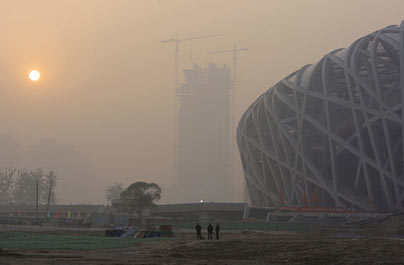
Via an new study recently published in the Journal of the American Medical Association, researchers found that the Chinese government's decision to close down Beijing's polluting factories and take cars off the road during the 2008 Olympics resulted in a remarkable short-term improvement in cardiovascular health. It's the first major study to look at the immediate effects of air pollution in young healthy adults.
In a synopsis published by Environmental Health News, one of the authors describes the study and its importance:
"For the 5-month study from June to November, the researchers recruited 125 resident doctors with an average age of 24 from a centrally located hospital. Half were male, and all were healthy with no history of diabetes or cardiovascular disease.
The researchers measured heart rate, blood pressure and six markers of cardiovascular diseases in blood samples before, during and after the games. The markers included C-reactive protein (CRP), fibrinogen, von Willebrand factor, soluble CD40 ligand, soluble P-selectin concentrations and white blood cell count (WBC).
Two markers associated with blood clotting significantly decreased from pre-Olympic to the during-Olympic period: P-selectin levels dropped by 34 percent and von Willebrand factor levels were reduced by 13 percent. After the games, when the pollution control measures were removed, most markers rose back to pregame levels. But two markers – P-selectin and systolic blood pressure – worsened and showed a significant increase compared to the levels during the games.
Air pollution emissions were also measured at similar times. Levels of most air pollutants during the games decreased up to 60 percent compared to their pregame levels, depending on the type of pollutants. For example PM2.5 dropped 27 percent, nitrogen dioxide 43 percent and sulphur dioxide 60 percent. After the games when pollution controls were removed, emissions rose to higher levels than were measured before the games started.
This study suggests that even young healthy people can benefit from short-term air pollution reduction and supports efforts to quantify and understand the benefits and costs of air pollution control measures."
The next time a politician complains about the cost of air pollution controls, make sure and ask them if they're for preventative heart disease treatment. When they say yes, please remind them that keeping crap out of our air that would otherwise end up in our lungs is such preventative care.
Study: Green Spaces Make Pregnancy Easier
 Coming under "Confirming Things You Probably Already Knew," is this study via the folks at Environmental Health News:
"Living in homes surrounded by grass and trees can reduce pregnant women's exposures to traffic-related air pollution, according to a study in Barcelona, Spain. As green space around their homes increased, their exposure to fine particles and nitric oxides decreased. Particles and gases in vehicle exhaust can affect the development and health of fetuses, so this study suggests that green space in urban neighborhoods has a health benefit."
Over the last five years, study after study has provided proof that living near roadways increases your likelihood of having respiratory problems and other health problems. And yet, just like the regulations surrounding lead smelting or waste-burning haven't caught up to the most recent science, so traditional highway risk assessments don't yet acknowledge most of this new scholarship.
The design of the CF Hawn/SM Wright freeway redo that will help shape South Dallas for a generation or more is in its final stages of planning. There may be as little as 2-4 months until approval will be given by the Federal Highway Administration to proceed with a 6-lane thoroughfare instead of a more community-friendly four land boulevard that residents have voiced support for time and again.
Now is the time to call attention to a factor that may not have been examined very thoroughly, if at all, by TXDOT or local officials in designing the redo – before another wrong is inflicted on South Dallas by the city.
The High Cost of Fracking
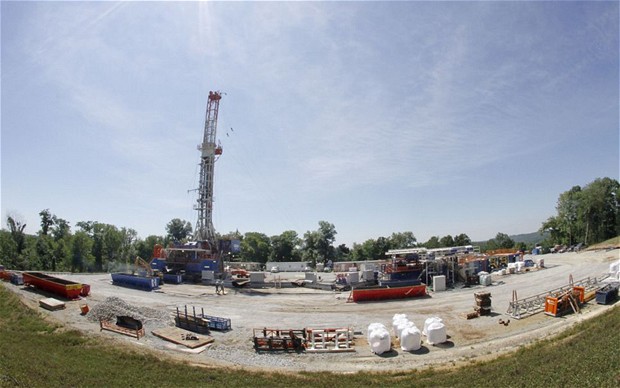 Yesterday, Environment Texas released a new compilation report in Dallas, titled, "The Costs of Fracking." There's not a lot of new information, but it does serve as a convenient catalog of the disadvantages of inviting the gas industry to town, as the Dallas City Council is considering via a new gas drilling ordinance. Every city council member should take a look, although we doubt they will.
The report covers the impact of fracking on public health, water, air, as well as the infrastructure demands of the gas industry. Among the tidbits:
"The truck traffic needed to deliver water to a single fracking well causes as much damage to local roads as nearly 3.5 million car trips. The state of Texas has approved $40 million in funding for road repairs in the Barnett Shale region, while Pennsylvania estimated in 2010 that $265 million would be needed to repair damaged roads in the Marcellus Shale region."
Fracking can affect the value of nearby homes. A 2010 study in Texas concluded that houses valued at more than $250,000 and within 1,000 feet of a well site saw their values decrease by 3 to 14 percent.
The average public health costs of air pollution from fracking operations in Texas’ Barnett Shale region reach $270,000 per day during the summer smog season.
Here's the press release. Here's the report.
Imagine That: Local Regulation of Polluters
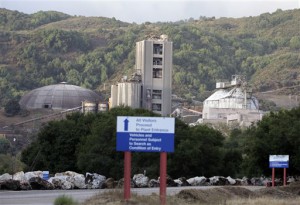 From San Francisco comes word that the area's largest Mercury polluter, the local Lehigh-Heidelberg Cement plant, may be the subject of tougher LOCAL air pollution regulations.
In 2011, the kiln spewed 260 pounds of Mercury into the local airshed and new regulations being proposed for the plant by the Bay Area Air Quality Management District would address not only this pollution, but emissions of dust, ammonia, dioxins, smog pollutants, and hydrocarbons.
In part, the new local rules are being spurred by EPA's own updating (and delaying) of its own air pollution rules for the nation's cement kilns. In part, local pressure from the public is driving their consideration. Bay Area for a Clean Environment collected over 1800 signatures demanding the new more stringent rules.
In California regional air boards are the prime shapers of air quality planning and policy, tailoring measures to their own geographical boundaries and problem areas. Imagine the 10-county DFW non-attainment area for smog (Collin, Dallas, Denton, Ellis, Johnson, Kaufman, Tarrant, Parker, Rockwall, Wise,) having its own air quality agency with the power to enforce new anti-pollution measures without having to get Governor Rick Perry's permission. Local control also means more opportunity for local citizens to have input rather than being blown off by ideologues in Austin intent on scoring political points rather than cleaning the air.
As we've noted before, if DFW officials really want cleaner air, they're going to have to get it themselves.