Posts by Downwinders At Risk
Groups Demand DFW Hearing on EPA’s Rollback of Cement Plant Rules
 In a letter sent Tuesday, ten grassroots and national groups from across the country, including Downwinders at Risk, joined together to call on EPA to schedule a public hearing in Dallas-Ft. Worth on its proposed rollback of cement plant emission rules.
In publishing the revised rules in the Federal Register last week, EPA proposed only one public hearing be held on August 2nd in North Carolina, where there is not a single operating cement plant, although the proposed new giant Titan cement plant is trying to win permit approval to operate near Cape Fear.
Downwinders was joined by Montanans Against Toxic Burning out of Bozeman; Montana Environmental Information Center in Helena; Selkirk, Coeymans, Ravena Against Pollution (SCRAP) in upstate New York; California Communities Against Toxics, based in Rosamond, the Stop Titan Action Network, Penderwatch and Conservancy, Cafe Fear River Watch, and North Carolina Coastal Federation, all from the Tarheel state, as well as Earthjustice, the DC-based legal defense team that has partnered with Downwinders and many of the other groups for 20 years in trying to get these new rules implemented.
In 2009, DFW was one of three metropolitan areas that hosted public hearings on the then-proposed rules, referred to as National Emission Standards for Hazardous Air Pollutants, or NESHAP. Over 200 people attended at the impossible-to-get-to DFW Airport Hotel and almost 100 testified – more than participated in the DC and LA hearings combined. All but five testified in favor of strong EPA regulation of cement plant emissions.
DFW is also downwind of the nation's largest concentration of cement plant manufacturing capacity, with three large plants and a total of six kilns operating today in Midlothian, in Ellis County.
EPA's changes to the rules, which include moving the compliance deadline from 2013 to 2015, as well as loosening the Particulate Matter standards and eliminating real time monitoring of PM pollution, were proposed just as the rules were about to be finalized and signed into law. No one at EPA can explain exactly why. No judge asked them to. The public didn't demand it. The Administration seems to be going out of its way to find favor with the cement industry even as the EPA is still carrying on a massive national enforcement initiative against it.
If you haven't done so already, please click here and send your comments opposing the changes in the cement plant emission rules. You only have until August 17th.
The full text of the groups' letter:
We, the undersigned groups, respectfully request that the Environmental Protection Agency hold a public hearing in Dallas, TX on its recently re-proposed NESHAP rule for Portland cement kilns. We request that this hearing be held in addition to the hearing scheduled at the Research Triangle Park facility in North Carolina.
There are no cement plants operating in North Carolina. It is incredibly important for the EPA to hold at least one public hearing in a location that is directly impacted by the toxic air pollution that this NESHAP rule addresses. Dallas is an appropriate additional hearing location for numerous reasons. First, there are multiple cement plants in the vicinity. Second, there is a precedent for public hearings on this rule in the region— on June 17, 2009, the EPA held a productive public hearing in Dallas on the Portland cement NESHAP. Third, Dallas's central location is more convenient for other impacted citizens from across the country who wish to travel to provide testimony.
We have worked for more than a decade to secure strong protections against the emissions of mercury, arsenic and other toxic air pollutants that cement plants emit. We would appreciate the opportunity to continue our involvement on this important issue at an additional public hearing in Dallas.
Smog Update: On the Brink
 Strong winds are usually among the most efficient smog-stoppers DFW has. Despite this last week's record-setting heat wave, ozone levels didn't go crazy like they did in June because the winds kept blowing. Only the Rockwall monitor recorded an "exceedance" of the 1997 85 parts per billion ozone standard on Saturday, it's first of the season.
That makes 17 out of 20 DFW monitors that have at least one such exceedance of the 85 ppb standard. 11 of 20 have at least two. 7 out of 20 have at least three. And 2 out of 20 already have the four exceedances they need to be registered as a violation of the standard (a "non-attainment area" ozone monitor gets three strikes before the fourth-highest reading gets counted against it).
That means we're just one bad air day away from seeing five more monitors record their fourth exceedance and become violators. Two bad days away from having nine – and August is traditionally much worse for ozone than July.
In 2010, there were two monitors in violation of the 85 ppb standard. Last year there were seven. Industry and state government have been trying to tell the public DFW is still making air quality progress despite these numbers – that last year was just an anomaly because of the drought. Not sure how they'll spin another year of seven or more monitors out of whack with a 15-year old smog standard
Let's remind everyone again that according to Governor Perry's three TCEQ Commissioners, there were going to be no violations of the 85 ppb standard this year, that this is the second state plan in a row to fail to meet the 85 ppb standard, and that the new EPA smog standard is 75 ppb. Heck of a job TCEQ.
Four Years Later, State Gets Around to Issuing Clean Air Plan for Exide That Won’t Apply
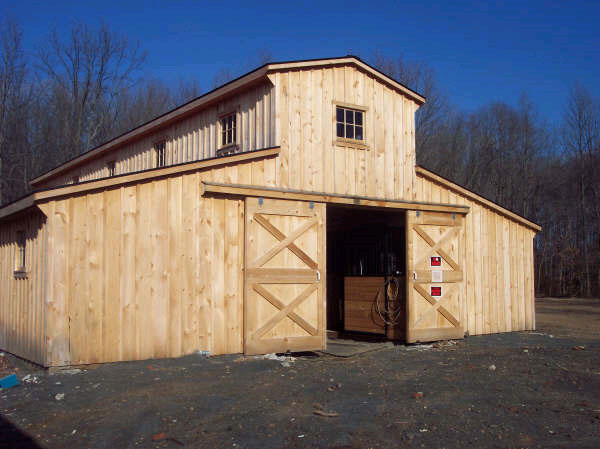
In 2008, the EPA issued a new lead-in-air standard for all U.S. lead smelters.
In 2011, the Texas Commission on Environmental Quality finaly submitted its first proposed plan to meet that new standard in Frisco, Texas, host of the Exide lead smelter. It was rejected as inadequate by EPA on the same day it was submitted.
In May of 2012, the City of Frisco and Exide reached a settlement that commits the company to ceasing the operation of its Frisco smelter on December 31st, 2012.
Last week, the Texas Commission On Environmental Quality released its second plan to meet the 2008 EPA lead-in-air standard at the Exide smelter in Frisco. Its effective date is December 31st, 2014, or two years after Exide will have closed per its agreement with the City of Frisco.
The plan and the accompanying Agreed Order doesn't incude any fines or enforcement measures that address the dozens of violations detailed by TCEQ inspectors at the Exide smelter just last year. Nor does it address the closure and adequate clean-up of the smelter once operations cease.
Between 2008 and the end of this year, Exide will have released an estimated 14,000-16,000 pounds of lead into the air in Frisco.
If you're thinking that this TCEQ planning document is irrelevant, you'd be pretty close to summarizing not only this episode, but decades of state oversight. And yes, this is why it's important to have citizens suing Exide themselves to enforce the law rather than Waiting for Godot TCEQ.
Another Day, Another White House Retreat on Clean Air
 In an election year, apparently no environmental initiative is safe from the Obama White House.
You may have missed this because it was one of those late Friday government announcments that officials like to use to bury bad news, but the EPA is going to consider softening those much-ballyhooed coal plant Mercury emissions rules that it fought so hard to get only last year. And because "consider" in this case means "we're going to do it," you can add these rules to the growing list of those clean air efforts in this supposedly environmentally-friendly administration that have bitten the dust because of political interfernce.
One of the reasons this rule is being rewritten is to satisfy the less-than-state-of-the-art White Stallion coal and pet coke-fired power plant being proposed for Matgorda Bay, whose owners have campaigned against the new rules since Day One. They say the rules are too strict and can't be met, despite being based on the track record of top performers in the utility industry. You will be unsurprised to learn that the Texas Commission on Environmental Quality is a co-facilitator in that campaign, up to the point of being so enthusiastic in its unquestioned support that it had to be ordered by a state judge to reconsider the first air permit it gave the plant because of the lack of any public participation.
White Stallion is going to be built less than 20 miles from the boundary of the eight-county Houston "non-attainment area" for ozone, or smog. Regulations on new sources of industrail pollution are tighter inside such areas than outside. That's pretty much all you need to know about the owner's commitment to using best technology. It's the same problem DFW used to face with the Midlothian cement plants and Ellis County until Donwiwnders petitioned, and EPA agreed, to include them in the North Texas non-attainment area.
Anything that makes it harder for Houston to meet clean air standards, also makes it harder for DFW to do the same. But this rollback is also a shame because of this administration's gap between promise and performance when it comes to critical upgrades in national polluiton standards – ozone, particulate matter, cement kilns and now coal plants. When push comes to shove, there seemingly isn't any polluter this White House won't do a favor for between now and November.
Low Birth Weight Pregnancies 25% More Likely Within 1.5 miles of Fracking
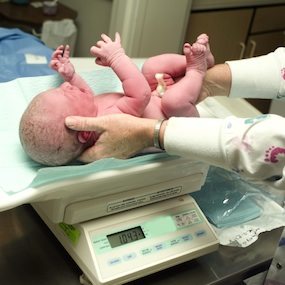 A mother's exposure to fracking increases the chance a a low weight birth by 25%, according to a new study by Elaine Hill, a doctoral candidate at Cornell University. Hill's research also found a 17% increase in "small for gestational age" births and reduced health scores among newborns whose moms lived close to fracking sites.
“Unconventional Natural Gas Development and Infant Health: Evidence from Pennsylvania” is the working title of the study, which has not yet been peer-reviewed or journal-published. Hill used data from 2010 and focused on those living up to 1.5 miles from gas development sites. Pennsylvania increased its unconventional natural gas wells from 20 in 2007 to 4,272 by the end of 2010.
Hill publicized her findings at a public hearing in New York state, which is considering new regulations for fracking. She decided to come forward now, rather than wait for up to two years for the review process to accredit her research because she believes her study has implications policy makers need to incorporate into those regulations.
“My study is robust across multiple specifications and it indicates that our future generation may be seriously harmed. I couldn’t possibly value my career over their well-being,” Hill said by email last Thursday.
We already have a Colorado School of Public health study released in March that shows a 66% higher chance of getting cancer if you live within a half mile of a fracking site. Hill's study is the first to track health effects up to a mile and a half away.
These reports are in addition to the hazard of earthquakes now officially linked to fracking waste injection wells by the US Geological Society, and the risk of getting silicosis from breathing in illegal levels of sand particles noted by industrial hygienists – both from earlier this year. All of this is new research that didn't exist before 2012. What other hazards are we ignorant of this year?
Just another reason why you should be at Dallas City Hall at 9 am on Wednesday, August 1st for the Thrilla on Marilla.
Rejected Smog Standard Would Have Saved 4100 Lives Annually – including DFW Residents
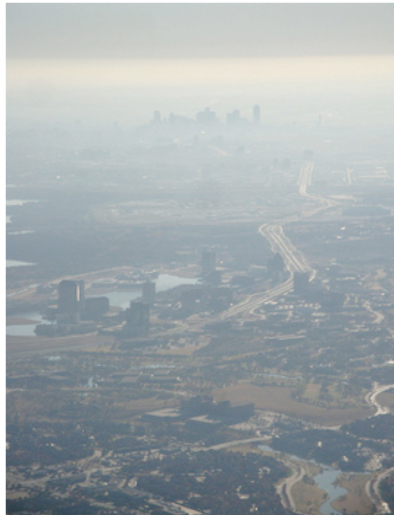 The EPA-proposed ozone/smog standard of 70 parts per billion the White House rejected at the last minute in 2011 would have saved almost twice as many lives per year over and above the Bush-era standard of 75 ppb that was eventually adopted, according to a new study by John Hopkins University scientists.
Most of those new leases on life would have come in large cities like New York, Chicago, and Los Angeles, where smog levels are historically high. But researcher say the standard would also have saved a significant number of DFW lives as well.
The lower standard was rejected by the Office of Management and Budget, and Executive Branch agency that has grown to have veto power over almost all EPA regulatory decisions based on their economic impact – a variable specifically excluded from consideration in the Clean Air Act.
The John Hopkins team also concluded that the lower 60 ppb standard that was in the lower range of what was recommended by EPA's own science advisory would have saved up to 8000 lives per year, compared with the 2500 annual lives estimated to be saved under the more lenient 75 ppb standard.
In addition to more lives saved, the study concluded that millions of asthma attacks and acute respiratory problems would be prevented with a lower ozone standard.
“We contend that a more stringent standard would prevent a substantial number of adverse health outcomes,” wrote the researchers, led by senior scientist Frank Curriero of the Johns Hopkins Bloomberg School of Public Health.
They calculated the reduced deaths by incorporating data from a variety of health studies around the country that have found that whenever ozone levels rise, deaths and hospitalizations from cardiovascular and respiratory problems rise, too.
There was also a warning that climate change would make higher ozone levels more likely, as seems to be in play this year with much of the country experiencing the kind of drought and heat Texas had last summer, and with national ozone level spiking.
EPA officials estimated that achieving the rejected 70 ppb standard would cost between $19 billion and $25 billion per year, including the estimated $8 billion for meeting the current standard set by the Bush administration in 2008. However, the agency estimated the health benefits would be worth $11 billion to $37 billion per year. Based on new evidence of medical costs associated with ozone pollution, that figure may have been very conservative.
The EPA's next review of the standard is supposed to begin in 2013. The Clean Air Act requires an evaluation every five years; Jackson, however, had planned to act early until Obama asked her to stop.
Meanwhile, DFW still can't meet the old 1997 85 ppb standard after three clean air plans in the last seven years. This year's fate is already sealed thanks to the June smog attack we had early on. Our worst monitors are averaging above 85 ppb and we haven't gotten to August – traditionally our worst month. Smog is taking its toll on our health in DFW, even if it doesn't make the nightly news.
State Farm Sending Letters To Johnson County Residents Offering Earthquake Insurance
 Following up on our follow-up….while no insurance companies offer homeowners protection against the hazards of fracking out right, State Farm seems to have figured out how to make money selling insurance for the symptoms of disposing of fracking waste. Buried deep inside this story on the recent wave of Johnson County earthquakes and their possible link to the County's numerous high-pressure injection wells for "fracking fluid" is the news that the Insurance giant sent out letters to Johnson County residents urging them to buy earthquake coverage.
If, as recently as five or six years ago, an enterprising insurance agent had tried to sell a Cleburne resident earthquake insurance, he would have been investigated for fraud. This is how fracking has changed North Texas.
New Study: Reducing Smog Brings More Health Benefits
 In the same Washington Post article on the monkey business surrounding the new PM pollution standard comes news of a new study that concludes cutting smog pollution could bring added health care benefits that haven't been accurately estimated in the past.
Researchers at the University of California at Santa Barbara and MIT examined data for five years between 2003 and 2008 from the 20 Eastern states and the District of Columbia where power plants and boilers are required to limit nitrogen oxide pollution between May 1 and Sept. 30 each year – in other words, "oozne season."
During this time, they found prescription drug expenditures dropped by 1.9 percent, or $900 million a year, and the states and DC had 2,200 fewer annual premature deaths among individuals aged 75 or older.
“This is now new evidence of the evidence of the health benefits of ozone reductions, which was not available when the president overturned the previous effort to revise the ozone standard,” said MIT economist Michael Greenstone, who has informed White House officials of his findings.
Imagine Our Surprise: PM Standard Weakened By White House
Confirming what a lot of observers had already suspected, the Washington Post reported on Wednesday that the White House submitted a new federal air standard for Particulate Matter air pollution this year that was higher than EPA originally proposed.
It's not the first time the Obama Administration has been accused of sacrificing science-based air quality standards for politics. Last year, the White House mugged EPA's Lisa Jackson with a last-minute decision to forgo tightening the Bush-era ozone/smog standard that she had already termed "legally indefensible."
Particulate Matter, or is the widespread and increasingly insidious pollutant that can be breathed-in and affect not only your respiratory system, but pass through the lung lining into the blood stream to also impact brain and heart function.
Based on a recommendation from its own panel of scientists, the Agency proposed a tightening of the PM standard from 15 to 12 micrograms per cubic meter of air. That recommendation then went to the Office of Management and Budget, which in the last 20 years has grown to have veto power over all EPA regulations. OMB directed the EPA to set the limit slightly higher, between 12 and 13 mg/m3. That doesn't sound like much of a change, but it could be the difference between areas like DFW getting a pass or having to adopt a plan to better control PM pollution.
Critics see the move as one more example of science taking a back seat to politics in the Obama White House when push comes to shove.
Kilnheads across the country just saw the same thing happen just last month with the EPA's proposed rollback of new cement plant emission rules that were 20 years in the making and on the verge of being implemented. However, that move is a stumper compared to the yanks that restrained the EPA on new ozone and PM rules – both national standards with widespread implications. Why is the EPA going out of its way at the last minute to bow to cement industry pressure when there don't appear to be nationwide political implications or impacts to these rules? We hope the Post can snoop around and get to the bottom of this reversal the same way it's reported on the retreats in ozone and PM.
Green Source Coverage of Dallas Drilling Fight
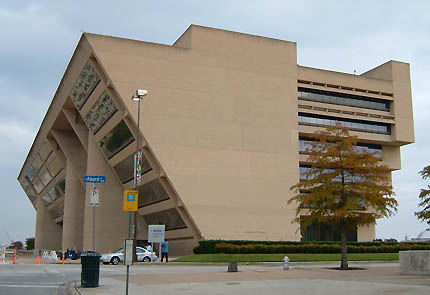 The folks over at Green Source continue to up their current events coverage of local environmental issues. This week it's a feature on the local "supergroup" of Dallas Residents at Risk, of which Downwinders is a proud member. DRR membership, whch also incudes the Dallas Sierra Club, Texas Campaign for the Environment, and the Mountian Creek Neighborhhood Alliance, has been instrumental in moving the fracking debate out of environmental circles and into Dallas neighborhoods. It's also set the agenda for the debate with its "five protections" proposal to improve the proposed new gas ordinance. This is going to be a close vote no matter what. Don't forget to be there at Dallas City Hall on August 1 for the next round.