air toxics
It Didn’t Come From Space: Frisco’s Purple Blobs and the Clean-up of Exide
 Via Frisco Unleaded member Eileen Canavan, comes this blast from the past that has implications for the scheduled clean-up of the Exide lead smelter.
On August 11th, 1979 the annual Perseid meteor shower was taking place over DFW. The very same night, Sybil Christian found three desk-phone-sized, two-pound purple blobs with the constancy of whipped cream in her front year, located in the "farming town" of Frisco. All three were warm to the touch and contained small chunks of metal. She was convinced they were space rocks.
Ms. Christian sprayed the blobs with a garden hose. One melted into the lawn. The other two were taken by Frisco police to the Heard National Space Museum and eventually to NASA. The further up the scientific food chain the samples went, the more it seemed as if there might be something to Ms. Christian's theory.
But an Assistant Director at the Ft. Worth Museum of Science and History wasn't buying it. He visited Frisco in the daytime and looked around to see what was near Ms. Christian's home. NASA had reported the the metal chunks found in Ms Christian's blobs were lead. So the scientific sleuth looked for possible sources of the metal. He found a large one – the GNB (now Exide) lead smelter about a mile and half away. "In the back" were tons of the same purple blob substance. It was a caustic soda used to clean the impurities out of lead from the millions of used batteries the plant was breaking open and mining for the metal. It was also learned that trucks carrying scrap iron went past the caustic soda dump and the Christian's house EVERY DAY. Case solved, according to the Museum Mythbuster.
But that was 1979, when lead waste falling off the back of a truck, instead of falling from space, in the small farming community of Frisco didn't strike people as being totally whacked.
At the bottom is Stewart Creek, on its way to Lake Lewisville, a source of drinking water for Dallas and other North Texas cities. The white stuff is contamination from the Exide lead smelter which is right behind the wall. This is an EPA inspection photo.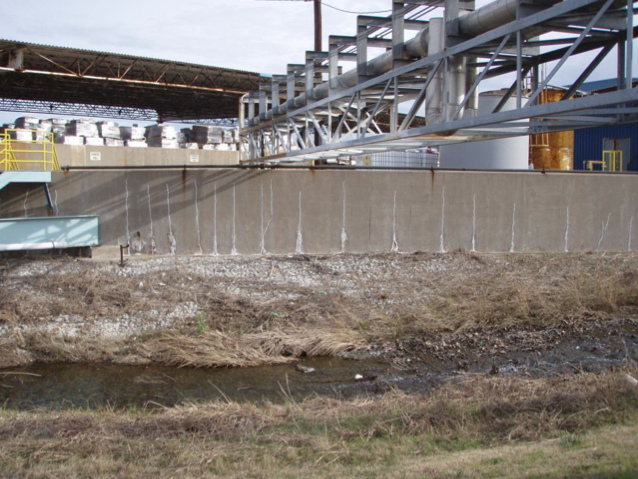
Everything agreed to by the City of Frisco and Exide as part of their historic settlement announced in late May concerns contamination in and around the smelter itself – either the physical structures or the acres of buffer zone the company tried to build around the smelter. Nothing is mentioned in the settlement about off-site contamination that decades of sloppy practices and misguided policy produced – the paving of Frisco city streets with lead. The use of lead as fill or soil additives in Frisco and Collin County. The dumping of lead waste in vacant lots. The routine spillage of lead waste along neighborhood streets.
Although it's a humorous incident, this 1979 story is also deeply disturbing. We'll never be able to fully know the extent of the toxic legacy left by the Frisco smelter because so little in the first two to three decades of operation was reported or noted. A spill here, a dumping ground there. Who will remember, or even be alive, some 30 years later to tell us what happened?
But that shouldn't be a license by the authorities or Exide to ignore tracking down the leads we do have and trying to minimize the surprises down the road. At this point there's no effort being made by EPA, the state of Texas, or the City of Frisco to chronicle the memories of old-timers and do archival searches to provide a better map of total contamination risks.
Moreover, with the Exide settlement, the City of Frisco has waived its right to have any say in how the worst part of the smelter is cleaned-up. It has agreed to not challenge any plans the Texas Commission on Environmental Quality will come up with for final disposition of the plant site, including just leaving everything in place and pouring some cement over it. Remember please that we got to this point in large part due to TCEQ not doing its job. Now the same people who created the problem are in charge of fixing it. Somehow, we don't think they have the local population's best interest at heart.
Who will be making sure the Exide clean-up is done well and right on behalf of the residents of Frisco?
The Petrochemical Circle of Smog
 Here's a piece by Texas Tribune off-shoot "State Impact" that more or less revels in the news that the Shale boom in Texas and elsewhere is now finally making its presence felt in the petrochemical capital of the world – the Houston Ship Channels and surrounding communities long the Gulf Coast. Fracking has made natural gas and its condensates so cheap and plentiful that billions are being spent to build new plastics manufacturing and processing plants. It's the "re-birth of the U.S. petro-chemical industry," to quote one producer.
Already the hub of something like 60% of all petrochemical capacity in the US, the Houston/Harris County area has an on-going historical struggle with air pollution. Residents who live near huge facilities like the Exxon-Mobil Baytown Refinery are always on guard against catastrophic accidents, much less the daily or weekly indignities of breathing its perfectly legal voluminous air pollution. Much of the pollution is not only toxic but also adds to Houston's smog problems.
These new Shale-driven facilities, while cleaner than their older counterparts, will nevertheless be adding tens of thousands of tons of new air pollution to the Houston skies. That's going to complicate things for getting cleaner air in Houston. They haven't really mastered how to have clean air after the first birth of the petrochemical industry, much less a rebirth.
DFW is downwind of Houston. When it's harder for Houston to achieve cleaner air, it's also harder for DFW. What else makes it harder for DFW to achieve cleaner air? Large new sources of Un-and-under-regulated emissions from Shale gas mining.
So gas is mined and processed here in North Texas, where it adds to a chronic air quality problem for us. Then it's shipped to Houston, where it's use in making new plastic adds to chronic air quality problems for that city, as well as returning via predominate winds during ozone season to further contribute to deteriorating air quality here in DFW. It's the Petrochemical Circle of Smog.
Wastes Waiting to Be Burned in Kiln Ignite Unauthorized Fire
What local news reports called a "massive fire" swept through the piles of industrial wastes waiting to be burned at the Argos Cement Plant in Harleyville South Carolina yesterday. Ten workers escaped injury, but the fire was so intense that it required the assistance of outside fire departments totaling 75 firefighters, three trucks and two aircraft, and lasted all day as crews snuffed out hot spots.
Starting at about 5 in the morning, the fire quickly engulfed the 60 by 100 foot warehouse stuffed with carpet pieces, paper, and rubber ready to be put into the cement kiln as "fuel." Imagine a landfill or tire fire and that's the kind of heat, smoke and toxicity you've got to deal with when your "recycled fuel" goes up in flames.
Of course, health officials denied there was any risk of exposure to toxic fumes even as they were still trying to determine exactly what was in the warehouse. That's the deductive reasoning process in action when it comes to local officials in company towns. Harleyville is home to the second-largest concentration of cement manufacturing in the country, behind only Midlothian. It hosts two large plants – Argos and Giant. It's also been a center of kiln waste-burning since the 1980's
The kinds of wastes that caught fire in South Carolina are among those that TXI now has a permit to burn in its Midlothian cement plant, along with car interiors and plastic garbage. A permit that did not offer any public comment or hearing opportunity. The Ash Grove and Holcim Midlothian cement plants also burn industrial wastes including tires and used oil. In the mid-1990's a tire "recycling" firm in Midlothian connected to the cement plants caught fire and burned for days with the black smoke wafting through downtown Dallas skyscrapers.
New Evidence of Ozone Health Harms in the Air You’re Breathing This Week
 As of 10 am on Tuesday, air quality monitors in Grapevine, Midlothian, Frisco and the Redbird area of Dallas had already recorded "Level Orange" concentrations of smog, including a 106 ppb reading in Grapevine. As late as 9 pm last night, ozone levels were still in the 90's in Weatherford. It's going to be another long, hot day of bad air throughout the DFW area. Which means they'll be people suffering form breathing that bad air. Today there's new evidence that that suffering includes heart attacks and strokes caused directly by ozone pollution.
EPA Toxicologists at Research Triangle, North Carolina exposed willing subjects to clean air, or to air containing 0.3 parts per million ozone. On the high-ozone day, volunteers inhaled the same cumulative dose that they would have received over eight hours in a place that exceeded the U.S. federal limit of 75 parts per billion for that length of time. Just like we've been doing here in DFW for the past three days. The results of the study showed ozone is causing acute — and even chronic — risk for heart attacks in the people who breathe it.
Blood levels of inflammatory agents increased, sometimes even doubling, after the subject's ozone exposure, and this increase could last more than a day. High ozone exposure also triggered subtle changes in heart rate variability, indicating a higher risk of arrhythmias. Ozone also altered levels of several proteins involved in blood clotting.
A decade ago the head of the Texas environmental agency stated that Ozone was a "benign pollutant" and argued against lowering the national standard for exposure to it. Last year, Texas state government again fought a lowering of the ozone standard, saying there was no proof of harms at levels below 85 parts per billion despite an independent panel of scientists saying there was. The more we know about how ozone impacts the human body the more we see that even levels considered "safe" a few years ago have far-reaching harmful effects.
75, 85, 105 parts per billion. These are just numbers from monitors. Behind them are real people having asthma attacks, heart attacks, and strokes. This is why it's important to win the battle with DFW's chronic smog. This is why it's a public health issue that's too important to be left up to a group of political appointees in Austin beholden to industry that too often pretends there's not even a problem.
CDC Issues Health Alert on Silica in Fracking
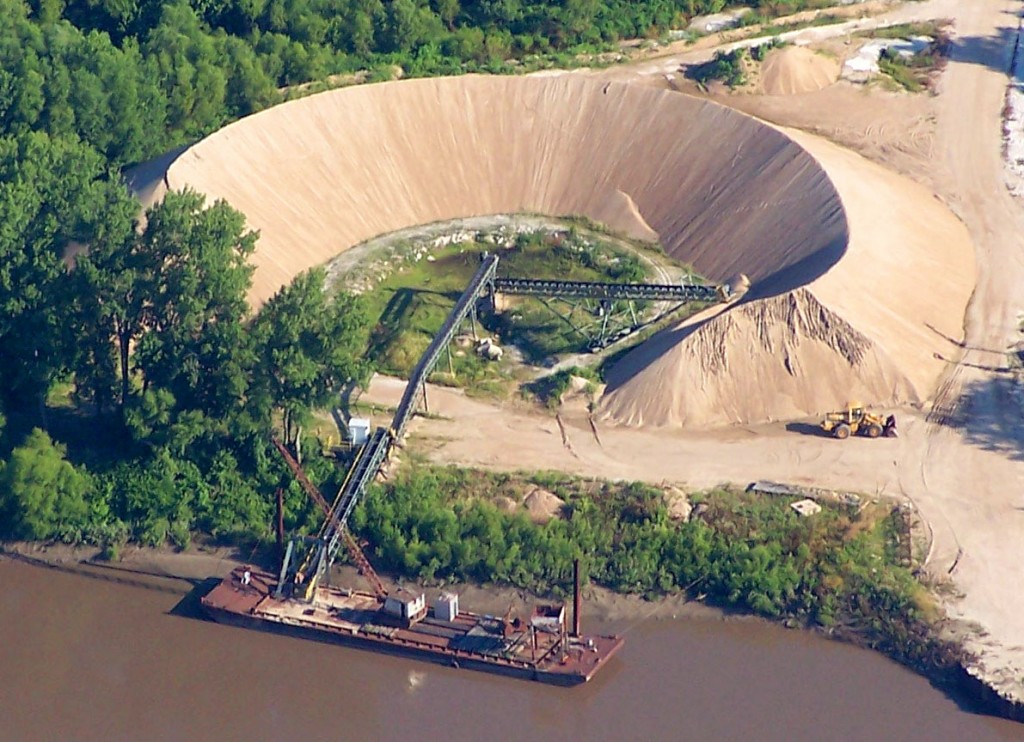 Last Thursday an arm of the Centers for Disease Control issued a "Hazard Alert" concerning exposure to Silica pollution at fracking drilling site. This comes after nationwide tests by the National Institute for Occupational Safety and Health at 11 well pads showed alarmingly high Silica levels in the air.
Silica is tiny sand particles. Breathe too many of them and you get Silicosis, a disease that literally suffocates you to death by putting down a layer of cement between you and your alveoli.
All the tests were at and around the drilling pad sites, not off-site, so we don't know what kind of hazard Silca pollution poses to surrounding residents. But the levels were so high at the pads that it's hard to believe it's never a factor. Reportedly, the amount of sand being used in fracking has significantly increased over the last decade.
For people west of DFW, that means more sand mining, and sand mining pollution in the Brazos and Red River valleys. For people near drilling sites, it could mean more air pollution nobody was trying to inventory until now.
Silica pollution wasn't even an issue of concern with fracking until somebody at the NIOSH decided to go looking for it. Who knows how many other fracking hazards are waiting to be discovered?
Halfway to Failure
 (Late Monday evening update: It's clear that the Hinton Street monitor will record its third "exceedence" of the 85 ppb standard this year, putting it just one away from making the entire region non-attainment" in 2012.)
It's a bad sign when there are ozone problems on the weekends. It means that even with less people on the road and many businesses on less than full throttle, there's still enough pollution to cause trouble. And it usually means a rough week ahead. That's what happened on Sunday, when summer finally caught up with DFW in a big way.
Four area ozone monitors set new annual highs set on Sunday, and many others saw very alarming numbers during the afternoon. There were three "exceedences" of the old 1997 85 parts per billion ozone standard, and one of those was the second time the Dallas Hinton Street site had seen an 8-hour average above 85 this year. Six other monitors have already had their first. And it's only June.
Four such exceedences within a year puts a monitor in official violation of the obsolete standard that DFW is still struggling to meet. So with the Hinton Street results, we're already halfway to being out of compliance with the 1997 standard again. But it's all academic. Everything is now geared toward meeting the new 75 parts per billion ozone standard by 2018. DFW could be in violation of the old standard every year from now until then, and except for the terrible toll on public health, there'd be no penalty from either the EPA or TCEQ.
On the other hand, its going to be pretty hard to meet that new, harder standard when you haven't been meeting the old, easier one.
The state's official response is mostly to sit back and hope that DFW drivers trade in their older, more polluting cars for cleaner, newer ones. That phenomena was supposed to be responsible for making this year the best one for clean air in decades. According to the Texas Commission on Environmental Quality's computer modeling, no DFW monitor will violate the Clean Air Act for ozone pollution in 2012. At least, that's what they told the EPA when they submitted the region's clean air plan to the feds in December. And the EPA bought it. Because the TCEQ computer modeling said everything was hunky-dory.
But reality has a way of rudely intruding on TCEQ's computer modeling. Only six months into the new plan and most of the DFW monitor averages predicted by the state are already underestimates. We had the highest ozone levels ever recorded in March. Maybe there's just not enough of you trading in your cars.
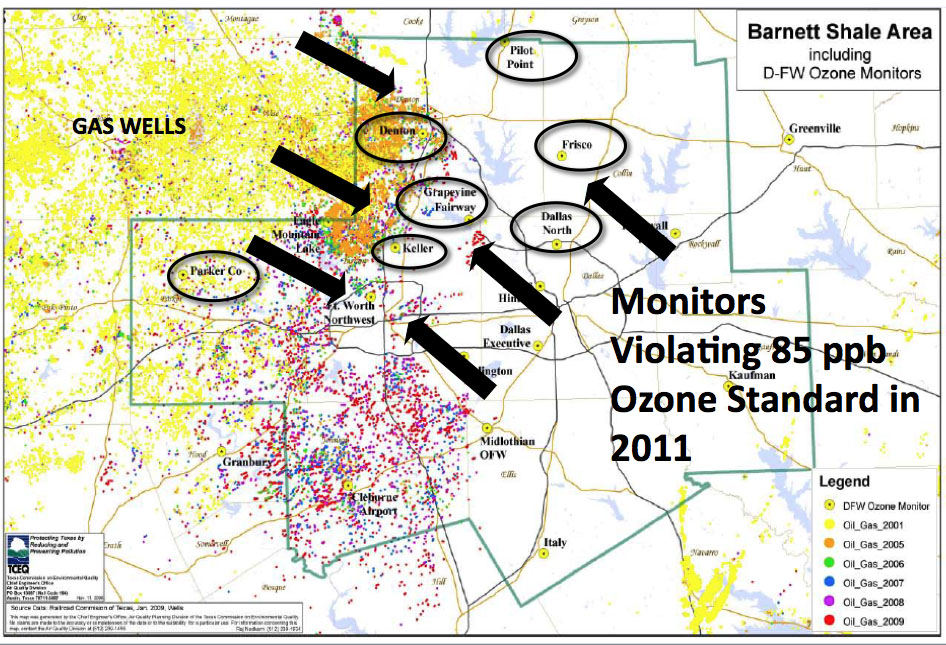 Or maybe it's just that old TCEQ junk science at work. One thing we know the state's computer model didn't consider was how already-dirty air makes the VOC pollution from natural gas operations more easily convert into ozone pollution. Denver officials who are also dealing with new gas operations contributing to long-standing smog problems have considered this factor and think it explains larger than expected ozone readings there.
TCEQ chose to ignore this variable. Supposedly because the gas patch was well west of DFW and "couldn't possibly" affect North Texas ozone levels. But as anyone who's driven I-30 or I-20 over the past ten years can tell you, the gas patch extends all the way from east of Denton to Grand Prairie to Midlothian, encompassing most of the 9 county non-attainment area. In the same December 2011 clean air plan the state predicted record-low ozone levels this year, it also estimated that gas industry sources were emitting 34 tons per day more smog-forming VOC pollution than all the cars and trucks in DFW combined.
It was a political decision not to look at how dirty air from Houston, the East Texas coal plants, the Midlothian cement kilns and everything else east of Weatherford makes gas industry emissions more likely to cause ozone in North Texas. TCEQ's clean air plans are always full of such decisions that drive the final results of its supposedly objective computer modeling. Hard to believe now, but there was a time in the not-so-distant-past that the same computer modeling made it clear that the Midlothian cement plans "couldn't possibly" be affecting DFW ozone levels.
A plan to meet the new 75 ppb standard must be submitted to EPA by 2015 to show three years of compliance by 2018. That's only two-years away. If new cars alone can't get us down below 85, it will be extremely difficult for the state to argue they can get us down to 75. More actual things that work to reduce pollution will be necessary. Including bringing better controls to the cement kilns and coal plants and other industries still putting out way too much pollution. It will be a fight. but so far, the evidence is that more is needed if DFW is ever going to have safe and legal air.
Fracking Call to Action
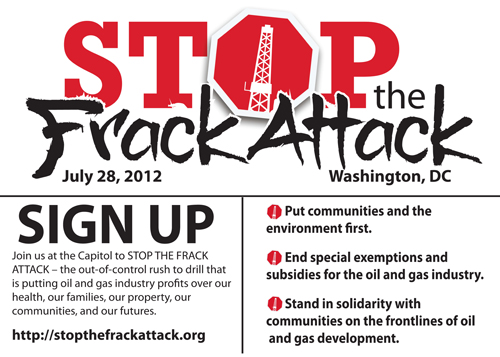 There are a bunch of grassroots groups endorsing and planning a late July series of actions in Washington DC aimed at countering the surge of fracking going on nationwide. The decentralized nature of the thing reflects the origins of the movement itself – one born inside the gas fields, not the Beltway. This is a good thing. The downside is that none of these groups have the kinds of budgets that allow them to go out and book fleets of buses or floors of hotels on spec. Nevertheless, they're trying to make it easy and cheap for you to do-it-yourself online with advice and listing and a checklist for booking buses and connecting you with housing opportunities in DC. You don't have to be a college kid with a sleeping bag. You can be a middle-aged couple with kids. They'll find spaces with real beds. Here's the FAQ page that can get you started.
The event is more than a rally. Its a four-day extravaganza in which you'll be able to meet your peers from all over the country and receive new ideas and information you can bring home to use in your own fight. Although it's not a Carribbean cruise, you'll more than get your money's worth. Here's the schedule
Wednesday- July 25th
Trainings
6:30pm-8:00pm Evening Lobbying and Marshall Trainings
Location: TBA
These trainings are not required for people who are lobbying, but we highly recommend that you attend. We will discuss how to lobby, what our asks to members are, what to expect from lobbying meetings and more importantly how to get around the Hill! We will also be having a Marshall Training where we will go over conflict resolution and the plan for the march and fracking water drop-off. We’ll also give out some other roles that we need filled to make sure STFA goes off without a hitch.
Thursday- July 26th
Lobby Day
9:00am-5:00pm Lobbying at the US Capitol
Location: US Capitol Visitor Center (we will have a space there all day)
After being trained the night before, we will hit the pavement of Capitol Hill and bring our message to our members of Congress. Lobbying is a tactic that is as old as government itself, and is a great way to create the pressure needed to close the loopholes in the Clean Water and Clean Air Acts. We will also take a group photo at noon on the steps of the Capitol!
More questions? Concerns? Shoot us an email: info@stopthefrackattack.org
Friday- July 27th
Stop the Frack Attack Gathering
10:00am- Noon: Trainings
Location: St. Stephens Church, 1525 Newton St. NW Washington, DC 20006
You’ve told us you want training before our day of action. Please fill out this survey to help us decide the topic of our fourth training! Check out the survey here!
1:00pm- 5:00pm: Strategy Session
Fracktivists from far and wide are coming to DC, and it’s time to figure out how we are actually going to win. We will break up by geographic regions, with a separate youth group, and talk strategy. What’s working? What’s not? What can we do better? These are the questions we hope to answer.
6:30-8:30: Town hall
We are working hard to get this event off the ground and we are gaining some traction, consider this the pre-rally. Our goal is to get someone from the Obama Administration here to talk to us about fracking and then have an open Q&A session… word on the street is it might be someone big, we’ll keep you posted!
Saturday- July 28th
Rally and March
2:00pm Rally
Location: The West Lawn of the Capitol
This is the big day, we are organizing to get as many people as possible! We have people coming from Texas, West Virginia, New York, Vermont, and even Australia. If you want to help get people there you can organize a bus! This rally will give us the energy needed to take our demands to the corporate powers pushing fracking onto our communities.
3:30 pm March
Location: The Streets of DC
After getting pumped up by our awesome speakers, it’s time to hit the streets. We will make a special delivery to the American Petroleum Institute and American Natural Gas Association. They say fracking is good for our water, we say nay and have the water to prove it!
And here's the mission statement for the action:
A rush to drill is sweeping the United States. Across the country, the oil and gas industry is surging into new areas as quickly and cheaply as possible.
And they have been using techniques like hydraulic fracturing (“fracking”) long before we fully understand the extent of the negative impacts on the health of the local people, communities, water, air, climate, and other critical resources.
Landowners and communities are struggling to cope: Existing laws are outdated and loophole-riddled, and enforcement is universally inadequate and underfunded. We battle a persistent myth that gas is a “clean” energy – which is not only false, but keeps us from moving towards truly clean energy and ending our reliance on fossil fuels.
The result: as industry rakes in record profits from fracking-enabled drilling, it passes on drilling’s heaviest costs to landowners, local communities and future generations. That’s because elected leaders (sometimes influenced by dirty energy money) too often refuse to hold the industry accountable for the damage they cause, or require them to prevent it.
The rush to drill, and the tragic consequences that follow, has made fracking a household word. In the process it has made “fracktivists” out of thousands of ordinary citizens — including some who regard “environmentalist” as a dirty word. Some are working to prevent fracking in their communities. Those already affected are fighting to protect their air, water, and health.
We all want to STOP THE FRACK ATTACK – the out-of-control rush to drill that is putting oil and gas industry profits over our health, our families, our property, our communities, and our futures.
Now is the time for us all to unite and demand that decisionmakers inside the Beltway hear our voice and take action to change the way the oil and gas industry operates in this country.
On July 28th, 2012, we invite community members and organizations everywhere to join us in Washington, D.C. for a rally at the Capitol to demand no more drilling that harms public health, water, and air. Instead of pushing for the increased use of oil and gas, elected officials and public agencies must insist that the industry stop all drilling that is dirty and dangerous, and put communities and the environment first, starting by removing special exemptions and subsidies for the oil and gas industry.
Join community leaders, celebrities and policymakers and add your voice to the call for a clean, fossil fuel free energy future.
Won’t you join us?
Signed,
Advisory Council:
Julie Archer, West Virginia
Stephen Cleghorn, Pennsylvania
John Fenton, Wyoming
Robert Finne, Arkansas
Rick Humphreys, West Virginia
Jenny Lisak, Pennsylvania
Kari Matsko, Ohio
Jill Morrison, Wyoming
Calvin Tillman, Texas
Matia Vanderbilt, Maryland
Jill Wiener, New York
Partners in Crime: TCEQ Lets Exide Lead Smelter Air Plan Deadline Pass
 Yeah, it's supposed to close by the end of the year. But that shouldn't mean the Exide lead smelter gets an even larger free pass to keep breaking the law on its way out the door.
Under the Clean Air Act, the facility is still subject to a clean-up plan for lead emissions that are violating the new federal lead-in-air standards passed in 2008. It's called a "State Implementation Plan," or SIP, because the state environmental agency, in this case the Texas Commission on Environmental Quality, is supposed to submit it to EPA for approval. The deadline for submitting Exide's SIP is July 1st, so the EPA has the required six months for public comment and processing through the Federal Register by the time the standard takes effect in December. As of today, the agenda for the last TCEQ Commissioners meeting in June did not have the Exide SIP on it.
It's true that the smelter doesn't have to start meeting that new standard until less than a month before it's scheduled closing via the agreement Exide and the City of Frisco announced in late May (and it's been exeeding that standard pretty regulalry since Spring began). But the adoption of a SIP could have put a nice regulatory bow on the package that the company and city have already prepared, and given the state the chance to tie up lots of loose enforcement ends.
By not submitting the SIP to EPA on time, the TCEQ is in violation of the law. What EPA will do about that is unknown, although its advocacy on behalf of Frisco residents over the long history of the smelter has been less than comprehensive and enthusiastic. Even now, neither it nor TCEQ have announced any fines or enforcement measures despite finding plenty of evidence of violations over the last three years' worth of inspections, much less the documented 30-year history of chronic abuses found in the agencies' files.
What might be some of the real world consequences of TCEQ lawbreaking this time? More lead air pollution and lead exposure to Frisco residents in the next six months than would otherwise have been allowed and more contamination of the land the City of Frisco has already bought and must pay to clean-up. A good thing to remember is how the company phased-out its Dixie Metals smelter in Dallas when it was forced to close by a December 31st 1990 deadline by the city. There was full production at the smelter until 12 Midnight, December 31st.
The official apathy of the state and federal agencies regarding Exide's criminal past and present has been breathtaking at times. So far, this missed SIP deadline seems to be one more yawnfest for them. Which is all the more reason citizens have to keep a vigilant eye on things even after the hoopla is over and the important work of cleaning-up a half-century's worth of poisons begins. Environmental protection is a do-it-yourself proposition.
Clean Air As Political Football
 Yesterday's Senate vote on rolling back the new EPA Mercury rules for power plants is a great example of how both sides use fake controversies to puff-up their political bone fides and financial support.
At issue is another move by Senator Inhofe of Oklahoma to gut the widely popular regulations that would establish limits for mercury pollution from power plants – the largest source of the air-borne poison in the US.
Inhofe's motives are pretty clear – this is just one more run at trying to deconstruct the EPA and the last 40 years of government-mandated clean air provisions. This is what the Senator does. Even when he knows he doesn't have the votes to win weeks in advance, as was the case with this vote. Why? Because it's a presidential election year and the EPA is red-meat to the Republican Party core constituency. After a week of publicity about the rules and the chance to demagogue against them, the vote itself is a mere formality. In fact, losing the vote gives the Senator a chance to say that the only way to permanently get rid of these kinds of awful business-killing EPA regulations is to elect a Republican president and Senate. Get those fundraising letters out. Mission accomplished.
Likewise, many of you probably received urgent appeals from large national environmental groups to e-mail your Senators about this power plant vote or risk losing the rules. This too was political posturing. If you'd been keeping track of the debate, you knew Senator Inhofe did not have the votes to win in the Senate. And even if he had somehow won, the President still would have vetoed the bill. The rules themselves were never in any danger. So why send out urgent appeals? Because it's a presidential election year and the Republican threat to EPA is a red meat issue to a core Democratic/Environmental constituency. After a week of scaring people into believing the rules were in jeopardy, the vote itself was a mere formality. And the "closeness" of the vote means that the only way we can protect rules like these is to keep a Democratic president and Senate. Cue those fundraising appeals. Mission accomplished.
Tomorrow, it's very likely that the Obama Administration will begin the self-inflicted process of dismantling parts of the EPA's new emission rules for cement plants that Downwinders and others have worked almost two decades to see implemented. These rules govern Mercury emissions too – cement plants are also a major source. For no reason that anyone in the environmental establishment in DC can understand, the EPA is going out of its way to weaken and delay these rules. This is not a drill. This is actually happening. And it's not the fault of Senator Inhofe this time. It's the Obama EPA. But the Senator won't be crowing about it because it doesn't conform to his own popular narrative about an anti-business EPA. We'll wait and see, but we also imagine there won't be any urgent national calls from Washington environmental groups next week to stop the EPA from eating its own and save the cement plant rules. That's not the narrative they're trying to sell either.
But it's the one taking place on the ground in Midlothian and another two dozen or so communities across the country that were depending on these rules to make their lives less miserable.
Meet a “Minor Source” of Air Pollution in the Natural Gas Mining Cycle
 Despite overwhelming community opposition, Allegheny County (Pittsburgh) is getting its very first compressor station this month. It's tastefully located near a mall in order to process gas being extracted from near-by Marcellus Shale wells. Not considered a great hot spot for the gas itself, the county nevertheless finds itself in close-enough proximity to the gas patch to be of use to operators as a repository for some of its other facilities along their fuel cycle. Along with five compressor engines there will also be three dehydrators, and reboilers, and two 6.500 gallon storage tanks. It will release 35 tons of smog-forming Nitrogen Oxide (NOx), 17 tons of Volatile Organic Compounds (VOCs), 7 tons of formaldehyde (a known carcinogen), and 11 tons of soot/Particulate Matter pollution. The NOx figure alone is the equivalent of something like 2500-3000 cars worth of pollution alone. No mention in the article how much CO2 is being emitted. This facility is considered a "minor source" of air pollution by the Allegheny County Health Department. Everything is relative of course. Compared to the steel mill smokestacks that made up the skyline of Pittsburgh for most of its existence 70 tons of crud a year might strike you as smallish. But when you stick that same 70 tons of crud as close as 500 feet away from a neighborhood or school that's not used to having heavy industry located so close, it doesn't look all that minor. And that's why the Dallas City Council's task force recommendation to allow compressors on the gas well pad itself, restricted only by the same zoning requirements of a drilling rig that produces a lot less pollution, is so nonsensical. Compressors are giant polluters. Their engines can be the size of locomotives. Imagine five of these only 500 feet from your yard or child's school. That's what's being endorsed by the task force and that's what citizens are rejecting out of hand. One of the major issues the Dallas City Council will have to decide as part of its new gas drilling ordinance is how and where these huge, necessary parts of the gas industry infrastructure will be allowed to locate.