Particulate Matter
Government Toxicity Test Misses Real World Reactions
 Just last week we were posting about the cumulative impacts of air pollution that are never taken into account by EPA risk assement. Now a new University of North Carolina study concludes that the toxic soup of chemicals and particulates found in many metropolitan areas is more harmful to human health than a common test used by government often reveals.
Researchers used a sunlit rooftop chamber to combine car diesel exhaust with a mix of Volatile Organic Compounds (VOCs) simulating urban air. They compared two methods for measuring the concoction’s toxicity: directly exposing human lung cells to particulates in chamber air with an electrostatic system, and a widely used method – that filters the air, resuspends the filtered particulates in a solution, and then applies this mixture to lung cells.
The cells directly exposed to the mix in the chamber experienced inflamation, whereas those that went through the filtering process did not. Based on analysis, scientists attributed the difference in reaction to semivolatile carbonyl compounds, which coat particles in air but are lost during filtration. Formaldehyde is one such carbonyl compound. Sunlight hitting VOCs in the atmosphere can create carbonyl compounds and coat very small soot particles, or Particulate Matter, suspended in air with the pollutants. When you breathe in the soot, you actually breathe in a tiny delivery device for these kinds of pollutants as well.
No risk assessment process incorporates these kinds of real world health impacts and it's just one reson why these assessments are not good models for actual human health impacts from pollution.
Nation’s Only Public Hearing on Roll Back of Cement Plant Rules Scheduled for Aug 16th in DFW
 Environmentalists are angry at EPA for giving the public less than two weeks notice prior to the nation's only hearing on a rollback of new air pollution rules for cement plants that the agency says could save thousands of lives annually, including many in DFW.
One of those who came in 2009, and vowed to show up again on the 16th was Ft. Worth resident Margaret DeMoss, who was instrumental in getting her city to adopt a "green cement" policy to reduce pollution from obsolete Midlothian cement kilns in southern DFW.
She also noted that in 2009, when the rules were being proposed, there were three national hearings coast to coast. Now that the rules are being weakened, there's only one.
"It's outrageous that the EPA would schedule this hearing at the last minute and in only one location in the nation; lot of other regions suffer downwind from cement kilns. Who will speak for them?"
Downwinders at Risk and other community groups repeatedly sued to get them enforced. That effort resulted in 2010 emission rules that were hailed as the largest single advance in air quality for the US cement industry, and were universally supported by citizens living near and around the nation's cement plants.
They had already passed all necessary regulatory review, just overcome their last legal hurdle, and were on their way to President Obama for his signature and implementation by 2013 when they got yanked by the administration's Office of Management and Budget earlier this year.
When the rules re-emerged, their enforcement was pushed back to 2015 and their strict Particulate Matter pollution provisions were considerably weakened.
According to EPA's own health impact studies for the rules, that two-year delay will cause at least 2000-5000 premature deaths nationwide.
Despite a halt in the burning of hazardous wastes at local cement plants in 2010, MIdlothian remains the home of the largest concentration of cement manufacturing in the entire U.S.
Three large cement plants – TXI, Holcim, and Ash Grove – are still the largest point sources of air pollution in North Texas, generating thousands of tons of air pollution.
Since DFW is downwind of Midlothian, Metroplex residents are exposed to more cement plant pollution than any other metropolitan area in the country, and represent a disproportional number of these 2-5000 annual deaths that EPA estimates will occur because of its rules delay.
"If these revisions are adopted, DFW residents will be paying a high price for the Administration's retreat," said Schermbeck. "That's why we must make our objections heard now."
He urged those that want to speak at the August 16th hearing to reserve a five-minute slot with EPA coordinator Pam Garrett by e-mailing her at garrett.pamela@epa.gov or calling (919) 541-7966
Lungs Like Fish Oil
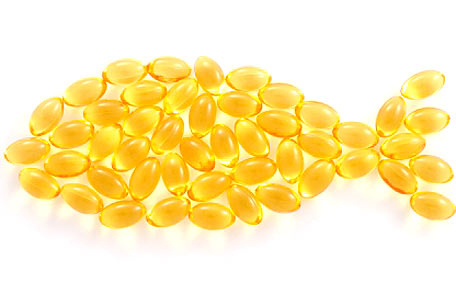 A new study shows that regular use of fish oi supplements in a person's diet can protect against the harms associated with Particulate Matter (PM) pollution.
"Twenty-nine people aged 50 to 72 took either olive oil or fish oil supplements for a month and then breathed concentrated outdoor air that contained extremely high levels of particulate matter pollution. After a short exposure to the high levels of particulate air pollution, heart rate variability decreased significantly in the participants who ate olive oil supplements. In contrast, the subjects on fish oil supplements showed little change. Researchers also found that the olive oil group showed longer repolarization duration and an immediate increase in two types of lipid levels in the blood (very low-density lipoprotein and triglycerides) after the exposures to concentrated air compared to the fish oil group."
Past studies have shown that exposure to particulate matter can lead to a variety of health problems such as asthma, stroke, heart failure, and decreased brain function. PM pollution in California alone is is estimated to cause 9,000 premature deaths per year. New PM emission rules for cement plants that are now being rolled back by EPA would save an estimated 2000-2500 lives per year nationally.
Another Day, Another White House Retreat on Clean Air
 In an election year, apparently no environmental initiative is safe from the Obama White House.
You may have missed this because it was one of those late Friday government announcments that officials like to use to bury bad news, but the EPA is going to consider softening those much-ballyhooed coal plant Mercury emissions rules that it fought so hard to get only last year. And because "consider" in this case means "we're going to do it," you can add these rules to the growing list of those clean air efforts in this supposedly environmentally-friendly administration that have bitten the dust because of political interfernce.
One of the reasons this rule is being rewritten is to satisfy the less-than-state-of-the-art White Stallion coal and pet coke-fired power plant being proposed for Matgorda Bay, whose owners have campaigned against the new rules since Day One. They say the rules are too strict and can't be met, despite being based on the track record of top performers in the utility industry. You will be unsurprised to learn that the Texas Commission on Environmental Quality is a co-facilitator in that campaign, up to the point of being so enthusiastic in its unquestioned support that it had to be ordered by a state judge to reconsider the first air permit it gave the plant because of the lack of any public participation.
White Stallion is going to be built less than 20 miles from the boundary of the eight-county Houston "non-attainment area" for ozone, or smog. Regulations on new sources of industrail pollution are tighter inside such areas than outside. That's pretty much all you need to know about the owner's commitment to using best technology. It's the same problem DFW used to face with the Midlothian cement plants and Ellis County until Donwiwnders petitioned, and EPA agreed, to include them in the North Texas non-attainment area.
Anything that makes it harder for Houston to meet clean air standards, also makes it harder for DFW to do the same. But this rollback is also a shame because of this administration's gap between promise and performance when it comes to critical upgrades in national polluiton standards – ozone, particulate matter, cement kilns and now coal plants. When push comes to shove, there seemingly isn't any polluter this White House won't do a favor for between now and November.
Imagine Our Surprise: PM Standard Weakened By White House
Confirming what a lot of observers had already suspected, the Washington Post reported on Wednesday that the White House submitted a new federal air standard for Particulate Matter air pollution this year that was higher than EPA originally proposed.
It's not the first time the Obama Administration has been accused of sacrificing science-based air quality standards for politics. Last year, the White House mugged EPA's Lisa Jackson with a last-minute decision to forgo tightening the Bush-era ozone/smog standard that she had already termed "legally indefensible."
Particulate Matter, or is the widespread and increasingly insidious pollutant that can be breathed-in and affect not only your respiratory system, but pass through the lung lining into the blood stream to also impact brain and heart function.
Based on a recommendation from its own panel of scientists, the Agency proposed a tightening of the PM standard from 15 to 12 micrograms per cubic meter of air. That recommendation then went to the Office of Management and Budget, which in the last 20 years has grown to have veto power over all EPA regulations. OMB directed the EPA to set the limit slightly higher, between 12 and 13 mg/m3. That doesn't sound like much of a change, but it could be the difference between areas like DFW getting a pass or having to adopt a plan to better control PM pollution.
Critics see the move as one more example of science taking a back seat to politics in the Obama White House when push comes to shove.
Kilnheads across the country just saw the same thing happen just last month with the EPA's proposed rollback of new cement plant emission rules that were 20 years in the making and on the verge of being implemented. However, that move is a stumper compared to the yanks that restrained the EPA on new ozone and PM rules – both national standards with widespread implications. Why is the EPA going out of its way at the last minute to bow to cement industry pressure when there don't appear to be nationwide political implications or impacts to these rules? We hope the Post can snoop around and get to the bottom of this reversal the same way it's reported on the retreats in ozone and PM.
PM Follow-Up: the 2005 Spike and the Midlothian Drop
 (Note: Downwinders sent out an air quality alert on Monday urging folks to send their comments 1) into EPA to support the new PM standard, and 2) the federal ATSDR in regards to its "health consultation" in Midlothian. The correct address for the PM comments is "a-and-r@docket.epa.gov" – the same as the alert, but apparently the the whole address didn't get underlined. Use the complete address and you shouldn't have any problem. The ATSDR address for comments used in the alert is cut and pasted from the agency's own website, but was rejecting comments Monday afternoon for some reason. Complaints have been made and we hope they'll actually be allowing comments on Tuesday.)
In covering the PM 2.5 standard announcement, a lot of attention was paid by the media to the fact that only a handful of counties in the US would not be able to meet the new number by 2020. The Obama Administration worked hard to send that message in order to preempt the kind of backlash that killed last year's new smog standards. But what are the actual levels now and how close or far is DFW from ever having to worry about being in non-attainment for PM pollution?
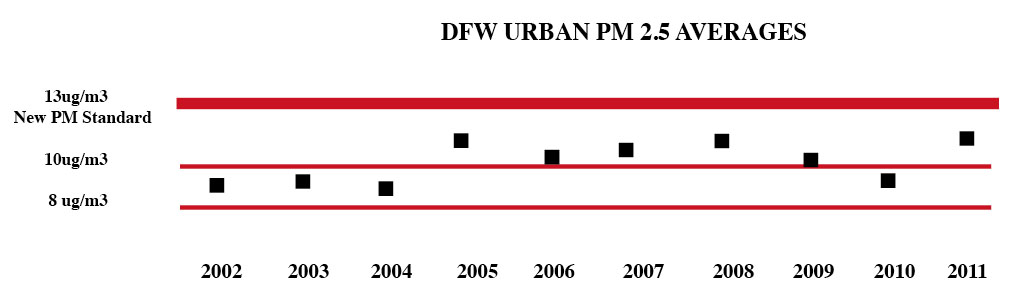
 The new standard is an annual average of 13 micrograms per cubic meter of air, expressed as ug/m3. As far as we can tell from the monitoring records TCEQ keeps online, DFW hasn't come close to exceeding that number. But that's not really as conclusive as it might first sound. There are only two PM 2.5 monitors located in the heart of the DFW metropolitan area. One is on /Hinton Street near Mockingbird and Harry Hines in Dallas and the other is at the Haws Athletic Center location just north of downtown Ft. Worth. All others are in far southern Ellis County, Kaufman County, or Johnson County and act as "background" monitors to track PM pollution coming in or leaving urban DFW. In contrast, there are at least nine ozone monitors located in urban/Suburban DFW .

Tracking the two central city core monitors over the last ten years shows a slow but steady rise in the average PM 2.5 levels being recorded, staring at a little below 9 ug/m3 in 2002 and ending with an 11.01 last year. That's an increase of almost 2 ug/m3 in a decade. 2011 was a drought year and so there was probably more dust in the air. But records show other years where annual averages were in the high-10 to 11 ug/m3 range. What they also show is that these higher levels all come after 2005. In fact, across the board, at all the DFW monitors recording PM levels from 2004 to 2005, there was a statistically significant jump from annual averages in the high 8 ug/m3 range in 2004 to over 11 ug/m3 by the end of 2005. And while some monitors came back down, the two central city monitors have stayed up – particularly at the Ft. Worth site. So what happened in 2005? There was a Mexican volcano eruption that summer, but it ended. The higher PM averages in North Texas didn't. It was too soon to see the effects of urban drilling, although that may play a part in keeping the Ft. Worth levels higher now. Whatever it was, it makes a clear bright line that separates the pre-2005 lower numbers from the post-2005 higher ones.
Last year's average of 11.58 ug/m3 at the Dallas site was the highest at that monitor, or any other, in the last ten years. It's less than 1.5 ug/m3 away from breaking the brand new PM standard of 13. That same monitor has already seen a 2.25 ug/m3 increase in annual averages since 2002.
EPA says don't worry, but we'd keep our eyes on those long term trends.
 The Obama administration is banking on the impact of new power plant rules, cement plant standards, and other emission-affecting regulations to lower PM levels over the next eight years. And that could be a good bet. One of the things that also sticks out from the limited amount of DFW PM data is how much of a drop there's been at the Midlothian monitor located north of the TXI cement plant over the last five years after reaching a peak in 2008. That was the year TXI decided to shut down its four obsolete wet kilns that burned hazardous wastes and rely solely on its newer and generally less polluting dry kiln. In 2008, the Midlothian monitor recorded an annual level of 10.7 ug/m3. Last year it recorded an annual average of 8.0. That's progress.
EPA Lowers National Particulate Matter Standard, World Doesn’t End
 In what will probably be one of the most important environmental health decisions of the Obama Administration, the EPA is proposing to reduce the national ambient air standard for what are called "fine particles" of particulate matter, or soot, a pervasive form of air pollution that is linked to an increasing number of ailments ranging from respiratory illnesses, to heart attacks, to Autism, and brain damage.
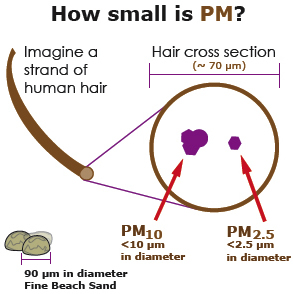
Particulate Matter 2.5, or tiny bits of soot that are 2.5 microns or less in diameter (a typical human hair is 50 microns) comes from the combustion process – gas-powered cars, diesel trucks, cement plants, utility plants, or boilers or furnaces of any kind.
Sand dust, at 90 microns in size, is much, much larger, so we're not talking about "EPA regulating dust." PM is an industrial pollutant. And study after study has shown that it kills and injures people even at levels that up until Friday were considered legal and "safe."
PM is so insidious because not only is it a toxin in its own right, it also acts as a tiny suitcase for all the by-products of whatever combustion made it. Coal or cement plant soot might contain Mercury or dioxins. Car soot could have Benzene residues. And these hitchhiking pollutants are carried deep inside the lung by the soot, where they stay, doing damage for years.
In a Boston Globe piece running thursday night, Dr. Albert Rizzo, chairman of the board of the American Lung Association, was quoted as saying that, "The science is clear, and overwhelming evidence shows that particle pollution at levels currently labeled as officially `safe' causes heart attacks, strokes and asthma attacks.
The new rule would set the maximum allowable standard for soot at range of 12 to 13 micrograms per cubic meter of air. That's the upper level of what the EPA's own panel of scientists recommended (11-13) without breaking the law by disregarding the panel's range as the Bush EPA did in 2006 when it decided to retain the 1997 standard. That annual standard was 15 micrograms per cubic meter. That doesn't sound like much of a reduction (17%), but it's the difference between a standard that embraces the newest science versus a 15-year old one that was not considered protective of human health. It could also mean the difference between metropolitan areas like DFW being given the all clear or classified as "non-attainment" for PM pollution, the same way it's in non-attainment for ozone, or smog pollution.
That would mean the region would have to put together a plan to reduce PM pollution, and of course that could mean opportunities to press for more modern controls on the Midlothian cement plants, east Texas coal plants, and other large PM polluters. One of the first steps will have to be putting more PM monitors in the DFW region – there are only eight now and three or four of those would be considered "background" sites, that is they monitor what's blowing into DFW, but not what residents are breathing.
Since monitoring began in 2000, annual highs in DFW have ranged mostly in the 20 and 30 microgram range, with forays into the 40s and 50's mid-decade. You can use this TCEQ website to track the four highest PM readings in DFW and the rest of the state for each of the last 12 years and this one to track daily readings – although both suffer from an obsolete color-coded alert system that underestimates health damage at lower levels of exposure.
In March, the Dallas Morning News compared DFW's mostly "moderate" levels of PM pollution to the most recent studies and concluded that local populations were at increased risk of heart attacks and strokes. It's not clear yet how EPA will enforce the standard or the timeline it will use but you can be sure it'll be generous since the Administration was forced to release this new standard by court order in an election year. That's because PM pollution is as widespread as ozone pollution and the measures necessary to reduce it could mean a long march toward modernizing many industries. t’s going to be a big step forward,” said Frank O’Donnell, head of the DC-based Clean Air Watch in the Washington Post article the broke the story. “This could help frame the national effort to clean this up for at least a decade.”
Think about how much effort has been directed at reducing smog in DFW over the last 20 years – HOV lanes, vapor recovery systems at the gas pump (put not necessarily at the gas well) and every paint shop, pollution controls on the Midlothian cement kilns, coal plants and other large industries.
It's probably going to take the same kind of all-inclusive slog to achieve compliance with this new standard, so the Obama Administration isn't gong to rush things. Despite opponents claims that these kinds of standards cost jobs, the opposite is actually true. Capital investment goes up because businesses are modernizing and putting on new control and implementing more efficient processes. Local jobs are created when those are installed. Waste is reduced. Operating costs often decrease. Despite being forced into the 20th Century by federal regs and citizen action, the cement industry in Midlothian has reduced emissions while also increasing manufacturing capacity. The same thing has happened in other industries.
Apparently the EPA is counting on the fact that previous rules aimed at other pollutants and problems have steadily been reducing PM pollution as a beneficial side effect, so the ramping up won't be as dramatic as it might have been. The proposed new standard will get published in the Federal Register and then finalized by next December 14th, so that no matter who wins in November, these rules seem to be on track. For a great primer on PM pollution in general and the history of today's decision, go check out Frank O'Donnel's Clean Air Watch website. Read More