Air Quality
Crohn’s Disease Linked to Lead Smelting Pollution
 Ulcerative colitis and Crohn's Disease are similar debilitating diseases of the digestive system which can include symptoms like severe abdominal pain and diarrhea. About a million and a half people in the US have the condition, which many researchers now believe to be linked to environmental causes.
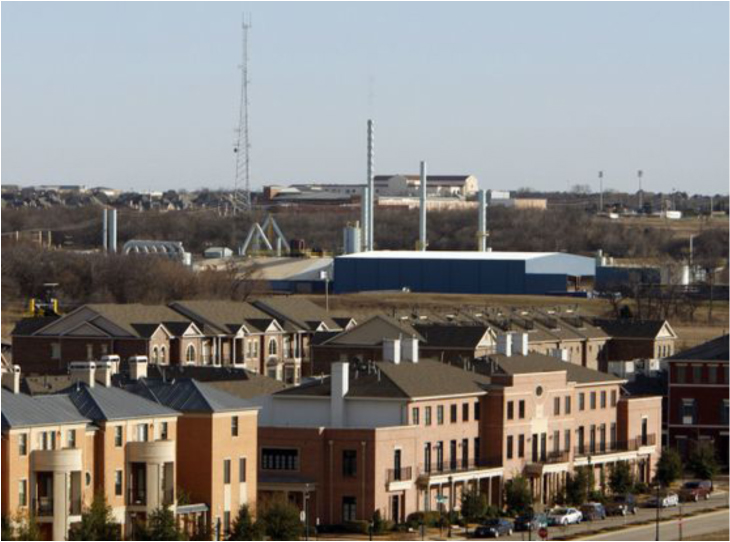
A Harvard Medical School study recently added to the evidence of such a link when it identified a cluster of suffers in extreme northern Washington state who live in proximity to an old lead and zinc smelter on the other side of the US-Canadian border. That smelter has been the source of complaints about pollution in the US as far back as the 1930's, when compensation for pollution damage was recommended by the Border Commission. Harvard doctors, including lead researcher Dr. Josh Korzenik, asked approximately 120 former and current residents of Northport, Washington to take a health survey. 17 of them had Ulcerative colitis or Crohn's.
“That’s about 10 to 15 times what we’d expect to see in a population the size of Northport,” said Korzenik, director of the Crohn’s and Colitis Center at Brigham and Women’s Hospital, one of Harvard Medical School’s teaching hospitals. “I’m not aware of any other cluster like it.”
But that could be because no one has looked. What kind of health survey logistics would it take to bring a similar study to Frisco, where emissions from the Exide lead smelter have been coating the surrounding areas for almost 50 years? Who would think that these symptoms could be linked to smelter emissions? Respiratory problems, IQ and developmental issues, even deafness, but not chronic stomach ailments. This is just one more disease that Frisco residents will have to try to determine if the Exide smelter is leaving behind as part of its toxic legacy.
Industry’s Man in the White House
 Not very many citizens realize the process that proposed environmental regulations have to go through in any administration in order to get out and published in he Federal Register in one piece. Not only does the regulation have to pass through the EPA's own cost-benefit analysis and survive various Congressional and court challenges, it must also pass through a murkier and more subjective test administered by the Office of Management and Budget, or OMB.
OMB is the very last stop an environmental regulation makes. There are no environmental scientists at OMB to judge the necessity of the regulation. No, OMB's job is to make sure the regulation doesn't hurt industry too much. That may seem like a worthwhile goal, but without any kind of strict guidelines for how to judge that, the conclusion is often open to a lot of interpretation. Industry knows that OMB is its last shot at stopping a regulation that otherwise has broad support form the public and even EPA. Among the non-profit environmental activists in DC, OMB is known as the place regulation go to die.
That's how last year's decision to leave the new ozone standard at 75 parts per billion, rather than the 70 ppb that EPA scientists had advocated – got done. Same thing for a weaker Particulate Matter standard this year. And we can't prove it yet, but we bet OMB had something to do with the rollback in cement plant emission rules being proposed suddenly by EPA/.
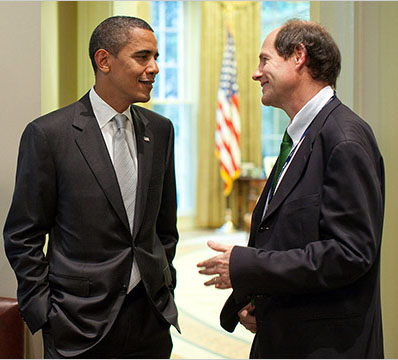
The face of the Obama Administration's OMB has been Cass Sunstein, head of the OMB's Office of Information and Regulatory Affairs (OIRA), a powerful department that holds sway over federal agency rulemakings. Having done his damage in the first Obama Administration, he recently announced he was leaving his job and returning to academia. But not before the DC publication "The Hill" got its hands on the e-mails Sunstein sent on behalf of the US Chamber of Commerce to get last year's ozone pollution standard weakened. In effect, he becomes a lobbyist on behalf of industry within the administration after industry has already lost the public health debate.
"The response to The Hill’s FOIA request shows Sunstein played an active role in alerting White House aides to business’s concerns about tightening the ozone standards. Internal communications show that ahead of the September decision, Sunstein circulated strong criticism of the ozone rule from a pair of powerful business groups, the National Association of Manufacturers (NAM) and the Business Roundtable, as well as House lawmakers opposing the tougher standards."
On July 15 of last year, Sunstein sent DeParle and two other aides a copy of a letter from the Business Roundtable to Daley, saying it was “worth reading.” The business group also released the letter publicly at the time.
On July 26, Sunstein sent a wider group of aides — including senior energy adviser Zichal and Phil Schiliro — a column titled “The Latest Job Killer From the EPA” that Business Roundtable President John Engler penned in The Wall Street Journal.
An un-redacted portion of the message from Sunstein states, “I am sure you saw this but just in case.
On Wednesday, Aug. 31, Sunstein forwarded several aides — including Stephanie Cutter, now a top Obama campaign official — an op-ed that NAM President and CEO Jay Timmons penned in The Hill attacking the ozone rule."
Possible New Catalyst for Methane Capture in Cars and Gas Field
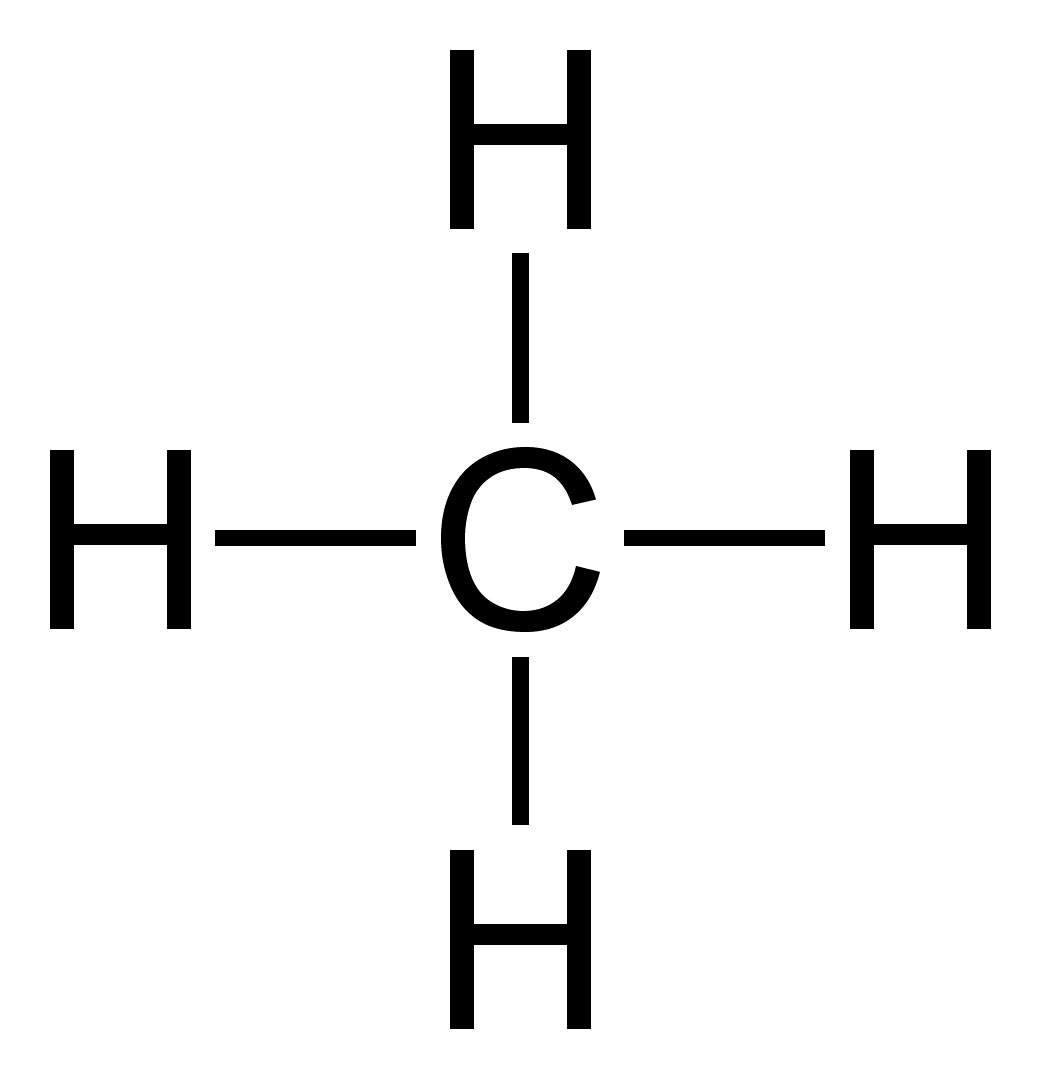 Via Chemical and Engineering News comes word that scientists from the University of Pennsylvania and the University of Trieste in Italy have developed a new low-temperature catalyst material that could remove methane emissions form vehicles as well as many different gas and oil field facilities. It would work the same way your car's catalytic converter works now – you force the emissions through a cylinder web or screen coated with a chemical designed to pick up specific molecules.
In the past, this process didn't work with Methane until you reached higher temps than are usually found in a car's engine. The breakthrough being reported solves that problem by allowing the capture of methane to take place at lower temperatures. Still in the testing phase, but we need to be on the lookout for better ways to capture methane pollution, which has been found to be something like 26 times more destructive to climate change per ton as CO2.
"Edman Tsang of Oxford University, an expert on catalysis and clean energy, says: “There is a tremendous need to remove small amounts of methane from the exhausts of gas turbines and internal combustion engines and from flue gases in petrochemical and related industries. The generally low activity of conventional catalysts and their instability at high temperatures” have made it difficult to meet this challenge, whereas the new catalyst makes a first step toward a solution. The approach needs further assessment but provides “a clear direction” for future research, he says."
Please Take 5 Minutes to Defend What it Took Us 20 Years to Build
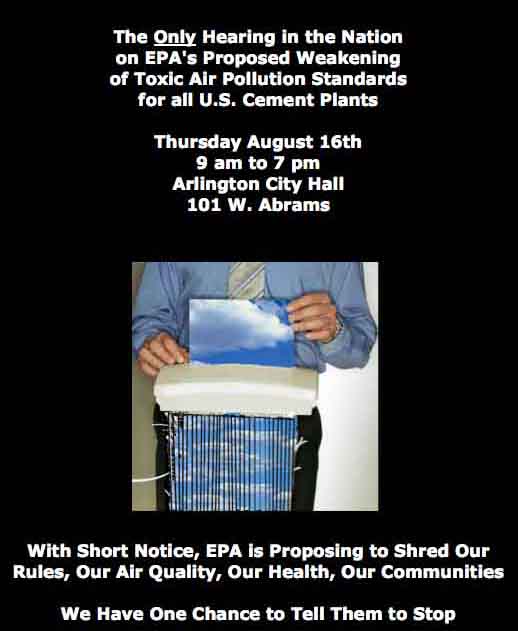 How to Reserve Your 5-Minute Speaking Slot on the 16th:
(919) 541-7966
Wake-Up and Breathe the Air Quality Progress/ Update X2
 6:00 pm Update: Rockwell hasn't hit 125 ppb yet, but it's hovered in the "red" high teens for three hours according to the latest update from TCEQ, which only goes up to 4 pm. Frisco, Arlington Airport and the old Redbird Airport monitors still seem likely to have their fourth and so, official violation the 1997 ozone standard of no more than 85 ppb for an eight hour stretch.
3:30 pm Update: In the time it took to write this, Rockwall has seen its ozone levels rise to 119 parts per billion. The very old original ozone standard was 125 ppb over a one-hour period. That's considered not just a red alert day – that's getting deep purple. We already had one of those in Arlington in June. Rockwall is on its way.
Original Post:
DFW's luck with the wind has ended.
Breezes have slowed and pivoted to the East, carrying coal plant and natural gas mining pollution. At 11 am the Rockwall smog monitor was already at 91 parts per billion; the next hour it was 111 ppb. The new federal standard is 75 ppb. Now a broad front of five monitors are in the 90's, from Frisco to Arlington. Of those five, two are just one more "exceedance" of the old 1997 standard of 85 ppb – a standard that despite two clean air plans from Austin, DFW has never managed to meet. if they trip today, that would bring the total number of DFW monitors officially out of compliance with that '97 standard to five.
As late as last December, the Texas Commission on Environmental Quality was maintaining with a straight face that there would be NO MONITORS OUT OF COMPLIANCE WITH THE 1997 OZONE STANDARD. Whenever you'd point out that we just had the worst year for ozone since 2007, or that such a goal would require the lowest ozone levels ever recorded in DFW, TCEQ staff would shrug their shoulders and say, "That's what the computer model tells us," as if that was that. In their own way, TCEQ has become the technocratic equivalent of those who beleive in the inerrent word of the Bible. The Bible Says It, I Believe It, and That Settles It. Substitute the word "model" for "bible," and you have the philosophy driving the TCEQ response to DFW's chronic dirty air. 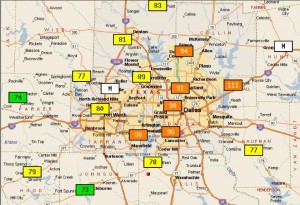
Of course, it matters what variables you put in that model, and how much weight you assign them, and how you run it. And if you're an extension of Rick Perry's permanent campaign machinery. In that case, the model has to say things will get better – because otherwise your critics would say the state needs EPA help to clean up the air; needs to not recommend new pollution control measures – because otherwise it would contradict your anti-government crusade; and needs to ignore the most potent source of new emissions in the last 20-30 years from what is historically the most powerful industry in Texas.
If you have all that going for you, well then why sure, every summer is a new chance to once again prove how the invisible hand of the marketplace can take care of everything. And if it doesn't? Well, it was the EPA's fault for interfering with the marketplace. You can never lose.
The biggest purveyor of junk science in Texas is TCEQ. It's become exactly what it criticizes. Local DFW governments say they are dependent on the agency to provide them with "expertise" they just can't afford. But what's the value of that expertise when: 1) It's always wrong, and, 2) TCEQ is acting directly against local interests by letting ideology trump good science?
In 2010, just one or two monitors were violating the 1997 standard. Last year it was seven. By the end of the day today it could be five. The smog is getting thicker, and TCEQ is playing with its inerrant models.
Government Toxicity Test Misses Real World Reactions
 Just last week we were posting about the cumulative impacts of air pollution that are never taken into account by EPA risk assement. Now a new University of North Carolina study concludes that the toxic soup of chemicals and particulates found in many metropolitan areas is more harmful to human health than a common test used by government often reveals.
Researchers used a sunlit rooftop chamber to combine car diesel exhaust with a mix of Volatile Organic Compounds (VOCs) simulating urban air. They compared two methods for measuring the concoction’s toxicity: directly exposing human lung cells to particulates in chamber air with an electrostatic system, and a widely used method – that filters the air, resuspends the filtered particulates in a solution, and then applies this mixture to lung cells.
The cells directly exposed to the mix in the chamber experienced inflamation, whereas those that went through the filtering process did not. Based on analysis, scientists attributed the difference in reaction to semivolatile carbonyl compounds, which coat particles in air but are lost during filtration. Formaldehyde is one such carbonyl compound. Sunlight hitting VOCs in the atmosphere can create carbonyl compounds and coat very small soot particles, or Particulate Matter, suspended in air with the pollutants. When you breathe in the soot, you actually breathe in a tiny delivery device for these kinds of pollutants as well.
No risk assessment process incorporates these kinds of real world health impacts and it's just one reson why these assessments are not good models for actual human health impacts from pollution.
3rd DFW Ozone Monitor Officially Trips the 1997 Standard
 What were we saying about smog problems marching east with the gas drilling?
Yesterday's dirty air left the Dallas North site – south, and downwind of LBJ's mess – with its fourth exceedance of the 1997 85 parts per billion (ppb) ozone standard. That means it's an official violation of that standard since every monitor gets three strikes before being called out. It joins the Grapevine and Dallas Hinton Street monitors in violating a 15-year old standard that has been declared unprotective of human health and replaced with a tougher standard of 75 ppb. 16 of 20 DFW ozone monitors have already violated that new standard this year, but those don't start counting against us until around 2015-16 when it takes full effect. At the same time, violations of the '97 standard it replaced don't count either. So DFW remains in a kind of smoggy purgatory. This wil be the 21st year we won't be in compliance with the federal clean air smog standard.
Last Wednesday, fracking proponents on the Dallas City Council kept refering to the Texas Commission on Environmental Quality as if it was some kind of immutable final word on all things environmental. Alas, the TCEQ is not infallible. With DFW air quality, it's never even been right. TCEQ's 2012 clean air plan for DFW was supposed to give us historically clean air with NO VIOLATIONS of the 1997 ozone standard. Now we've had three with another two months of ozone season left.
For the record, in 2010 we had one monitor with four violations of the '97 standard. That was as close as we've come to complying with it. Last year we had seven. This year we have three and still counting. Despite all of these violations contradicting the state's predictions, TCEQ still insists in calling this air quality progress. It's not. It's continued non-compliance with an old standard that most of the rest of the country already meets.
Nation’s Only Public Hearing on Roll Back of Cement Plant Rules Scheduled for Aug 16th in DFW
 Environmentalists are angry at EPA for giving the public less than two weeks notice prior to the nation's only hearing on a rollback of new air pollution rules for cement plants that the agency says could save thousands of lives annually, including many in DFW.
One of those who came in 2009, and vowed to show up again on the 16th was Ft. Worth resident Margaret DeMoss, who was instrumental in getting her city to adopt a "green cement" policy to reduce pollution from obsolete Midlothian cement kilns in southern DFW.
She also noted that in 2009, when the rules were being proposed, there were three national hearings coast to coast. Now that the rules are being weakened, there's only one.
"It's outrageous that the EPA would schedule this hearing at the last minute and in only one location in the nation; lot of other regions suffer downwind from cement kilns. Who will speak for them?"
Downwinders at Risk and other community groups repeatedly sued to get them enforced. That effort resulted in 2010 emission rules that were hailed as the largest single advance in air quality for the US cement industry, and were universally supported by citizens living near and around the nation's cement plants.
They had already passed all necessary regulatory review, just overcome their last legal hurdle, and were on their way to President Obama for his signature and implementation by 2013 when they got yanked by the administration's Office of Management and Budget earlier this year.
When the rules re-emerged, their enforcement was pushed back to 2015 and their strict Particulate Matter pollution provisions were considerably weakened.
According to EPA's own health impact studies for the rules, that two-year delay will cause at least 2000-5000 premature deaths nationwide.
Despite a halt in the burning of hazardous wastes at local cement plants in 2010, MIdlothian remains the home of the largest concentration of cement manufacturing in the entire U.S.
Three large cement plants – TXI, Holcim, and Ash Grove – are still the largest point sources of air pollution in North Texas, generating thousands of tons of air pollution.
Since DFW is downwind of Midlothian, Metroplex residents are exposed to more cement plant pollution than any other metropolitan area in the country, and represent a disproportional number of these 2-5000 annual deaths that EPA estimates will occur because of its rules delay.
"If these revisions are adopted, DFW residents will be paying a high price for the Administration's retreat," said Schermbeck. "That's why we must make our objections heard now."
He urged those that want to speak at the August 16th hearing to reserve a five-minute slot with EPA coordinator Pam Garrett by e-mailing her at garrett.pamela@epa.gov or calling (919) 541-7966
” A stunning increase in the frequency of extremely hot summers”
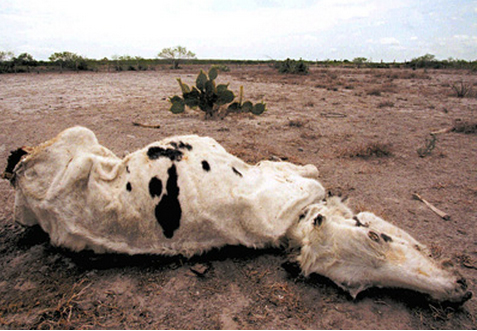 That's James Hansen and other researchers' conclusion after looking at the past 60 years of thermometer readings from Mother Earth. They use last year's $5 billion drought here in Texas as a vivid example of the kind of thing that used to be rare, but no longer is, and they lay the blame squarely on human-made pollution.
"This is not a climate model or a prediction but actual observations of weather events and temperatures that have happened. Our analysis shows that it is no longer enough to say that global warming will increase the likelihood of extreme weather and to repeat the caveat that no individual weather event can be directly linked to climate change. To the contrary, our analysis shows that, for the extreme hot weather of the recent past, there is virtually no explanation other than climate change."
Wasting No Time, Texas Rushes To Apply Health Care Ruling to EPA “Mandates”
 A huge national law firm that the State of Texas has hired to represent it in various facets of its anti-EPA jihad has taken the rhetoric of the recent Supreme Court decision and is now attempting to apply it to federal environmental mandates.
According to an Energy and Environment article from last week,
"The focus for now is on part of the health care decision in which the court held, on a 7-2 vote, that the federal government cannot take away all of a state's Medicaid funding if it declines to implement new provisions that were introduced under the reform law. The court saw such a move as akin to coercion.
Congress cannot "penalize states that choose not to participate in that new program by taking away their existing Medicaid funding," Chief Justice John Roberts wrote in the majority opinion.
Lawyers at the Baker Hostetler law firm, which represents Texas, were clearly paying attention to the academic debate that immediately broke out, in which some scholars saw similarities between the Medicaid provisions in the health care law and how the federal government interacts with states over their role in enforcing the Clean Air Act via state implementation plans, known as SIPs."
Most legal scholars don't believe this will go anywhere, but this move is just more evidence that Governor Perry and Co. are still fighting the Civil War all over again.