cement industry
ATSDR E-Mail Address For Comments is Bad, Compensates with Week Extension
 The ATSDR finally admitted that, yep, that e-mail address we published for people to submit their commnets on the Agency's Midlothian "health consultation" doesn't work and never will work, and so they're providing another and extending the commenting opportunity by one week to Friday, June 29th. Here's he entirety of the ATSDR's response:
ATLANTA— The public comment period for the recently released Midlothian Public Health Assessment has been extended to June 29, 2012.
Comments on the document must be made in writing and those received during the public comment period will appear in the final version of the health consultation. Comments (without the names of persons who submitted them) and ATSDR’s responses to these comments will appear in an appendix to the final health consultation. Names of those who submit comments will be subject to release in answer to requests made under the U.S. Freedom of Information Act (FOIA).
Send comments to: rlm6@cdc.gov,or mail to:
ATSDR Records Center
Attn: Rolanda Morrison
Re: Midlothian Area Air Quality – PHC #1
4770 Buford Highway, NE (MS F-09)
Atlanta, Georgia 30341
No "We're sorry we screwed-up the public comment process" or "It's all our fault, try again." We could say this is one big metaphor for the Agency's multi-year invovlvement in Midlothian, but we won't. We'll let you do that in your comments.
PM Follow-Up: the 2005 Spike and the Midlothian Drop
 (Note: Downwinders sent out an air quality alert on Monday urging folks to send their comments 1) into EPA to support the new PM standard, and 2) the federal ATSDR in regards to its "health consultation" in Midlothian. The correct address for the PM comments is "a-and-r@docket.epa.gov" – the same as the alert, but apparently the the whole address didn't get underlined. Use the complete address and you shouldn't have any problem. The ATSDR address for comments used in the alert is cut and pasted from the agency's own website, but was rejecting comments Monday afternoon for some reason. Complaints have been made and we hope they'll actually be allowing comments on Tuesday.)
In covering the PM 2.5 standard announcement, a lot of attention was paid by the media to the fact that only a handful of counties in the US would not be able to meet the new number by 2020. The Obama Administration worked hard to send that message in order to preempt the kind of backlash that killed last year's new smog standards. But what are the actual levels now and how close or far is DFW from ever having to worry about being in non-attainment for PM pollution?
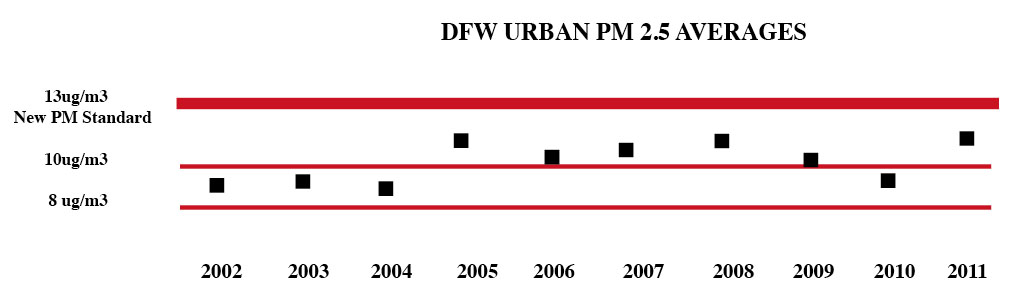
 The new standard is an annual average of 13 micrograms per cubic meter of air, expressed as ug/m3. As far as we can tell from the monitoring records TCEQ keeps online, DFW hasn't come close to exceeding that number. But that's not really as conclusive as it might first sound. There are only two PM 2.5 monitors located in the heart of the DFW metropolitan area. One is on /Hinton Street near Mockingbird and Harry Hines in Dallas and the other is at the Haws Athletic Center location just north of downtown Ft. Worth. All others are in far southern Ellis County, Kaufman County, or Johnson County and act as "background" monitors to track PM pollution coming in or leaving urban DFW. In contrast, there are at least nine ozone monitors located in urban/Suburban DFW .

Tracking the two central city core monitors over the last ten years shows a slow but steady rise in the average PM 2.5 levels being recorded, staring at a little below 9 ug/m3 in 2002 and ending with an 11.01 last year. That's an increase of almost 2 ug/m3 in a decade. 2011 was a drought year and so there was probably more dust in the air. But records show other years where annual averages were in the high-10 to 11 ug/m3 range. What they also show is that these higher levels all come after 2005. In fact, across the board, at all the DFW monitors recording PM levels from 2004 to 2005, there was a statistically significant jump from annual averages in the high 8 ug/m3 range in 2004 to over 11 ug/m3 by the end of 2005. And while some monitors came back down, the two central city monitors have stayed up – particularly at the Ft. Worth site. So what happened in 2005? There was a Mexican volcano eruption that summer, but it ended. The higher PM averages in North Texas didn't. It was too soon to see the effects of urban drilling, although that may play a part in keeping the Ft. Worth levels higher now. Whatever it was, it makes a clear bright line that separates the pre-2005 lower numbers from the post-2005 higher ones.
Last year's average of 11.58 ug/m3 at the Dallas site was the highest at that monitor, or any other, in the last ten years. It's less than 1.5 ug/m3 away from breaking the brand new PM standard of 13. That same monitor has already seen a 2.25 ug/m3 increase in annual averages since 2002.
EPA says don't worry, but we'd keep our eyes on those long term trends.
 The Obama administration is banking on the impact of new power plant rules, cement plant standards, and other emission-affecting regulations to lower PM levels over the next eight years. And that could be a good bet. One of the things that also sticks out from the limited amount of DFW PM data is how much of a drop there's been at the Midlothian monitor located north of the TXI cement plant over the last five years after reaching a peak in 2008. That was the year TXI decided to shut down its four obsolete wet kilns that burned hazardous wastes and rely solely on its newer and generally less polluting dry kiln. In 2008, the Midlothian monitor recorded an annual level of 10.7 ug/m3. Last year it recorded an annual average of 8.0. That's progress.
Downwinders, The Early Years
Looks Like EPA Will Stymie Hard-Won Cement Plant Rules On Friday
 We don't this very often, but because many of you spent so much time helping us get the first new cement plant emissions rules in 20 years, we thought it was important to reprint the entirety of a Subscription-Only INSIDE EPA article from Tuesday that puts the fate of those rules very much in question:
Activists Warn Possible EPA Weakening Of Cement MACT Likely Unlawful
New Cement Plant Rules in Trouble at EPA?
 There's been a flurry of news about cement plant pollution this past week or so that we haven't been able to cover as well as we should have for a clean air group that has the largest concentration of cement manufacturing capacity in the US in its own backyard. Most important of all is the possibility that EPA will mess with its tough new cement plant emissions rules that Downwinders and so many of you fought long and hard to get passed. These are the rules that were at the center of the 2008 DFW airport hearing that drew 200 people – the largest hearing on them in the country. These are the rules that are forcing old wet kilns like Ash Grove and others around the country to finally modernize. Originally mandated to come on line in 1997, they're just now on the verge of being promulgated as final by EPA. Only there's a catch. For no apparent reason that anyone in the environmental side of the table can figure out, EPA is seriously considering giving industry a two-year extension that no court has ordered EPA to give them. There's a June 15th deadline that the agency imposed on itself, to respond to a Portland Cement Association's petition to either delay the rule outright until 2015 instead of 2013, or take comment on such an extension. Either move would delay the implementation since they're on schedule to become official in November. No one at EPA will say why they're taking the PCA petition so seriously when they've spend the last two decades blowing off similar requests by citizens. Downwinders, along with 14 other local groups, has signed a letter going to EPA Assistant Administrator Gina McCarthy that protests ANY delay and asking her to reject the PCApetition. Downwinders Director Jim Schermbeck was one of seven people that met with McCarthy in Washington DC earlier in the month to discuss how important these rules are to places like Midlothian – where's there not one, not two, but three cement plants operating within close proximity to one another. While the meeting went well, McCarthy was non-committal. We're not ones to quietly sit on the sidelines as something that we've worked for almost 20 years gets victimized by what looks to be election year politics. Expect to see more in the coming days about what you can do to prevent this public health tragedy from an increasingly wimpy EPA. Stay tuned
They Were Against Clean Air Before they Were For It
 It's always a good darkly-comic read when fierce opponents of clean air take credit for progress even while they're still fighting against it. So get ready from some really twisted pretzel logic as you tackle the official and severely anti-climatic Ash Grove press release that announces the 2-year, $136 million effort to convert the Last Wet Kilns in Texas™ to dry kiln technology, eliminating hundreds of thousands of tons of air pollution by 2014.
This news was first broken by us last January, then Ash Grove applied for the state permit it needed (w/o having to be bothered with public notice or comment), and then again over a week ago when we pointed out they'd ink the engineering contract. Nevertheless, we'll leave it up to the company to have the belated last word. But you're not going to find any mention of Downwinders' seven-year "Green Cement Campaign," or the more than a dozen local governments that overwhelmingly voted for procurement policies that explicitly said they were not buying wet kiln cement because it produced too much air pollution. Or the lawsuit that Ash Grove eventually was forced to file when they lost a 5-0 vote over such a procurement policy at the Tarrant County Commissioners Court. Or how Downwinders successfully intervened last year to protect those procurement policies when Dallas and Arlington were thinking about ditching them over that Ash Grove lawsuit. No, Charles Sunderland the Third and Company would rather drink lye than give us our due.
But the press release does cite the "U.S. Environmental Protection Agency’s (EPA) portland cement National Emissions Standards for Hazardous Air Pollutants (NESHAP) rule, which are scheduled to take effect in Sept. 2013," as a determining factor in the modernization.
That would be the same standard that over 200 local residents supported in-person throughout a day-long hearing at DFW airport in 2008. It was the largest, best-attended hearing on the rules that EPA hosted that year, including stops in L.A. and Washington D.C. , capping over a decade of organized support from Downwinders at Risk. No other single grassroots group did more for so long to make sure those rules got approved because no other group was faced with such a concentration of old, dirty wet kilns that we knew would have to modernize to conform to them. By linking their decision to the NESHAP standard, the company is at least acknowledging a large factor that Downwinders had a large impact on. But the comedy of the Ash Grove press release lies not in what it leaves out, but what it crams in – toasts to its success from all the elected officials who worked do diligently to destroy the NESHAP rule and, or thwart our Green Cement Campaign.
“My colleagues will be delighted, as I am, to know that Ash Grove is making this investment in Midlothian during difficult economic times. The costs that this company is incurring to comply with mandated federal air emissions regulations are incredible while sales are down in the industry by more than 40 percent. We are fortunate that they are 0making this investment in Texas. In my estimation, Ash Grove always has been a leading corporate citizen,' Texas House Appropriations Chairman Jim Pitts (R-Waxahachie) said in his reaction to the decision."
Give him points for consistency: Rep. Pitts was against the federal cement plant rules when the economy was booming too. And he fought any and all attempts to protect the downwind cities from Ash Grove's green cement lawsuit in the Texas legislature. But he's delighted that both evil strategies worked in concert with one another and produced this wonderful result!.
Smokey Joe is merely pleased: “For years, I’ve seen these companies scrutinized by groups who would rather shut them down and force Texans to rely on imported cement. In spite of that, in a bad economy, Ash Grove has chosen to continue to operate in Texas and further improve on its record of reducing air emissions. I am pleased by Ash Grove’s decision and by the knowledge that it will be among the lowest emitting cement producers in Texas,' said U.S. Rep. Joe Barton (R 6)….."
Yes. That's the same Joe Barton still trying to sabotage the very NESHAP rules he's congratulating Ash Grove for following. Don't spend too much time thinking about the hypocrisy in this one, it'll make you pass out. In point of fact, the fight over cement pant pollution in Midlothian has been about citizens dragging an industry kicking and screaming into the 21st Century, being forced to reduce its pollution but also becoming more efficient. Jim Pitts, Smokey Joe, and Charles Sunderland the Third never mention that while pollution has been significantly reduced in Midlothian as a result of all those nasty federal mandates and citizen lawsuits and permit fights, the actual manufacturing capacity to make cement at Midlothian's three cement plants has grown.
Mesopotamia or Midlothian – Burning is Bad
 Here's a great story from Wired that reports the results of the first tests done in and around the places where the military's "burn pits" were located during the most recent Iraq and Afghanistan wars.
Not familiar with "burn pits?" If you grew up in rural Texas you are because it's exactly the way your grandfather got rid of his family's trash – by putting it in a big pile and then putting a match to it. Besides turning a ravine into an impromptu landfill, burn pits are the most popular way of disposing of your garbage when Waste Management just can't get to you.
In the military, burn pits were the disposal option of choice for everything: human waste, paints and paint removers, asbestos insulation, plastic and styrofoam containers, old computers and monitors – any waste you can imagine being generated at a front line military base.
Not surprisingly, troops that spent time around these open-air waste incinerators have been complaining about chronic bronchitis, neurological disorders, and rare cancers – just like people who live dowwnind of waste burning at cement kilns and incinerators. Military spokespersons have reassured these whiners that there was "no specific evidence" of the pits doing any human health damage. To which all of you who've been doing this for a while will respond: "How many times did anyone look for such damage?" The answer is zero – until now. Pulmonologist Dr. Anthony Szema of the Stony Brook School of Medicine, just released the results of an experiment that links the burn pit dust to immune system damage. Dr. Szema exposed 15 mice to the dust from the remains of a burn pit in Iraq. When collected on-site, the pit still stunk with the incinerated remains of animal carcasses, lithium batteries, printers and glues. This lovely cocktail of toxins was then inhaled by the mice and researchers tracked their respiratory system and spleen for signs of strain. And they got them.
Lung inflammation occurred within two hours of exposure, and T-cells dropped by a third. T-Cells are a critical component of the human immune health originating in the bone marrow but then going to the Thymus to finish their development. AIDS and other immune destroying diseases kill T-Cells. After two weeks of being regularly exposed to the burn pit dust, the mice had lost 70% of the T-cells they started with. "I can't even imagine what this date shows when you think about someone coming back from Iraq," Szema says. "these guys weren't inhaling the air once. They were working in it, sleeping in it, exercising in it. For days on end." Despite being limited to mice, Szema is confident that the results are transferable to humans. The symptoms of his mice line up with those being reported by veterans to a database at BurnPits360, a website dedicated to tracking the health of exposed servicemen and women. It's also one more step in understanding why different people react to pollution differently. With your immune system offline everyone is vulnerable to different inherent health weaknesses that are exacerbated. Dr. Szema isn't surprised at the results of his groundbreaking tests. "Based on the patients I've seen, this is a no-brainer. If anyone tries to say, ' Oh dust is just dust,' I can tell them that's simply not true."
Four Years After Kiln Waste-Burning Ends, ATSDR’s “Evaluation” of Midlothian Keeps Going
 Although on any given day there's a lot of competition, the Agency for Toxic Substances and Disease Registry might be the most irrelevant government bureaucracy going. Thursday it announced that the latest installment of its years-long "health consultation" of Midlothian will be the subject of yet another community meeting in that town on Thursday May 24th from 7 to 8:30 at the Midlothian Conference Center. The ATSDR evaluation started in 2005 at the request of Midlothian Citizens when TXI was still burning hazardous waste. It then was the subject of a 2010 Congressional investigation that revealed how the Agency mostly neglected to do any real science in the course of its evaluation. This new meeting concerns an analysis of air monitoring information that "will support public health evaluations for many of the pollutants of concern." Of that we have no doubt. Since ATSDR does no monitoring of its own, it's completely reliant on the monitoring done by theTexas Commission on Environmental Quality. Does anyone know of any instance where TCEQ monitoring has shown anything to be concerned about? If citizens complain about getting sick from industrial pollution, it's TCEQ position that it's the fault of anything but the pollution itself. No amount of empirical evidence collected by citizens in the field from their own sampling or experience can convince Austin otherwise. TXI quit burning waste in 2008. ASTDR's evaluation of Midlothian? It just might outlast the plant itself.
Study: Low Levels of Hydrogen Sulfide Linked to Asthma
 You may not know the name of the chemical, but you know it by smell. "Rotten eggs" is the olfactory indication you're being exposed to Hydrogen Sulfide. There's a reason it smells like that. Biological sources can emit it. Certain bacteria produce hydrogen sulfide as they decompose waste – like rotten eggs. It also occurs in geothermal situations. Hot water, steam and magma from inside the Earth carry heat, minerals and gases – like Hydrogen Sulfide – to the surface, liberating them in springs, geysers and volcanic lava. If you've ever been to Yellowstone, you know the smell. Industrial sources of hydrogen sulfide include oil and gas drilling, refineries, paper mills, large scale livestock production, waste water treatment and landfills. At high levels of exposure, Hydrogen Sulfide is linked with serious neurologic damage – including death. Lower levels can trigger eye irritation, fatigue and headaches…and asthma according to a new three-year study out of Iceland. Measuring levels of Hydrogen Sulfide near major intersections and power plants in the capital city of Reykjavik that turn geothermal energy into electricity and heating steam, researchers found a weak but constant association between the pollutant and asthma medication rates. It's one of the first studies to find respiratory ailments at low levels of Hydrogen Sulfide – much like you'd find in the Barnett Shale or any gas or oil patch. The fact that oil drilling has been around for over a century, and yet only now are we actually studying what happens when people are exposed ti it at exposure levels found in real life, tells you all you need to know about the risks of allowing drilling so close to people.
Cement Industry
Cub Scout Tours and Burning Plastic? Must Be Time for Cement Plant Environmental Awards!
Thursday, April 26, 2012
Irony isn't dead. But even it has to sit down and self-medicate when the Portland Cement Association rolls out it annual"Environment and Energy Awards." This year's winners include the CEMEX Louisville Kentucky plant (27,000 pounds of toxic releases in 2010) for its substitution of a a pug screw for the more traditional pug mill, Titan's Troutville, Virginia plant (13,882 pounds of toxic releases in 2010) for it's excellent cub scout tours and self-interested quarry expansion PR campaign, and Holcim's Theodore, Alabama plant (1, 037 pounds of toxic releases in 2010) for burning tires and plastics. We are not making this up.
TCEQ's War on Public Hearings
Wednesday, April 11, 2012
You already know how much the current Perry-fueled Texas Commission on Environmental Quality has stripped the right of citizens to contest permits being issued like candy to polluters in Austin. In Texas, you can decide to change your entire fuel regimen, from coal to coal and tires, and plastics, and car interiors, as the TXI cement plant in Midlothian recently did, and not face any public questioning at all. Or say you want to tear down your old plant and put up a new one. You don't need any public comment or hearing for that either, as Ash Grove found out when it applied for its "permit amendment" to rebuild its Midlothian cement plant. There has been a very premeditated and methodical campaign to make it impossible for any member of the public to interfere in the least bit with the right of the polluter to do any damn thing they want. Today, TCEQ is voting to go after other state agencies' ability to interfere as well, making it impossible, for example, for the Texas Parks and Wildlife Department to intervene in a case where the state parks might be impacted by a polluter. The proposed rules would "have a significant impact on the TPWD's ability to carry out its statutory and regulatory obligations and its ability to protect the shared public resources of the State of Texas that are under TPWD's jurisdiction," the agency wrote TCEQ in protest. It's just another effort to destroy the checks and balances of a regulatory system that was already gamed toward industry in the first place. By the time this Governor leaves office, it may well be criminal offense to even ask for a public hearing.
Comply or Be Shut Down
Tuesday, April 10, 2012
Public outrage over cement plant pollution has sparked a government ultimatum that the industry must comply with new emission standards in three months or risk being shut down temporarily or permanently. This isn't happening n Western Europe. And because this isn't fiction, it's not the US either. No it's Dubai. It's part of a larger effort to reduce polluiton from cement plants by 50% in three years in that country, which is still experiencing a construction boom. Plus, how's this for nice touches, the plants also have to "ensure 50 per cent of the boundary of their factories be covered with trees and other foliage, to mitigate some of the carbon dioxide emissions and to 'improve the ecology' and appearance of the area."Meanwhile, we're hearing nasty rumors about the EPA possibly backing off its new cement plant emission rules that are due to be implemented in the fall of next year. Never thought we'd say it, but could we just be guaranteed the same kind of environmental protection as a Developing Country?
First they Come for the Peanut Shells
Saturday, April 07, 2012
Here's a story from Florida about the Brooksville Cemex cement plant's new permit that displays the quintessential spin from the cement industry about their transformation into garbage burners. 1)The headline uses the preferred industry term of"alternative fuels" instead of garbage. 2) It leads with all the feel-good fuzzy bio-garbage like peanut shells and wood chips. Only further down do they let you see the rest of the list – "including plastics, carpet, roofing materials and wood treated with creosote. Included, too, are so-called engineered fuels such as cleanup debris from natural disasters, processed municipal solid waste, dried and sanitized sewage bio-solids, noninfectious hospital materials, expired pharmaceuticals and confiscated narcotics." 3) It makes sure you know that this new garbage burning will shrink the plant's carbon footprint and lower emissions of toxic chemicals like Mercury – but the plant will not be amending its operating permit to reflect those proposed decreases. 4) for all the talk of "alternative fuels," the plant is mainly still burning coal and tires, both of which it's been burning for a long time. The largest expense of running a cement plant is fuel costs. The industry is always finding a way to cut those costs. In the 1980's and 90's it tried turning cement kilns into hazardous waste incinerators by getting paid by polluters to burn their crap for less money than the pros. That met with quite a bit of public resistance and new regulations that made it harder to keep doing that. So now the industry is pivoting toward a laundry list of "non-hazardous" wastes – municipal garbage, sewage, medical waste, plastics, car interiors – garbage.Except that anyone who's ever studied the the history of American garbage incineration – and there's quite a history – knows there's nothing non-hazardous about the practice. Just because a waste isn't classified by EPA as a "hazardous" waste coming in the front door doesn't mean it doesn't emit hazardous air pollution when it's burned or carted off as ash out the back door. And even thought there's a lot of boasting about emission decreases, the industry isn't backing up that talk with real cuts in their permits. Places like Midlothian, home of three huge cement plants, and a concentration of cement manufacturing unmatched anywhere else in the US, are looked upon as nothing but large "landfills in the sky" to both waste producers and the cement plant operators themselves. TXI's Midlothian plant, directly south and upwind of DFW, just received a new permit "amendment" last June that allows them to burn the same kind of long list of garbage as the Florida kiln. They got this without any public notice or hearing or anything. None required as long as TXI promises, cross their heart, that the emissions won't increase above what they are now. And if they do? We won't even be able to know for sure until a test burn that will occur after they start burning garbage – they can wait up to a year to do the testing. This is why public participation is an over-arching issue in Texas now. Without it, there are no checks and balances. Only more experiments taking place in your lungs.
Public Participation Key in NJ Incinerator Pollution Fight
Thursday, April 05, 2012
Really, the headline from the New Jersey Spotlight says it all: For Smog Control at Incinerator, Public Pressure Played Key Role." At issue was the kind of air pollution controls to require on the largest garbage incinerator in the state, run by Essex County itself. And see if this doesn't sound vaguely familiar. In 2009, the New Jersey Department of Environmental Protection issued a new air permit renewal for the incinerator but failed to give proper public notice. The state failed to even notify the groups that were already suing over the incinerator's violations of its former permit. Feeling a little hurt, the groups filed a petition with EPA to revoke the state's new permit and have a complete re-do of the whole thing, using evidence of permit violations of Particulate Matter and Sulfur Dioxide by the facility as leverage to force an agreement. When a public hearing was finally called on the proposed permit, hundreds of residents attended and demanded that air pollution from the incinerator be reduced. So the state relented and demanded the incinerator install controls that will be at least 50% better at collecting PM pollution and use modern diesel engines to reduce Sulfur Dioxide emissions. William Schulte, an attorney for the Eastern Environmental Law Center, which represented the community organizations, was quoted in the article as saying that “Without the public, DEP could never had made that deal." Public participation doesn't always guarantee victory for a grassroots group, but you can't win without it.That's how Downwinders won our historic settlement with Holcim Cement in 2006. That's how we forced the cement plants and Chaparral Steel Mill to add controls. That's why Governor Perry and his friends want to limit your ability to even know about permit changes in Texas – to the extent that Ash Grove can re-build its entire cement plant under a "permit amendment" that requires no public notice. Ditto with the permit the state gave TXI last June that gives the company permission to turn its cement kiln into a giant garbage burner. No public notice required. No public hearing required. No public participation wanted. That is one thing we should all be working to change in Texas. Meanwhile, here's to another win by people power.
So Sue Us: "Pollution From the Titan Cement Plant will Kill and Injure People"
Thursday, April 05, 2012
Titan Cement is trying to build a huge new cement plant near Cape Fear in North Carolina. People who live there areputting up quit a fight to prevent them from doing that. In order to get these people to settle down, Titan sued a couple of local residents, Kayne Darrell and pediatrician David Hill, who made comments at a County Commissioners' meeting that went like this: "…we know from numerous studies that if we build this thing, more children will get sick, a handful of them will die. We also know from the adult studies that more adults will get sick and quite a few more of them are going to die as well Which ones? Can't tell you. That makes it difficult, but there will be some."Quite right. We know all these things because numerous scientific studies show a very straight-forward relationship between the kinds of crud put out by cement plants and rates of asthma, heart attacks, strokes, etc. There is nothing the least slanderous or libelous about saying so. And yet Titan sued in hopes of intimidating not only the two citizens it sued, but everyone else who wanted to speak up but now would be afraid of getting sued. That's how SLAPP (Strategic Lawsuits Agains Public Participation) suits work. No one ever expects to win a case. If you're a company, you win just by filing because it shuts people up, or a least that's the intent. Well, today comes word that Titan and the citizens have "settled" the case and Titan now "recognizes that reasonable minds have the right to disagree, and respect both Dr. Hill and Ms. Darrell's right to do so." Isn't that precious? The Greek Multinational Cement Giant agrees that the quaint American First Amendment is still the law of the land here. In organizing, we often say it's all about relationships and the Titan press release onthe matter seems to bear this out. "Prior to today's mediation, we had not personally met and spoken with Dr. Hill and Ms. Darrell," Titan said in a statement. "Having done so, we do not believe that either Dr. Hill or Ms. Darrell intentionally made any false statements about Titan or our plant in New Hanover County." So you know, all it took was seeing that in fact these citizens were not horned devils for the company to change its mind. For his part, Dr. Hill would not comment on the resolution Wednesday except to say, "I look very much forward to being able to focus all my energy on my efforts to improve the health of children in this region." Both defendants will release a statement in the next 24 hours according to their attorney. Meanwhile, Titan won its state air permit, but its's still not a free and clear path to construction.
DFW Posted the Highest March Ozone Pollution on Record Saturday
Sunday, March 25, 2012
Beginning at noon on Saturday and continuing until 7pm, the air monitor in Frisco recorded a 75 parts per billion or higher level of ozone, a violation of the new smog standard just adopted by EPA. By evening it had come within less than 1 part per billion of violating the obsolete 85 ppb standard. It was the single highest ozone reading on a day in March since air monitoring for the pollutant began in DFW in the late 1990's. A violation of the 85 ppb standard this early in the year would also have been an historic first because according to the government, "ozone season" doesn't even officially start until April 1. What made it even more spectacular was that it was on a Saturday – traditionally not a high-ozone day of the week in DFW. Not an auspicious start to a year when we're supposed to have the very lowest levels of ozone ever monitored, according to your Texas Commission on Environmental Quality. At least that's what they told the EPA when they had to submit a plan for cleaning-up DFW ozone way back in December. It's the miraculous new "free market new car pollution control measure" TCEQ has been touting for two years now that says so many more local residents will buy newer, cleaner cars that the air will reach almost Alpine purity by September. Unfortunately for Austin, all it took was some unseasonably warm weather in March (just an anomaly we're sure) to consign that prediction to the ash heap of previous TCEQ predictions about improving air quality in DFW. To achieve TCEQ's prediction for better 2012 ozone levels, Frisco's air monitor can't record anything higher than a 58 ppb 8-hour average this year. Yesterday, it was at 84.24 at the end of the worst eight hours that saw readings go as high as 96 ppb. Given the weather forecast for the rest of the week, it's not unthinkable that we'll have our first violation of that old 85 standard before April begins. We would say we told you so, but really, how smart do you have to be to know that another TCEQ optimistic prediction about DFW air quality would fail miserably right out of the gate?
"There are no safe doses for endocrine disruptors"
Tuesday, March 20, 2012
That's the conclusion of a new report that was three years in the making. Dr. Laura Vandenburg of Tufts University led 12 other scientists in an effort that examined hundreds of recent studies on the effects to people and animals of hormone-changing chemicals that are widely used in industry, including cosmetics, pesticides and plastics. They found that even tiny doses of these chemicals, called "endocrine disruptors," can cause harmful health effects such as infertility, cardiovascular disease, obesity, and cancer. Writing in a separate editorial about the report, Vandenburg stated that "After reviewing hundreds of studies, my colleagues and I have concluded that there truly are no safe doses for these hormone-altering chemicals. We found overwhelming evidence that these hormone-altering chemicals have effects at low levels, and that these effects are often completely different than effects at high levels. For example, a large amount of dioxin would kill you, but a very small dose, similar to what people are exposed to from eating contaminated foods, increases women’s risk of reproductive abnormalities." In North Texas, we're not only surrounded by endocrine disruptors in products we buy, but also in the air we breath. Lead from Exide's Frisco smelter is an endocrine disruptor. Many of the pollutants released by the Midlothian cement plants – TXI, Holcim and Ash Grove – are endocrine disruptors, as are a good percentage of the chemicals emitted by the gas industry when its fracking a well. Like so many other kinds of human-made pollutants, endocrine disrupters were allowed in commerce without full understanding of their possible public health effects. That's why the report also recommends that the way the government tests for a chemical's toxicity be modernized. Currently, there's no evaluation of health effects from endocrine disruptors at the low level of exposure encountered by most people. These chemicals actually can harm you more in smaller doses over a long period of time than really high short term exposures. It's called a "non-linear" response because it doesn't follow the old "the dose is the poison" rule that makes the amount of poison the driver of any possible toxic effects. “Current testing paradigms are missing important, sensitive endpoints” for human health, Vandenburg and Co. said.“The effects of low doses cannot be predicted by the effects observed at high doses. Thus, fundamental changes in chemical testing and safety determination are needed to protect human health.” In other words, we need a system that catches these chemicals before they're widely marketed in consumer products, or released as pollution into the environment; before we become unwitting lab rats.
"Moderate" PM Pollution in DFW Kills and Maims
Tuesday, March 13, 2012
It's behind the paywall, but the Morning News and Randy Lee Loftis commit real journalism today in the form of anarticle on the dangers of Particulate Matter pollution, even at so-called "moderate" levels. It's based on two recent studies, inlcuding one we profiled here last week, but then does the right thing by localizing what the results of those studies mean for DFW air quality. The answer isn't pretty. It turns out there were an average of 41 days a year from 2007 to 2011when PM readings at one of two monitoring stations in Dallas were in the range that's associated with increased risk of heart attacks and strokes. By comparison, DFW experienced 38 days last summer when the new 75 parts per billion ozone standard was exceeded. Considering that there are about three times as many ozone monitors as PM monitors in DFW, you can see where some folks might think we have a problem: for more than a month every year, we breathe air that can make us sick or kill us. Unfortunately for future victims, it appears it will take some kind of threat from the federal government, or the courts, or both to make PM pollution as much of a target for control as ozone pollution, even thought the scientific evidence continues to mount that particulates cause much more widespread public health damage. That's because state and local governments risk losing federal highway dollars if they don't try and reduce ozone pollution, or smog. There is no such threat driving public policy regarding any other air pollutant. There are almost 40 posts on PM pollution listed in our category directory for this blog. Many of these summarize recent studies showing how pervasive PM pollution is and how insidious its health effects are. It damages you by being both a piece of dirty soot that can make it hard to breathe, and as a carrier of any number of toxic chemicals that attach themselves when the piece of soot is created. PM can have lead or mercury on it. It can have benzene or formaldehyde. It's a microscopic suitcase for toxins. PM can cross the lung/blood vessel barrier and travel throughout your body, affecting your brain, your reproductive health or your immune system. It's the most underestimated, and under-regulated pollution. Federal standards for PM pollution are stuck way behind the times and need to be updated, but the Obama Administration decided not to go forward with trying to write a new standard in its first term – probably because of projections about how far-reaching the solutions to PM pollution will have to be – taking in everything from cars to power plants to diesel trucks, to cement plants. You've seen the howling from industry over new ozone standards and power plant mercury rules. Imagine the reaction to a tougher PM standard. Yet that is the direction the science is sending us. We've often been critical of the dearth of local environmental reporting in DFW, but this piece today is an excellent example of he kind of work a major metropolitan daily needs to be churning out on a regular basis. Kudos to the News and Loftis.
Six-Year Green Cement Campaign Wins, Ash Grove to Decommission Last Wet Kilns in Texas™
Monday, February 27, 2012
(Dallas)—-Kansas City-based Ash Grove Cement Company has submitted a permit amendment to the Texas Commission on Environmental Quality that seeks permission to convert its Midlothian plant from three wet process kilns operation to a single dry process kiln by 2014. In a cover letter to the TCEQ dated January 13th, Trinity Consultants’ Kasi Dubbs writes that, “With this permit amendment application, Ash Grove is proposing to modify Permit Number 1 to decommission two kilns at the plant, and reconstruct that third kiln from a wet process kiln to a preheater, precalciner kiln system." According to the permit amendment application, total plant manufacturing capacity will decrease by 230, 000 tons a year, from a maximum of 1,182,000 tons of cement to 949,000 tons. Ash Grove claims that this decrease in capacity combined with cleaner dry process kiln technology will reduce pollution from its Midlothian operations by almost 105,000 tons of air pollution a year, including 98,000 tons of CO2, 6,000 tons of Sulfur Dioxide, and 560 tons of smog-forming Nitrogen Oxides. Ash Grove’s decision means that in two years, Texas will no longer host any obsolete wet cement kilns that were the industry standard throughout the 20th Century but whose energy inefficiency and pollution made them disadvantageous in the 21st. As recently as 2008, Midlothian had almost a fifth of the nation’s total wet kilns. Wet kilns depend on massive quantities of water to mix the ingredients of cement and then uses equally massive amounts of energy to evaporate the water out of the cement through exposure to extreme heat. They began to fall out of favor after the second Arab oil embargo of the 1980’s when energy prices climbed significantly. Their numbers have been steadily declining for decades. In 2010, TXI Cement announced they were closing their four wet kilns in Midlothian, almost a decade after operating side-by-side with its huge new dry “Kiln #5”. With Ash Grove’s conversion, there will be only a handful of wet kilns left in the entire U.S. Citizens who had spent years campaigning to close the Midlothian wet kilns were celebrating. “This is truly an end to an era. These kilns have been operating since 1965. They were the dirtiest cement kilns in Texas. They inspired a grassroots rebellion in DFW that forced Ash Grove to court. Their closure is one more step in bringing all of the Midlothian cement plants into the modern era,” said Jim Schermbeck, Director of Downwinders at Risk, the local clean air group founded almost 20 years ago to oppose the burning of hazardous waste in the Midlothian kilns. It was Downwinders who broke the story on January 4th that Ash Grove was finally considering dry conversion in Midlothian, while also being the target of a national EPA enforcement action. The group encouraged it supporters to launch waves of e-mail blasts to both the company’s headquarters and EPA administrators urging Ash Grove to commit to dry conversion, while also seeking to include the switch as part of the agency’s list of demands in any national settlement. Nine days later, Ash Grove submitted its permit amendment to the TCEQ. Regulators admitted that the publicity probably accelerated the final corporate decision in Kansas City. In 2006, Downwinders successfully pushed for inclusion of a recommendation in that year’s DFW smog plan that urged local governments to buy cement exclusively from the state’s dry kilns to provide an incentive for wet kiln operators to modernize. Schermbeck and the group then began their “green cement campaign” that methodically collected agreements from city and county governments that cut Ash Grove off as a potential cement supplier for municipal and county projects. Dallas passed the nation’s first green cement policy in May of 2007 during the last days of Mayor Laura Miller’s term. Over the next two years, Ft. Worth, Arlington, Plano, Denton and the Dallas County School District passed green cement policies – all unanimously. When Tarrant County passed a green cement policy by a vote of 5-0 in November 2008 Ash Grove decided it couldn’t afford to lose any more customers and took the County and all the rest of the green cement cities to court. Last January, when it looked like Dallas and Arlington might be forced to give up their policies as part of a settlement with Ash Grove, Downwinders stepped in and was praised for reaching a compromise that saved the policies’ intent to force modernization, but removed the threat of Ash Grove legal action. Meanwhile, in the 2007 and 2009 state legislatures, green cement bills garnered a bi-partisan group of sponsors including former State Senator Kim Brimer, his successor, State Senator Wendy Davis, and Tarrant County State Representative Vickie Truett. Schermbeck noted that the green cement campaign had been of the few grassroots environmental success stories during the tenure of Governor Rick Perry. Ash Grove’s decision was also just the latest victory in a string of wins by citizens that have transformed each of the three Midlothian cement plants into more modern facilities. In 2005, Holcim Cement reached a settlement with Downwinders that resulted in the first use of a specific pollution control technology that is now standard equipment on new kilns. In 2008, TXI Cement suspended operation and then closed its four wet kilns, and stopped burning hazardous waste. Now Ash Grove is converting the last wet kilns in Texas. Comparing the emissions generated by all of the Midlothian cement plants before and after the changes sought by Downwinders over the last two decades,there’ll be at least 23,000 tons less air pollution when the new Ash Grove kiln goes online in 2014 than at the peak of the bad old days in the late 1990’s and early part of the 21st Century at all three plants – not including the reduction of an estimated hundreds of thousands of tons of greenhouse gases like CO2 that weren’t even officially counted until recently.“I think anyone will be hard pressed to find a more successful grassroots group in the state of Texas over the last 10 years than Downwinders at Risk,” said Schermbeck. “It’s hard work to win even one of these concessions from industry. To be able to reduce this amount of air pollution from all three plants is an accomplishment that will be hard to duplicate. But that doesn’t mean we won’t be trying.”Schermbeck noted that the group has been busy pressing for the adoption of advanced pollution controls at the cement plants that have been used for a decade in Europe but have yet to reach the U.S. He expects to see those controls included in the next DFW clean air plan. “We’re not stopping until every cement plant in North Texas is a state-of-the-art facility.”
EPA releases Non-Cancerous Half of Dioxin Report
Wednesday, February 22, 2012
After 21 years, four Presidents, countless political battles and lots of pollution, the EPA finally released its health reassessment of Dioxin this past Friday. Like so many environmental decisions from this Administration, the report splits important hairs. While confirming that ultra-low exposures (we're talking 1 millionth of a gram or less) to Dioxin can cause damage to a person's immune and reproductive systems, cause skin rashes and liver damage, EPA says that levels of exposure for most Americans have declined so much over the last two decades that there should be no significant risk. To at least one expert, that was an "very odd statement." Arnold Schecter of University of Texas School of Public Health, noted that EPA's assurances really didn't jibe "because some people are more highly exposed than average and some groups, such as fetuses and nursing babies, are more sensitive to the effects." What other populations are more highly exposed to Dioxin? People who live downwind of facilities where its emitted – power plants, cement plants, and lead smelters, to name a few. DFW residents live downwind from all three. Exide's lead smelter in Frisco was the 9th largest dioxin polluter in Texas in 2009, releasing more of the poison than industrial facilities many times its size. While most exposures come through eating or drinking animal products that contain dioxin because the animals themselves were contaminated and store it in their fat, breathing in dioxins directly is also a pathway of exposure when you live near a place that burns hazardous wastes, smelts metals, or deals with a lot of chlorinated materials. Like millions of DFW residents. While there was a lot of disappointment by environmentalists at the lack of follow-through on the report, the food industry is sweating bullets over its conclusions. Last year, food industry groups wrote the EPA, stating that most Americans could “easily exceed the daily [0.7 picogram limit] after consuming a single meal or heavy snack." Now they're afraid safer food advocates will use the report to push for new restrictions on how much of one of the most poisonous substances ever discovered can be included in their food products. Indeed. How unreasonable to expect less human-made poison dreck in your food. No release date for the part of the reassessment dealing with cancer risks.
This week, we've examined new studies linking brain damage to breathing. Let's take on heart disease now.Short-term exposure – less than seven days – to common air pollutants raises the risks of heart attack, according to a new study that looked at air quality from 100 studies on five continents. "…an improvement in air quality could have a significant effect on public health,” wrote the authors, led by Dr. Hazrije Mustafic of the Paris Cardiovascular Research Center at University Paris Descartes. Dr. Jesus Araujo, an assistant professor of medicine and director of environmental cardiology at UCLA, said there is now “more than enough evidence” from human, animal and cellular studies that air pollution kills. One of the most important findings of the new research is that it confirms that heart attacks increase even when exposures to worsening air quality are short in duration.“We don’t have to be exposed for weeks or months or years,” Araujo said. The study found harmful effects to the heart from breathing in microscopic particulate matter, or soot, sulfur dioxide, nitrogen dioxide and carbon monoxide, often at levels that are considered "safe." “The more scientists look, the more they find effects at lower exposures,” said Jean Ospital, Director of Southern California's Air quality District, “This is a question that always comes up, how low do we need to go to protect public health? It seems to be a moving target in terms of where the health effects are, where we really need to go to have health protection.” Indeed.
Warning: Breathing Can Cause Brain Damage
Tuesday, February 14, 2012
Yet another study is out confirming the link between air pollution and brain damage. Published recently in the Archives of Internal Medicine, this is one of the largest to ever explore the connection, relying on interviews with 22,000 women over a period of six years. It concludes that long-term exposure to Particulate Matter, or soot, reduces a woman's cognitive functions. "We keep learning about more adverse effects (from pollution) than we thought possible,” said Jean Ospital, health effects officer with the South Coast Air Quality Management District who was not involved with the current research. “I’m not sure I find these results surprising,” he said, “but I’m also not sure I would have expected them if you’d asked me 10 years ago.” For years, environmental health experts have been urging regulators to get more serious about regulating PM pollution based on the wide variety of injuries it causes, even at currently "safe" levels of exposure. Regulators have stalled, because even more than smog, PM pollution is ubiquitous, being released by everything that has a flame or dust or both – from backyard grills and home fireplaces to internal combustion engines, to industrial processes of all kinds – cement plants, power plants, smelters, gas drilling, steel mills, etc. Only last week 11 states went to court to sue the Obama Administration for purposely delaying the downward revision of PM standards, saying in their challenge that new rules for PM exposure were vital to public health. This new study links the kind of decline in brain function identified with PM pollution to an increase in dementia diagnoses, already beginning to rise significantly. This has a significant public policy aspect that was noted by the study's main author, Jeanifer Weuve of Rush University Medical Center, “What’s interesting about air pollution is that other factors that may cause dementia are generally found at the more individual level – diet, weight, smoking. And we can help to try to prevent them at that level. But in this case, we’re looking at something that we can do to intervene at a broad scale, with society at large. It's a whole new way to think about prevention for dementia and cognitive decline."
Toxic in a California Landfill = Safe in Your Texas Lungs
Friday, February 10, 2012
Via the NYT, we again revisit California'scrackdown on auto shredders and the toxic waste they generate that's creating headaches for regulators. Auto shredders strip a vehicles of all of its non-steel, non-frame parts, send the frame off for scrap metal, and grind everything else into bits and pieces containing chemicals from Vinyl Chloride to Mercury to Lead to Asbestos to PCBs, depending on the age and model. It's full of sharp metal, wires, and hard plastic, but for some reason, the industry nickname for this waste is a very cuddly "fluff." When they cover this fluff with a "special coating" of cement-like material and bury it in landfills, it tends to leech out all of those toxic ingredients and cause problems. So why do you care? Because dear reader, what California thinks is too toxic to be landfilled, Texas is allowing into your lungs via TXI's Midlothian cement plant, where the TCEQ just gave a permit to burn this very same kind of auto "fluff." It was part of TXI's "Landfill in the Sky" permit that Downwinders tried to modify or deny, except that the state agreed with the company that there should be no public notice, comment, or hearing on the matter. TXI received the permit last summer, but has yet to build the infrastructure on-site to be able to process all the new wastes it wants to burn, including car fluff. We won't know when they're going to begin throwing this stuff into the kiln until after the fact. In Rick Perry's Texas, that's just the way it is.
California Heavy Metal
Wednesday, February 08, 2012
In an excellent follow-up to its "Poisoned Places" series, the Center for Investigative Reporting focuses on a Lehigh cement plant in Tehachapi California that has seenits Mercury emissions skyrocket from just over 100 pounds a year to 872 pounds in 2010 – the most of any cement plant in the Golden Gate state and the second-highest among all cement plants in the United States. For comparison, all three Midlothian cement plants just south of Dallas reported a total of 86 pounds of Mercury released into the air in 2010, 50 pounds of which comes from Ash Grove's ancient wet kilns. Relatively speaking, it looks like we're a little better off. Except the Ameristeel Steel Mill (formally Chaparral Steel) right across the street from TXI's cement plant released 606 pounds of Mercury in 2010. That's s lot. It's also a warning sign that could eventually affect TXI's numbers. The kiln has received a new "permit amendment" nt subject to any public participation to burn Auto Shredder Residue (ASR) from Ameristeel – basically all the non-steel parts of a car after they've been through an industrial blender. This waste could have a lot of Mercury (from switches in older cars) in it as indicated by the Steel mill's emissions of the poison. When TXI burns it, that Mercury will be coming out of its own smokestack. New EPA cement plant emission standards being implemented starting in 2013 will require controls for Mercury and other pollutants at all US kilns and they're causing a once-in-a-lifetime modernization of an industry that still relies on a lot of technology from the last century that was never updated. Jane Williams, California's #1 citizen Kilnhead and the folks in Chanute, Kansas that Downwinders has tried to help get a shout-out in the piece, as does Jim Pew with the EarthJustice legal team, who've been indispensable in bringing the industry into the 21st Century kicking and screaming.
Green (algae) Cement
Thursday, February 02, 2012
Why aren't we seeing this kind of pilot-project at US cement plants? In Canada, St. Mary's Cement Company and the Ontario government have teamed up with Pond Biofuels to use an algae bio-reactor to absorb the Greenhouse Gas pollution from the plant. The algae in turn can be converted into an ingredient for industrial production or used as a fuel. Initially a 4300 gallon-capacity reactor, provided a small example of how this system works with an industrial host. By the end of the year, that will be scaled-up to over 26,000 gallons of capacity, and then to a full-scale commercial operation by 2014. According to Ponds, St. Marys could then create up to 250,000 tonnes of algae, which could produce 29 million litres of biodiesel fuel. It's free pollution control for the cement plant and produces a commercial product Ponds can sell. These are the kinds of innovations and pollution reduction projects that could be encouraged by new EPA rules to cut Greenhouse Gas pollution – if they ever get implemented.
Cement Plants Make You Sick
Wednesday, January 25, 2012
Those folks in North Carolina opposing the construction of a giant new Titan cement plant on their coast have released a new study estimating that the proposed plant's particulate matter and smog could cause up to $6.5 million in local heath care costs in just five months of operation. The report focused on the two pollutants most associated with breathing difficulties and was written by ICF International commissioned by the Southern Law Center. "…the 31-page study used modeling software from the Environmental Protection Agency to analyze current and projected air quality numbers, then used that data to estimate the related health effects from May to September, typically North Carolina's hottest months." This comes on the heels of the epidemiological study out of Italy this month showing a strong association between exposure to cement plant plumes and children's respiratory health. And oh yeah, we also found this 2003 journal-published study from Chinashowing a strong correlation between living near a cement plant and premature births. Other than all those, no evidence at all that cement plant pollution is bad for your health. And here's a reminder that just saying the headline of this post out loud in North Carolina was reason enough for Titan to sue to citizen activists in an attempt to intimidate them and their peers.
New Epidemiological Study: Kids Downwind of Kilns More Likely To Go to the Hospital
Monday, January 23, 2012
Thanks to fellow kilnhead Jim Travers, via our good and old friend Pat Costner, comes word of this new epidemiological study of the population living adjacent to, and downwind from a cement plant in Italy, published January 14th in Environment International. According to the authors,"Epidemiological studies have shown the association between the exposure to air pollution and several adverse health effects. To evaluate the possible acute health effects of air pollution due to the emissions of a cement plant in two small municipalities in Italy (Mazzano and Rezzato), a case–control study design was used. The risks of hospital admission for cardiovascular or respiratory diseases for increasing levels of exposure to cement plant emissions were estimated, separately for adults (age > 34 years) and children (0–14 years)." It will come as no surprise to most of you that the study found a strong correlation between exposure to the cement plant's plumes and getting sick. "Statistically significant risks were found mainly for respiratory diseases among children…with an attributable risk of 38% of hospital admissions due to the exposure to cement plant exhausts. Adults had a… weaker attributable risk of 23%. Risks were higher for females and for the age group 35–64. These results showed an association between the exposure to plant emissions and the risk of hospital admission for cardiovascular or respiratory causes; this association was particularly strong for children." Lest you think Italian cement plants are any dirtier than US ones, realize that the Italian multinational Italcementi S.p.A, is the 8th largest cement manufacturer in the US, and that Italy has a SCR-equipped cement plant and the U.S. does not. These kinds of studies are extremely hard to do and that's why you don't see them often. That's too bad because they're one of the only ways you can ever put the circular logic of TCEQ and industry "toxicology" to the acid test.Everything leading up to granting an permit to pollute in Texas is based on guesstimates about how the new facility or equipment will operate and what its public health impacts will be. While it's now possible to determine if the plant may or may not be complying with the purely operational aspects of the permit, what check and balance can determine that it's not causing a public health problem? For the TCEQ, it's the theology/hypothesis that it's quite impossible for long-term, low-level chemical exposures to harm people because there's no proof. When citizens directly challenge this belief system with sampling results taken even as they were experiencing adverse health effects, showing the presence of industrial by-products in the air they're breathing, but below "safe levels," the state says that something else must have been causing their health problems. In 2012, TCEQ is the environmental equivalent of a Medieval Pope. Don't confuse them with your evidence, they have a religion to run. Or in their case, an industry agenda to implement. This is why direct, on-the-ground epidemiological studies like this one (or even associative ones like the local Cook Children's Hospital one featured in the graphic above) are so important. They are not guesstimates. They're not an hypothesis. They're real science telling you the system is not performing as predicted. We bet the Italian cement plant's permit promises not to cause a public health nuisance. And yet it appears that it does.
Tell EPA to Move Forward on Dioxin Regulation
Friday, January 20, 2012
Dioxin is the name given to a group of long-lasting, very potent toxic chemicals. It's the poison that contaminated Vietnam and Vietnam veterans as Agent Orange, as well as Love Canal, New York and Times Beach, Missouri as buried chemical waste. It's so toxic, emissions are measured in grams, not pounds or tons. Today, dioxin isn't manufactured. It's a by-product of facilities that use or burn chlorinated materials. Maybe you think dioxin isn't your problem since you don't live near a industrial polluter. Think again. DFW is full of dioxin sources. Cement plants are a huge source. Most of North Texas' six million residents live downwind form three of them in Midlothian. Lead smelters are also a large source. We've got one of those in Frisco. Wastewater treatment facilities – every city has one. Moreover, dioxins are very mobile and travel very long distances where they bio-accumulate in living things, like people and the things people eat, like cows, and the things that cows make, like cheese and milk. As a result, nearly every American has some dioxin in them already. In 1985, an EPA report concluded that Dioxin caused cancer at low levels of exposure. In fact, the agency’s estimate of the cancer risk to humans from dioxin exposure was by far the highest defined for any chemical by any government agency anywhere in the world at the time. An official reassessment was supposed to codify Dioxin's dangers and pave the way for increased regulations that would limit exposure. But believe it or not, that official reassessment, begun in 1994, still hasn't seen the light of day because of industry pressure. Now the folks at the Center for Health, Environment and Justice have begun a petition campaign aimed at EPA Administrator Lisa Jackson that they hope will finally get things moving. They're looking for signatures from everybody, not just groups or their leaders, so swing by and sign-on. And if you want more information on what dioxin is, why it's so harmful and what industries produce it, check out the CHEJ's dioxin resource page.
Inventorying the "most ambitious clean air rules in decades"
Sunday, January 15, 2012
Reuters has the run down on the plethora of new EPA clean air rules coming down in the next year or so, including resolution of the cross-state regs, vehicle efficiency, fracking emissions, Greenhouse Gases, and Coal Ash rules. We know there's been a lot of justifiable disappointment with this Administration, but please look at this agenda and try to imagine that any part of it would be coming from an EPA run by any of the current GOP presidential candidates. It's pretty much impossible.
First-Ever U.S. Greenhouse Gas Emissions Inventory Gives a New Picture of DFW Pollution
Thursday, January 12, 2012
Yesterday, the EPA released the first national emissions inventory of Greenhouse Gases from the largest stationary sources. All 2010 releases of CO2, Methane, and Nitrogen Oxides (NOx) from large industrial facilities were self-reported by industry per EPA guidelines In North Texas, that meant a lot of cement plants, power plants, landfills and gas industry compressors and processing plants.Specifically, it's the first time we have a map of the impact of the last ten years of Barnett Shale gas mining. 45 gas plants or compressors with a total of over 2 million tons of GHGs were listed within the DFW "non-attainment area" for smog.Those usually don't show up in traditional Toxic Release Inventories that have been coming out annually since 1989. Totals from the three Midlothian cement plants accounted for almost 2.3 million tons of GHS. The cement plants were #3, 4, and 5 among the top CO2 emitters, and #1, 2, and 3 among the top ten NOx polluters. Ash Grove's dirty old wet kilns were the top NOx polluters in the entire North Texas area. Slightly exceeding the cement industry totals was the combined output of GHGs from regional landfills. While gas sources emitted primarily CO2, landfills released the majority of industrial methane as might be expected. Topping all those categories was the amount of GHG pollution released by the area's power plants, totaling 5.3 million tons in 2010. In all, over 100 facilities reported close to 13.4 million tons of GHGs in 2010. By County, Ellis assumed a top ranking because of the cement plant complex in Midlothian plus some huge emissions from the gas-fired power plant in Midlothian. Wise County was next with power plant and gas facility emissions, then Johnson, Hood, Dallas, Tarrant, Parker, Denton (where Frisco's Exide Lead Smelter was the top CO2 polluter) and then Collin. There were no listings for Kaufman of Rockwall. The placement of more rural counties ahead of Tarrant and Dallas reflects where the larger power plants, gas production facilities, and other large sources have been locating over the last 15 years or so. We're going to have more analysis as we continue to go through the inventory. You can download the entire national emissions inventory at the EPA's site here.
Is Another Local Cement Company Under Federal Scrutiny?
Tuesday, January 10, 2012
As of last week we know that Ash Grove's operations across the country are the target of an national PEA enforcement action similar to ones we've been seeing emerge after a couple of years of focused attention on the entire industry. In response, we asked you to let EPA know there was an opportunity to match that enforcement action with what we also now know to be Ash Grove's consideration of converting it Midlothian wet kilns to dry technology. From EPA comes word that the e-mail messages you sent have been received. But this week begins by Downwinders trying to confirm that the owners of a second Midlothian cement plan is also the subject of one of these EPA national enforcement actions. If true, it gives DFW citizens another chance to win public health concessions from one of the single largest polluters in the region. More to come as we find out what's going on. Please take note – despite the fact that the owners of two large North Texas cement plants look to be the target of federal action, the only place so far you'll find any news about this development is right here. Looking for more reporting on clean air issues in DFW? You found it.
Act Locally, Connect Globally
Monday, January 09, 2012
Greek multinational Titan Cement is trying to build a huge new cement plant in the Cape Fear area of North Carolina. A lot of people who live there don't want them to and have been putting-up one hell of a fight over the past couple of years to prevent it form ever being built. Now these North Carolinians are connecting with fellow downwinders who live next to a Titan cement plant in Egypt and don't like getting shat on by their industrial neighbor. How? With the required tool of every early 21st century constructive hell-raiser: Facebook. Here's a story with some pics up at CNN and here's a report from on the ground by a local paper in North Carolina. As the desire for more democracy spreads through the developing world, it carries with it a built-in demand for more accountability in how people are poisoned by whatever manifestation of the government-industrial complex they're suffering under. Authoritarianism and pollution go hand-in-hand. So do Democracy and cleaner air and water.
Toxic Pollution Climbed Almost 20 Percent in 2010
Friday, January 06, 2012
EPA has released the 2010Toxic Release Inventory(TRI) numbers and the news isn't good.What are called "toxic releases" to the air land and water increased by 16% over 2009 levels. Particularly disturbing is a 10% rise in dioxin pollution. Dioxin is the powerful chemical behind Agent Orange woes. It's a human carcinogen and potent Endrocrine disruptor. It's so toxic that it's not measured in pounds or ounces, but in grams. It's undergoing a long overdue complete health effects review inside EPA right now that the chemical industry is desperate to delay or kill. Maybe you think this isn't your problem. Think again. Cement kilns are large emitters of dioxin and chances are you're downwind of six of those. Smelters turn out to be a large source as well, but you sure don't hear about that in connection with the Exide lead smelter in Frisco do you? Even though it churns out dioxin in cement plant-like amounts. According to the EPA, 2010's increase in Dioxin is attributed to mining industries – like smelters – and incinerators and cement plants burning hazardous waste.
Ash Grove Update and Thanks
Friday, January 06, 2012
As of this week, EPA officials mulling a national settlement agreement over various Ash Grove transgressions across the country know that the company is considering converting their Midlothian old wet kilns to new dry technology and can take that into account when drawing-up the terms of said settlement agreement. Also, as of this week, Ash Grove corporate headquarters knows the cat is out of the bag and the public knows it's considering the switch. That's more than either party knew last week – thanks to citizens. From all available indications, both the Ash Grove VP in charge of Environmental Affairs and the EPA's Assistant Administrator in charge of Civil Enforcement received lots and lots of e-mails yesterday about the subject because so many of you were nice enough to respond to our action alert. Thanks and well done. Having added these new ingredients into the mix, we will now stand back from the stove for a minute and watch to see how things stew. EPA could now make it clear that the national Ash Grove enforcement settlement must include a dry conversion of its Midlothian kilns. Ash Grove could decide to preempt what looks like a forced move by EPA and announce it's already made the decision. Maybe neither. Meanwhile, we're out shaking the bushes for more information. Since the company was supposed to make a decision by early December we can't help but feel some new development is imminent. Stay tuned. And thanks again for being active citizens instead of passive receptors.
Will Ash Grove Decision Bring the End of Old Wet Kilns in Texas? Want to Help Make Sure?
Wednesday, January 04, 2012
Here's a Fighting for Air Exclusive: Rumors out of the Overland Park, Kansas headquarters of Ash Grove Cement indicate that the company is seriously considering converting its three Midlothian wet kilns into one or more dry ones. This would be instead of a piece meal approach of installing a variety of new pollution controls demanded by the new MACT rules going into effect in September, 2013.Apparently out of the running are the less drastic options of closing the plant all together, or building a new DFW plant on the property Ash Grove owns in Grayson, County. According to our source, Ash Grove says it has at least 50 years of limestone left at its Midlothian quarry and the company is trying to decide whether to invest in a dry conversion now or try to make a lot of new equipment demanded by EPA's new rules blend with a very old, out-of-date wet kiln facility. Adding to the company's consideration is the likelihood of coming greenhouse gas regulations for kilns and other changes that are designed for dry kiln adaptation. We haven't taken a recent count, but there are probably not more than 15 wet kilns left in the entire country. Ash Grove operates the Last Wet Kilns in Texas.™ Converting to a dry kiln would cut all kinds of air pollution significantly from Ash Grove's Midlothian cement plant, beginning with smog-forming Nitrogen Oxide, Sulfur Dioxide, Particulate Matter, and Volatile Organic Compounds. It's been done before and there should be no technical obstacle to the change if Ash Grove wants to make it. If you'd like to encourage Ash Grove to make the jump to a dry kiln, please feel free to drop a short and polite e-mail to Curtiss Lesslie, the company's Vice-President for Environmental Affairs at curtis.lesslie@ashgrove.com. (Example: Dear Mr. Lesslie, as a resident of North Texas I'd appreciate it if Ash Grove would convert its Midlothian wet kilns to dry ones and pollute less. Thanks) But wait, there's an important factor that could help Ash Grove make its decision to convert to dry kiln technology. Downwinders has also learned that EPA is pursuing a nationwide, multi-plant enforcement action against Ash Grove that is now in settlement talks. These are the same kinds of national enforcement actions and settlements that have previously resulted in requiring new controls on kilns across the country and pilot testing of Selective Catalytic Reduction. As part of this national settlement, EPA could require that Ash Grove convert to dry kiln technology or close its Midlothian plant. Will it? We don't know, but we know one way to encourage that result: sending a short e-mail to Cynthia Giles, the EPA Assistant Administrator who oversee these settlement agreements at giles-aa.cynthia@epa.gov. (Example: Dear Ms. Giles, As a resident of North Texas, I'd appreciate it if, as part of the Agency's nationwide enforcement settlement with Ash Grove Cement, the EPA would require the Ash Grove plant in Midlothian, Texas to convert from wet to dry kiln technology. It would help a lot with DFW air quality. Thanks.) We promise to follow this story as it develops. Stay tuned.
Mighty Changes From Little Struggles Flow: Another Downwinders Success Story
Friday, December 30, 2011
This is not a story that will ever make national headlines. It hardly even got a respectably-sized article in the town where it's taking place. But for beat-down citizen-soldiers of the air wars looking for proof that their own local battles can affect national policy, it's a tale worth telling. Yesterday, the Department of Justice and EPA announced a settlement agreement with a multinational cement company called ESSROC. Among other things, the agreement calls for the pilot testing of advanced Selective Catalytic Reduction (SCR) pollution control technology at ESSROC's two obsolete wet kilns in Logansport, Indiana. Wet kilns like the three at Ash Grove's Midlothian plant. It will be the first demonstration of this remarkable technology on wet kilns anywhere in the world. Last year, DOJ reached a similar agreement with LaFarge Cement that's requiring a pilot test of SCR on a dry kiln in Illinois. Those results are due by July, 2013. The results from the wet kilns in Indiana will be due by May, 2015. This will be about the time the DFW area is trying to assemble a new clean air plan to reach the just-announced ozone standard of 75 parts per billion. We'll have pilot tests of SCR on both types of kilns in Midlothian, and Downwinders will be using those tests to advocate finally requiring SCR on all Midlothian cement kilns. In use in European cement kilns for a decade, SCR – basically a huge industrial size version of the catalytic converter every US car has – has been proven to reduce emissions of smog-forming Nitrogen Oxides by 90% or more, while also reducing Particulate Matter pollution, metals, and dioxins. It's considered the gold standard of kiln control technology. When it does end up in Midlothian, SCR will be coming back to the kilns and people that are responsible for its import into the US. That's because Downwinders was the first citizens group in the country to began advocating the use of SCR in cement kilns – way back in the year 2000, as part of a DFW anti-smog plan. Impossible the state and cement companies said. Too expensive. Not technically feasible. We didn't win, but we kept up with information about the technology. A couple of years later, our modest assistance to a group of citizens fighting a proposed Holcim cement plant right on the banks of theHudson in New York gave us access to their hired engineering expertise, which had done its own technical review of SCR in Europe. We took that information and made it a basis for a demand in our own settlementwith EPA and TCEQ over the failed 2000 DFW air plan to do an independent review of SCR for application to the Midlothian kilns. That 2006 study is still the only study of its kind in the nation. Much to TCEQ's lasting chagrin, that report confirmed that SCR was technically and economically feasible for application on the Midlothian cement plants. TCEQ has done its best to run away from that report every since, even having its staff perjure themsleves in state legislature testimony about its conclusions, but it got published and distributed nationwide. Other states and engineers read it, and are still using it. During this same time Downwinders, with the help of funding acquired through yet another settlement, hired its first ever technical expert, a young engineer from SMU named Al Armendariz. One of his jobs was to review the SCR report we'd generated and collect more data on the track record of the technology in Europe. By the end of his stint, he was somewhat of an expert on cement control technology, especially SCR. And then he went to go to work as the Regional Administrator of EPA. As it happens, EPA was in the middle of a national enforcement initiative involving the entire US cement industry. Many of the violations that were found revolved around illegal and excessive emissions of Nitrogen Oxides. Downwinders pressed for SCR pilot tests as part of these agreements. In January, 2010 EPA and DOJ announced the LaFarge settlement requiring a first-ever US pilot test of SCR. In discussions with EPA Midwestern staff afterwards, it was clear that the TCEQ report and Downwinders's efforts were well-known and provided the technical evidence to help drive the settlement talks toward including an SCR provision. Yesterday' announcement of a new round of SCR pilot-testing indicates that influence is still being felt…..Did we need luck? Absolutely. Did we make our own luck? Absolutely. We were opportunistic as hell. We advanced the cause at every turn. We fit square pegs into round holes. Unrelated developments got pulled into relationships that built on previous steps because we saw a path that nobody else did. We slowly built the technical and political scaffolding we needed. And these last two years have seen the fruits of that strategy. What began as a demand for a specific control measure for a local DFW clean air plan has now brought the entire US cement industry to the brink of using a control technology that could bring massive reductions in pollution nationwide. This is a story about the un-sexy, un-Erin Brockovich way of grinding out incremental social change with small groups of very persistent people. And it's the way progress is made most of the time. Want to change the world? Start in your own backyard.
Enviro Fuel Cubes! Now with More Dioxins and Metals!!
Monday, December 26, 2011
Word comes that Lehigh's Glens Falls New York cement plant is applying for a another version of a "Landfill in the Sky" permit that would allow them to burn International Paper's"Enviro Fuel Cubes" made-up of all kinds of wood and paper waste. Lehigh says the cubes reduce Sulfur Dioxide pollution. So do Scrubbers. On the other hand, the cubes also produce "minor increases" in dioxins, chromium, lead, and nickel. There is no safe level of exposure to minor increases in dioxin or lead. A letter to the N.Y. state environmental agency from 27 groups also points out that burning this kind of waste discourages the real recycling and in-house reduction of it. As always, cement kilns are acting as cheap garbage disposals for waste from other industries.
Major Polluter Leaves Arlington
Monday, December 26, 2011
That would be Congressman "Smokey Joe" Barton, who thanks to redistricting has put his Arlington home up for sale and moved back to his hometown of Ennis in hopes of being in his current district by the time the dust settles on the court challenge now headed to the Supreme Court. His current district, while not exactly blue, was getting more purple as the percentage of Arlington voters grew. By trying to squeeze another possible Hispanic-dominated district or two into DFW, redistricting may have given new life to Barton's incumbency by drawing him a more Republican-centric district to represent.
Downwind of its own Cement Plants, Austin Barely Attains Safe and Legal Air
Tuesday, December 20, 2011
Despite DFW and Houston having very bad smog years, the Austin-San Marco Metropolitan Area managed to achieve compliance with the new 75 parts per billion ozone standard in 2011 – but just barely. The San Marcos Mercury runs down the particulars, including the origin of Central Texas air pollution where half of the amount of ozone is from on-road vehicles, 20-25 percent is from non-road sources like construction and agricultural equipment, and the remaining 25-30 percent is from industrial sources such as power plants, cement kilns, lime kilns, and oil/gas production equipment. Cement kilns? Why yes. In fact, the Lehigh cement plant in Buda, south and upwind of Austin, is the largest point source in the Austin MSA for nitrogen oxide (NOx) – a major smog-forming pollutant. Also upwind of Austin, TXI, Capitol and Alamo cement plants form the second largest cluster of kilns in Texas (second only to Midlothian) between New Braunfels and San Antonio. And don't forget all the Eagle Shale pollution south of San Antonio that'll also find its way to the Capitol City on some "ozone season" days. There's no question that should smog get worse in Austin (likely), or the ozone standard come down to 70 ppb in 2014-2015 when it's next reviewed by EPA (likely if President Obama is still in office) Austin air quality planners will be looking to how Downwinders worked to reduce NOx pollution from the Midlothian cement kilns. Nor is Austin the only American city that will have to deal with cement plant pollution because of more protective ozone standards in the coming years. As "non-attainment areas" get bigger, more cement plants that were "out in the country" will all of a sudden be in the upwind backyard of metropolitan areas. In this respect, the template that Downwinders has helped establish in Midlothian/DFW – retrofitting pollution controls for 30 to 40% reduction, while pushing for newer systems from Europe that can get up to 90% reductions – will be serving as a national model for years to come. "Give us a place to stand, and we can move the world."
Court Upholds 2008 Cement Plant Emissions Rules
Friday, December 09, 2011
On Friday, the DC Court of appeals upheld 99.99% of the EPA's 2008 emission rules of cement plants against a challenge by the Portland Cement Association of America. With the help of our friends at EarthJustice, Downwinders at Risk intervened to support the rules, which we worked hard to pass, including rallying 200 people to an all-day EPA hearing at DFW airport in 2008 that saw testimony from citizens from 9 am to almost 9 pm. These new standards will significantly reduce Mercury, Particulate Matter, and Hydrochloric Acid emissions from the nation's cement plants by requiring the same basic minimum standards for a variety of air pollutants. The only thing the court ruled that EPA needed to do differently is re-visiting the requirement for enclosing the piles of finished clinker product on a plant site, but that will not delay the implementation of the standards. This is the last major legal hurdle for the rules, which take effect in September 2013. Many operators of obsolete wet kilns have announced plans to close rather than face expensive modernizing to meet the EPA standards, although Ash Grove's Midlothian plant isn't one of them so far. Meanwhile, House Republicans are still busy trying to add a rider to the payroll tax bill President Obama wants to sign that would prevent these emission standards from being implemented on schedule.
FW Weekly Reviews the State of DFW Air
Wednesday, December 07, 2011
With the Star-Telegram abandoning the idea of having an environmental reporter all together, and the de facto abandonment of environmental beat coverage at the Dallas Morning News, DFW residents are having to rely on the alternative weeklies to provide the kind of coverage they used to get in the dailies. This week, the Ft. Worth Weekly provides another example of this trend with an excellent retrospective of where DFW air quality stands after the worst ozone season since 2007. Kudos to Weekly editor Gayle Reaves for taking up the slack and committing journalism in the name of public interest.
New EPA Rules for Solid Waste Incineration at Kilns Still Suck
Tuesday, December 06, 2011
Among the many faux EPA outrages Big Business and House Republicans have fostered upon us, you may remember the meme that the feds were going to put thousands of hospitals and school boilers out of business with super strict new emission rules. In fact, the facilities most affected by the rules weren't schools or hospitals. They were on-site chemical incinerators and boilers and of course, cement kilns. However, the pile of manure that was churned out enveloped the Agency and, as with the new ozone standards, made it retreat and reconsider the originally-proposed rules. Newly reconstituted, the Commercial and Industrial Solid Waste Incineration rules (CISWI) were dumped by the Administration last Friday at closing time like a late-night gangland victim at a hospital emergency room. After review, it's easy to understand why. The rules did not go far enough for industry, which would find any regulations onerous. And in an attempt to win the business community favor, the administration gave away strict standards for particulate matter, dioxin, and toxic heavy metals like lead and cadmium. Nothing was done to narrow the broad definitions of "nonhazardous solid waste" that allows for the burning of just about everything is it gets the right exemptions, including tires, plastics garbage,car interiors, and creosote-treated wood. This is where the entire industry is headed – the grey area of these nonhazardous solid wastes – as exemplified by TXI's "landfill in the sky" permit recently awarded by TCEQ to the company without any public notice or opportunity for comment. And for the time being, this administrations seems happy to allow it.
Bad Time For "Texas" Polluters Fuels Rumors of Takeovers
Thursday, November 24, 2011
While there may be some signs of life in the national economic picture, it seems to be a terrible time to have the Lone Star State's name attached to your business. As the Thanksgiving holiday began, the stock price of TXI, aka Texas industries, aka the owners of a brand new permit to burn industrial wastes at its Midlothian cement plant, reached a 52-week low of about $22 per share, compared to more than twice that earlier in the year. That decline could have something to do with its "EBITDA to sales ration," basically an earnings to revenue formula that's supposed to tell you how financially healthy a company is supposed to be. It's estimate of how many years of earnings would be necessary to pay back all the debt a company has. This ratio is considered to be alarming when it is greater than 3.0. TXI's is 146. It's next closest competitor in the construction materials market is Headwaters at 11. It's numbers like these that consistently land TXI on a list of companies ripe for takeover, especially in an industry that's been consolidating at a record pace the last twenty years. It's also what's motivating the company to turn itself back into a waste incinerator. By this time next year, TXI headquarters could be overseas. Meanwhile Energy Future Holdings, aka, the old Texas Utilities, is also swimming in debt thanks to ill-timed gambling on aging coal plants and hitching its fate to natural gas prices."It's kind of like Greece — by any cold, sober analysis, the math doesn't work,' said one power investment banker," according to Reuters lengthy analysis. The once mighty giant could hit a wall as soon as 2014 when it faces a $4 billion loan payment. Markets put the chance of EFH going into default at 91%. Changes in ownership mean changes in operation at the large polluting facilities of these companies. Could be good – jettisoning those old coal plants for example, or bad – cranking up the kiln to burn even more wastes to cut fuel costs. Stay tuned.
Better late than never: Texas Monthly does the Perry vs EPA story
Friday, November 18, 2011
TM's Nate Blakeslee gets the assignment to track down how Rick Perry runs against those crazy environmentalists and EPA the way George Wallace ran against those crazy civil rights marchers and the Justice Department. He can't quite bring himself to mention Downwinders' name when establishing Region 6 EPA Administrator Al Armendariz' credentials but we're represented nonetheless as, "a citizens’ group that won a judgment against one of the many cement manufacturing companies south of Dallas, which have long contributed to the Metroplex’s intractable air pollution problems." Nothing much new here, especially for those of us living this story, but it's good to see Perry's disastrous run for the Presidency have some decent side-effects like coverage of his anti-environmental stances.
This Just In: The Current System Isn't Working
Wednesday, November 16, 2011
Twenty-two years ago, Congress deemed 200 kinds of chemical air pollution so toxic as to require strict enforcement and regulation of their release on a strict schedule in a speedy way. That hasn't happened. It hasn't happened in a spectacular, why-don't-we-all-have-jet-packs-yet kind of way. The Center for Public Integrity follows up last week's "Poisoned Places" collaboration with NPR with a great dissectionof why the current system of regulating toxic threat is outdated and overwhelmed. It's the best argument for why new chemicals should be required to prove their benign effects up front – BEFORE they get released into the marketplace and we all become lab rats in someone else's experiment.
New TXI Waste-Burning Permit Awarded With No Public Comment
Tuesday, November 15, 2011
(Dallas)—- Only three years after it finally stopped the controversial practice of burning hazardous waste at its Midlothian cement plant, TXI was awarded a permit in June by the Texas Commission on Environmental Quality allowing the company to burn at least 12 new kinds of industrial wastes in its kiln without any public notice, comment, or hearing, and based only on other cement plants' data.
NPR Focuses on Haz-Waste Burning in Kilns, with an Assist from Downwinders
Friday, November 11, 2011
As part of its "Poisoned Places" series this week, NPR ran a story in association with Slate Magazine and the Center for Public Integrity on Thursday that focused on the cement industry's "permission to pollute" when it comes to burning hazardous waste in kilns that were never designed for that job. Focusing on the 100-year-old Ash Grove cement plant in Chanute, Kansas, the producers explain how "Unlike hazardous-waste incinerators, cement kilns built or rebuilt before 2005 can release 43 percent more lead and cadmium, as much as twice the hydrocarbons, close to four times the hydrogen chloride and chlorine gas, and twice the particulate matter, according to EPA standards. Altogether, 13 kilns in six states operate under those standards and can emit toxics at those levels." One can imagine the trouble local concerned citizens, led by the Galemore Family, have in trying to take on not only the largest industry in town, but one that's been there for a century, where their opponents labeled them "the Chanute al-Qaida." It's a situation Downwinders knows well from working in the company town of Midlothian for so long. But at least we were in a major media market and a metropolitan area downwind of the plants. The folks in Chhnute are out in the middle of a media desert, with no local Sierra Clubs to help them, no downwind cities who get the air pollution but not the tax base. All alone. That's one reason why we sent reporter Sarah Harris to Chanute for this story over a year ago. We met Sarah, a Dallas native, when she was doing a student media project that focused on cement plant pollution in Midlothian. Seeking to follow that up with a piece she could get published in the national media, we told her about the folks we had just met in Chanute and their plight. We urged her to visit the town and find out what it was like. She did. And about the same time, producers for NPR were looking for stories that focused on unusual toxic problems in the US. And that's how the story of the haz-waste-burning cement plant in Kansas ended up on national radio and in a national magazine by way of Downwinders. We Kilnheads have to stick together.
Correction: Explaining the Two "Watch Lists" Featured in NPR's "Poisoned Places"
Tuesday, November 08, 2011
In trying to get the news out quickly about the four-part NPR/Center for Public Integrity series on toxic pollution in America titled "Poisoned Places," we didn't do a very good job of explaining the origin and purpose of the two different "watch lists" that the reporters discovered and publicized. In fact, we're pretty sure we got it dead wrong. So here's a second try. There's a list that was begun by the Bush Administration in 2004 that included what the EPA considered "high priority violators" nationwide. As of September, this list was about 1600 names long. In North Texas, TXI, Holcim, Ash Grove, Exide, Magnablend, the GM plant, the Bell Helicopter plant, and over 100 other sites are included on this longer "high priority violator" list. There's a second, smaller "watch list" of 464 facility names of facilities nationwide with on-going violations, but which no administrative action has been taken to resolve. This is the list that only two North Texas sites are on – GE Engine in Ft. Worth and Ash Grove Cement in Midlothian. National Map of the 1600 sites is here. State map of the Texas sites on the 1600 list is here.
DFW full of "Poisoned Places"
Monday, November 07, 2011
Stung by criticism that it wasn't doing enough about cracking down on chronic polluters, and facing a tough re-election fight, the Bush Administration in 2004 established a secret "watch list" to help it identify the worst bad actors. If, after nine months of knowing about a critical environmental violation at a faclity, there still hadn't been any enforcement action, the facility took its place on the list. As of September of this year, that list had grown to 1,600 facilities. Thanks to NPR and the Center for Public Integrity, you can look at andinvestigate a map of the US identifying those 1600 plants, including over 100 in the DFW area when you use the Zoom tool the NPR website provides. Many names are familiar – TXI, Holcim, Ash Grove and the Ameristeel steel plant in Midltohian all make the list, as does the Exide lead smelter in Frisco, as doesMagnablend, the Waxahachie plant that just blew up, as does places you might suspect like the GM plant in Arlington or the Bell plant in Ft. Worth, However, there are lots and lots of places that maybe you haven't suspected, like the Americhem plant in Mansfield, or Valley Solvents and Chemicals in North Ft. Worth. The sites on the list are rated 1 to 5 on a EPA "Risk Factor Scale," with 5 being the maximum risk. All of those sites we just listed are all rated at Risk Factor 5 – that is the combination and/or volume of chemicals released make them among the most dangerous sites on that "watch list." But wait, there's more. Within this larger watch list, there's a second, more selective list of REALLY bad actors that numbers 464. Almost 10% of those sites are in Texas, but only two are in DFW: GE Engine Services on FAA Blvd. in Ft. Worth and our good friends at Ash Grove Cement. You remember Ash Grove – the owners of the last obsolete wet kilns in Texas that refuse to modernize their cement plant just south of DFW. As we remarked on Monday when DFW officially replaced Houston as the "Smog Capital of Texas," DFW hasn't historically been associated with dirty air and dirty industries the way the Gulf Coast has been. Unfortunately, that's changing.
The View from Midlothian
Saturday, October 22, 2011
Here's a new Salon article on the continuing battle by House Republicans, including Smokey Joe, to roll back the 2008 cement plant emission rules that had overwhelming popular support, with an emphasis on what is means for Midlothian, "the Cement Capitol of Texas." As usual, the Midlothian city leadership distinguishes itself with its aggressive ignorance on the subject of cement plant pollution, and adopts the knee jerk position that any regulation of these facilities is over-regulation. That's the same fearless stand the city fathers took in the 1980's and 90's too – when there wasn't any regulation at all. Good to know they're keeping up with the changing times. One day in the future, Midlothian residents who don't make their living from cement are going to get tired of having their health threatened by people who only have the cement plants' interests at heart. But not today.
Two More Wet Kilns Close: Judgement Day for Ash Grove is Nigh
Thursday, October 20, 2011
Word comes that the 100 year-old LaFarge Fredonia Kansas wet kiln cement plant is closing. There's no current good count, but that must leave less than a dozen such wet kilns left in the entire country. There's no doubt that the recession is to blame for exacerbating the cost disadvantages of these relics, but there's also the new EPA emission rules that are still, despite Republican and and Industry opposition, scheduled to take effect in the fall of 2013. For a couple of wet kilns like those in Fredonia to try and comply would mean a very large investment in new pollution control equipment like scrubbers, a new baghouse, and maybe even SNCR for a facility that is already inherently inefficient and more costly to run. This is the same dilemma faced by DFW's own Ash Grove wet kiln cement plant in Midlothian, whose Kansas-City based owners haven't yet indicated whether they will close it or choose to upgrade its circa 1965 operation. For the amount of new equipment that would have to be installed, there would probably be at least a year to 18 month construction and start-up. Meaning that if Ash Grove isn't doing some heavy duty remodeling by this Spring or next Fall, you can pretty much count them out. What the company may be waiting on, along with the rest of the cement industry, is to see whether President Obama is re-elected. If he's defeated, then you can be sure the new EPA rules, despite already being promulgated, would never be implemented, and Ash Grove can continue to operate its ancient plant without having to do a thing. If he's in for another four years, they're stuck with the rules, and probable closure. Don't think voting makes a difference?
TRI Turns 25: You Have a Right-to-Know
Tuesday, October 18, 2011
It's hard to believe, but as late as 1988, an American citizen could not find out what kinds of chemicals an industrial plant in their neighborhood were using or storing on-site, nor the kinds or volumes of pollution being emitted by the facility. There was no way to access that information, no law compelling companies to disclose what hazards they might be imposing on a community. In short, there was no "Right-to-Know."That changed with the passage of a bill introduced and passed 25 years ago by Senator Frank Lautenberg, who was inspired by the Bhopal/Dow Chemical disaster in India in 1984 and is still around to celebrate the anniversary. The annual release of TRI information has become so routine that it hardly gets any notice anymore, but in the late 1980's to mid 1990's these annual totals were shocking evidence that air toxics were everywhere, and that the local chemical plant down the road was a source of poison for the people surrounding it. Information is power, and having this information and making it public was enough to shame many corporations into reducing their toxic pollution. What they were doing was drug out into the harsh light of day, and, like many things that were once done in dark corners, the mere exposure was enough to change the public relations calculations, and the practice. TRI is how we know that the Exide lead smelter in Frisco has dumped at least 80,000 pounds of lead into the air since 1988. It's how we know about the emissions of the cement plants in Midlothian, or the GM factory in Arlington, or any other major point sources of pollution. Moreover, after TRI came TRI Explorer and the RTK net folks who take the EPA's data base of reports submitted and allow you to search by zip code, city, facility name and other variables. These days, you're now literally only a click or two away from knowing which toxics the manufacturing plant down the street from your new house is releasing into the environment. That's progress and it was made possible by a Senator who cared and citizens on the ground who helped generate support for it.
Coming to A Kiln Near You: The Brave New World of "Alternative Fuels"
Monday, October 17, 2011
A profile of a Florida Cemex plant reveals the fluidity of current fuel mixes finding their way to your local neighborhood kiln. The entire industry is in flux as a result of new EPA emission rules, concern about greenhouse gases, and the costs of coal in a poor economy. That's opened up possibilities that just weren't there even five years ago. In this case, the good news is that agricultural waste such as peanut shells and wood chips are being taken seriously. The bad news is that the plant is still burning tires and tire "fluff" – the polyester part of what you roll on – and trying to equate those hazardous "non-hazardous" wastes with with the biofuels that could really improve air quality. We're seeing the same thing here in North Texas with TXI's new proposed "Landfill in the Sky" permit that could have the Midlothian plant burning everything from Switchgrass and Wheat Straw (Good) to plastic trash and car "fluff" – all the non-steel parts of a car ground up into piles that are thrown into the kiln (Bad). Because of the uncertainty surrounding where all this is going in light of new EPA definitions of "solid wastes" and "recycling," now is a good time for citizens to intervene in local permit fights and state and federal policy decisions in order to direct that chaos in a direction that benefits public health. In this case "crisis" really does translate into "danger" and "opportunity."
These POPs Also Last a Long Time and Can Cause a Lot of Damage
Thursday, October 13, 2011
POPs – "Persistent Organic Pollutants" are bad chemicals that can stick around in the environment or your body for a long time. They include things like PCBs, Dioxins, DDT, and other endocrine-disrupting substances that are emitted when fossil fuels, hazardous, and even "non-hazardous' wastes are burned, as well as being consumed through the food you eat, the kind of container you eat it from, or on, and the water you drink. Locally, the Midlothian cement plants, gas field mining and even the lead smelter in Frisco (which reports releasing more dioxins than some of the cement plants) are are large sources of these kinds of endocrine-disrupting chemicals. A new Chinese study links these POPs to neural tube (brain and spinal cord) defects in newborns, while others point to the contaminants as a reason for lower fertility rates among couples, with research suggesting that even the low levels of PCBs found in the general public were "adverse to early pregnancy outcomes."
Why Non-Hazardous Auto Shredder Waste is Really Hazardous
Tuesday, October 11, 2011
TXI's giant cement plant in Midlothian is seeking permission to burn a long list of so-called "non-hazardous" wastes, including a substance called ASR – Auto Shredder Residue. This waste, also called auto fluff, is composed of all the non-steel parts of a car or truck. The plastic and foam dashboard that turns into dioxin when it's burned. The switches and dials, some of which still have mercury and PCBs in them. The asbestos-coated brakes. All of it gets thrown into a giant grinder that turns an Accord into a pile of little quarter size chunks in minutes. One of the objections to burning this kind of waste is that it's really a hazardous waste. A recent enforcement action in California against an Auto Shredder confirms these fears. It was caught sending wastes full of dangerous levels of lead and cadmium to a non-hazardous waste landfill. At least there it can be dug up and reburied at a haz-waste landfill. You can't un-burn that kind of mistake at a cement plant.
Midlothian with Spanish Subtitles
Monday, October 10, 2011
Burning hazardous wastes in cement kilns reached its apex in the US in the 1990's and has been decreasing both in terms of volume of wastes and the number of cement kilns doing it. Since then it's been continually exported overseas in a big way with the same bogus claims of "recycling," "alternative fuel," "co-processing" and the like, with the same public health results as communities in the US such as Midlothian experienced. The Foundation for the Defense of the Environment in Argentina released a report last weekdocumenting what it called criminally high releases of Dioxins from a local Holcim cement plant burning hazardous waste over the last two years, including some emissions that were 200% more than allowed by national law. Dioxin is a human carcinogen. It can cause harm at very low levels, and because it's stored in the body's fat cells, can be extremely persistent. Embryos, fetuses, pregnant women, babies and children tend to be most affected by exposure to Dioxins. Dioxins can affect a person's hormonal and immune systems and produce sarcoma, endometriosis, birth defects and other health problems.
Midlothian is the Congressional Poster Child for Cement Rules Again
Thursday, October 06, 2011
Throughout most of the last 15 years, various Downwinders board members have traveled east to testify to Congress or the EPA about the public health harms of living adjacent to a cement plant. Many times it's been on behalf of the emission standards passed in 2008 that were the first national industry air pollution standards Our name and situation are well-known among congressional staffers of those members of Congress trafficking in environmental and public health issues, like the esteemed Henry Waxman (D-Ca) former Chair of the House Commerce and Energy Committee. So it wasn't a complete surprise when Waxman used a graphic illustration of what's at stake with the House Republican plan to roll back the 2008 cement plant emission rules by enlarging the picture of the Baxter Elementary School's proximity to Holcim's cement kilns in Midlothian and using it inWednesday's floor debate over the Cement Bill Regulatory Relief Act. Still, it's nice to know we're still he poster child for these rules.
President Says He'll Veto Cement Rules Rollback Legislation
Tuesday, October 04, 2011
It won't come to that because this thing will never make it out of the Senate, but ti's still good to see the President draw the line in the sand somewhere, Here's the complete statement issued by the Administration yesterday:
Another Ellis County Fire Reminds Us We All Live Downwind
Tuesday, October 04, 2011
In 1995, a Midlothian tire disposal company that collected, stored and shipped used tires for the near-by cement plants to burn in their kilns caught fire itself and burned for almost a month. It was located right across the street from the TXI plant. Black, toxic smoke wafted between high rise office buildings in Downtown Dallas for days. At the time, the fire was particularly and painfully ironic for Downwinders at Risk supporters who had been trying to tell people why burning tires in cement plants is a bad idea, as well as how Dallas air could be affected by pollution from the cement plants despite the state saying they were too far away. Now, here in plain sight from Reunion Tower, columns of carbon black smoke thousands of feet high originating less than 2000 feet from TXI gave lie to the official assurances that the cement plant was too distant to affect DFW air quality, or that miniatures versions of this fire was supposed to be effective "recycling" of tire wastes. Oh yeah, the name of the tire disposal company? "Safe Tire."
The Asthma Epidemic In North Texas
Monday, October 03, 2011
Jan Jarvis plays the Star-Telegram's environmental reporter-for-the-day role and chronicles the updatedinventorying of North Texas asthma rates as reported by the Cook Childrens Hospital's Children's Health Assessment and Planning Survey, or CHAPS. Two years ago Downwinders was specifically invited to a presentation on the asthma data, because of a certain graphic that mapped where the worst rates of children's asthma were in North Texas. It looked suspiciously like a graphic we'd been showing for years based on where the predominant winds push the pollution from the Midlothian cement plants. We report, you decide.
Largest US Cement Fight Going to Hearing This Week
Tuesday, September 27, 2011
Carolina Cement wants to build a new giant cement plant on the Cape Fear River in North Carolina appropriately, Titan Cement. A lot of people don't want them to do that in their selected location. So many that 2-3 thousand people turned out last time there was a public hearing on the plant's permits. This week there are three scheduled air permit hearingsplanned because of the anticipated crowds. This fight is by far the most high profile controversy over a US cement plant and is being watched closely by industry. You may remember Titan from a previous post we did highlighting their SLAPP suit against two citizens who had the temerity to say cement plants kill people with their pollution. We say that all the time, but unfortunately, nobody's decided to make our day and sue us for it.
Nature's Way of Telling You: Parker County is 7th DFW Monitor to Violate 85ppb Ozone Standard
Monday, September 26, 2011
Yesterday was September 26th. Saturday will be October 1 and the "official" end of the DFW "ozone season." We're supposed to be winding down the orange alerts and high ozone levels of Smogust. But someone didn't tell September. Besides creating some records highs early in the month, yesterday saw both the Parker County and Keller monitors with extremely high ozone levels – in the triple digits – set a new Parker County seasonal high of 96 ppb, and pushed the Parker monitor into being the 7th DFW monitor to violate the old 85 ppb standard.
Plume Exclusive: EPA Directive On New Ozone Standard Sets Schedule for Tougher DFW Air Plan
Monday, September 26, 2011
As promised, we're posting the EPA's directive on the new old 75 ppb federal ozone standard. Administrator Jackson referred to the document in testimony on Capitol Hill Thursday and this weekend Region 6 made it available to Downwinders. This is the first outline of how the mechanics of the switch from the current 85 ppb standard to the new 75 ppb one will take place. You can find a pdf of the memo here, at the bottom of our "Safe and Legal Air Project" webpage.
"The most dangerous attacks on clean air since the Clean Air Act was signed"
Thursday, September 22, 2011
Tomorrow marks the beginning of the House Republican assault on the Clean Air Act, including gutting rules that would reduce smog, mercury poisoning, and toxic air pollution of all kinds. Every week from now until Thanksgiving, Republicans will be targeting a different EPA policy for destruction, including the 15-years-in-the-making emission rules for cement plants that Downwinders was instrumental in winning in 2008.
I don't know but it's been said, the streets of Frisco are paved with lead.
Monday, September 19, 2011
One of the most disturbing and unforgettable images conjured up by the recent TCEQ inspection report on the Exide lead smelter in downtown Frisco is the revelation that for a number of years it was routine for the town's streets to be paved with highly contaminated lead slag waste from the facility.
"The Most Anti-Environmental House in History"
Tuesday, September 13, 2011
Thanks to the redoubtable Henry Waxman, Congressman from Wisconsin for assembling thiscomprehensive data base on the current Congress' torrid, shameful orgy of industry-backed legislation
Are there 108 Champions of Clean Air in DFW?
Wednesday, September 07, 2011
This way, you only hamper our ability to take a breath
Sunday, September 04, 2011
A cynical piece of fallout from yesterday's ozone standard decision buried in a Washington Post analysis piece.
For the past several years the gas industry in North Texas has repeatedly claimed that they're not really a significant source of smog-forming pollution, despite official inventories showing a huge rise in emissions from their sources since 2005. This rise was what fueled Downwinders at Risk's Fair Share Campaign this last spring to include more pollution cuts from gas sources in the official DFW "do-over" clean air plan that attracted the support of seven local North Texas city and county governments.
In words and manner reminiscent of the Midlothian cement plants' party line in the 1990's, gas company spokespeople argued that it was all those nasty old cars that you and I drive, and not their facilities, that cause our smog problems. What we emit, they said, was inconsequential, really.
But on page 2 of the Post article, there is this piece of news about what those same gas companies have been saying to the Obama Administration in regard to a lower ozone standard:
"Natural-gas companies, for example, argued to the administration that the rule might hamper their ability to take advantage of newly accessible natural-gas reserves."
As Kathy Martin, an oil and gas engineer that was one of the citizen expert witnesses for the Dallas Gas Drilling Task Force this past was quoted as saying, "I'm not anti-drilling. I'm just anti-lying. But sometimes they're the same thing."
Pollutants Linked to Neural Tube Birth Defects at Center of 90's Midlothian Controversy
Tuesday, July 19, 2011
"Babies who were exposed to certain organic pollutants in the womb are at a highly increased risk of neural tube defects leading to conditions such as spina bifida, according to researchers in China.
Neural tube defects, in which the spinal cord, the brain or their coverings fail to develop completely, arise very early in pregnancy and affect more than 320,000 infants worldwide every year. They can lead not just to spina bifida, in which the spinal covering does not close completely, but also to severe cranial abnormalities such as anencephaly, which often leads to stillbirth, and other conditions."
Landfill Mining for Kiln Fuel
Thursday, June 23, 2011
How cozy: "Entsorga, a subsidiary of the Tortona, Italy-based Entsorga Italia S.p.A, has proposed to lease 4 acres of the Solid Waste Authority's old landfill property at 870 Grapevine Road for the "waste-to-alternative-fuel" operation. The lease the company proposed is for 20 years, Hogbin said. The fuel produced after the raw waste is separated, shredded, granulated and screened could be used at facilities such as a cement kiln operated by Essroc Italcemente Group, which quarries limestone and produces cement nearby, DEP engineer Steven R. Pursley said Thursday."
Another Wet Kiln Bites the Dust
Wednesday, June 15, 2011
Holcim's Catskill plant from the 1960's – circa Ash Grove's wet kilns – decides to throw in the kiln and close.
Kiln cuts Mercury pollution 90 percent complying with new EPA rules
Saturday, June 04, 2011
That's why the new MACT/NESHAP rules for cement plants that take effect in 2013 are so very important. That's why fighting Congressional Republican efforts to repeal them is so important. And that's why Downwinders at Risk spent over a decade fighting for them, in the courts, in the EPA, and in the court of public opinion.