Posts by Downwinders At Risk
First they Come for the Peanut Shells
Here's a story from Florida about the Brooksville Cemex cement plant's new permit that displays the quintessential spin from the cement industry about their transformation into garbage burners. 1)The headline uses the preferred industry term of "alternative fuels" instead of garbage. 2) It leads with all the feel-good fuzzy bio-garbage like peanut shells and wood chips. Only further down do they let you see the rest of the list – "including plastics, carpet, roofing materials and wood treated with creosote. Included, too, are so-called engineered fuels such as cleanup debris from natural disasters, processed municipal solid waste, dried and sanitized sewage bio-solids, noninfectious hospital materials, expired pharmaceuticals and confiscated narcotics." 3) It makes sure you know that this new garbage burning will shrink the plant’s carbon footprint and lower emissions of toxic chemicals like Mercury – but the plant will not be amending its operating permit to reflect those proposed decreases. 4) for all the talk of "alternative fuels," the plant is mainly still burning coal and tires, both of which it's been burning for a long time. The largest expense of running a cement plant is fuel costs. The industry is always finding a way to cut those costs. In the 1980's and 90's it tried turning cement kilns into hazardous waste incinerators by getting paid by polluters to burn their crap for less money than the pros. That met with quite a bit of public resistance and new regulations that made it harder to keep doing that. So now the industry is pivoting toward a laundry list of "non-hazardous" wastes – municipal garbage, sewage, medical waste, plastics, car interiors – garbage. Except that anyone who's ever studied the the history of American garbage incineration – and there's quite a history – knows there's nothing non-hazardous about the practice. Just because a waste isn't classified by EPA as a "hazardous" waste coming in the front door doesn't mean it doesn't emit hazardous air pollution when it's burned or carted off as ash out the back door. And even thought there's a lot of boasting about emission decreases, the industry isn't backing up that talk with real cuts in their permits. Places like Midlothian, home of three huge cement plants, and a concentration of cement manufacturing unmatched anywhere else in the US, are looked upon as nothing but large "landfills in the sky" to both waste producers and the cement plant operators themselves. TXI's Midlothian plant, directly south and upwind of DFW, just received a new permit "amendment" last June that allows them to burn the same kind of long list of garbage as the Florida kiln. They got this without any public notice or hearing or anything. None required as long as TXI promises, cross their heart, that the emissions won't increase above what they are now. And if they do? We won't even be able to know for sure until a test burn that will occur after they start burning garbage – they can wait up to a year to do the testing. This is why public participation is an over-arching issue in Texas now.Without it, there are no checks and balances. Only more experiments taking place in your lungs.
Companies That Don’t Care About You Usually Don’t Care About Their Workers Either
 Ever noticed that the companies with the worst environmental records also don’t seem to give a darn about their employees either? It’s no coincidence. The same thinking that makes it OK to gas downwind populations also makes it OK to gas your own workers. That was the story at Exide’s Frisco lead smelter that received a catalogue of violations from both the state and EPA over contamination issues that endangered public health, then promptly got written up by OSHA for risking their own employees health. And that’s the story at Magnablend, the chemical mixing operation in Waxahachie that exploded in a huge ball of fire last December. Last week the company was cited by OSHA with seven serious violations that are defined as a “substantial probability that death or serious physical harm
could result from a hazard about which the employer knew or should have
known.” The Ellis County Right to Know group has all the details and you can see Channel 8’s Brett Shipp chase Magnablend’s CEO into a building trying to make him answer questions. Good times.
Why Shouldn’t Dallas Allow Compressors 500 Feet From Homes and Schools? Because They Explode
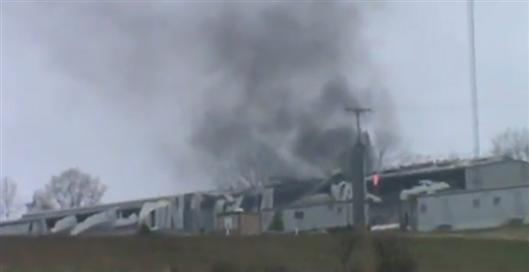 Sharon already caught all of this, but it’s important to note its relevance to what’s going on in the re-writing of the Dallas drilling ordinance. We really wonder if most of the members of the Dallas gas drilling task force knew what a compressor station was and did, or spoke to anyone that’s lived within 500 feet of one. Because on the very last day of the Task Force, and without taking any public input, they decided to let compressors sit on well pads that could be as close as 500-1000 feet from a home, school, hospital or other “protected use.” Why is that a bad idea? Compressors are some of the largest and most polluting kinds of facilities in the natural gas fuel cycle. They routinely emit tens of thousands of tons of air pollution. They are very loud. Their low-decibel noise output can cause serious health effects. And, oh yeah, they can explode, like this Williams Company compressor did in a Pennsylvania township last week: “An explosion at a natural gas compressor station in Susquehanna
County on Thursday morning blew a hole in the roof of the complex
holding the engines, shaking homes as far as a half-mile away and
drawing emergency responders from nearby counties. The 11 a.m. blast at the Lathrop compressor station off Route 29 sent
black and gray clouds billowing from the building for several hours,
but the damage was contained to the site and no one was injured, said a
spokeswoman for Williams Partners LP, which owns the Lathrop station.” A half mile is more than twice the distance of the elastic 500-1000 foot buffer zone the Dallas task force recommended. The compressor station pressurizes and dehydrates natural gas from the local Marcellus Shale for transport to market. It was moving 365 million cubic feet of gas PER DAY. In reports on the day of the accident, Williams and its partners sounded very contrite. But then this happened: “A damaged Susquehanna County natural gas compressor station restarted
operations last week despite state regulators’ request the facility
remain shut down during an investigation, the Department of
Environmental Protection said Wednesday.Williams Partners turned on some of the seven compressor engines at
the Lathrop station without permission Friday evening after the state
denied the company’s request to begin operating in a limited capacity,
regulators said.” And so besides demonstrating why 500-100 feet might be a bit too close to put a compressor to your children’s swing set, this story also shows why we also need every local government to have its on gas enforcement infrastructure that watches these gas operators like hawks, not ostriches.
Public Participation Key in NJ Incinerator Pollution Fight
 Really, the headline from the New Jersey Spotlight says it all: For Smog Control at Incinerator, Public Pressure Played Key Role.” At issue was the kind of air pollution controls to require on the largest garbage incinerator in the state, run by Essex County itself. And see if this doesn’t sound vaguely familiar. In 2009, the New Jersey Department of Environmental Protection issued a new air permit renewal for the incinerator but failed to give proper public notice. The state failed to even notify the groups that were already suing over the incinerator’s violations of its former permit. Feeling a little hurt, the groups filed a petition with EPA to revoke the state’s new permit and have a complete re-do of the whole thing, using evidence of permit violations of Particulate Matter and Sulfur Dioxide by the facility as leverage to force an agreement. When a public hearing was finally called on the proposed permit, hundreds of residents attended and demanded that air pollution from the incinerator be reduced. So the state relented and demanded the incinerator install controls that will be at least 50% better at collecting PM pollution and use modern diesel engines to reduce Sulfur Dioxide emissions. William Schulte, an attorney for the Eastern Environmental Law Center,
which represented the community organizations, was quoted in the article as saying that “Without the
public, DEP could never had made that deal.” Public participation doesn’t always guarantee victory for a grassroots group, but you can’t win without it. That’s how Downwinders won our historic settlement with Holcim Cement in 2006. That’s how we forced the cement plants and Chaparral Steel Mill to add controls. That’s why Governor Perry and his friends want to limit your ability to even know about permit changes in Texas – to the extent that Ash Grove can re-build its entire cement plant under a “permit amendment” that requires no public notice. Ditto with the permit the state gave TXI last June that gives the company permission to turn its cement kiln into a giant garbage burner. No public notice required. No public hearing required. No public participation wanted. That is one thing we should all be working to change in Texas. Meanwhile, here’s to another win by people power.
So Sue Us: “Pollution From the Titan Cement Plant will Kill and Injure People”
 Titan Cement is trying to build a huge new cement plant near Cape Fear in North Carolina. People who live there are putting up quit a fight to prevent them from doing that. In order to get these people to settle down, Titan sued a couple of local residents, Kayne Darrell and pediatrician David Hill, who made comments at a County Commissioners’ meeting that went like this: “…we know from numerous studies that if we build this
thing, more children will get sick, a handful of them will die. We also
know from the adult studies that more adults will get sick and quite a
few more of them are going to die as well Which ones? Can’t tell you.
That makes it difficult, but there will be some.” Quite right. We know all these things because numerous scientific studies show a very straight-forward relationship between the kinds of crud put out by cement plants and rates of asthma, heart attacks, strokes, etc. There is nothing the least slanderous or libelous about saying so. And yet Titan sued in hopes of intimidating not only the two citizens it sued, but everyone else who wanted to speak up but now would be afraid of getting sued. That’s how SLAPP (Strategic Lawsuits Agains Public Participation) suits work. No one ever expects to win a case. If you’re a company, you win just by filing because it shuts people up, or a least that’s the intent. Well, today comes word that Titan and the citizens have “settled” the case and Titan now “recognizes that reasonable minds have the right to disagree, and respect both Dr. Hill and Ms. Darrell’s right to do so.” Isn’t that precious? The Greek Multinational Cement Giant agrees that the quaint American First Amendment is still the law of the land here. In organizing, we often say it’s all about relationships and the Titan press release onthe matter seems to bear this out. “Prior to today’s mediation,
we had not personally met and spoken with Dr. Hill and Ms. Darrell,”
Titan said in a statement. “Having done so, we do not believe that
either Dr. Hill or Ms. Darrell intentionally made any false statements
about Titan or our plant in New Hanover County.” So you know, all it took was seeing that in fact these citizens were not horned devils for the company to change its mind. For his part, Dr. Hill would not comment on the resolution Wednesday except to say, “I
look very much forward to being able to focus all my energy on my
efforts to improve the health of children in this region.” Both defendants will release a statement in the next 24 hours according to their attorney. Meanwhile, Titan won its state air permit, but its’s still not a free and clear path to construction.
Britain Sent Foreign Aid to EDF to Fight Texas Climate Deniers
 Whew. There’s quite a story from today’s Guardian involving the British Government, the Environmental Defense Fund, and right-wing Texas elected officials. The year was 2009. Her Majesty’s Foreign and Commonwealth Office gave 13,673 Pounds (about $21,000) to Texas EDF to “influence climate security policy and legislation in Texas.” How did EDF use this money to accomplish that goal? By organizing voters in key Texas districts? No. By arranging the elected officials to meet Texas victims of climate change? Nope. “The money was used to fly two Texan state politicians, including the climate sceptic Republican Troy Fraser, to the UK to receive a briefing with climate scientists and government officials. A Conference was also held in Austin in which a video of Prince Charles personally addressing Texan politicians on the subject of climate change was shown.” The article doesn’t say so, but it’s obvious what the strategy at work here was. Unable to persuade Texas lawmakers of the righteousness of their cause with only local speakers of the Queen’s English to do the work, EDF was at a loss. If only we could impress the importance of global warming on Fraiser and Co. by using people with authoritative British accents to explain it to them. Brilliant! And it would have worked too, except no one could understand what the Prince was actually saying on that video. Of course, when Governor Perry found out about all this, he was rightfully indignant, taking the position that the English had no business interfering with his plan to devolve state government into a a giant polluter oligarchy. That’s what the EPA is for. There was some other stuff too about how Texas has a great (cough) record of clean air accomplishments (cough) and how global warming is really just a vast left-wing conspiracy, yada, yada, yada. But you expect that from the Guv. What’s EDF’s excuse? EDF’s Texas Director Jim Marston explained that “There are people in Texas, including Governor Perry, who are uneducated
[on this subject]. This was the period leading up to the Copenhagen climate summit. We wanted to get it away from the theoretical and move it to a country where the Kyoto [protocol]
had already been ratified. We wanted them to hear it from the best
scientists from the UK, a country that Texans tend to respect.” See, British accents make everything infinitely more respectable. And how grateful was Senator Troy Frasier after his London Homesick Blues junket? Marston says “he came back very enthused. Sadly, his enthusiasm has decreased since,
partly because the issue [of climate change] has become so politicized.” That, plus the power of an English accent tends to wane when it’s not constantly reinforced. As Texas grassroots environmental activists, should we be more disappointed in the British for being so condescending about our environmental fights when they’re building breeder reactors and stopping wind turbine farms that ruin Donald Trump’s view of the ocean, or EDF for being so wasteful and naive? We report. You decide.
No More “Republicans for Environmental Protection”
 Word comes from Politico that after 17 years of trying, “Republicans for Environmental Protection” is 86’ing the concept and changing its name to some kind of focus-group-tested “ConservAmerica.” It’s not so much that conservatives have abandoned the environment and public health. Poll after poll shows broad support for most of the environmental agenda, and over the last 20 years some of the most successful projects Downwinders has pulled off have been with Republican office-holders as partners. It’s that a controlling faction of the Republican Party is increasing hostile to what has been an historical bi-partisan set of goals for their own sake, differing only in approaches. In 2012, the very value of having clean air is routinely questioned by that faction, as is the science behind any advance in knowledge that contradicts a worldview where corporations make all the decisions about our risks for us. So instead, the former RFEPs are hoping to attract conservatives in general. “We’re seeing more and more independents out there,” said David Jenkins,
the group’s vice president for governmental and political affairs.
“Messaging through a Republican frame doesn’t reach those people as well
as reaching them through a conservative frame.” They may be on to something. The most ardent conservative critics of pollution in North Texas are not state or federal Republican office-holders, but grassroots right-wingers like former DISH Mayor Calvin Tillman, who feels as though the GOP has let him down. It’s one more sign that the modern Republican Party is further isolating itself on an issue that really doesn’t give a flip about the politics of your lungs.
The Case For Local Control of GHG Pollution in 3 Easy Articles
 It doesn’t often work out this way, but three related stories came over the transom recently that so eloquently spelled out the case for Dallas regulating the Greenhouse gas pollution from the gas industry, that we could have written them ourselves. but we didn’t have to. Downwinders and the Dallas Residents at Risk alliance support the idea of the City of Dallas requiring the “mitigating”, or “off-setting” of new and large air pollution emissions that come with gas drilling. For every ton of Greenhouse Gas emitted by a new well, or compressor, or storage tank, the operators would have to fund a project that would reduce that same amount of pollution in Dallas, so that there would be no net increases in pollution. So why do this? ARTICLE #1: The Pittsburgh Tribune-Review covers a local permit for a gas compressor station that could emit between 20 and 90 tons of smog-forming Nitrogen Oxide, also a Greenhouse Gas. The state already has almost 400 such facilities because of its location in the Marcellus Shale gas play. According to the article, “The stations, which compress gas to get it to move through pipelines, release air pollutants that compound the state’s long-standing ozone problem.” Gas drilling brings large amounts of new air pollution that isn’t covered under current regulations on either the state or federal level. Just one compressor station in Dallas could spew more Greenhouse Gas pollution than all the current industrial sources in the city combined. ARTICLE #2: The New Scientist gives voice to the growing perspective that the fastest way to affect climate change progress is to cut methane and soot emissions, not necessarily CO2. “Methane is a more important control on global temperature than previously realised. The gas’s influence is much greater than its direct effect on the atmosphere,” says Peter Cox, of the University of Exeter. Curbing methane, he adds, may now be the only way to prevent dangerous warming. “Oil and Gas sources in the US make-up 40% of all industrial methane pollution releases. Dallas has signed the US mayors agreement to reduce its Greenhouse Gas emissions. It won’t be ale to keep that commitment if it allows gas drilling without some form of mitigation or off-setting. ARTICLE #3: A piece from the San Luis Obispo Tribune that details how a local county air pollution control board is now regulating greenhouse gases for new housing and commercial developments. What are they doing? Requiring mitigation. “The staff estimates that of 1,142 projects countywide over the next 10 years, 56 would be large enough to require mitigations. Mitigations usually come in the form of sidewalks, bike paths and other amenities that discourage the use of cars.Other developments could be exempted if they are covered by a qualified local emission reduction strategy….” Dallas wouldn’t even be the first to think about GHG emission control on the local level, although it might be the first to apply it to the gas industry. Because that’s what the biggest new threat to air quality in Dallas is.
There’s an App for That: “Fracking 101” PowerPoint Now Ready to Download

2012 to Be Most Awesome Ozone Season Ever
 Sunday marked the official start of the 2012 ozone season. Unofficially, it began the week before on March 24th, when both the Frisco and “Dallas North” ozone monitors operated by the Texas Commission on Environmental Quality recorded violations of the new federal standard of 75 ppb, and then on March 25th, when the Keller, Grapevine, and Eagle Mountain Lake monitors also all recorded violations of the 75 standard. Frisco came within less than a single ppb of being in violation of the old 85 ppb and set the record for the highest March ozone reading TCEQ’s ever recorded. It’s this old 85 ppb standard that DFW is still trying to meet even as the regulatory goalposts have been moved back to account for new science linking smog to heart attacks and strokes at lower levels of exposure. In submitting its new clean air plan to EPA to finally get below 85 ppb, you might remember that TCEQ predicted that in 2012, DFW would see the lowest ozone averages ever recorded – primarily because so many people are replacing their older more polluting cars with newer, cleaner ones. This prediction even came two months after the end of the 2011 ozone season showed DFW had worse smog than Houston. No, state leaders were not deterred by naysayers in taking a strong, optimistic stand for clean air when it came time to turn-in its compliance plan for EPA. Theirs is a faith-based initiative. According to Austin, all 18 DFW air quality monitors will be registering lower levels of smog in 2012 than any of them have ever recorded in the decade since monitoring began in DFW. At some monitors, TCEQ predicts summer maximums will drop by 40 parts per billion or more, an annual decrease no monitor in DFW has ever registered. Given the high readings from March already, it’s hard to believe that this prediction could possibly come true, but hey, they’re the experts,right? So put away those gas masks and get out and breathe that fresh North Texas air. Haze? No, that’s just steam.