
Smog
June Smog Attack: Day 3
 High ozone levels continued to take their toll on people and monitors Wednesday. Grapevine joined the Hinton Street Dallas monitor in recording its fourth "exccedence" of the old 1997 85 ppb smog standard and so establishing an official violaiton of it.
This is an 8-hour standard wherein the average over eight hourly readings must be 85 or above, So we're not talking about short-term spikes. These are day-long spikes.
Monitors in Keller, Eagle Mountain Lake, Arlington, North Dallas and the Redbird area of southwest Dallas saw their third exccedence of the 85 ppb standard, meaning one more day of bad smog could also make them environmental crime scenes. Midlothian, Northwest Ft. Worth, and Frisco all have two exceedences as of yesterday,
We're going to wait until there's a pause in the bad news to look at how off the mark the all powerful and holy TCEQ computer model is so far, but suffice to say that after this week, there's not likely to be any monitor inside the nine-county area that will even be close.
Happy Ozone Non-Attainment Day!
 Ozone Non-Attainment Day is a traditional annual DFW event. Every summer there's a day when one or more air quality monitors records its fourth "exceedence" of whatever national ozone standard the region is violating. Then and only then does the monitor officially violate the Clean Air Act and put DFW in "Non-Attainment" of clean air once again.
Gifts of inhalers, oxygen tanks, and emergency room visits are often exchanged by family members and friends on and around the actual day of Non-Attainment.
This year Governor Perry and the Texas Commission on Environmental Quality made sure our Ozone Non-Attainment Day arrived extra early. Usually, we don't see it come until August. In fact, ever since ozone monitoring began in 1997, there's only been one other year when it came as early as this year.
In 2006, we had Non-Attainment day on June 14th. Boy, that was a doozy of a summer – 12 out of 19 monitors eventually tripping. Think this one might be as big? It's sure possible.
One sign is that the monitor that triggered this year's Non-Attainment Day is the historic Hinton Street site near Mockingbird and I-35. This particular monitor hasn't even recorded a violation of the Clean Air Act since 2005 – so welcome back Hinton Street! But this site has a long and storied Non-Attainment history. The Hinton Street monitor recorded violations for five years straight during some of the worst smog pollution DFW has ever seen, from 2000 to 2005, with some of those years seeing 14 out of 18 monitoring sites recording violations.
So Hinton Street monitor violations are associated with really bad air. So are Non-Attainment Days that arrive in June. We could have one long hellacious summer ozone pollution episode ahead of us this year. Maybe even a return to double-digit monitors in violation. Isn't it exciting?
You may want to send Non-Attainment Day greetings to Governor Perry and TCEQ Chair Bryan Shaw, since it was their idea of watching people buy newer cars as a pollution control strategy, along with ignoring the large increase in smog-forming pollution from the natural gas industry, that made this June Non-Attainment Day possible. (Downwinders reminds you to please breathe responsibly).
“Air Pollution Warning: Level Red”
 Monday turned out to be the single worst day for smog in DFW in 2012. Monitors in Northwest Ft. Worth, Grapevine, North Dallas and Dallas/Hinton Street recorded 8-hour averages of "Level Red" ozone – a level of pollution according to the Texas Commission on Environmental Quality that means,
"The highest measured levels of ozone during the previous hour are considered unhealthy. Everyone, especially children, should limit prolonged outdoor exertion. People with respiratory disease, such as asthma, should avoid prolonged outdoor exertion."
Ten monitors exceeded the old 1997 eight-hour 85 ppb standard and those same three – Ft. Worth Northwest, Hinton and Arlington Airport, averaged over 100 ppb for eight hours or more.
In fact, Arlington saw a one-hour high of 128 ppb – an "exceedence" of a standard more than 20 years old – and it's 107 8-hour average on Monday was the highest at any DFW monitor since 2007.
The Hinton Street monitor recorded it's third exceedence since March. One more and DFW will once again be in non-attainment with the Clean Air Act, for the 21st year in a row. Four others recorded their second exceedence.
Last year it took us into the middle of Summer before that happened. This year it may occur during the first week of Summer. This is what Governor Perry and TCEQ call progress.
Halfway to Failure
 (Late Monday evening update: It's clear that the Hinton Street monitor will record its third "exceedence" of the 85 ppb standard this year, putting it just one away from making the entire region non-attainment" in 2012.)
It's a bad sign when there are ozone problems on the weekends. It means that even with less people on the road and many businesses on less than full throttle, there's still enough pollution to cause trouble. And it usually means a rough week ahead. That's what happened on Sunday, when summer finally caught up with DFW in a big way.
Four area ozone monitors set new annual highs set on Sunday, and many others saw very alarming numbers during the afternoon. There were three "exceedences" of the old 1997 85 parts per billion ozone standard, and one of those was the second time the Dallas Hinton Street site had seen an 8-hour average above 85 this year. Six other monitors have already had their first. And it's only June.
Four such exceedences within a year puts a monitor in official violation of the obsolete standard that DFW is still struggling to meet. So with the Hinton Street results, we're already halfway to being out of compliance with the 1997 standard again. But it's all academic. Everything is now geared toward meeting the new 75 parts per billion ozone standard by 2018. DFW could be in violation of the old standard every year from now until then, and except for the terrible toll on public health, there'd be no penalty from either the EPA or TCEQ.
On the other hand, its going to be pretty hard to meet that new, harder standard when you haven't been meeting the old, easier one.
The state's official response is mostly to sit back and hope that DFW drivers trade in their older, more polluting cars for cleaner, newer ones. That phenomena was supposed to be responsible for making this year the best one for clean air in decades. According to the Texas Commission on Environmental Quality's computer modeling, no DFW monitor will violate the Clean Air Act for ozone pollution in 2012. At least, that's what they told the EPA when they submitted the region's clean air plan to the feds in December. And the EPA bought it. Because the TCEQ computer modeling said everything was hunky-dory.
But reality has a way of rudely intruding on TCEQ's computer modeling. Only six months into the new plan and most of the DFW monitor averages predicted by the state are already underestimates. We had the highest ozone levels ever recorded in March. Maybe there's just not enough of you trading in your cars.
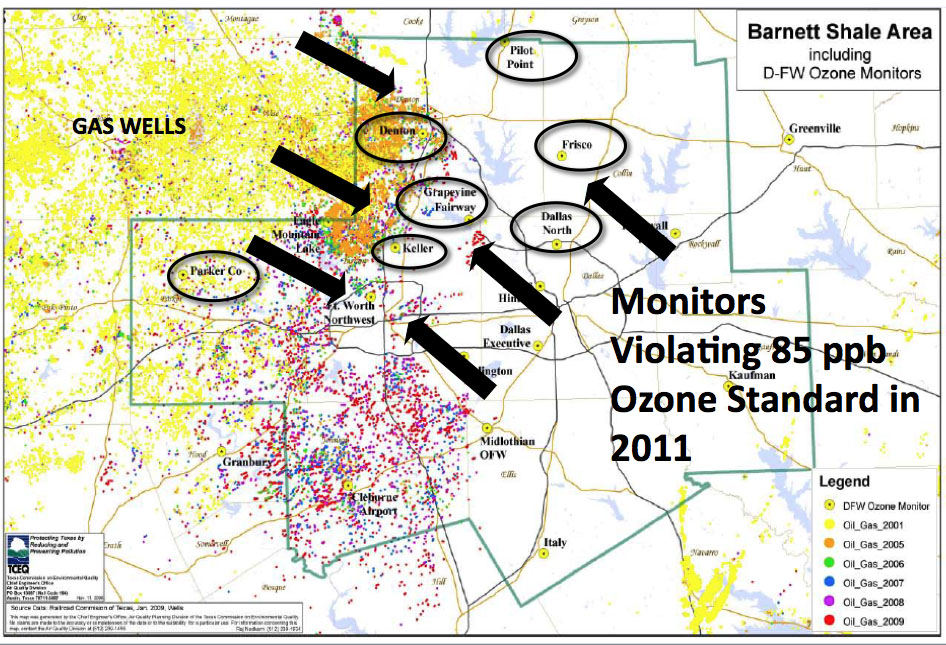 Or maybe it's just that old TCEQ junk science at work. One thing we know the state's computer model didn't consider was how already-dirty air makes the VOC pollution from natural gas operations more easily convert into ozone pollution. Denver officials who are also dealing with new gas operations contributing to long-standing smog problems have considered this factor and think it explains larger than expected ozone readings there.
TCEQ chose to ignore this variable. Supposedly because the gas patch was well west of DFW and "couldn't possibly" affect North Texas ozone levels. But as anyone who's driven I-30 or I-20 over the past ten years can tell you, the gas patch extends all the way from east of Denton to Grand Prairie to Midlothian, encompassing most of the 9 county non-attainment area. In the same December 2011 clean air plan the state predicted record-low ozone levels this year, it also estimated that gas industry sources were emitting 34 tons per day more smog-forming VOC pollution than all the cars and trucks in DFW combined.
It was a political decision not to look at how dirty air from Houston, the East Texas coal plants, the Midlothian cement kilns and everything else east of Weatherford makes gas industry emissions more likely to cause ozone in North Texas. TCEQ's clean air plans are always full of such decisions that drive the final results of its supposedly objective computer modeling. Hard to believe now, but there was a time in the not-so-distant-past that the same computer modeling made it clear that the Midlothian cement plans "couldn't possibly" be affecting DFW ozone levels.
A plan to meet the new 75 ppb standard must be submitted to EPA by 2015 to show three years of compliance by 2018. That's only two-years away. If new cars alone can't get us down below 85, it will be extremely difficult for the state to argue they can get us down to 75. More actual things that work to reduce pollution will be necessary. Including bringing better controls to the cement kilns and coal plants and other industries still putting out way too much pollution. It will be a fight. but so far, the evidence is that more is needed if DFW is ever going to have safe and legal air.
Meet a “Minor Source” of Air Pollution in the Natural Gas Mining Cycle
 Despite overwhelming community opposition, Allegheny County (Pittsburgh) is getting its very first compressor station this month. It's tastefully located near a mall in order to process gas being extracted from near-by Marcellus Shale wells. Not considered a great hot spot for the gas itself, the county nevertheless finds itself in close-enough proximity to the gas patch to be of use to operators as a repository for some of its other facilities along their fuel cycle. Along with five compressor engines there will also be three dehydrators, and reboilers, and two 6.500 gallon storage tanks. It will release 35 tons of smog-forming Nitrogen Oxide (NOx), 17 tons of Volatile Organic Compounds (VOCs), 7 tons of formaldehyde (a known carcinogen), and 11 tons of soot/Particulate Matter pollution. The NOx figure alone is the equivalent of something like 2500-3000 cars worth of pollution alone. No mention in the article how much CO2 is being emitted. This facility is considered a "minor source" of air pollution by the Allegheny County Health Department. Everything is relative of course. Compared to the steel mill smokestacks that made up the skyline of Pittsburgh for most of its existence 70 tons of crud a year might strike you as smallish. But when you stick that same 70 tons of crud as close as 500 feet away from a neighborhood or school that's not used to having heavy industry located so close, it doesn't look all that minor. And that's why the Dallas City Council's task force recommendation to allow compressors on the gas well pad itself, restricted only by the same zoning requirements of a drilling rig that produces a lot less pollution, is so nonsensical. Compressors are giant polluters. Their engines can be the size of locomotives. Imagine five of these only 500 feet from your yard or child's school. That's what's being endorsed by the task force and that's what citizens are rejecting out of hand. One of the major issues the Dallas City Council will have to decide as part of its new gas drilling ordinance is how and where these huge, necessary parts of the gas industry infrastructure will be allowed to locate.