
Posts by Downwinders At Risk
Where Speaking Up Can Get You Killed
Jose and Maria Santos were executed last year for trying to save the Amazon
Now imagine you were doing the same thing in China, or the Congo, or Brazil, where the global environmental "Rio+20" conference is going on right now.
According to the group Global Witness, 365 environmental advocates around the world were killed for their work last year, including Jose and Maria Santos of Brazil, a married couple who were both shot down in cold blood for their work in protecting the Amazon forest from timber companies. Jose predicted his own death only six months earlier:
"I will protect the forest at all costs. That is why I could get a bullet in my head at any moment."
Brazil recorded almost half of the killings worldwide, the majority of which were connected to illegal forest clearance by loggers and farmers in the Amazon and other remote areas.
It's no picnic to be an environmental advocate in Texas, the home of the world's petrochemical industry and the country's most virulent anti-green rhetoric. But it's not a death sentence either.
ATSDR E-Mail Address For Comments is Bad, Compensates with Week Extension
 The ATSDR finally admitted that, yep, that e-mail address we published for people to submit their commnets on the Agency's Midlothian "health consultation" doesn't work and never will work, and so they're providing another and extending the commenting opportunity by one week to Friday, June 29th. Here's he entirety of the ATSDR's response:
ATLANTA— The public comment period for the recently released Midlothian Public Health Assessment has been extended to June 29, 2012.
Comments on the document must be made in writing and those received during the public comment period will appear in the final version of the health consultation. Comments (without the names of persons who submitted them) and ATSDR’s responses to these comments will appear in an appendix to the final health consultation. Names of those who submit comments will be subject to release in answer to requests made under the U.S. Freedom of Information Act (FOIA).
Send comments to: rlm6@cdc.gov,or mail to:
ATSDR Records Center
Attn: Rolanda Morrison
Re: Midlothian Area Air Quality – PHC #1
4770 Buford Highway, NE (MS F-09)
Atlanta, Georgia 30341
No "We're sorry we screwed-up the public comment process" or "It's all our fault, try again." We could say this is one big metaphor for the Agency's multi-year invovlvement in Midlothian, but we won't. We'll let you do that in your comments.
PM Follow-Up: the 2005 Spike and the Midlothian Drop
 (Note: Downwinders sent out an air quality alert on Monday urging folks to send their comments 1) into EPA to support the new PM standard, and 2) the federal ATSDR in regards to its "health consultation" in Midlothian. The correct address for the PM comments is "a-and-r@docket.epa.gov" – the same as the alert, but apparently the the whole address didn't get underlined. Use the complete address and you shouldn't have any problem. The ATSDR address for comments used in the alert is cut and pasted from the agency's own website, but was rejecting comments Monday afternoon for some reason. Complaints have been made and we hope they'll actually be allowing comments on Tuesday.)
In covering the PM 2.5 standard announcement, a lot of attention was paid by the media to the fact that only a handful of counties in the US would not be able to meet the new number by 2020. The Obama Administration worked hard to send that message in order to preempt the kind of backlash that killed last year's new smog standards. But what are the actual levels now and how close or far is DFW from ever having to worry about being in non-attainment for PM pollution?
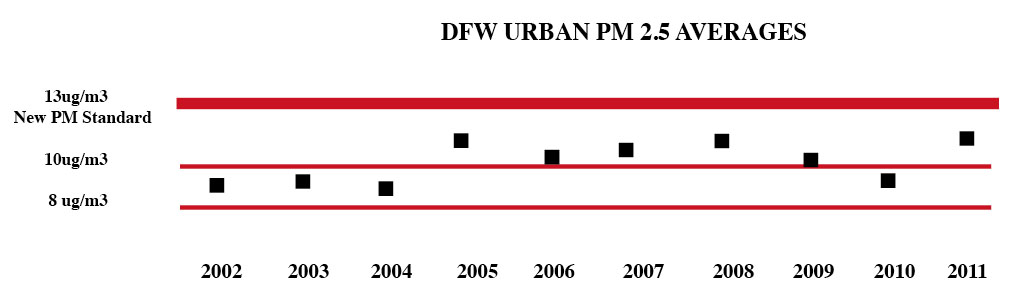
 The new standard is an annual average of 13 micrograms per cubic meter of air, expressed as ug/m3. As far as we can tell from the monitoring records TCEQ keeps online, DFW hasn't come close to exceeding that number. But that's not really as conclusive as it might first sound. There are only two PM 2.5 monitors located in the heart of the DFW metropolitan area. One is on /Hinton Street near Mockingbird and Harry Hines in Dallas and the other is at the Haws Athletic Center location just north of downtown Ft. Worth. All others are in far southern Ellis County, Kaufman County, or Johnson County and act as "background" monitors to track PM pollution coming in or leaving urban DFW. In contrast, there are at least nine ozone monitors located in urban/Suburban DFW .

Tracking the two central city core monitors over the last ten years shows a slow but steady rise in the average PM 2.5 levels being recorded, staring at a little below 9 ug/m3 in 2002 and ending with an 11.01 last year. That's an increase of almost 2 ug/m3 in a decade. 2011 was a drought year and so there was probably more dust in the air. But records show other years where annual averages were in the high-10 to 11 ug/m3 range. What they also show is that these higher levels all come after 2005. In fact, across the board, at all the DFW monitors recording PM levels from 2004 to 2005, there was a statistically significant jump from annual averages in the high 8 ug/m3 range in 2004 to over 11 ug/m3 by the end of 2005. And while some monitors came back down, the two central city monitors have stayed up – particularly at the Ft. Worth site. So what happened in 2005? There was a Mexican volcano eruption that summer, but it ended. The higher PM averages in North Texas didn't. It was too soon to see the effects of urban drilling, although that may play a part in keeping the Ft. Worth levels higher now. Whatever it was, it makes a clear bright line that separates the pre-2005 lower numbers from the post-2005 higher ones.
Last year's average of 11.58 ug/m3 at the Dallas site was the highest at that monitor, or any other, in the last ten years. It's less than 1.5 ug/m3 away from breaking the brand new PM standard of 13. That same monitor has already seen a 2.25 ug/m3 increase in annual averages since 2002.
EPA says don't worry, but we'd keep our eyes on those long term trends.
 The Obama administration is banking on the impact of new power plant rules, cement plant standards, and other emission-affecting regulations to lower PM levels over the next eight years. And that could be a good bet. One of the things that also sticks out from the limited amount of DFW PM data is how much of a drop there's been at the Midlothian monitor located north of the TXI cement plant over the last five years after reaching a peak in 2008. That was the year TXI decided to shut down its four obsolete wet kilns that burned hazardous wastes and rely solely on its newer and generally less polluting dry kiln. In 2008, the Midlothian monitor recorded an annual level of 10.7 ug/m3. Last year it recorded an annual average of 8.0. That's progress.
Drilling is Bad for Business
 Via the Fish Creek Monitor out of Arlington comes word of a Chesapeake 5-acre drilling well pad that's seemingly condemned a piece of adjacent property at a potentially lucrative intersection in that city. The entity doing the loudest complaining? The developer whose land Chesapeake is allegedly ruining.
The property is now covered with gas pipelines. It's illegal to build anything on top of gas pipelines for safety reasons. It's not illegal to use your Eminent Domain power as a gas pipeline company to take valuable real estate and make it useless for the purpose the owner intended.
We've seen this before. There's a similar gas pipeline no-man's land in DISH in Denton County that was slated to be an entire sub-division.
This is one of those little known, but hugely consequential results of not thinking through what it means to allow gas drilling in your town. You'd think that a practice that ruins perfectly good real estate from becoming the next 7-11 or Taco Bell would be anathema to the usual Powers-That-Be. It tells you something about how much things have changed in the past decade that not even developers outrank gas companies in DFW.
Welcome to our Remodeled Digs
 We didn't change the dressing on our www window to the world all that much, but we can do a lot more now.
Like write in paragraphs on the front page without a page jump. it feels good just to…
…..stretch. Not sure who invented paragraphs, but there should be a statue to them somewhere.
This is only the fourth iteration of the Downwinders at Risk website that goes back all the way to 1996. In line with our philosophy, each one has been more participatory than the one before. This WordPress version allows for a lot more multi-media options and interactive features on both ends of the site.
Thanks for being patient over the course of this transition, which took much longer than we anticipated. We hope we can now reward you with better online service.
Downwinders, The Early Years
EPA Lowers National Particulate Matter Standard, World Doesn’t End
 In what will probably be one of the most important environmental health decisions of the Obama Administration, the EPA is proposing to reduce the national ambient air standard for what are called "fine particles" of particulate matter, or soot, a pervasive form of air pollution that is linked to an increasing number of ailments ranging from respiratory illnesses, to heart attacks, to Autism, and brain damage.
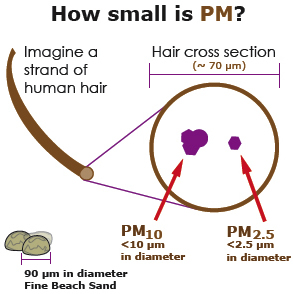
Particulate Matter 2.5, or tiny bits of soot that are 2.5 microns or less in diameter (a typical human hair is 50 microns) comes from the combustion process – gas-powered cars, diesel trucks, cement plants, utility plants, or boilers or furnaces of any kind.
Sand dust, at 90 microns in size, is much, much larger, so we're not talking about "EPA regulating dust." PM is an industrial pollutant. And study after study has shown that it kills and injures people even at levels that up until Friday were considered legal and "safe."
PM is so insidious because not only is it a toxin in its own right, it also acts as a tiny suitcase for all the by-products of whatever combustion made it. Coal or cement plant soot might contain Mercury or dioxins. Car soot could have Benzene residues. And these hitchhiking pollutants are carried deep inside the lung by the soot, where they stay, doing damage for years.
In a Boston Globe piece running thursday night, Dr. Albert Rizzo, chairman of the board of the American Lung Association, was quoted as saying that, "The science is clear, and overwhelming evidence shows that particle pollution at levels currently labeled as officially `safe' causes heart attacks, strokes and asthma attacks.
The new rule would set the maximum allowable standard for soot at range of 12 to 13 micrograms per cubic meter of air. That's the upper level of what the EPA's own panel of scientists recommended (11-13) without breaking the law by disregarding the panel's range as the Bush EPA did in 2006 when it decided to retain the 1997 standard. That annual standard was 15 micrograms per cubic meter. That doesn't sound like much of a reduction (17%), but it's the difference between a standard that embraces the newest science versus a 15-year old one that was not considered protective of human health. It could also mean the difference between metropolitan areas like DFW being given the all clear or classified as "non-attainment" for PM pollution, the same way it's in non-attainment for ozone, or smog pollution.
That would mean the region would have to put together a plan to reduce PM pollution, and of course that could mean opportunities to press for more modern controls on the Midlothian cement plants, east Texas coal plants, and other large PM polluters. One of the first steps will have to be putting more PM monitors in the DFW region – there are only eight now and three or four of those would be considered "background" sites, that is they monitor what's blowing into DFW, but not what residents are breathing.
Since monitoring began in 2000, annual highs in DFW have ranged mostly in the 20 and 30 microgram range, with forays into the 40s and 50's mid-decade. You can use this TCEQ website to track the four highest PM readings in DFW and the rest of the state for each of the last 12 years and this one to track daily readings – although both suffer from an obsolete color-coded alert system that underestimates health damage at lower levels of exposure.
In March, the Dallas Morning News compared DFW's mostly "moderate" levels of PM pollution to the most recent studies and concluded that local populations were at increased risk of heart attacks and strokes. It's not clear yet how EPA will enforce the standard or the timeline it will use but you can be sure it'll be generous since the Administration was forced to release this new standard by court order in an election year. That's because PM pollution is as widespread as ozone pollution and the measures necessary to reduce it could mean a long march toward modernizing many industries. t’s going to be a big step forward,” said Frank O’Donnell, head of the DC-based Clean Air Watch in the Washington Post article the broke the story. “This could help frame the national effort to clean this up for at least a decade.”
Think about how much effort has been directed at reducing smog in DFW over the last 20 years – HOV lanes, vapor recovery systems at the gas pump (put not necessarily at the gas well) and every paint shop, pollution controls on the Midlothian cement kilns, coal plants and other large industries.
It's probably going to take the same kind of all-inclusive slog to achieve compliance with this new standard, so the Obama Administration isn't gong to rush things. Despite opponents claims that these kinds of standards cost jobs, the opposite is actually true. Capital investment goes up because businesses are modernizing and putting on new control and implementing more efficient processes. Local jobs are created when those are installed. Waste is reduced. Operating costs often decrease. Despite being forced into the 20th Century by federal regs and citizen action, the cement industry in Midlothian has reduced emissions while also increasing manufacturing capacity. The same thing has happened in other industries.
Apparently the EPA is counting on the fact that previous rules aimed at other pollutants and problems have steadily been reducing PM pollution as a beneficial side effect, so the ramping up won't be as dramatic as it might have been. The proposed new standard will get published in the Federal Register and then finalized by next December 14th, so that no matter who wins in November, these rules seem to be on track. For a great primer on PM pollution in general and the history of today's decision, go check out Frank O'Donnel's Clean Air Watch website. Read More
Getting Ready to Rumble: Dallas Schedules Gas Drilling Briefings for August 1 and 15th
 According to the Morning News, Assistant City Manager Jill Jordan sent a memo to staff today laying out the timeline for how the Dallas City Council will get officially "briefed" on the creation of a new gas drilling ordinance. Apparently on August 1, the council will have a kind of staged policy wrestling tag-team match between a spokesperson picked by Council member Scott "Grizzly" Griggs and one picked by Council member Sheffie "Killer" Kadane. Both spokespersons – as yet unnamed or still unchosen – will get 30 minutes to offer their best shot at what a good Dallas drilling ordinance looks like. All of this will be going on out in the open for public consumption. Then on August 15, the Council will be meeting in a closed door session to receive information from their lawyers. No word yet on public hearings that ought to be accompanying this march to a final vote as well.
Public Warming to Climate Change
 Via Climate Progress, news of a new survey on climate change from the Brookings Institute in DC shows a solid majority of the public accepts the fact of climate change. Although not yet back up to the 70% plus rates seen before 2008, support has increased almost 15 points from its nadir in the Tea Party Spring of 2010. According to the same survey the most influential factor in this shift is not accumulation of scientific evidence but the day-to-day anecdotal experience of most Americans – 68% said recent mild winters had influenced their thinking.
Looks Like EPA Will Stymie Hard-Won Cement Plant Rules On Friday
 We don't this very often, but because many of you spent so much time helping us get the first new cement plant emissions rules in 20 years, we thought it was important to reprint the entirety of a Subscription-Only INSIDE EPA article from Tuesday that puts the fate of those rules very much in question:
Activists Warn Possible EPA Weakening Of Cement MACT Likely Unlawful